A new side-by-side comparison video is inviting Zelda fans to look at The Legend of Zelda: Ocarina of Time and Breath of the Wild less as disconnected takes on a familiar fantasy setting, and more as views of a single country separated by an almost unimaginable span of history.
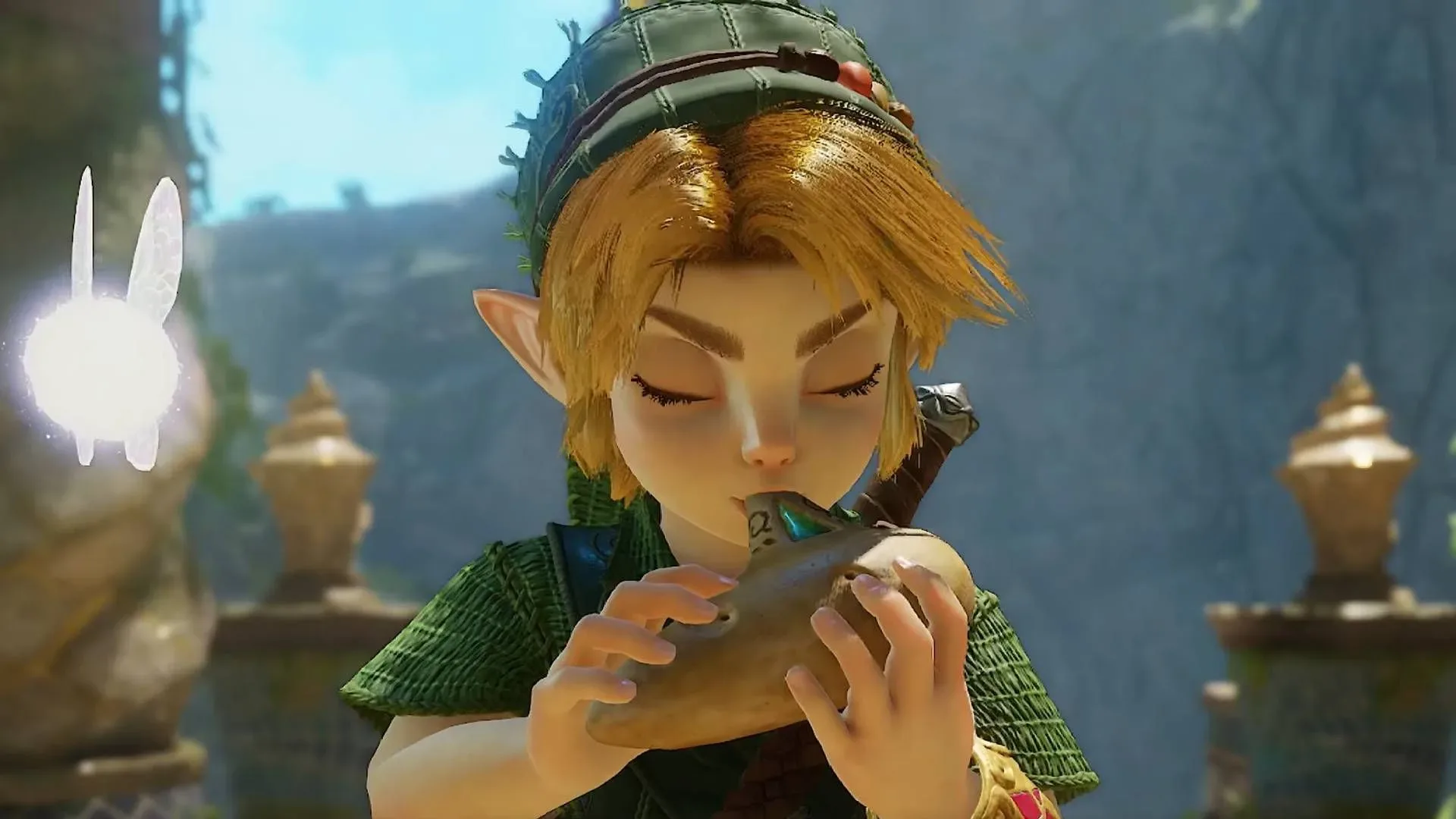
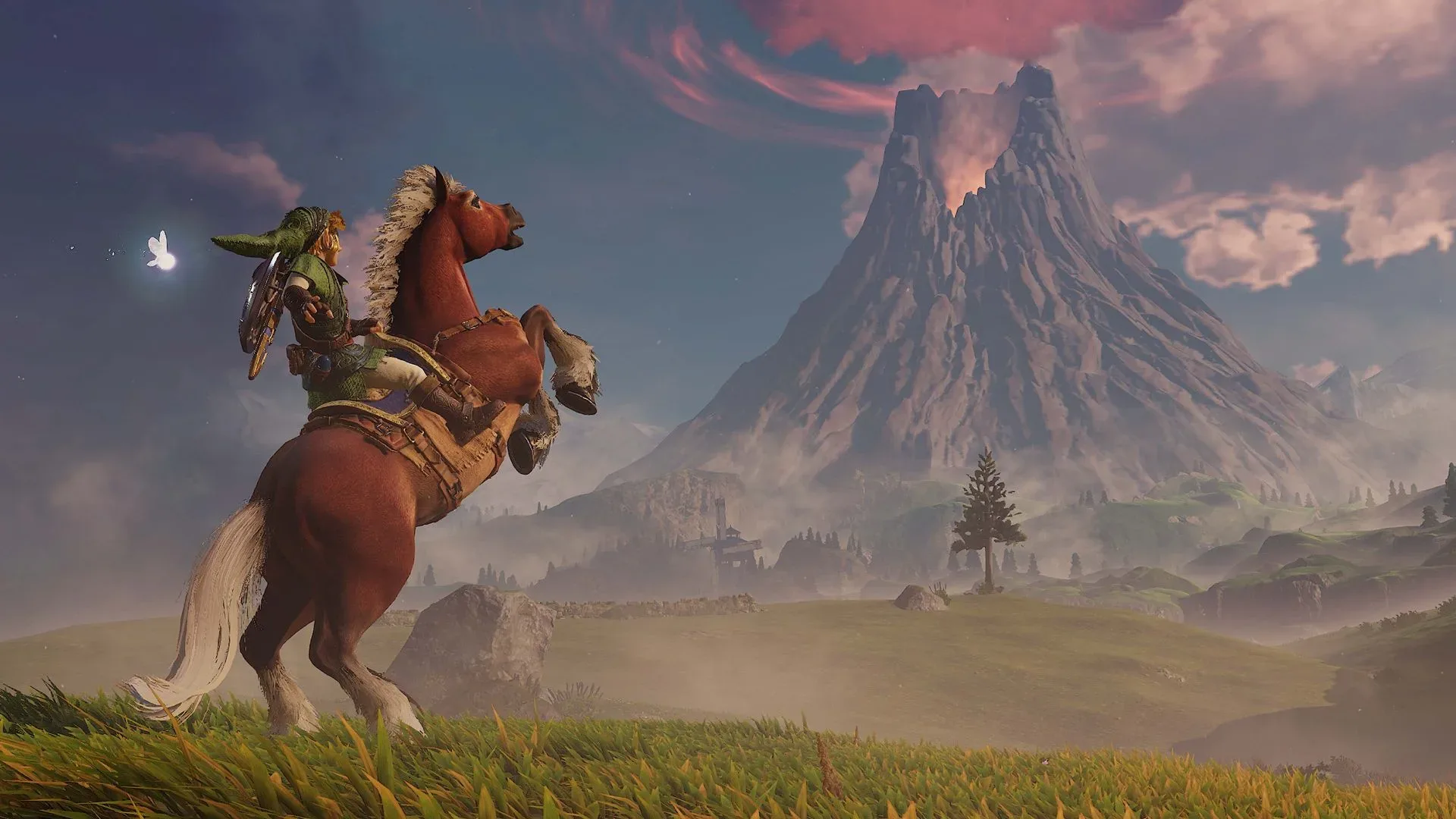
The footage compares locations that appear in both games, including the Temple of Time, Lake Hylia, Lon Lon Ranch and Death Mountain. Its most interesting quality is not simply the updated visual presentation attributed to the Switch 2 Ocarina of Time remake. It is the way matching landmarks, altered terrain and ruined architecture can make Hyrule’s continuity feel physical rather than merely stated.
Zelda has long returned to Hyrule while changing its stories, technologies, art direction and systems of play. That leaves room for a recurring player question: when a game revisits a named location, is it meant to be the same place, a reimagining, or both? These comparisons make a strong visual case for the first interpretation in several prominent cases. The places have changed, sometimes dramatically, but their changes can be read as evidence of age rather than evidence that they are unrelated.
That distinction matters because environmental continuity can tell a story without stopping play for a history lesson. A collapsed wall, a diminished mountain or the skeletal remains of a ranch can communicate that generations have passed. The world itself becomes an archive.
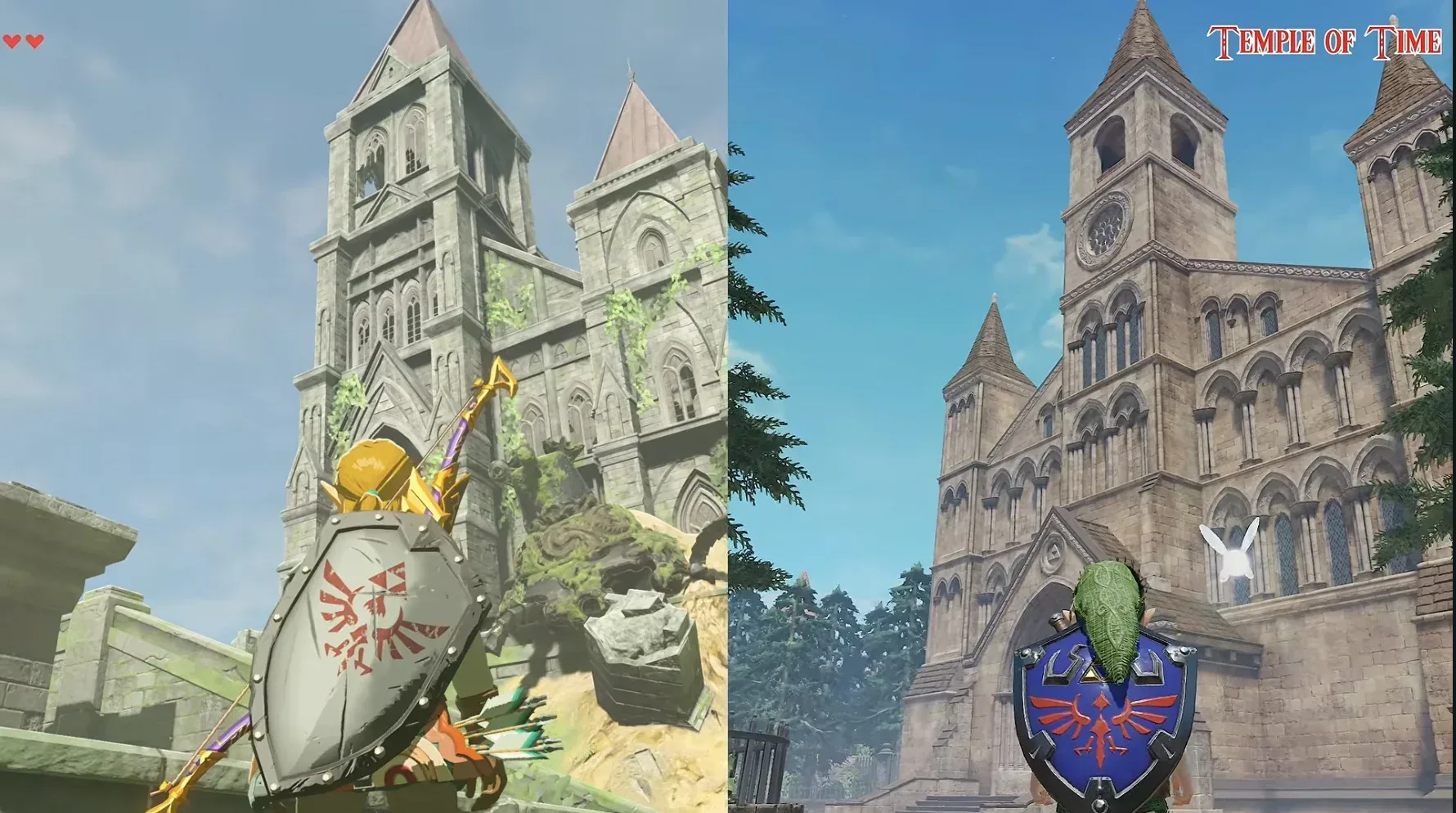
The Temple of Time is the clearest architectural link
The Temple of Time is particularly effective in the comparison. In Ocarina of Time, it is a major destination associated with Link’s early journey and the Spiritual Stones. In Breath of the Wild, the structure bears the marks of calamity and long neglect, including the loss of a substantial part of its façade.
Yet the surviving shape is recognisable enough that the ruin can plausibly be understood as the same building after disaster, weather and time have done their work. That is a different kind of connection from reusing a name. A name can signal an echo or a reference; a consistent silhouette and placement ask the player to imagine a building with a history.
Some interior differences remain. Those may indicate that the games do not use identical structural layouts, but they do not automatically undo the broader connection. Real buildings can be restored, expanded, remodelled or partially rebuilt while retaining their identity. Within the comparison’s interpretation, altered rooms are not necessarily a contradiction. They can instead be the kind of inconsistency one would expect from a monument that has endured changing eras.
There is an important limit to that reading. Similarities in game spaces can result from design homage as well as literal chronology, and a side-by-side video cannot independently settle every timeline question. But the comparisons are valuable precisely because they do not need to resolve every disputed detail. They show how the games’ geography and landmarks support the idea of historical persistence.
Related coverage includes Ocarina of Time Remake Comparisons Highlight Hyrule’s Long Memory.
Ruins work differently when players know what was lost
Breath of the Wild builds much of its atmosphere around abandonment and recovery. Its ruined landmarks can be evocative even for someone with no knowledge of earlier Zelda games. But the effect changes for players who recognise a ruined site as a location that once had inhabitants, routines and a role in another adventure.
Lon Lon Ranch is a clear example. In Ocarina of Time, it is connected to Malon and Talon. By the era depicted in Breath of the Wild, the comparison points to only long-abandoned remnants. The contrast turns a simple ruin into something more specific: not merely evidence that a building fell apart, but the lingering footprint of a place that was once lived in.
That is one of the practical pleasures of shared-world design. Returning players are rewarded not only with recognition but with a prompt to infer change. New players can see ruins as environmental storytelling; veteran players can supply the earlier context themselves. Neither approach requires the game to pause and explain every connection.
This technique also lets the series preserve mystery. The video’s comparisons offer visual parallels and plausible continuity, but do not turn every stone into a definitive answer about Hyrule’s chronology. The best environmental links can encourage interpretation while still leaving room for the strange, layered mythology for which the series is known.
Death Mountain shows that continuity does not mean stasis
Geography can be as expressive as architecture. Death Mountain appears tall in Ocarina of Time, while the comparison presents its Breath of the Wild counterpart as much more worn down. That difference gives the landscape a sense of duration: even a landmark defined by its imposing scale has not remained untouched.
In this context, continuity should not be mistaken for exact visual preservation. A believable long-lived setting should display transformation. Buildings deteriorate. Landscapes erode. Settlements vanish. The meaningful connection is not that every contour matches perfectly, but that enough remains to suggest a relationship between an earlier form and a later, weathered one.
Lake Hylia and the other shared locations add to the same impression. Taken alone, one landmark may look like a familiar Zelda reference. Taken together, the locations begin to resemble a map with memory. They encourage viewers to consider roads, structures and natural features as remnants of a place that has survived its own legends.
What “environmental storytelling” means here
Environmental storytelling is the practice of using spaces, objects, damage and spatial arrangement to imply events or history. Instead of a character explaining that a settlement was abandoned, players may find empty foundations, broken walls or a building overtaken by the surrounding landscape.
The comparison footage puts a Zelda-specific spin on that idea because the environmental clues span games with different mechanics and stories. The Temple of Time’s ruin is not just an atmospheric prop in isolation. For players familiar with its earlier role, it can operate as an architectural afterimage. Lon Lon Ranch can carry an emotional charge because its absence is measured against what players remember of Malon and Talon’s home.
That approach is also a useful reminder that graphical improvement is not the only point of a remake. Greater detail can help a location read more clearly, but the lasting appeal of revisiting an older Hyrule is the opportunity to revisit its meaning. A sharper model or more elaborate lighting matters most when it helps make a setting’s identity legible.
It is a principle that applies beyond Zelda. A restoration can preserve an older work’s recognizable form while presenting it with new technical clarity, as explored in this look at a 4K return that does not rewrite a film’s past. For game remakes, the equivalent challenge is retaining the landmarks and associations that make a familiar space feel like itself, even as its presentation changes.
Hyrule’s unity is strengthened by places, not just recurring names
Zelda’s continuity has often been carried by recurring figures, legendary roles and names that reappear across eras. The visual links in these comparisons offer another route: continuity through infrastructure and terrain. A character can return in a new context, but a broken temple or abandoned ranch suggests that the world has retained scars from contexts that are gone.
That helps explain why the footage has attracted attention. It gives form to a premise that can otherwise remain abstract: Hyrule is one place, even when the series reshapes it around new stories and gameplay ideas. The gap between Ocarina of Time and Breath of the Wild is described as thousands of in-world years, a distance too large to intuit from dialogue alone. Seeing buildings and landforms carry traces across that gulf makes it easier to feel.
For players revisiting either game, the comparisons offer a useful way to look more closely. Rather than treating recognisable landmarks as simple references, consider what has endured, what has been lost and what might have been rebuilt. The value is not in forcing every alteration into a single definitive explanation. It is in recognising that Hyrule’s places can carry their own history.
That is the quiet achievement of these side-by-sides. They make the connection between two very different Zelda adventures feel less like a timeline diagram and more like looking at an old landscape after centuries have passed.