Pre-release feature, October 18, 2026: Nintendo Switch Sports Resort is scheduled to launch October 22 for Nintendo Switch 2. We have not played it, and this is not a review. What follows is a close reading of Nintendo's confirmed announcements and of the older games that made motion sports a living-room ritual. The interesting question is not just whether twelve events sound like a lot. It is whether a modern Wuhu Island can make those events feel like parts of a place—and whether the new controllers can make movement simple to understand without making it shallow.
A resort is a promise, not a review
On October 18, four days before launch, Nintendo Switch Sports Resort occupies an unusually loaded position. It is officially scheduled for October 22, 2026, and officially listed for Nintendo Switch 2 only. That makes this a pre-release analysis, not a verdict disguised as one: the game has been announced, its feature set has been described, and its historical reference points are clear, but its actual precision, comfort, latency, depth and long-term appeal remain unverified until players can use it under ordinary conditions.
The interesting promise is not simply “more sports.” Nintendo is reuniting three ideas that have drifted apart since the Wii era: motion play that invites immediate participation, a setting designed to make repeated visits feel coherent, and a control system that aspires to communicate the character of each activity rather than reduce every sport to button prompts. The return of Wuhu Island matters because it gives the 12-sport lineup a shared destination. Whether that destination becomes a genuine social hub or merely a familiar backdrop is one of the central questions the launch cannot answer in advance.
That distinction is important because the original Wii Sports was never just a collection of minigames. Released in 2006 and bundled with Wii in North America, Europe and Australia, it demonstrated the console’s central argument through five immediately legible sports. Its success helped define a generation’s understanding of motion control, though it would be inaccurate to turn that cultural impact into a claim that Wii Sports caused any particular number of hardware sales. Wii ultimately reached 101.63 million units worldwide, but Nintendo has not presented that total as a measurement of the game’s influence.
Wii Sports Resort, released in 2009, made the setting explicit. It brought 12 sports to Wuhu Island and bundled the Wii MotionPlus accessory with the game, addressing a limitation that was fundamental to the first Wii Remote. Nintendo’s developer explanations described the original controller’s accelerometer as sensing linear acceleration, while MotionPlus added a gyroscope for rotation and twisting; even then, calibration and sensing limits remained part of the design problem. Resort was therefore not merely a sequel with a holiday theme. It was an argument that motion could become more expressive when the hardware better understood how the controller was being moved.
The new Resort arrives after a different path. Nintendo Switch Sports launched in 2022 in Spocco Square with six sports, later adding Golf and Basketball. It should not be treated as a renamed version of either Wii title, nor should the 2026 game’s return to Wuhu Island be mistaken for a simple restoration of the 2009 package. Nintendo is presenting a new Switch 2 product with its own lineup, avatar systems and online structures. The historical connection is meaningful, but it does not establish that the new game inherits the earlier games’ balance, clarity or staying power.
Nintendo’s announced roster is broad: Boxing, Table Tennis, Archery, Tennis, Volleyball, Bowling, Basketball, Golf, Thumb Wrestling, Skateboarding, Power Cruising and Prop Plane. Jump Rope is described as a warm-up rather than one of the 12 headline sports, a small distinction that nevertheless shows why pre-release language matters. A long list can signal variety, but it says little about how fully each activity is developed, how well its rules communicate themselves, or whether the sports support different kinds of players instead of merely different visual themes.
The control pitch is similarly specific without being conclusive. Nintendo promotes Joy-Con 2 motion control for rackets, bows and handlebars, while Skateboarding uses Joy-Con 2 mouse mode. Those announcements suggest an effort to give sports distinct physical metaphors rather than applying one generic gesture to everything. They do not, by themselves, establish tracking precision, input delay, calibration demands, physical comfort or reliability across different rooms and playing styles. Those are measured and lived questions, and no responsible preview can answer them from promotional descriptions alone.
The same caution applies to the social framework. Nintendo lists single-system offline play for one to four players and online play for two to 16 overall, with player counts varying by sport. Friend Lobby supports up to eight people, with up to two per console, while Casual Online Play and Pro League offer different forms of competition. Offline Island Crown includes champions and legends, including Matt, across nine sports. Sightseeing Tour, Spocco Photos and Spocco Points for cosmetic customization imply a broader loop around the events, but the announced existence of those systems does not reveal whether they create meaningful reasons to return or simply organize repeat sessions.
Avatars also carry more weight here than they might in a conventional sports collection. Mii and Sportsmate characters are available, linking the game to two eras of Nintendo’s social identity: the instantly recognizable silhouettes of the Wii years and the more contemporary figures associated with Spocco Square. That combination could make Wuhu Island feel like a meeting place rather than a museum exhibit. It could also expose a tension between nostalgia and progression if the older and newer presentation styles do not serve a common purpose. Before release, that remains an interpretive possibility, not an observed result.
Nintendo advises players to use wrist straps and leave room to move, which is sensible for a package built around rackets, bows, handlebars and whole-body gestures. Yet safety guidance should not be confused with a complete accessibility account. This preview cannot claim how comfortable extended sessions will be, how forgiving the controls are for different ranges of motion, or what alternatives exist for players unable to perform the advertised gestures. Those questions deserve attention after launch, alongside the less visible tests of calibration, matchmaking, progression and whether casual participation remains welcome once competitive systems enter the picture.
So the most useful way to approach Nintendo Switch Sports Resort on October 22 is as a proposition with unusually recognizable ingredients, not as a proven return to form. Wuhu Island may give social play a sense of place; the 12 sports may give motion design room to become precise and varied; and Switch 2 may provide the context for Nintendo to revisit an idea that shaped the Wii era. None of those possibilities is an outcome yet. A resort is an invitation, and this editorial’s task before launch is to examine what Nintendo is promising, what history can illuminate, and what only actual play will settle.
Wii Sports taught a console to introduce itself
When the Wii arrived in 2006, its most important software was not presented as a traditional showcase of graphical ambition. Wii Sports was an explanation. Five activities—tennis, baseball, bowling, golf and boxing—gave the Wii Remote a vocabulary that could be understood without first understanding games. Swing it like a racket, roll it like a bowling ball, point it down a fairway, throw a punch. The software’s great achievement was not simulating those sports in detail, but making the relationship between movement and result legible almost immediately.
That clarity mattered because Nintendo was asking people to reconsider what a console was for. A gamepad assumes a player already knows the grammar of buttons, sticks and menus. The Wii Remote offered a more physical invitation: hold an object, make a familiar gesture, and see an on-screen avatar respond. The gestures were simplified and often symbolic rather than literal, but that was part of their power. The player did not need a tutorial in analog-stick technique to understand why a bowling ball travelled down a lane after an arm swing.
The five sports also divided the burden of introduction sensibly. Tennis made timing and direction visible through a shared court; baseball turned a swing and a pitch into compact moments of anticipation; bowling gave each participant a clear turn; golf slowed the interaction into aim and force; boxing made the two-handed Wii Remote and Nunchuk setup feel more active. None required a season-long commitment to appreciate the central idea. A person could participate for a few minutes, watch someone else take over, and still understand what the console was demonstrating.
That watchability was as significant as the controls. Wii Sports made spectators part of the room without pretending they were merely waiting for their turn. A bowling frame or tennis rally could be followed from across the sofa, while the exaggerated Mii characters and uncluttered presentation made successes and mistakes readable at a glance. The game converted local multiplayer into a low-pressure social ritual: one person played, others commented, laughed, advised or reached for a controller. Participation did not have to begin with ownership of the device or fluency in the medium.
This was a different kind of accessibility from the term’s more precise modern uses. Nintendo’s design lowered barriers to entry, but it did not make every activity equally possible for every body, nor did it eliminate the physical demands of swinging, pointing or moving. It is important not to retrofit the game with claims it did not make. Its broader audience appeal came from recognizable actions, forgiving abstraction and a willingness to let imperfect gestures produce entertaining results—not from a universal solution to physical access or competitive depth.
The social design was reinforced by the Mii system. Players could see familiar faces, family members or deliberately comic versions of themselves occupy the field and lanes. That personalization made the software feel less like a detached demonstration and more like a record of the room using it. The Mii was not a detailed avatar demanding identification with a fictional role; it was a quick visual marker that helped everyone know who was batting, serving or bowling. In a group setting, that small distinction made the action easier to discuss and remember.
Nintendo bundled Wii Sports with the Wii in North America, Europe and Australia, though not in every territory. That regional qualification matters when describing its place in the machine’s launch story. In the territories where the bundle applied, the software was effectively part of the console’s public introduction rather than a separate purchase that curious newcomers had to seek out. Retail demonstrations, family gatherings and television advertising could therefore point to the same immediate proposition: the hardware was unusual, and its included software showed why.
Bundling also changed the meaning of a “launch game.” A conventional pack-in can be treated as a bonus, while a more ambitious title is expected to justify its price independently. Wii Sports occupied both roles. It was a free-feeling welcome mat for new owners and a recurring social activity that could remain useful long after the initial setup. That dual identity helped Nintendo market the Wii through demonstration rather than specification. The console’s pitch was not simply that it had a new controller, but that people could understand the controller by watching someone use it.
The Wii’s eventual lifetime total of 101.63 million systems supplies the scale of the surrounding phenomenon, not a precise measurement of Wii Sports’ contribution. Because the game was bundled in several major markets, software shipment or ownership figures cannot be read as independent evidence of how many people bought a Wii specifically for it. Nor can the console total be divided into a causal share belonging to the pack-in. The defensible conclusion is narrower: Wii Sports gave Nintendo an unusually effective demonstration vehicle during a period when the company was trying to broaden the perceived audience for dedicated games hardware.
That distinction preserves what was genuinely remarkable about the original without turning it into a sales-myth shortcut. Wii Sports did not need to replace conventional games or prove that everyone wanted motion controls. It needed to make one new kind of interaction comprehensible, social and inviting enough to try. By placing five familiar activities in a format that encouraged both spectatorship and participation, it taught the console to introduce itself before players had learned the vocabulary of the machine. The lesson would shape Nintendo’s motion-sports ambitions for years, but its first and clearest achievement was simpler: making the hardware’s unfamiliar idea feel immediately discussable in an ordinary room.
Why Wii Sports Resort changed the movement
Wii Sports Resort arrived in 2009 with a deceptively simple proposition: the Wii Remote could become more expressive if it understood not only that a player had moved, but how the controller had rotated while moving. That distinction was the game’s central technical and design event. The original Wii Sports, released in 2006 with five sports and bundled with Wii hardware in North America, Europe and Australia, made accelerometer-based gestures legible to a huge audience. Its successor sought to make those gestures less like broad signals and more like physical actions with direction, angle and timing.
The key was Wii MotionPlus, an accessory bundled with Wii Sports Resort. Nintendo developer interviews described the original Wii Remote’s accelerometer as a way to sense linear acceleration: the controller could infer that it had been moved, and in broad circumstances could distinguish the direction of that movement. MotionPlus added a gyroscope, allowing the system to track rotation and twist more directly. A turn of the wrist, the changing face of a racket, the angle of a sword or the orientation of a bow could therefore become part of the input rather than being reduced to a general shake or swing.
That extra information changed what a sports minigame could ask of its player. A swing no longer had to be represented solely by the path of the hand through space. Wrist angle could influence the face of a racket or the attitude of an object; a short motion could carry a different meaning from a long one; stopping at the right moment could matter as much as starting the gesture. In design terms, the controller gained a vocabulary of rotation, timing and restraint. The game could ask for an action that was recognizably shaped like a real sporting movement without requiring a literal simulation of every muscle and joint involved.
The breadth of Wii Sports Resort mattered as much as the hardware. Its 12 sports provided a tour of the new sensing possibilities, from swordplay and wakeboarding to archery, basketball, table tennis, golf and air sports. Some activities emphasized a compact change in orientation; others relied on pointing, aiming or controlling a vehicle. This variety made MotionPlus feel less like a specialist accessory for one showcase and more like a platform for a family of control ideas. The game’s achievement was not simply that it recognized more motion, but that it encouraged designers to decide which aspects of motion were worth exposing to the player.
Wuhu Island gave those ideas a shared geography. Rather than presenting every activity as an isolated menu item, Wii Sports Resort placed its sports in a bright, navigable destination whose coastline, mountains and resort spaces helped turn a collection of demonstrations into a coherent setting. The island was not a physical simulation of a real holiday resort, nor did it need to be. It supplied continuity and a sense of place, making the different control experiments feel like parts of one playful world. That identity is a major reason the island has remained more memorable than many of the individual events it hosted.
Still, MotionPlus did not abolish the problems inherent in motion control. Nintendo’s own development discussions acknowledged limits around sensing and calibration. The system had to establish a useful understanding of the controller’s orientation, and that understanding could drift or require correction. Acceleration data alone could be ambiguous, while rotational data did not magically explain the player’s full arm position, the surrounding room or the difference between an intentional gesture and an accidental one. Better measurement reduced certain uncertainties; it did not turn a consumer controller into an all-purpose motion-capture device.
That qualification is important because Wii Sports Resort was often remembered through its most persuasive demonstrations. When a game maps a twist or stopping motion cleanly to an on-screen result, the connection can seem almost self-evident. But the apparent directness is designed. Developers choose which sensor readings to privilege, how much assistance to provide, when to accept an input and how to handle ambiguous movement. The player is not receiving a perfect mirror of their body. They are participating in a negotiated interpretation that can be convincing precisely because the rules are carefully narrowed.
Nintendo Switch Sports Resort’s announced control ambitions sit in that lineage, while also making the comparison more complicated. Nintendo lists Joy-Con 2 motion control for rackets, bows and handlebars, and says Skateboarding uses Joy-Con 2 mouse mode. Those are official descriptions of intended inputs, not independent evidence of precision, latency, comfort or one-to-one physical correspondence. Before the October 22 launch, it is not possible to establish how consistently those systems will distinguish subtle wrist angles, short motions or abrupt stops, nor how demanding they will be over longer sessions.
The historical lesson is therefore more useful than a promise that newer hardware will simply make everything perfect. Improved sensing can give designers more room to build sports around posture, orientation and timing, but that room still has to be spent wisely. A motion can be technically detectable and still be tiring, unclear or too forgiving to create meaningful skill. Conversely, a game may deliberately smooth or simplify an input so that a broad audience can understand it. Fidelity is not automatically the same thing as fun, accessibility or depth; it is one design resource among several.
That is why the return of Wuhu Island carries more weight than nostalgia alone. It recalls the moment when motion control moved beyond the broad promise of “swing the remote” toward a more nuanced question: which parts of a movement should a game notice? The new resort’s 12 headline sports and Joy-Con 2 features suggest that Nintendo is revisiting that question with a later generation of hardware, not reproducing a guaranteed technical breakthrough. Whether the result makes movement clearer or merely more elaborate will depend on calibration, interpretation and sport-by-sport design—questions that announced specifications cannot answer in advance.
Wuhu Island was more than a menu
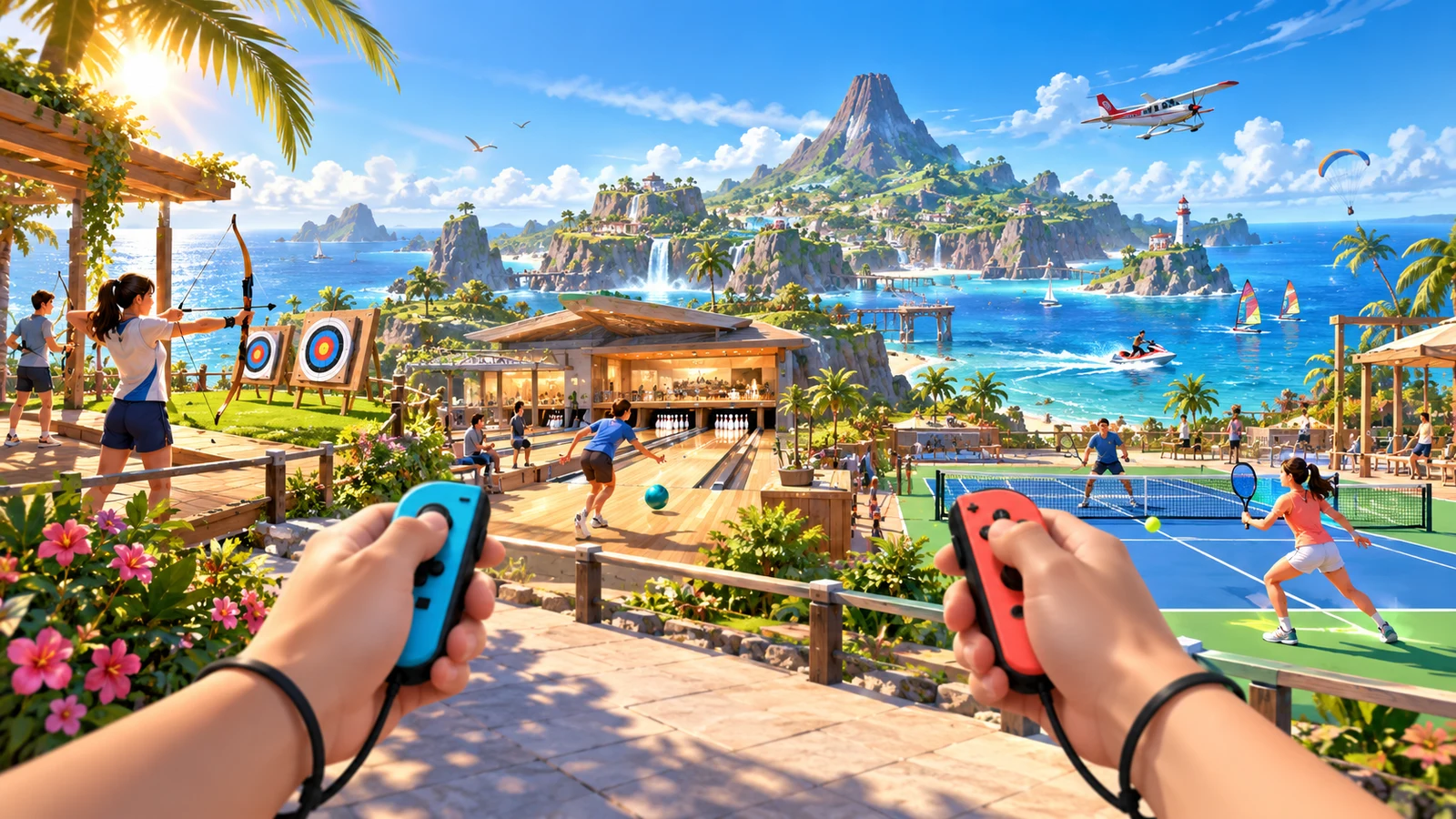
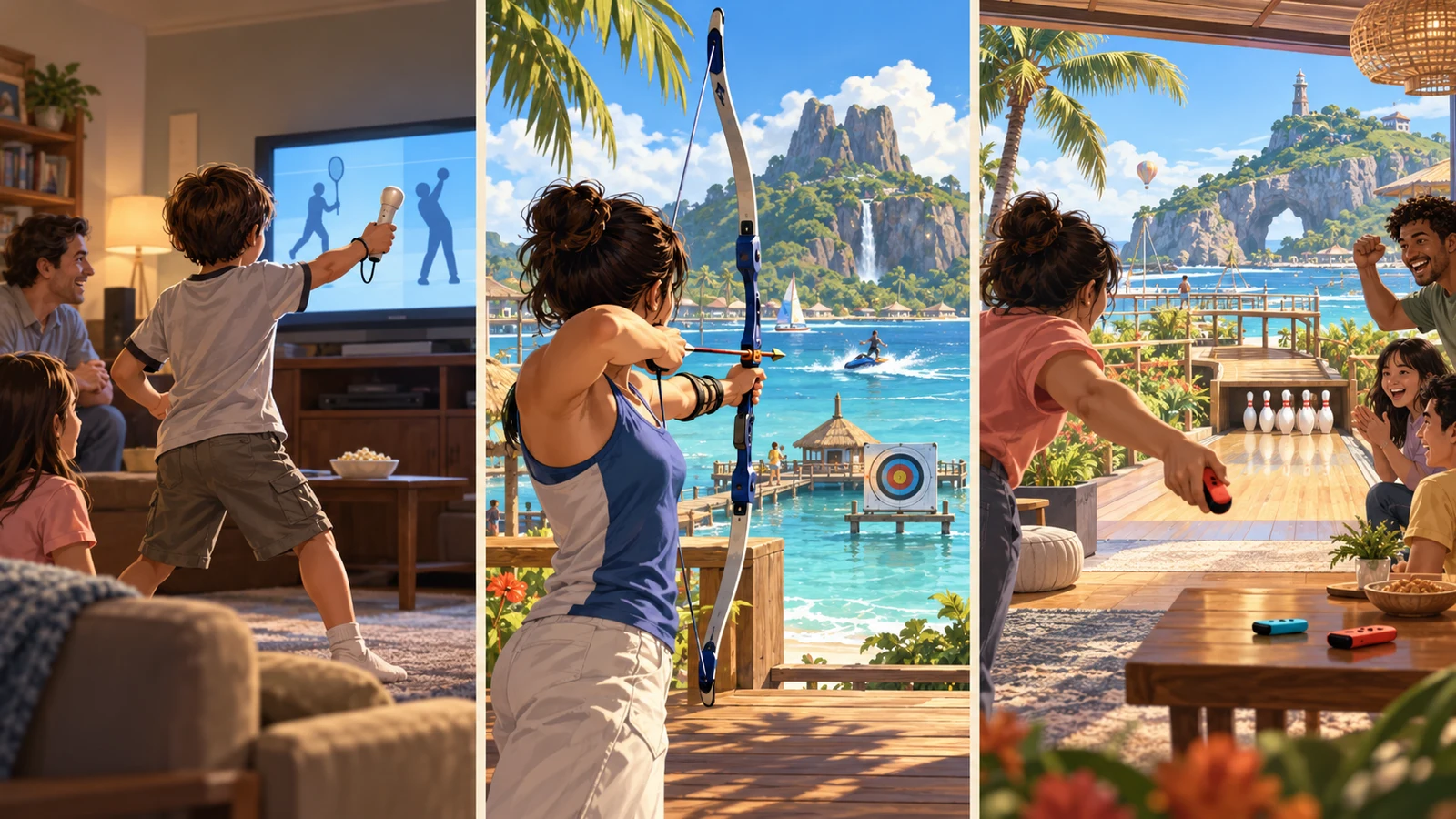
In Wii Sports Resort, Wuhu Island did a job that a conventional sports menu could not. It gave the collection a location, a horizon and a reason for its activities to coexist. The island’s beaches, cliffs, roads and resort buildings made archery, golf, swordplay, cycling and aerial activities feel like different appointments during the same holiday rather than unrelated demonstrations gathered under one logo. That distinction mattered. The original Wii Sports had the clarity of a five-event introduction to Wii Remote controls; its 2009 sequel supplied a setting in which those controls could become part of a broader idea of leisure.
That idea was never simply “sports, but with scenery.” Wuhu Island framed competition as one possible way to occupy a day. A player could pursue a score, take in a view, travel between locations or discuss which activity seemed worth returning to. Even when the underlying interactions were compact, the island connected them through a shared mental map. The 12-sport structure benefited from that connection: the collection suggested a resort itinerary, not merely a row of minigame cards. Nintendo Switch Sports Resort’s return to Wuhu therefore carries a larger responsibility than reproducing a recognizable backdrop.
Place can make a compilation legible. A themed menu tells players what kind of relationship the game wants them to have with its contents. A card labeled “Archery” asks for selection; an archery range situated within a resort implies a destination, a routine and a relationship to the surrounding landscape. This is a subtle difference, but it is one reason the 2009 game remains unusually easy to remember as a whole. Its activities had individual identities while still belonging to Wuhu. They could be compared as parts of a trip: the event with the best view, the one suited to a group, the one that demanded a rematch.
The announced 2026 game has an especially interesting opportunity because its sports lineup is both familiar and eccentric. Boxing, Table Tennis, Tennis, Volleyball, Bowling, Basketball and Golf can readily suggest a recreational complex. Thumb Wrestling, Skateboarding, Power Cruising and Prop Plane need a stronger spatial logic if they are to read as parts of one resort rather than additions to a catalog. Wuhu could provide that logic by making the island’s geography do some of the organizational work. A waterfront, a promenade, a park, a course and an air route can turn variety into an itinerary without forcing every activity into the same competitive frame.
Nintendo’s announced features point toward that broader use of place. Sightseeing Tour is described as a way to encounter Wuhu Island, while Spocco Photos suggests a photographic layer and Spocco Points connect participation with cosmetic customization. Those elements could make the setting more than a decorative lobby, particularly if they encourage players to notice how sports occupy the island and how avatars inhabit it between events. Friend Lobby, Casual Online Play and Pro League may establish the social and competitive routes through the game, but a resort needs noncompetitive reasons to return as well. The announced structure at least acknowledges that distinction.
Still, “explorable” is a broad promise, and the available information does not establish what Wuhu Island means in practice this time. It is not yet clear how freely players can move, how much of the environment is accessible, whether travel is continuous or divided by menus and loading transitions, or how much variety exists beyond sport entrances and photo opportunities. Those are not technical footnotes. They determine whether Wuhu functions as a connective space or merely as a pleasant wrapper around separate modes. An island can be visible without being meaningfully navigable.
The question of scale is similarly important. A resort does not need to become an open-world game, and demanding a huge, uninterrupted map would miss the point of the series. What matters is the quality of the connections: whether locations have memorable relationships, whether moving between them communicates a change of activity, and whether the island offers small discoveries that make the sports feel situated. A compact space with clear landmarks could be more effective than a broad but empty one. Nintendo has not, before launch, provided enough detail to judge that balance.
Wuhu also has to earn its return rather than relying on recognition alone. Familiarity can be welcoming, especially for players who associate the island with the unusually social character of Wii Sports Resort. But nostalgia becomes thin when scenery is repeated without a renewed purpose. The 2026 title needs to show why these particular sports belong here now, and why the setting adds something that a clean, efficient mode-select screen could not. If the island only displays activities, then it has been reduced from a world into branding.
There is a related issue of social storytelling. The best resort games do not require elaborate characters or scripted narratives to produce stories; they create occasions people can describe afterward. A missed contest, a surprising route, a favorite overlook or an argument about the most enjoyable event can make a short session feel like a shared outing. Wuhu’s value lies partly in giving those memories a common vocabulary. The 2026 game’s support for single-system offline play for one to four players and online play for two to 16 creates the potential for many kinds of gatherings, but the island’s design will determine whether those gatherings feel like participation in a place or simply simultaneous activity in a lobby.
That is why Wuhu Island should be evaluated as structure, not scenery. The announced return is promising because the setting historically joined competition, sightseeing and social ritual into one readable identity. Yet its success will depend on unconfirmed details: freedom of movement, environmental variety, transitions, discoverability and the extent to which non-sport features have substance. Before the October 22 launch, the most useful conclusion is a measured one. Nintendo has brought back the right connective idea; whether Nintendo Switch Sports Resort restores the island’s purpose, rather than its silhouette, remains for the finished game to demonstrate.
The intervening Switch Sports chapter
Nintendo Switch Sports was not a direct attempt to rebuild Wii Sports Resort. Its setting, Spocco Square, traded Wuhu Island’s holiday-island illusion for a compact, contemporary sports complex: a place designed less as a destination to explore than as a social hub where players could arrive, compete and see other avatars. That change mattered. The 2022 game treated a sports collection as an online service with a recognizable meeting point, rather than primarily as a showcase for how many activities motion controls could accommodate.
Its launch lineup made that intention clear. Nintendo introduced six sports: Tennis, Chambara, Soccer, Bowling, Volleyball and Badminton. They offered a mixture of familiar Wii-era ideas and newer forms suited to Joy-Con play, with Soccer in particular bringing larger teams and a more overtly competitive structure than the compact contests of the original Wii Sports. The package was not trying to reproduce the twelve-event breadth of Wii Sports Resort. It was establishing a smaller set of repeatable activities around which online competition and avatar customization could operate.
That online emphasis was most visible in Pro League. Rather than treating a match as an isolated party-game round, Switch Sports gave several sports a ranked ladder and a reason to return, with players pursuing divisions and seasonal progress. Rewards and customization items added another layer to that routine. Sportsmates could be dressed and adjusted over time, turning victories, participation and continued engagement into visible identity. The system was modest compared with a full live-service game, but it understood a modern problem that Wii Sports Resort largely did not have to solve: how can a simple ruleset remain socially legible after the novelty of the first afternoon?
The answer was not purely competitive. Switch Sports also made room for casual online play and local multiplayer, preserving the low barrier that defined the series while placing those modes beside a more persistent progression structure. This balance is important in assessing the new Nintendo Switch Sports Resort. Nintendo’s announced plans include Friend Lobby, Casual Online Play and Pro League, alongside offline Island Crown competition and cosmetic customization through Spocco Points. Those are announced features, not evidence that the new game’s competitive ecosystem will be deeper or healthier. Still, their presence suggests Nintendo has carried forward the lesson that a sports collection needs both drop-in sociability and longer-term goals.
The post-launch additions to Switch Sports further complicate its legacy. Golf arrived after launch, expanding the game toward the broader, slower-paced activity associated with Wii Sports Resort. Basketball followed later, extending its team-sport identity and demonstrating that the original six-sport boundary was not final. These updates showed a willingness to build the package over time rather than define it entirely on day one. They also exposed a strategic difference between the two Resort games: the older title presented its breadth as a complete destination, while Switch Sports treated its lineup as something that could grow around an online audience.
That distinction should prevent an easy comparison between Spocco Square and Wuhu Island. Spocco Square’s value was largely social and functional. It gave avatars a shared visual context and made the act of entering a match feel connected to a broader community, even when the underlying activity remained brief. Wuhu Island, by contrast, supplied a sense of place that linked sports, sightseeing and motion-control demonstrations. The returning island in the 2026 game therefore carries a different burden from Spocco Square: it must be more than a familiar backdrop if Nintendo wants it to recover the connective tissue that made Wii Sports Resort feel like a unified world.
Nintendo’s announced features point in that direction without proving the result. Nintendo Switch Sports Resort includes a Sightseeing Tour, Spocco Photos and Island Crown, with champions and legends including Matt across nine sports. It also supports Mii and Sportsmate avatars, rather than forcing the new presentation to choose between the series’ older identity and its newer one. Those ingredients could allow Wuhu Island to function as a meeting place, archive and competitive stage at once. But until release, it is only possible to describe the intended architecture, not whether these activities form a convincing persistent-world identity.
The online history also raises a question about what progression should reward. Pro League supplied structure by measuring competitive advancement, while cosmetic rewards gave players a reason to care about how their avatar appeared. A resort setting offers other possibilities: collecting memories, revisiting landmarks, comparing records or building a personal relationship with the island. Nintendo has confirmed Spocco Points for cosmetic customization and the Island Crown’s offline champion structure, but has not established that these systems will produce a richer sense of place than Switch Sports did. More menus and unlocks would not, by themselves, make Wuhu Island persistent.
There is a practical lesson here as well. Online play can extend a sports game’s life, but it can also make the experience feel organized around matchmaking rather than people sharing a room. Switch Sports kept local play in the picture while making networked competition central; the new game lists single-system offline play for one to four players and online play for two to sixteen overall, with player counts varying by sport. Nintendo Switch Online membership is required for online play. Those options indicate a broad social plan, though the final success of that plan will depend on how clearly local, friend-based and ranked activities complement one another.
The most useful inheritance from Switch Sports, then, is not a particular sport or interface but an understanding of continuity. The 2022 game demonstrated that the series could attach simple motion-controlled contests to profiles, rewards and recurring online competition without abandoning its party-game roots. The 2026 game has the opportunity to add the missing sense of somewhere to those systems through Wuhu Island. Whether it becomes a genuine connective world or merely a brighter wrapper around menus and matches remains unverified before October 22. Its challenge is to make online persistence serve the resort, rather than make the resort serve the ladder.
What Nintendo has actually announced for 2026
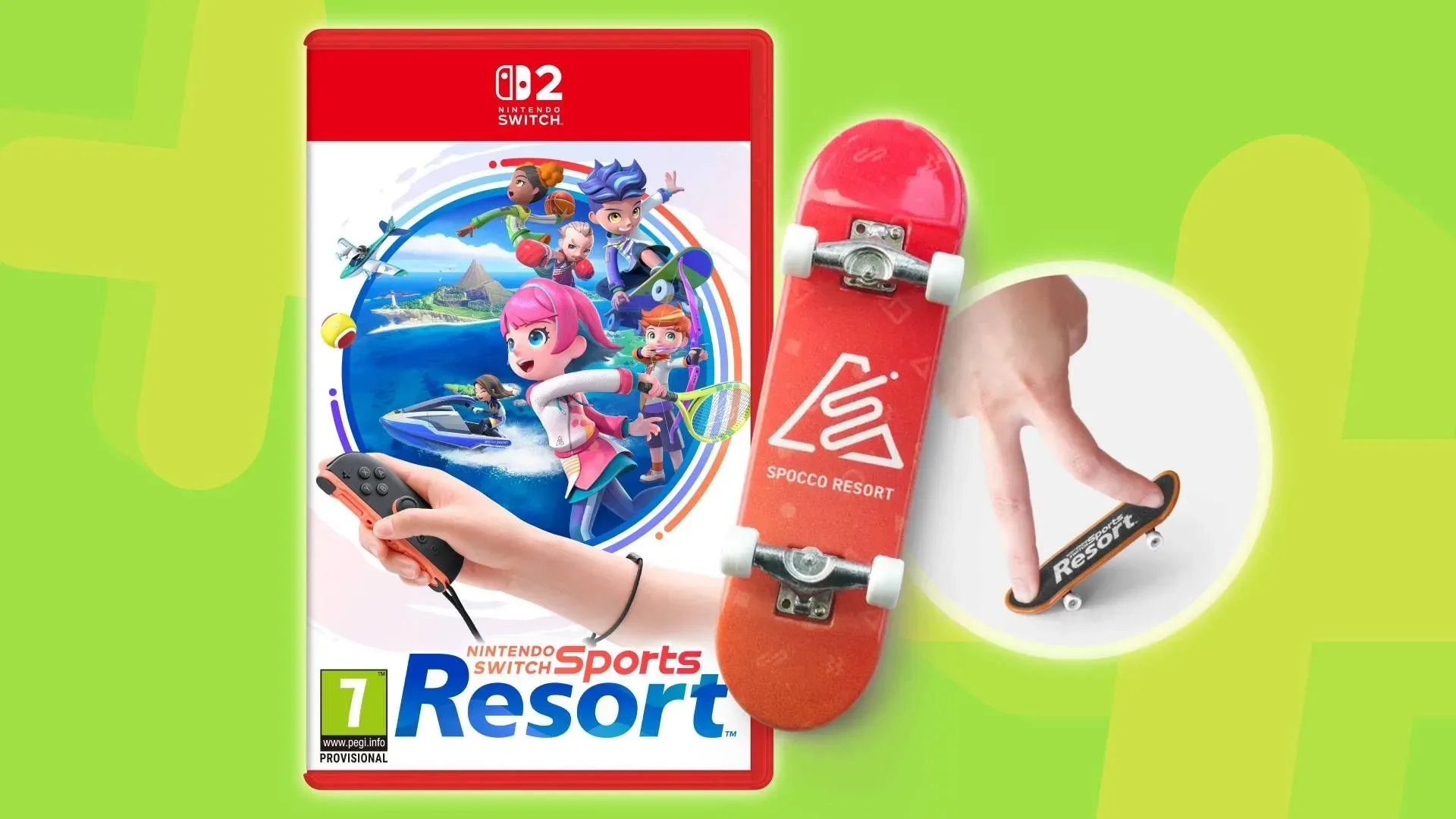
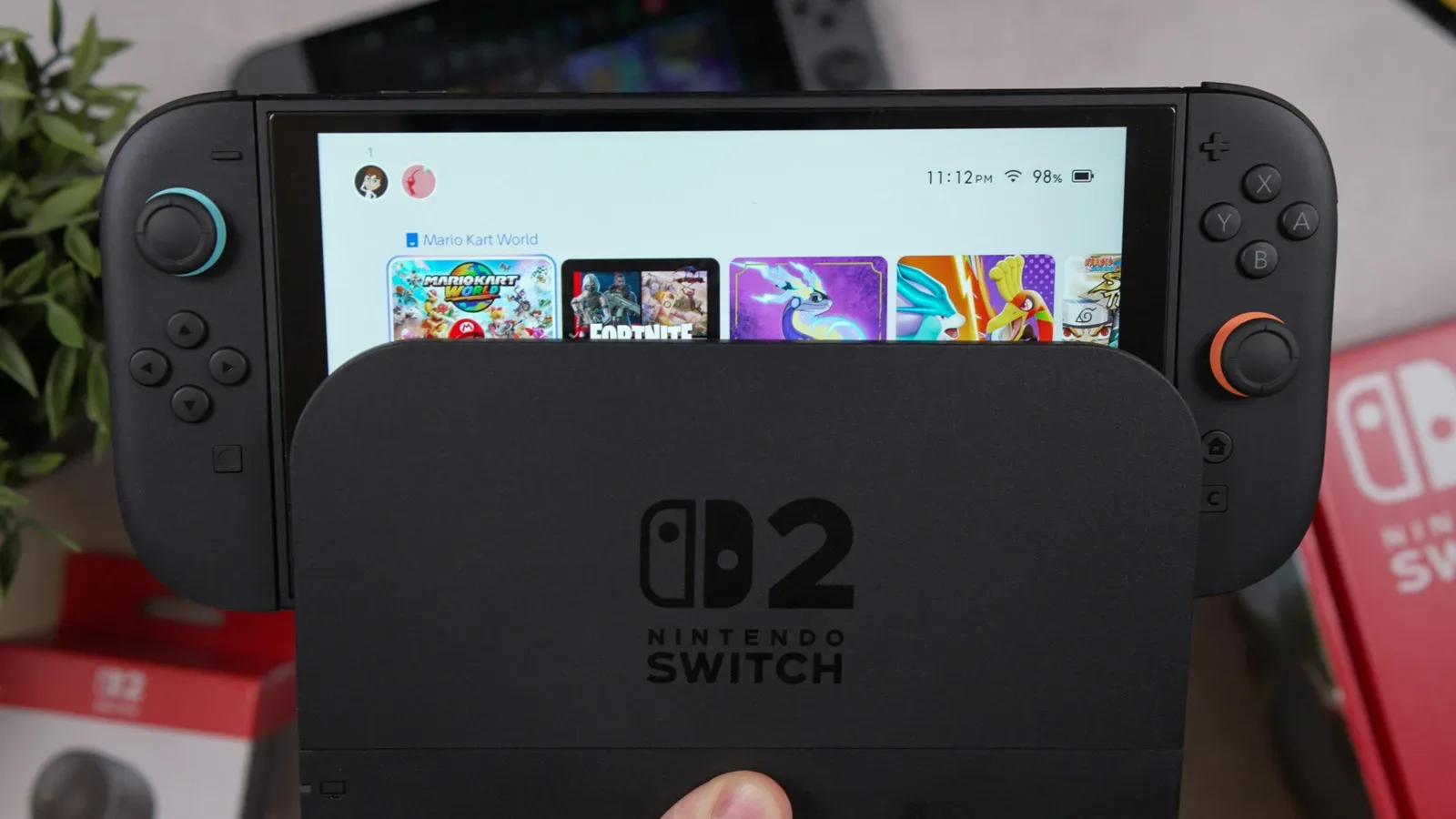
With four days remaining before its announced October 22 launch, Nintendo Switch Sports Resort is a notably specific proposition: it is listed for Nintendo Switch 2 only, not for the original Switch. That platform boundary matters more than a routine hardware footnote. The game is being presented as a new destination for the current console generation, with its control features and social structure tied to Joy-Con 2 and Switch 2 services. It also means that comparisons with the 2022 Nintendo Switch Sports release should be handled carefully; this is not a renamed version of that game, nor a late expansion for the older hardware.
Nintendo’s headline sport count is exactly 12. The announced lineup is Boxing, Table Tennis, Archery, Tennis, Volleyball, Bowling, Basketball, Golf, Thumb Wrestling, Skateboarding, Power Cruising and Prop Plane. That list mixes familiar Wii-era activities with sports and diversions that have not previously occupied the same Nintendo collection. Jump Rope is described separately as a warm-up rather than one of the 12 sports, an important distinction when evaluating Nintendo’s presentation and any future discussion of the package’s scope.
The returning names carry different kinds of historical weight. Bowling, Tennis, Boxing, Golf and Table Tennis connect to the broad, immediately legible physical vocabulary established by the earlier Wii games, while Archery and several of the newer activities point toward a more varied interpretation of a resort. Yet a sport’s presence on a feature list says nothing by itself about its rules, competitive depth, control margin or physical demands. Nintendo has announced the activities, not independently verifiable measures of how substantially each one is developed.
Wuhu Island returns as the setting, linking this project most directly to 2009’s Wii Sports Resort rather than to 2022’s Spocco Square. That continuity is useful as a statement of intent, but it should not be mistaken for a promise that the new activities reproduce the older game’s structure. Nintendo’s current listing is the firm ground: the island is back, the 12 sports are named, and the broader feature set includes sightseeing and social functions. Details beyond those announcements remain matters for release coverage rather than pre-release certainty.
Control support is similarly clear in broad outline and unproven in performance. Nintendo promotes Joy-Con 2 motion control for rackets, bows and handlebars, while Skateboarding uses Joy-Con 2 mouse mode. Those descriptions identify the intended input methods, not their measured precision, latency, calibration behavior or comfort over extended sessions. Nintendo’s advice to use wrist straps and leave room to move is a practical reminder that these are physical controls, but it does not establish how accessible every event will be for every player.
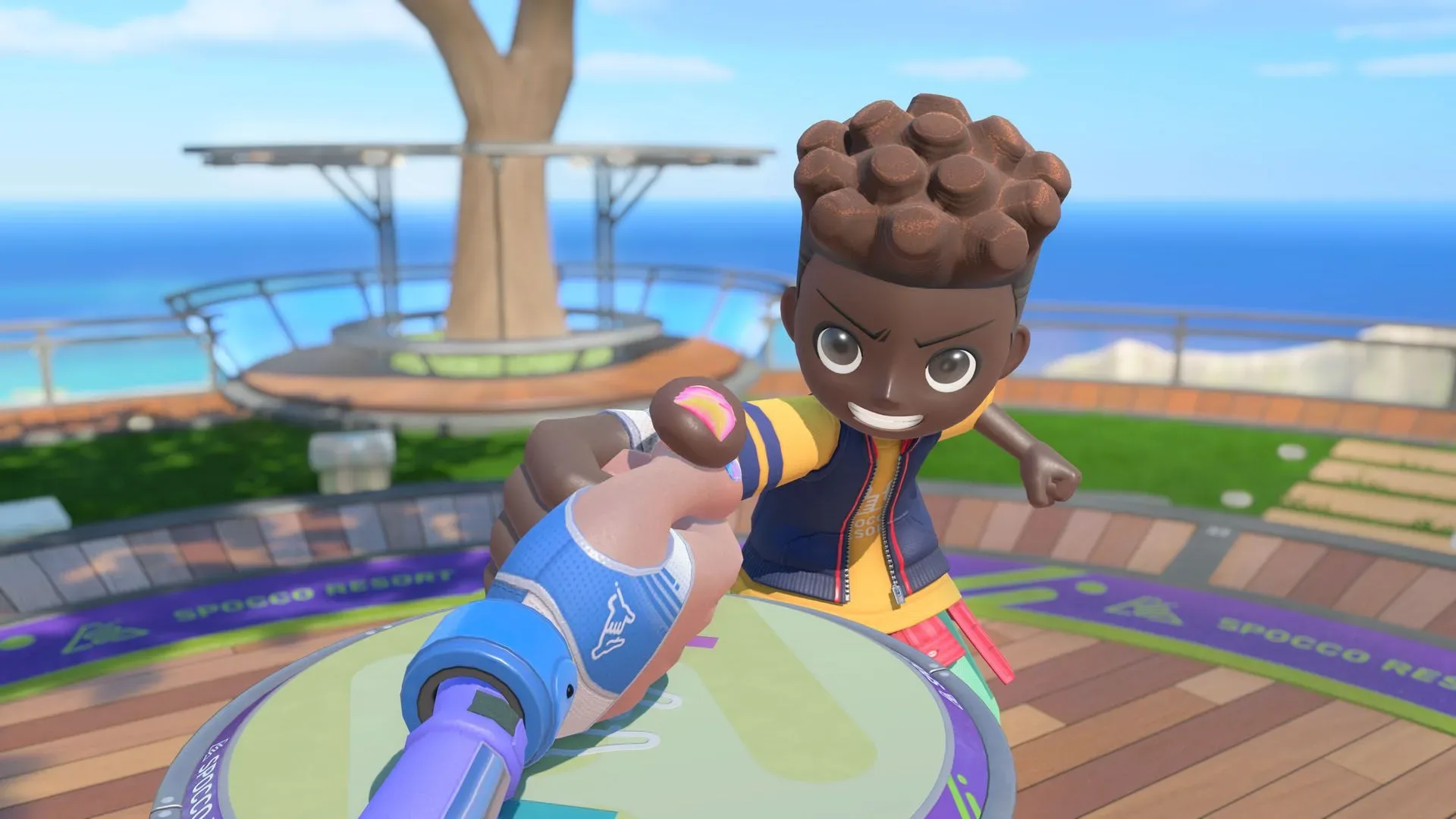
Players can choose between Mii and Sportsmate avatars. That choice continues Nintendo’s long-running tension between personal familiarity and a more unified contemporary character style: Mii representation carries the history of Wii-era social play, while Sportsmates provide the visual identity associated with newer Nintendo Switch Sports branding. Nintendo has announced both options, but not a hierarchy between them or any claim that one avatar type changes the underlying sport rules. Customization is also connected to Spocco Points, which are listed for cosmetic use rather than as evidence of a deeper progression system.
For local play, Nintendo lists single-system offline support for one to four players. That is the clearest baseline for a household or gathering using one Switch 2, but it should not be read as a universal promise that every one of the 12 sports accommodates four people in every mode. Nintendo notes that player counts differ by sport. That qualification is easy to lose beneath an overall “one to four” label, yet it will determine whether the package works equally well as a party game, a turn-taking activity or a solo exercise.
The online headline is larger but requires equal care. Nintendo’s store information lists online play for two to 16 players overall, while the individual events have different participation limits. Sixteen therefore describes the product’s aggregate online range, not a claim that Boxing, Golf or Prop Plane supports 16 simultaneous competitors. Some online modes require a paid Nintendo Switch Online membership, and that subscription requirement is part of the practical cost of the advertised feature set. The game’s online availability is consequently broader than local play, but not frictionless or uniform across sports.
Announced online structures include Casual Online Play, Pro League and Friend Lobby. Friend Lobby supports up to eight people, with up to two players per console, while the broader online total reaches as high as 16 depending on the sport and mode. These labels suggest different priorities—low-pressure matchmaking, ranked competition and organized private sessions—but they do not yet establish ranking rules, matchmaking quality, moderation outcomes or the long-term health of any competitive ladder. Those are questions that can only be answered once the public service is operating.
Nintendo also lists an offline Island Crown, with champions and legends—including Matt—across nine sports, alongside Sightseeing Tour and Spocco Photos. These features indicate that the resort is not solely a menu for repeated matches: there is an offline goal structure, a tour-oriented activity and a way to record the surrounding presentation. Still, “champions” and “legends” describe the announced framing, not a confirmed difficulty curve or meaningful endgame. Until release, the responsible conclusion is narrower: Nintendo has outlined a substantial set of modes around its 12 sports, with participation limits, platform requirements and subscription conditions that matter as much as the sport count.
Joy-Con 2: motion, mouse, and an unanswered question
Nintendo Switch Sports Resort’s most consequential promise may be less about its twelve sports than about the way Joy-Con 2 is expected to translate them. Nintendo is presenting motion control as the language of rackets, bows and handlebars, while Joy-Con 2’s mouse mode is assigned to Skateboarding. Those are recognisable metaphors: swing an object like a racket, draw and release like an archer, steer with a handlebar, and manipulate a board through a pointing-device convention. They also place different demands on hardware and player interpretation. A pre-release specification can establish the intended vocabulary; it cannot establish whether that vocabulary is precise, comfortable or equally legible to everyone.
The historical comparison begins with the original Wii Remote, whose accelerometer detected linear acceleration rather than directly reading every turn of the hand. That distinction mattered. A player could make a convincing swing, but the system had to infer what kind of movement had occurred from limited information, and calibration and orientation introduced boundaries. Wii Sports made those constraints part of its design achievement: its activities were deliberately broad enough for a small gesture to stand in for a larger physical action. The result was accessible as a concept, even when the underlying sensing was never magic.
Wii Sports Resort added Wii MotionPlus, an accessory bundled with the 2009 game, to supplement the Wii Remote with a gyroscope capable of detecting rotation and twist. That changed the design space more than it simply promised “better motion.” Wuhu Island’s sports could ask the player to manage orientation as well as acceleration, making the controller’s angle more relevant to the virtual tool. Yet MotionPlus still existed within a system of calibration, assumptions and software interpretation. Its presence did not eliminate the need for designers to decide which physical differences mattered and which could be safely ignored.
Joy-Con changed the practical shape of that problem in 2022’s Nintendo Switch Sports. The controllers were compact, detachable and already associated with motion input, but the game’s Spocco Square setting and initial sports lineup did not amount to a simple remake of Resort. Nintendo added Golf and Basketball later, and the title’s control language was shaped around the capabilities and ergonomics of contemporary Joy-Con rather than the Wii Remote and its add-on. Resort’s return therefore has to negotiate with two legacies: the cultural memory of Wii motion play and the more modular, smaller controller that followed it.
For the new game, Nintendo specifically promotes Joy-Con 2 motion control for rackets, bows and handlebars. That phrasing suggests a useful division between tools that are swung, aimed or steered, but it does not explain how much of each action is recognised. A racket sport might care about the direction and timing of a face, an archery activity might distinguish aim from release, and a handlebars metaphor might depend on rotation or tilt. Those are design possibilities, not confirmed rule sets. The important question is whether the game communicates the relevant motion clearly enough that players can learn its logic rather than guess at an invisible calibration model.
The racket metaphor is especially vulnerable to ambiguity. Real swings contain speed, angle, preparation and follow-through, while a motion-controlled game may deliberately reduce that continuum to a handful of meaningful inputs. Reduction is not automatically a weakness; it can make a sport approachable and keep a living room from becoming a court. But Nintendo’s eventual implementation should be judged on whether the simplification preserves decisions that matter. If direction, timing or racket orientation changes the result, the game needs to make those relationships understandable without demanding athletic repetition or exaggerated gestures.
Archery raises a different issue because aiming and releasing are sequential rather than merely expressive. Nintendo has confirmed the bow as a Joy-Con 2 motion-control example, but has not publicly established the precise interaction model that will govern it. A serious hands-on assessment should observe how the system handles changes in stance, controller angle, draw duration and release timing; whether players receive immediate, intelligible feedback; and whether returning the controller to a neutral position is required between attempts. It should also record whether calibration remains stable across different heights, grips and playing positions instead of treating a single ideal posture as universal.
Handlebars offer the clearest physical metaphor and perhaps the largest ergonomic question. Holding a controller like a bar invites two-handed participation and naturally suggests steering through rotation or tilt, yet that posture can also encourage players to hold their arms out for long periods. Nintendo advises using wrist straps and leaving room to move, sensible precautions for any motion game but not a substitute for evaluating comfort. A future test should examine how much range of motion the game asks for, whether seated play is supported, how consistently it recognises small steering adjustments, and whether the control scheme accommodates players who cannot reproduce the assumed posture.
Skateboarding’s use of Joy-Con 2 mouse mode is the more radical departure. Rather than extending the Wii-era fantasy of turning a controller into a physical sporting implement, it assigns the controller a computer-like relationship with a surface and a cursor or pointer paradigm. That could provide a different kind of precision, because mouse input is conventionally associated with controlled travel across a plane rather than acceleration in free space. Still, the metaphor must be examined on its own terms. Nintendo has announced the mode, not demonstrated its latency, required surface, hand position, calibration process or suitability for extended use.
A careful pre-release analysis should resist the easy conclusion that newer hardware automatically resolves older motion-control problems. Joy-Con 2 may offer designers additional options, but announced support for gyroscopic motion or mouse input does not independently verify improved precision, lower latency, reduced drift or broader accessibility. Those qualities require observation under repeatable conditions. Testing should compare identical gestures across players, note false inputs and missed inputs, check whether recalibration interrupts play, and distinguish hardware recognition from software assistance. It should also ask whether the game explains its control rules without relying on players to imitate a Nintendo trailer.
The unanswered question, then, is not whether Joy-Con 2 can make a racket swing, bow gesture, handlebar movement or mouse action possible. Nintendo has already defined those intended roles. It is whether Resort can turn several sensing methods into coherent sports rather than a collection of impressive demonstrations. The eventual evidence should include control clarity, fatigue, consistency across body types and positions, and the consequences of mistakes—not just the novelty of moving a controller. Wuhu Island’s return will carry the Wii name’s expectations, but the more meaningful test will be whether its new controls respect both the possibilities and the limits of the hands holding them.
Rackets and timing: Tennis and Table Tennis
Racket sports are where Nintendo’s motion-control argument has always been easiest to understand. A swing is intuitive, its result can be shown immediately, and a rally creates a rhythm that even a spectator can follow. They are also where the gap between a convincing gesture and a dependable game system becomes most important. For Nintendo Switch Sports Resort, Nintendo is promoting Joy-Con 2 motion control for rackets, but the company’s announcement does not establish how precisely the game distinguishes every angle, speed, or moment of contact. Those details will matter more than the broad promise that players can swing.
Tennis has the clearest historical reference point. In Wii Sports, the player’s avatar moved around the court automatically while the Wii Remote supplied the timing and general character of the stroke. That division of responsibility was a major part of its appeal: players could concentrate on returning the ball rather than mastering footwork, camera control, or a catalogue of buttons. A forehand, backhand, and serve were legible because the game reduced tennis to a small set of highly visible decisions. Its simplicity was not a weakness by default; it was the structure that made a family rally understandable within seconds.
Nintendo’s announced Resort tennis controls appear to preserve that accessible idea while placing the emphasis on swinging a Joy-Con 2 as a racket. The important question is not whether the controller can detect a movement in the abstract, but how much of that movement meaningfully belongs to the player. Does the timing of the swing decide contact while the direction shapes placement? Are different racket faces represented by recognisable ball trajectories, or does the system primarily classify a handful of broad gestures? Until release, those nuances remain questions rather than evidence of either sophisticated simulation or hidden simplicity.
That uncertainty is especially relevant to rally rhythm. Tennis works best when a player can understand why a return succeeded, failed, landed short, or gave an opponent an opening. Readable feedback does not require a detailed physics model, but it does require a stable relationship between intention and outcome. If a late swing is visibly late and a mistimed stroke produces a comprehensible consequence, beginners can learn from the exchange and experienced players can build a style around it. If the same movement sometimes produces different results without a clear visual explanation, the rally becomes spectacle without much tactical ownership.
Table tennis belongs to the same family, but its scale changes the timing problem. Wii Sports Resort introduced the sport during the Wii MotionPlus era, when Nintendo was making a more specific case for rotational sensing. Its compact table, rapid exchanges, and emphasis on quick shots gave the accessory a more demanding showcase than the original game’s broad tennis gestures. Nintendo’s developer explanations described the original Wii Remote’s accelerometer as sensing linear acceleration, while MotionPlus added a gyroscope for rotation and twist; that distinction helped make small orientation changes more useful, even though motion sensing still had calibration and practical limits.
The announced table-tennis control for Nintendo Switch Sports Resort points toward quick Joy-Con 2 shots rather than the longer, more theatrical swings associated with tennis. That should create a different kind of contest if the recognition is sufficiently consistent. A short exchange can turn on preparation, reaction, and the angle of the racket face. It raises promising but unconfirmed questions: can players deliberately open or close the face to alter the ball’s path, can a sharp motion produce a distinct attacking shot, and does the game reward restraint as well as speed? Nintendo has not publicly provided enough detail to treat those possibilities as established mechanics.
Comparing the two sports therefore means comparing two kinds of readability, not merely two sizes of racket. Tennis has room for a generous input window and a clear back-and-forth cadence. Table tennis demands that the player and the audience read smaller differences in timing, direction, and return height. The latter can offer greater nuance, but nuance only helps when the game communicates it. A table-tennis match that looks fast yet gives no dependable indication of why a shot was returned or missed risks becoming opaque to newcomers and frustrating to anyone seeking improvement.
This distinction also affects spectatorship, one of the quiet strengths of Nintendo’s sports games. A tennis rally can be entertaining because its structure is immediately visible: serve, return, pressure, error. Table tennis can be equally compelling, but its faster decisions may need stronger animation, sound, court positioning, or ball-flight cues to make the contest legible from across a room. Those are presentation questions as much as control questions. Nintendo’s announced feature list tells us that both sports use Joy-Con 2 motion control; it does not yet tell us how effectively the finished game will explain its decisions to someone holding neither controller.
Skill levels complicate the definition of fairness. A broad recognition system can prevent an experienced player from overwhelming a first-timer through tiny technical distinctions, which is valuable in a social game. Conversely, if every useful stroke collapses into the same forgiving response, practice loses its purpose. The best balance would let a novice return a ball through a simple, understandable action while allowing timing and orientation to matter more as players become deliberate. Whether Resort reaches that balance cannot be inferred from Nintendo’s promotional control descriptions alone, and claims about precision, latency, comfort, or physical accessibility would be premature before independent testing.
The return of Wuhu Island gives these rackets a useful historical frame. Wii Sports made tennis an emblem of motion control’s immediate accessibility; Wii Sports Resort used table tennis to argue that the same idea could become more exacting with newer sensing technology. The 2026 game arrives after Nintendo Switch Sports, a separate title set in Spocco Square, and its racket sports will have to connect both traditions without simply repeating either one. Nintendo is promising the familiar pleasure of swinging, but the real test will be whether tennis remains as instantly readable as its predecessor while table tennis earns its sharper timing through feedback players can trust.
Line, arc, and restraint: Bowling, Golf, Archery
Bowling, Golf and Archery are useful tests of what Nintendo Switch Sports Resort is trying to preserve from its predecessors. None depends on a complicated button layout. Each asks the player to express a physical idea—rotation, a swing along a line, or the controlled release of tension—through Joy-Con 2 motion. That simplicity is the appeal, but it also makes calibration and visual feedback unusually important. When the vocabulary is this small, a game has fewer places to hide ambiguity. The player needs to understand what the controller is reading, what the avatar is doing, and why the ball or arrow travelled where it did.
Bowling’s announced twist input is the clearest example. Nintendo describes a throw in which the player can add spin, extending the familiar Wii Sports gesture beyond simply moving the arm forward. The idea is not new to the series: the original Wii Sports made bowling a demonstration of how a wrist movement could become a visible change in the ball’s path. Resort developed that vocabulary in a broader package of sports, while Switch Sports later carried bowling into Spocco Square rather than Wuhu Island. Resort’s return therefore has to make the curved line legible without turning the throw into an exercise in guessing how much the controller rotated.
That distinction matters because spin is not merely a flourish. It gives the player a relationship between preparation and consequence: the angle of the hand, the direction of the release and the eventual movement toward the pins. Nintendo’s announced Joy-Con 2 motion controls establish the intended physical language, but they do not establish how forgiving or exact the final interpretation will be. Those qualities cannot be inferred from a feature description. They depend on calibration, the timing window assigned to release, the way the game communicates unwanted rotation, and the clarity of the lane and pin reaction. Until the game is available, claims about precision or latency would go beyond the evidence.
Golf approaches the same problem from a different angle. Its motion design is built around aiming and swinging rather than steering a ball after it has been struck. That creates a two-part promise: the player should be able to establish a line, then make a physical gesture whose force and direction have visible consequences. Wii Sports Golf succeeded historically because it translated a small set of motions into a surprisingly understandable ritual. Wii Sports Resort’s golf belonged to a larger Wuhu Island framework and benefited from the Wii MotionPlus era’s emphasis on more faithful rotational information. The new game’s return to Wuhu Island makes that lineage explicit, even though the announcement does not provide a technical account of its swing model.
The historical difference between the two Wii generations is significant. The original Wii Remote could sense linear acceleration, while Wii MotionPlus added a gyroscope for rotation and twisting. That addition did not make motion capture limitless or eliminate calibration; it expanded what the system could distinguish and introduced its own need for the game to establish a reliable reference. Switch Sports Resort is now promising Joy-Con 2 motion control for rackets, bows and handlebars, with the sports themselves expected to communicate the rest of the design. For golf, the central question is not whether a swing is detected at all, but whether the game makes the boundary between aim, timing and rotation intelligible.
Archery gives that question a more deliberate shape. Nintendo’s announced design centres on drawing, aiming and releasing, an appealing translation of the sport because each phase has a distinct physical metaphor. The bow is not just a remote pointed at a target; the player must hold a line, manage the draw and decide when to let go. That structure can make even a compact activity feel measured rather than frantic. It also places greater demands on the interface. The target must remain readable, the reticle or arrow direction must be understandable, and the game must show enough of the trajectory to explain a miss without pretending that the player is operating a real bow.
Wind is the natural complication in any archery design that wants to suggest a shot beyond a stationary target. If Nintendo uses wind as part of the announced or presented challenge, its success will depend on whether that force is communicated before the release and reflected clearly afterward. A gust that exists only as hidden arithmetic would make the sport feel arbitrary; a visible, comprehensible influence could give aiming a second layer without requiring a more elaborate control scheme. The announcement establishes the draw, aim and release framework, but it does not justify assumptions about wind strength, assistance, trajectories or difficulty. Those remain questions for the finished software.
Across all three sports, readable trajectories are more valuable than raw simulation. Bowling needs a clear connection between twist and ball curve. Golf needs the flight of the ball to clarify how aim and swing interacted. Archery needs an arrow path that distinguishes poor alignment from a changing environmental factor, if such a factor is present. These are not merely visual niceties. They are the feedback loop that converts a motion-control game from a sequence of gestures into a learnable system. The player can tolerate an imperfect result more readily when the game makes the cause visible.
Calibration is the quieter half of that equation. Motion controls begin from a physical reference that can drift as a player changes posture, grip or position, and Nintendo has historically had to design around the limits of accelerometers, gyroscopes and human inconsistency. The Wii generation’s calibration prompts were not an admission that the concept had failed; they were part of making an abstract sensor understandable. Joy-Con 2 may offer a newer platform and Nintendo is promoting motion use for these sports, but no announcement can prove how the finished games handle misalignment, repeated swings or different playing spaces. Those issues will matter especially for players who cannot reproduce an ideal gesture every time.
Wuhu Island is therefore more than a nostalgic backdrop for these activities. It recalls a period when Nintendo used simple sports to teach new control ideas, while also carrying the lessons of Wii Sports Resort’s twelve-sport breadth and MotionPlus foundation. Switch Sports Resort’s Bowling, Golf and Archery can honour that history without simply replaying it, provided their lines, arcs and releases remain understandable. The announced designs offer a coherent set of motion metaphors, but the important achievement will be restraint: asking for a twist, a swing or a draw, then giving players enough information to know what that action meant.
Teams and contact: Volleyball, Basketball, Boxing, Thumb Wrestling
The social sports need more than recognizable gestures
Among Nintendo Switch Sports Resort’s 12 headline sports, these four make the clearest argument that the collection is about people sharing a room, not merely collecting motion-control demonstrations. Volleyball, Basketball, Boxing and Thumb Wrestling all involve contact, opposition or cooperation that should be immediately understandable to spectators. That legibility matters. A player can recognize a spike, a shot, a guard or a thumb pressed into a contest without needing a tutorial, while the game still has to translate those gestures into rules that are fair enough to sustain a rematch.
Volleyball is the most obviously cooperative proposition. Nintendo presents it around coordinated timing, with teammates reading the same rally and contributing to its continuation rather than taking isolated turns. That structure can make a living-room match unusually social: the important moment is not just whether an individual gesture registers, but whether two people anticipate one another. It also creates a demanding design problem. The game must communicate whose action matters, when a ball is available, and why a point was won without burying a casual group under technical explanation.
Joy-Con 2 motion control is being promoted for the rackets, bows and handlebars in the wider lineup, but Nintendo’s volleyball presentation likewise places the emphasis on physical motion and shared timing. The announced feature is not evidence of measured accuracy, latency or comfort. Those questions will require play after launch, especially when several players are moving at once. A forgiving interpretation may help families and first-time players, while an overly generous one could make coordination feel cosmetic. Conversely, strict timing could reward practice but turn a supposedly welcoming team sport into an exercise in arguing over inputs.
Basketball shifts the social rhythm from a shared rally to a sequence of decisions: dribble, pass and shoot are the basic actions Nintendo highlights. That combination gives the sport more connective tissue than a simple target game. Passing can make a local team feel collaborative, while dribbling and shooting offer clear individual responsibility. Yet those verbs do not, by themselves, establish the depth of the basketball model. Whether positioning, turnovers, defensive pressure or shot selection meaningfully shape a match is something the announced feature set does not settle.
That uncertainty is particularly important for local play. A basketball game can be easy to understand from across the room while still producing uneven participation if one player dominates every possession. Nintendo lists single-system offline play for one to four players overall, while noting that player counts vary by sport; the exact local arrangement for each activity therefore matters. A two-player contest, a cooperative team configuration and a four-person room could each demand different balancing. The eventual question is not whether players can perform a pass or shot, but whether everyone has a reason to remain involved.
Boxing supplies the most direct form of opposition in this group. Nintendo describes punches and guarding as central to the activity, a compact vocabulary that should make a bout readable even to someone watching for the first time. It also raises more serious questions about interpretation than a volleyball rally does. If the system distinguishes a meaningful guard from a hurried movement, players may find a foundation for counterplay. If it mainly rewards repeated arm motions, the visual language of boxing could promise more tactical exchange than the underlying contest provides.
Physical space is part of that equation. Nintendo advises using wrist straps and leaving room to move, guidance that is sensible for any motion-controlled sport but especially relevant when boxing invites larger gestures. A clear area can reduce accidental collisions, yet not every household has a spacious television room, and not every player can comfortably make the same motions. Nintendo has not established, in the public information available before launch, how much the boxing controls accommodate limited range of motion, seated play or fatigue. Those are accessibility and comfort questions, not details that marketing descriptions can answer.
Thumb Wrestling is the stranger inclusion, and that is precisely why it may become one of the collection’s most revealing experiments. Its appeal is immediate: a familiar hand-game idea reduced to a contest that can be explained in seconds. Unlike basketball or boxing, it does not need to simulate a large arena or a recognizable professional skill. Its success will depend on whether the digital version preserves the anticipation and reversals that make the physical pastime amusing, rather than turning a tactile joke into a narrow exchange of prompted motions.
The sport also tests how Nintendo understands novelty. Wii Sports Resort could make an accessory such as Wii MotionPlus part of a broader demonstration of rotational control, while Switch Sports placed its own activities in Spocco Square and expanded beyond its original six with Golf and Basketball. Resort’s return to Wuhu Island is therefore not automatically a return to the old design philosophy. Thumb Wrestling, in particular, has to justify its place alongside established sports through social energy and clarity, not through the assumption that a quirky premise is enough.
Across all four activities, the announced modes may matter as much as the gestures. Nintendo lists Friend Lobby for up to eight people, with up to two players per console, alongside Casual Online Play and Pro League; Nintendo Switch Online membership is required for online play. Those options could give a locally understandable sport a longer life, but online competition also magnifies any ambiguity in timing, contact detection and balance. The advertised structure promises opportunities for comparison, not proof that these activities will remain compelling beyond the first novelty.
That distinction is the central pre-release issue. Volleyball needs cooperation that cannot be reduced to simultaneous waving; Basketball needs passing and shooting that create choices rather than a sequence of obvious inputs; Boxing needs guarding and counters that reward reading an opponent; Thumb Wrestling needs a small ruleset with genuine back-and-forth. Their local legibility is a strength, and their modest space requirements may make them practical party activities, but comfort, accessibility, precision and strategic depth remain unverified. By October 22, the question will be whether these sports turn contact and timing into durable play—or merely recognizable gestures that look better than they last.
Leisure sports make the island feel inhabited
Wuhu Island has always suggested a life beyond the boundaries of a match. In Wii Sports Resort, its beaches, cliffs and distant venues gave the sports collection a shared geography, even when the games themselves remained discrete activities. The announced return of that setting in Nintendo Switch Sports Resort therefore matters for more than nostalgia. Nintendo is presenting three of the new headline sports—Skateboarding, Power Cruising and Prop Plane—as ways to move through or look around the island, not simply as additional score-based events. That distinction could give the resort a different rhythm: competition in some spaces, recreation in others.
The most unusual control idea belongs to Skateboarding. Nintendo says Joy-Con 2 mouse mode is used for the sport, a notable departure from the motion-control language associated with the racket, bow and handlebar activities. The choice implies that the controller’s position on a surface, rather than its orientation in the player’s hand, is central to the interaction. That could make Skateboarding feel closer to guiding a cursor or board across a miniature landscape than swinging a physical object. It also raises practical questions Nintendo’s announcement does not answer, including what surface is expected, how much desk or table space is useful, and whether a living-room setup will be equally suitable.
Mouse control can be precise in one context and awkward in another. A player sitting at a table may have a natural place to move a Joy-Con 2, while someone playing near a television without a convenient flat surface may need to improvise. None of that establishes a flaw before release; it simply marks the gap between a control description and an actual accessibility or comfort assessment. The same applies to the sport’s physical demands. Nintendo has not publicly established how much arm movement, repeated repositioning or bodily balance Skateboarding asks of players, so the feature should be understood as an intriguing design proposition rather than a confirmed improvement over conventional motion controls.
Power Cruising returns the idea of travel to a more overtly shared activity. Nintendo promotes paired Joy-Con 2 controls and steering for the sport, suggesting a control scheme built around handling a vehicle or watercraft rather than manipulating a ball, racket or character directly. “Paired” may be important here, whether it means coordinating two controllers or sharing the experience across players, but the announced information does not provide enough detail to define every arrangement. It is safest to say that Power Cruising is designed around steering and that its control language may make the coastline itself part of the attraction.
That coastline could turn a familiar Nintendo sports structure outward. Traditional sports ask players to focus on an opponent, a target or a sequence of plays. A cruising activity can instead make direction, landmarks and the route between destinations meaningful, even if only in a limited, authored course. The scope remains unknown: Nintendo has not confirmed whether Power Cruising is free exploration, a collection of guided routes, a race format, or some combination of those possibilities. The promotional description supports an island-travel reading, but it does not justify assuming a seamless open world or a fully navigable shoreline.
Prop Plane presents another version of movement, with tilt-based flying listed among its controls. Tilt is an especially legible fit for a small aircraft: the player’s physical adjustment can stand in for banking through the sky. Yet that apparent simplicity conceals questions about calibration, sustained comfort and the relationship between turning and altitude. Motion controls have never been magic merely because they are intuitive in a demonstration. Nintendo’s earlier hardware history makes that worth remembering: the Wii Remote could detect linear acceleration, while Wii MotionPlus added a gyroscope for rotation and twist, but those systems still had calibration limits and constraints. Joy-Con 2’s advertised capabilities are not a substitute for measuring how Prop Plane behaves in real rooms and hands.
The plane could be the clearest bridge between sport and sightseeing. From above, Wuhu Island can function as a place to observe rather than a course to conquer, allowing visual details and the arrangement of venues to become part of the reward. That possibility is reinforced by Nintendo’s separate Sightseeing Tour and Spocco Photos features. Their existence indicates an interest in looking around and recording a visit, but the available announcement does not establish whether Prop Plane directly feeds into those modes, whether tours are guided or open-ended, or how much of the island is visible from the air.
Those uncertainties are important because “island” can describe several very different designs. It might mean a connected hub with meaningful travel between sports, a set of scenic menus joined by short activities, or a backdrop that lends personality to otherwise separate events. Nintendo’s artwork and promotional presentation can communicate the intended atmosphere, but they are not evidence of final footage or proof of uninterrupted traversal. Until the software is available, claims about hidden routes, discoverable landmarks, transportation systems or a fully simulated resort would be invention rather than analysis.
Still, the announced structure points toward a more relaxed use of the game. Nintendo lists single-system offline play for one to four players and online play for two to 16 overall, with the exact player count varying by sport. It also advertises Friend Lobby, Casual Online Play and Pro League, all of which support the competitive side of the package. Sightseeing Tour and Spocco Photos could provide a counterweight, giving a group reasons to remain in the same digital place after a match ends. Whether that counterweight is substantial or merely decorative will depend on how these modes connect and what they ask players to do.
The return of Wuhu Island consequently has a larger question attached to it than whether the setting looks familiar. Wii Sports Resort used the island to make a dozen activities feel like parts of one destination; the new game may be trying to make the destination itself playable. Skateboarding’s mouse controls, Power Cruising’s steering and Prop Plane’s tilt-based flight each offer a different answer to the problem of inhabiting that space. None has been independently assessed for precision, latency, comfort or accessibility before the October 22 launch, and Nintendo advises wrist straps and room to move. For now, the island’s leisure promise is credible as a design direction, but its actual breadth remains one of the resort’s most consequential unanswered questions.
Island Crown, Matt, and reasons to play alone
A ladder gives the resort somewhere to go
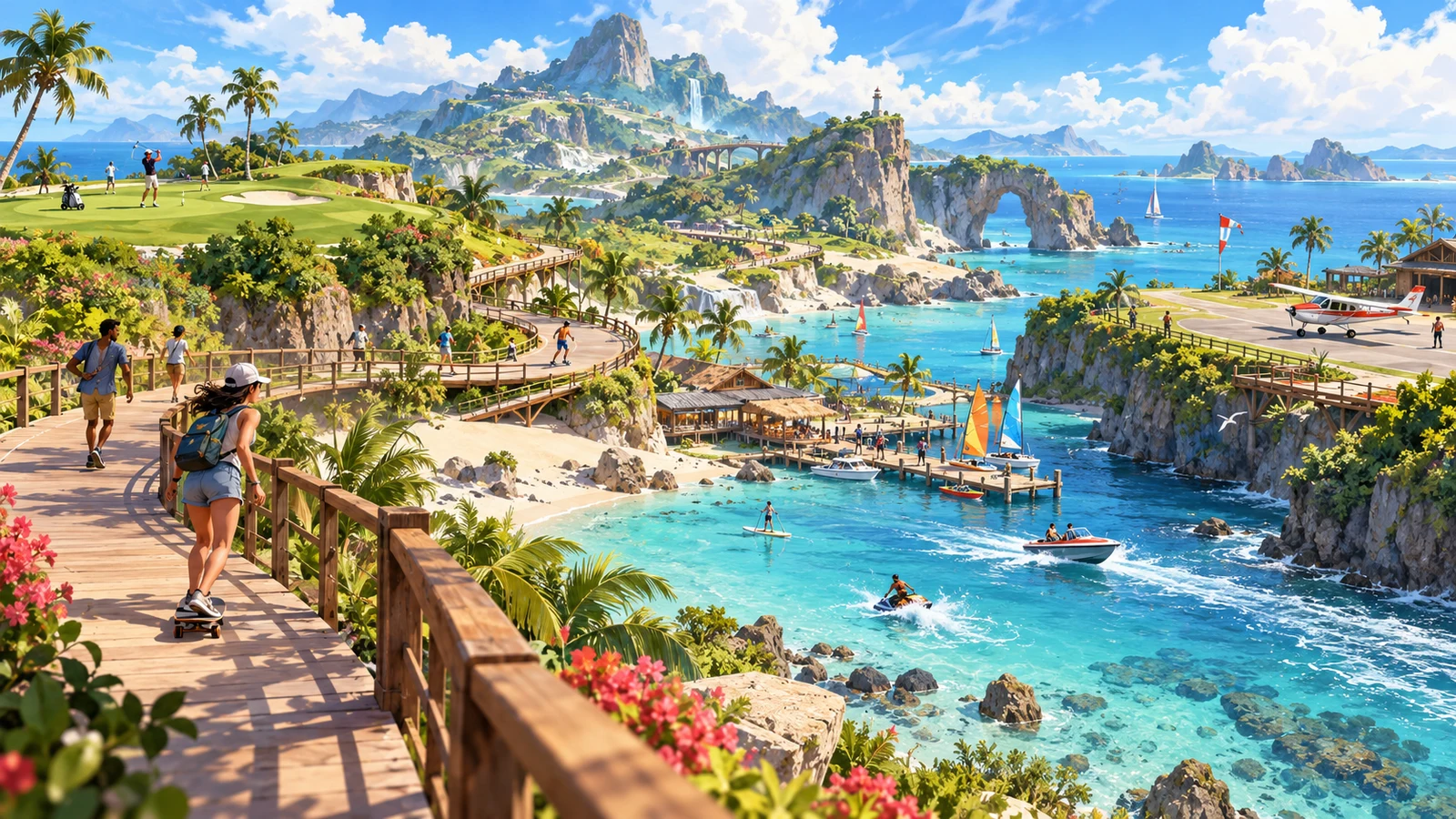
The most consequential solo feature in Nintendo Switch Sports Resort may also be the least glamorous on its announcement page. Island Crown is an offline challenge built around champions and legends across nine sports, with the familiar Mii fighter Matt among the names Nintendo has confirmed. That framing matters because a collection built for living rooms and parties can otherwise become dependent on the availability of another person, a stable internet connection, or the novelty of learning its controls. A ladder supplies a reason to return when the room is quiet, even if its ultimate value will depend on how meaningfully each contest escalates.
Nintendo has not presented Island Crown as a conventional career mode, and there is no verified account yet of its progression structure, opponent behavior, or rewards. The confirmed shape is narrower and more useful to discuss: an offline sequence of challenges against named champions and legends, spanning nine of the twelve headline sports. That leaves Boxing, Table Tennis, Archery, Tennis, Volleyball, Bowling, Basketball, Golf, Thumb Wrestling, Skateboarding, Power Cruising and Prop Plane as the broader resort catalogue, while Island Crown is a curated subset rather than a promise that every activity receives an equivalent solo campaign.
Matt gives the mode an immediately recognizable point of reference. In Wii Sports and Wii Sports Resort, Nintendo’s Mii athletes helped turn anonymous computer opponents into part of the series’ visual language, and Matt became a particularly durable shorthand for an intimidating CPU rival. His inclusion is therefore more than a nostalgic namecheck, though it would be premature to assume that his presence guarantees a specific difficulty curve or a repeat of any old reputation. Nintendo has confirmed the character’s place among the champions and legends, not the exact conditions under which players will meet him or what beating him will unlock.
That distinction is important for a game positioned as a successor to Wii Sports Resort rather than simply another party pack. A solo ladder can make familiar sports legible as disciplines instead of isolated demonstrations: an opponent, a target, a rematch, and a visible reason to refine one’s approach. It can also expose whether the collection has enough variation beneath its motion-control premise. If every challenge merely raises an invisible number while preserving the same exchange, Island Crown may function as a checklist. If rivals impose different tactical problems without relying on unfair surprises, it could give the sports a durable shape that casual multiplayer alone cannot provide.
The offline designation is equally significant. Nintendo lists single-system play for one to four players, but Island Crown’s purpose is not to reproduce a four-person gathering with computer-controlled bodies filling empty seats. It is a direct acknowledgement that this series must work for an individual owner. That includes players who want to practice privately, households using one console at different times, and anyone for whom online competition is unavailable or undesirable. Since online play requires Nintendo Switch Online membership, a substantial local challenge helps keep the resort from making its most persistent activities conditional on a subscription.
Customization appears to provide a second solo motivation. Nintendo says players can earn Spocco Points for cosmetic customization, with both Mii and Sportsmate avatars available. The announced framework establishes a relationship between participation and appearance, but not the exchange rate, item catalogue, pacing, or whether Island Crown is the principal source of those points. Those details matter more than the existence of a currency. A reward system can encourage variety by recognizing different sports, or flatten the collection into repetitive accumulation if it simply asks players to perform the same efficient task until another costume appears.
The distinction between progression and decoration deserves particular care. Cosmetic rewards can make a personal avatar feel like a record of time spent at the resort, especially in a series whose characters are designed to be seen by other people. They do not, by themselves, establish deeper solo content. Nintendo has not announced stat growth, equipment systems, branching careers, or permanent competitive advantages, and inventing those elements would misunderstand the appeal of the format. The open question is whether Spocco Points complement satisfying challenges or are being asked to substitute for them.
Sightseeing Tour points in another direction: away from mastery and toward place. Wuhu Island’s return gives the game a setting with more identity than a sequence of menus, and a tour can make that setting part of the single-player proposition rather than mere scenery around a match. Nintendo has also announced Spocco Photos, suggesting a more observational, keepsake-oriented use of the resort. Neither feature should be treated as confirmed exploration depth. Their importance will rest on what players can actually discover, frame, or revisit, not on the implication that a named island automatically constitutes a substantial adventure.
That slower layer may be especially valuable alongside Island Crown. A ladder asks the player to concentrate; sightseeing and photography can offer a change of pace after a difficult contest or a reason to return without pursuing another victory. It also broadens the definition of success. Someone uninterested in chasing champions may still find meaning in collecting visual memories or tailoring an avatar, while a competitive-minded player can treat those features as a breather rather than mandatory homework. The balance will depend on whether these activities have enough authored detail to reward attention without pretending to be a separate genre.
Post-launch testing should therefore ask concrete questions rather than assume that a familiar champion solves the solo problem. Do the nine sports receive comparable care? Are the legends distinct in strategy, or merely stronger? Does the offline ladder offer a coherent arc after the first completion, and do rematches reveal new demands rather than only harsher timing? Are Spocco Points earned at a fair pace across different play styles? Do Sightseeing Tour and Spocco Photos provide meaningful reasons to revisit Wuhu Island? Nintendo’s announcements establish an encouraging foundation, but only sustained public play can determine whether Island Crown is a durable home for solitary players or simply the resort’s most convenient answer to an empty room.
A room full of players, and a room online
Nintendo Switch Sports Resort is being positioned as a game for several kinds of gathering at once: the people sharing one television, the friends spread across several homes, and the competitors who want a more structured online ladder. Those audiences overlap, but they do not ask the same thing of a sports collection. A living-room game must make participation easy to understand and physically manageable. An online game must make waiting, grouping and losing tolerable. Nintendo’s announced modes suggest an attempt to serve both, although the quality of that balance will depend on details that cannot be judged before launch.
At the broadest level, Nintendo lists single-system offline play for one to four players. That is an important promise for a series historically associated with handing a controller to whoever happens to be nearby, but it should not be read as a universal four-player guarantee. Nintendo also notes that player counts differ by sport and mode. A group planning an evening around several events may therefore need to check which combinations support everyone, rather than assuming that the headline maximum applies everywhere.
That qualification matters because local multiplayer is partly an exercise in logistics. How many Joy-Con 2 controllers are available, whether players need to swap them between rounds, and how much room each activity demands can shape the evening as much as the rules themselves. Nintendo advises using wrist straps and leaving room to move, sensible guidance for a package built around rackets, bows and handlebars. Skateboarding’s announced mouse-mode control introduces another physical arrangement to consider. None of this makes the game inaccessible by definition, but it does mean that “four players on one system” is a capacity statement, not a guarantee of effortless participation.
The physical space question is especially relevant when the audience includes spectators or people who are taking turns. A player waiting beside the television needs to know when they are next, where controllers should be placed, and how much clearance is safe for the person currently moving. In a small room, the most welcoming setup may involve a deliberate rotation rather than everyone standing at once. Nintendo has not published a complete account of sport-by-sport control requirements or physical-accessibility options, so those practical judgments remain for release and further documentation. It would be premature to call the collection universally suitable for a party simply because its maximum local number is four.
Online, the overall ceiling rises to two through 16 players, with a Nintendo Switch Online membership required. The range is substantial, but again it describes the game’s online offering in aggregate rather than every individual contest. A full virtual room may involve multiple matches, events or groups rather than 16 people occupying one uninterrupted contest. That distinction protects the announcement from being misread, while also making the interface and scheduling of those groups important. If some players are active and others are waiting, clear status information will be central to whether a large session feels communal or merely fragmented.
Friend Lobby is the more concrete social bridge: Nintendo lists up to eight players, with up to two players per console. That arrangement could be useful for households or pairs of friends who want to share a screen while joining people elsewhere. It also creates a modest planning burden. Eight participants might be distributed across four systems, and each console has its own physical space, controller supply and local audience. The format is potentially more sociable than a purely one-player-per-system lobby, but only if the game communicates turns and match boundaries well enough that people in the same room do not disappear into an online queue.
Casual Online Play is aimed at lowering the stakes, at least in principle. A casual space can give friends and strangers room to participate without making every mistake part of a public record, and it may be the better destination when a group’s abilities or attention spans vary. Yet “casual” does not automatically solve waiting or uneven competition. If the most experienced player dominates a rotation, less confident participants may still become spectators. The announced structure gives Nintendo a place to separate relaxed sessions from more serious ambitions; it does not, before launch, tell us how effectively those spaces will manage mismatched groups.
Pro League supplies the counterweight. Its existence acknowledges that the appeal of motion sports is not limited to party-game novelty: some players want repeatable competition, rankings and a reason to refine their technique. That can give the online side a durable purpose beyond assembling a quick match. It can also raise the social pressure. A player who is comfortable laughing through a missed shot with friends may not welcome the same result when it affects a standing. Whether Pro League feels motivating or intimidating will depend on its progression, presentation and matchmaking, none of which should be inferred from the label alone.
There is room here for spectators to matter, too. In local play, someone waiting for a turn can coach, tease or simply enjoy the spectacle. Online, a friend who is not currently active may instead become a commentator in voice chat or watch the action from the same room. Nintendo’s announced lobby scale makes those sidelines potentially significant, particularly when a sport supports fewer active players than the surrounding group. The game’s social design will need to make non-playing time legible rather than treating it as dead air. That is an interface challenge, not merely a networking one.
The result is a promising but carefully bounded social proposition. Resort appears to offer a flexible range from one-system play to larger online gatherings, while retaining a competitive lane for players who want measurable stakes. Its success will depend less on the maximum numbers in the feature list than on the friction between them: controller handoffs, room safety, queue visibility, sport-specific limits and the emotional difference between a friendly loss and a ranked one. Before October 22, those remain questions rather than verdicts. What can be said now is that Nintendo is treating the room itself, whether physical or virtual, as part of the game’s design.
Could it revive the Wii sales magic?
The comparison is irresistible, but it needs a careful qualification. Wii Sports was not merely a successful game associated with the Wii; in North America, Europe and Australia, it was bundled with the console and functioned as a demonstration of why the hardware existed. Handing someone a Wii Remote and letting them swing, bowl or serve made the system’s central idea legible without a specification sheet. That role matters when assessing Nintendo Switch Sports Resort, arriving on October 22, 2026, but the commercial circumstances surrounding the two games are not interchangeable.
Nintendo reports 101.63 million Wii systems sold worldwide over the hardware’s lifetime. That is an extraordinary total, and Wii Sports was plainly part of the Wii’s public identity. It would nevertheless be inaccurate to turn the figure into a measurement of the game’s sales effect. The bundle makes direct attribution especially difficult: a console sale included the software, while the game’s familiarity may have encouraged some purchases, reinforced others and mattered little to still more. The evidence supports calling Wii Sports a major hardware demonstration, not assigning it a precise number of consoles sold.
The original game also benefited from arriving at the moment when motion control itself was the proposition. Its five sports gave the Wii Remote a simple vocabulary: point, swing, roll and move. That simplicity helped the game travel beyond the audience that normally followed games, particularly because the hardware and software were presented together. Wii Sports Resort broadened that demonstration in 2009 with 12 sports and Wuhu Island, but it used Wii MotionPlus, an accessory bundled with the game, to address the original controller’s limitations rather than introducing an entirely new console audience to motion play.
The technical distinction is significant. Nintendo’s developer explanations describe the original Wii Remote’s accelerometer as sensing linear acceleration, while MotionPlus added a gyroscope for rotation and twisting. That was a meaningful change, though not a magical removal of calibration or sensing limits. The historical lesson is less that one accessory transformed the market than that Nintendo repeatedly used approachable software to explain why a control technology might be worth owning. Resort now inherits that demonstration burden on Switch 2, where Joy-Con 2 motion control and mouse mode are being presented as reasons to notice the hardware.
That makes Nintendo Switch Sports Resort a plausible controller showcase, particularly because its announced lineup reaches beyond a single input gimmick. Nintendo lists motion control for rackets, bows and handlebars, while Skateboarding uses Joy-Con 2 mouse mode. The range could help communicate that Switch 2’s controllers are not simply revised Wii Remotes. Yet those are announced control methods, not evidence of measured precision, lower latency, physical comfort or deeper sport simulations. Before launch, it is possible to discuss the proposition, not certify the execution.
The audience is different as well. Wii Sports arrived attached to a console whose most important sales pitch was a new way to interact with games. Switch Sports Resort is officially a Switch 2-only release, so it cannot serve the existing Switch population in the same broad way. Its immediate audience consists of people who already own Nintendo’s new hardware or are considering it, and the game’s appeal may therefore be strongest when it answers a question about Switch 2 rather than introducing gaming to an entirely new household. That is an inference from the platform restriction, not a forecast of market performance.
There is also no stated bundle equivalence to the Wii arrangement in the facts Nintendo has announced for this release. A standalone game can still demonstrate a system, but the path from seeing a demonstration to acquiring the hardware is less direct when the software is not automatically present with every console. Price, regional packages, retail visibility and the size of the Switch 2 audience at launch will all affect that path. None can be responsibly converted into a sales prediction here, particularly four days before release.
Family use presents another difference. The Wii’s appeal was amplified by living-room spaces that could accommodate a group and by the novelty of inviting non-players into the activity. Nintendo is again emphasizing local play, with single-system offline support for one to four participants, and it advises using wrist straps and leaving room to move. Those details acknowledge the physical setting rather than eliminating its constraints. A household still needs suitable space, willing participants and controllers available to it. A game can make those conditions worthwhile; it cannot assume them.
The announced online structure changes the proposition further. Friend Lobby supports up to eight people, with up to two per console, while broader online play reaches 2–16 overall and requires Nintendo Switch Online. Casual Online Play and Pro League offer ways to engage beyond one room, but online competition is not the same social phenomenon as a bundled game passed around a family television. It may extend the audience for the sports, yet it also makes access dependent on subscriptions, connectivity and a community of players. That is expansion, not a replacement for the original bundle’s immediacy.
Wuhu Island may help bridge these eras because it carries recognizable continuity without making the new release merely a museum piece. But nostalgia is not causal evidence either. The strongest case for a Wii-scale effect would require more than familiar geography and a large sports list: it would require Switch 2 owners and prospective buyers to regard the game as an unusually clear justification for the hardware. Nintendo Switch Sports Resort has been positioned to make that argument through motion, mouse input, local play and online systems. Whether those ingredients produce a comparable sales catalyst will depend on adoption, pricing, timing and household circumstances that remain outside a pre-release editorial’s evidence.
The questions October 22 must answer
Four days before the October 22 launch, the most responsible conclusion is not a recommendation but a testing plan. Nintendo Switch Sports Resort is announced for Nintendo Switch 2 only, and its twelve headline sports, returning Wuhu Island, and expanded online structure make it easy to discuss as a successor before anyone can establish how well those pieces hold together. The useful questions are narrower and harder: does the control technology serve each sport rather than merely decorate it, and does the package remain inviting after the novelty of seeing Wuhu again has passed?
Tracking quality should be examined sport by sport, not granted by association with Joy-Con 2. Nintendo promotes motion control for rackets, bows, and handlebars, while Skateboarding uses Joy-Con 2 mouse mode. Those are different demands. A useful test would compare intended inputs with on-screen results across Boxing, Table Tennis, Archery, Tennis, Volleyball, Power Cruising, and Prop Plane, noting whether timing, angle, rotation, and positioning are communicated consistently. That is not the same as asking whether controls are technically impressive. Calibration, accidental inputs, recognition of smaller movements, and the consequences of a missed gesture will determine whether practice is rewarding or merely corrective.
Comfort belongs in the same conversation, but it must not be confused with precision. Nintendo advises wrist straps and room to move; reviewers should record the physical demands of repeated swings, pointing, mouse-style movements, and any required changes between controllers. Boxing and Skateboarding may ask different things of the hands and arms, while a long local session could expose fatigue that a short demonstration would hide. Accessibility assessment should likewise be explicit: which control options, sensitivity settings, button alternatives, seated approaches, visual aids, or participation rules are actually available? No assumption about accessibility should be made from the presence of motion controls alone.
Sport-by-sport depth is the central examination. Twelve headline sports sound substantial, but a count cannot reveal whether Boxing, Table Tennis, Archery, Tennis, Volleyball, Bowling, Basketball, Golf, Thumb Wrestling, Skateboarding, Power Cruising, and Prop Plane each offer meaningful decisions, varied challenges, and reasons to return. The relevant distinction is between a sport that supports improvement and a short interactive diversion that has been given a menu. Rules, modes, training, difficulty curves, unlocks, and multiplayer dynamics should be documented without treating variety as depth by default.
The single-player question deserves its own clock. Nintendo lists offline Island Crown competition with champions and legends, including Matt, across nine sports, as well as Sightseeing Tour and Spocco Photos. Testing should ask how these activities are ordered, how often they introduce a genuinely new demand, and whether failure encourages another attempt or simply sends the player back through familiar material. A good solo structure can make party-oriented software useful between gatherings; a thin one can leave even a broad sports roster dependent on having other people available.
Local play should be evaluated as a practical household ritual, not just a player-count statistic. Nintendo lists single-system offline play for one to four people, but the permitted number differs by sport. Reviewers should check how quickly a group can understand the rules, choose profiles or avatars, pass controllers, restart a match, and see whose turn it is. Mii and Sportsmate avatars, Spocco Photos, and Spocco Points may provide continuity and personalization, yet their value depends on whether they clarify participation or bury a simple game night beneath menus. The room, controller, and display requirements should be made clear for families before purchase.
Online stability is another area where announcement language cannot answer the important questions. The game is listed for online play with two to sixteen participants, requires Nintendo Switch Online, and includes Friend Lobby for up to eight people with up to two per console, alongside Casual Online Play and Pro League. Testing should separate matchmaking speed from connection reliability, examine how disruptions are handled, and establish whether competitive structure gives players understandable goals rather than an opaque ladder. The existence of a league is not evidence that competition will be balanced, lively, or welcoming; those qualities emerge only over time and across a populated service.
Visual readability can quietly determine whether motion sports are approachable. Wuhu Island’s return is meaningful only if courts, targets, hazards, avatars, and prompts remain legible during movement and in a crowded living room. Reviewers should inspect camera behavior, text size, contrast, color dependence, and the clarity of feedback after an input. This is especially important when several sports share a social setting but impose different visual priorities. A striking island panorama cannot compensate for a target that is hard to distinguish or an instruction that disappears before a new player understands it.
Value should therefore be judged against the audience’s likely use, not against the number twelve. Someone seeking a modern party game, a motion-controlled activity for a Switch 2 household, or a new way to revisit Nintendo’s sports tradition has a reasonable reason to be interested now. Someone expecting a full simulation, deep solo progression, or guaranteed long-term competitive support should wait for evidence about modes and community durability. The price, required Nintendo Switch Online subscription for online play, controller needs, and the practical frequency of local gatherings all belong in the calculation. Before launch, any purchase advice should remain conditional rather than pretending those trade-offs have already been settled.
That caution does not make the return to Wuhu Island insignificant. Wii Sports demonstrated the Wii Remote’s accelerometer-driven promise in 2006, while Wii Sports Resort used MotionPlus in 2009 to add gyroscopic awareness and made the island a shared setting for twelve sports. Switch Sports moved the lineage to Spocco Square in 2022, with Golf and Basketball arriving later. Resort’s new-old geography consequently represents more than nostalgia: it is Nintendo testing whether a familiar social language can survive new hardware, new controllers, and a more connected audience. On October 22, the answer will begin with tracking and menus, but it will ultimately depend on whether people still find a reason to hand the controller across the room.