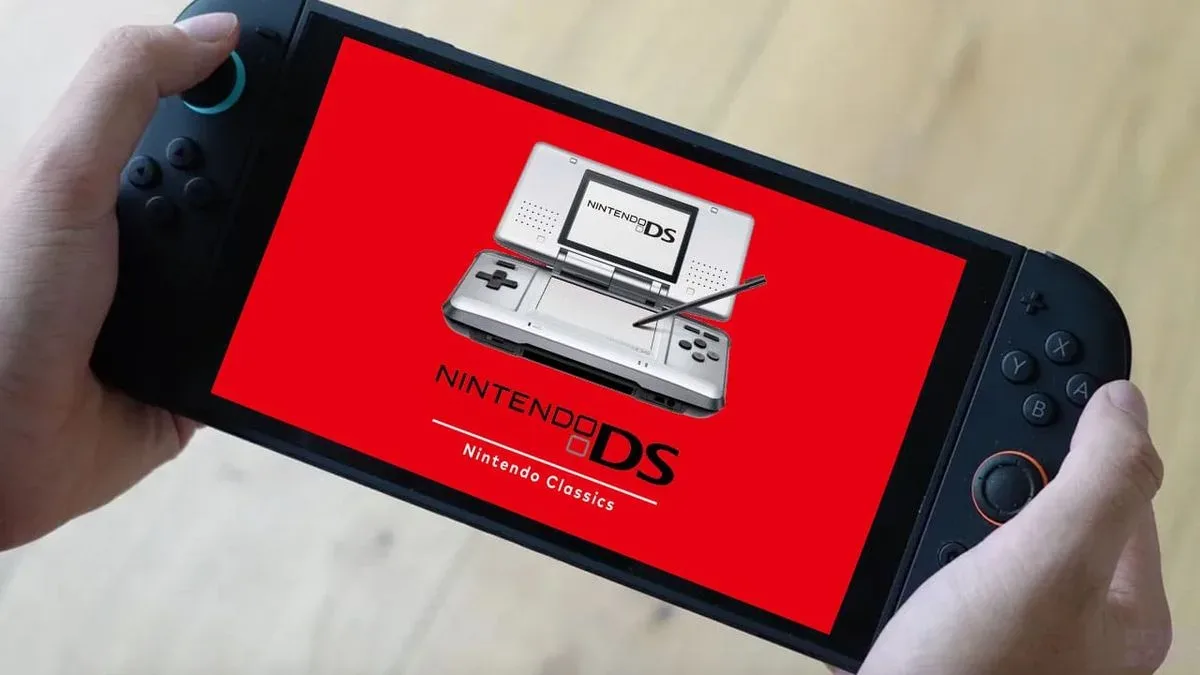
Nintendo has published patent material that is reigniting a familiar question: how could games built around two screens work on Switch-era hardware? The answer suggested by two recent filings is not necessarily a new plastic attachment. Instead, it could involve two independent consoles working together, with one machine providing video on a television and another operating as a touchscreen interface.
The filings have prompted speculation that an original Switch could potentially have a second life alongside Switch 2 hardware in a DS- or 3DS-style arrangement. That is an interesting possibility, particularly for players hoping that games designed around a top display and a touch-controlled lower display may eventually become accessible through a modern Nintendo service or release.
It is crucial, though, to separate what the documents describe from what Nintendo has actually confirmed. A patent is evidence of an idea or technical approach being considered and protected; it is not a promise of a product, a feature, a game library, or a release window. Nintendo has not confirmed DS or 3DS games for Switch 2 on the basis of these filings.
What the two patents appear to cover
The first publication, US20250312692A1, concerns transferring game video between two independent game consoles. The second, US20250319396A1, concerns using a second game console as a touchscreen and user interface.
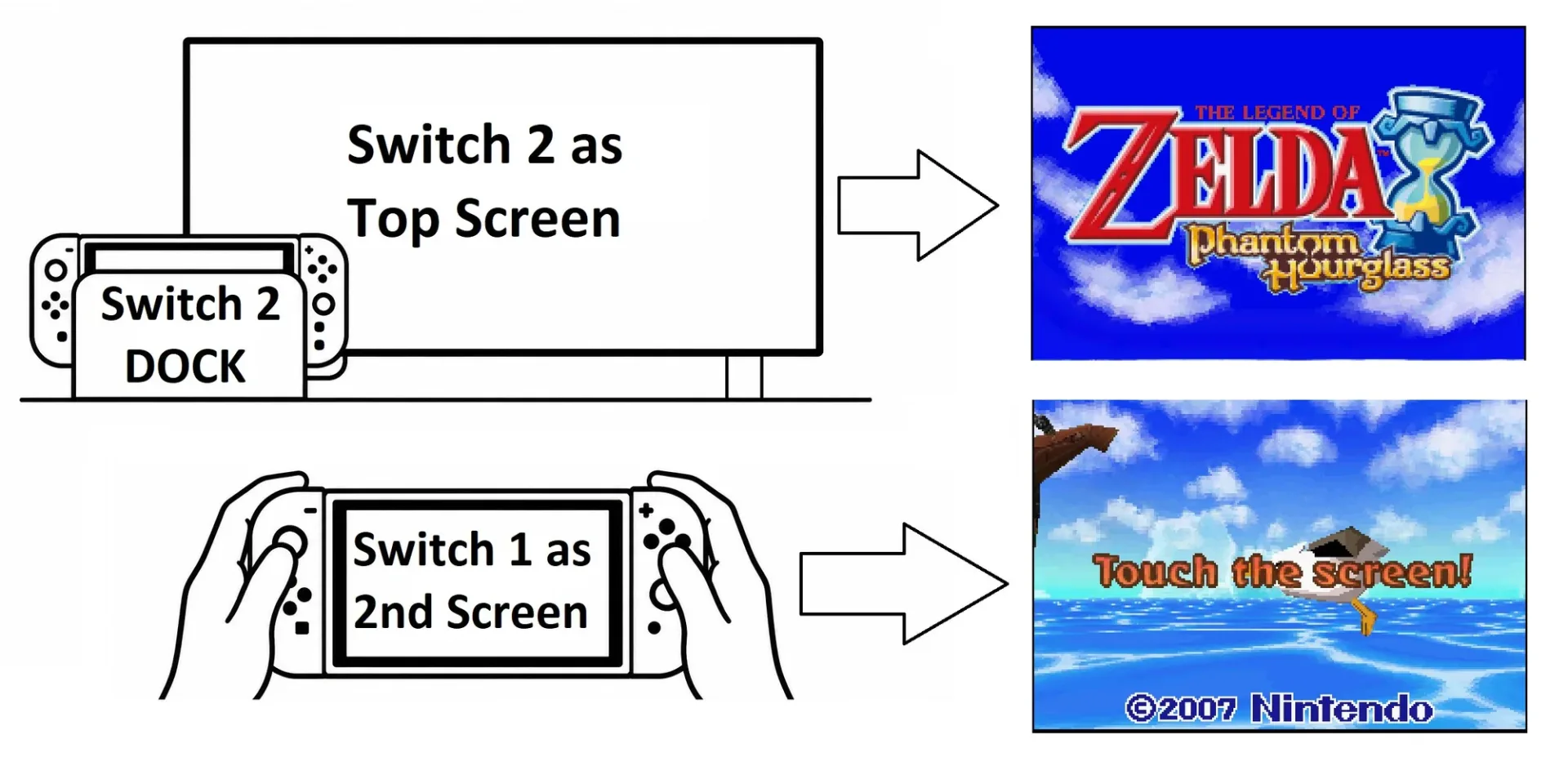
Read together, those broad descriptions create an obvious theoretical use case. A Switch 2 could run or present one portion of a game on a TV while a separate Switch serves as the lower, touch-enabled screen. In that arrangement, the display roles would resemble the split-screen design central to Nintendo DS and Nintendo 3DS software.
That does not establish that the patents were written specifically for DS or 3DS compatibility. Their concepts could have uses beyond legacy games: companion displays, asymmetric multiplayer, menu control, accessibility options, or entirely new software designs are all possibilities in the abstract. The DS comparison is compelling because of Nintendo’s history with dual-screen devices, but it remains an interpretation rather than a stated product plan.
Why two screens are a real design problem
For a conventional game, moving from one system to another is mostly a matter of performance, controls and display resolution. DS and 3DS games pose an additional issue: their interface was often designed around two separate displays with different jobs.
One screen could show the main action while the other handled maps, inventories, menus, puzzles, notes or touch input. In some games, the lower screen was not optional decoration. It was a core part of how the player navigated the world and performed actions.
Related coverage includes Nintendo Patents Renew Speculation About DS Games on Switch 2.
Phantom Hourglass, one of the games players have singled out while discussing this possibility, is an easy example of why that distinction matters. A touchscreen is more than a substitute for a button prompt when a game has been built around direct stylus-style interaction. Recreating that experience on one display can require compromises in screen layout, control mapping, or both.
A two-console arrangement could avoid at least some of those compromises. The television could act as the top screen, while the older Switch’s built-in display and touch controls could fill the lower-screen role. It would be a more literal recreation of the original hardware concept than simply placing two virtual screens side by side on a TV.
Technical terms: what the filings imply, and what they do not
Independent game consoles is the key phrase in the first patent description. It suggests hardware capable of operating separately while exchanging video information. That matters because a DS-style solution would need the two screens to remain coordinated: what happens in the game on one display must correspond promptly to what the player sees and does on the other.
Touchscreen and user interface refers to the player-facing controls and information layer. In this context, the second console would not merely mirror an image. It could potentially become the place where the player taps, reads menus, manages items or otherwise interacts with software.
There are still major unanswered questions that the patent descriptions alone do not resolve:
- Would both consoles need to be owned and paired by the same person?
- Would the original Switch need to be nearby, connected locally, or connected through another method?
- Could the system work only while Switch 2 is docked, or in handheld and tabletop play as well?
- Would the setup support every DS or 3DS title, or only software selected and adapted by Nintendo?
- How would controls, touch accuracy, display orientation and software compatibility be handled?
- Would the feature be part of a subscription offering, individual releases, or a different program entirely?
None of those details can be treated as settled. The filings identify technical ideas, not a consumer-facing instruction manual.
The old-Switch angle is what makes the theory notable
Players have long speculated about a physical dual-screen accessory for Switch hardware. That concept has obvious appeal: attach a second display and recreate the basic silhouette of a DS or 3DS. Nintendo also updated a patent connected to a dual-screen attachment in 2025, though that update has not led to an announced accessory.
The newly discussed approach is different because it could potentially use hardware many people already own. Rather than producing a dedicated second-screen device, Nintendo could theoretically assign the original Switch a supporting role. That would make the older system useful as an interface even if the newer console handled the TV output.
For consumers, the practical appeal is clear. A player who kept an original Switch would have a possible use for it beyond its existing library. For Nintendo, the arrangement could offer a route toward preserving the dual-screen logic of selected games without requiring every player to buy a separate, purpose-built peripheral.
But that same setup could introduce friction. DS systems were self-contained: pick up one device and both screens were ready. A two-console solution may require charging two machines, keeping them paired, arranging them comfortably near a television, and ensuring the touchscreen is positioned where it can actually be used. Those are not reasons the idea could not work, but they are the kind of everyday considerations that would determine whether it feels elegant or cumbersome.
Why patents should be read with restraint
Patent activity often attracts attention because it offers a glimpse into a company’s research, experimentation and contingency planning. It is not the same thing as a product announcement. Businesses may protect ideas that are never built, built much later, used in a different form, or applied to a purpose the public did not anticipate.
That restraint is especially important here because the speculation jumps across several steps: from two patents, to a dual-console setup, to DS and 3DS support, to a possible catalogue of games. Each step may be plausible, but none is confirmed by the filings alone.
The more grounded takeaway is narrower: Nintendo has documented concepts involving communication between separate consoles and the use of a second console as a touchscreen interface. Those concepts happen to align with one of the hardest challenges in bringing dual-screen software to a TV-oriented platform.
That alignment is enough to make the conversation worthwhile. It is not enough to declare that DS games are coming, that 3DS games are coming, or that an original Switch will be required.
What it could mean for DS and 3DS preservation
Dual-screen games create a preservation and re-release challenge because they were designed for a particular physical format. A modern platform can emulate the software itself, but the user experience still needs to make sense when the original screen arrangement, touch layer and controls are no longer present in the same way.
A second-console touchscreen could offer one route through that problem. It may allow a game’s main view and interactive panel to remain distinct rather than being squeezed into a single television display. In theory, that could make certain menu-heavy, map-driven or touch-focused games feel closer to their original structure.
There is no indication that Nintendo has committed to supporting any particular title, including Phantom Hourglass. Still, the technical idea helps explain why enthusiasts are paying attention. The question is no longer only whether older games can run on newer hardware. It is whether the hardware can preserve the unusual relationship between the player, two displays and touch input.
The discussion also arrives as the wider games business weighs the changing cost and role of dedicated hardware. For broader perspective on that pressure, see the debate around rising hardware costs and gaming beyond consoles. Nintendo’s patents do not answer that industry-wide question, but they do show why existing devices can be valuable as part of a larger ecosystem rather than simply becoming obsolete when new hardware appears.
What to watch for next
The next meaningful evidence would be an official Nintendo announcement, a system update that describes a second-console function, or a clearly identified software initiative built around the concept. Until then, the most sensible position is cautious interest.
The patents make a dual-device touchscreen setup technically imaginable, and the potential fit for DS-style play is straightforward. Yet a patent publication cannot reveal whether Nintendo intends to commercialize the method, how it would work in a living room, or which games—if any—would use it.
For now, original Switch owners do not need to treat their system as a guaranteed future DS accessory. They can, however, take the filings as one more reason the dual-screen question remains open. Nintendo’s older software has always been unusually tied to its hardware ideas, and these documents suggest the company is at least thinking about ways for separate consoles to share the work.