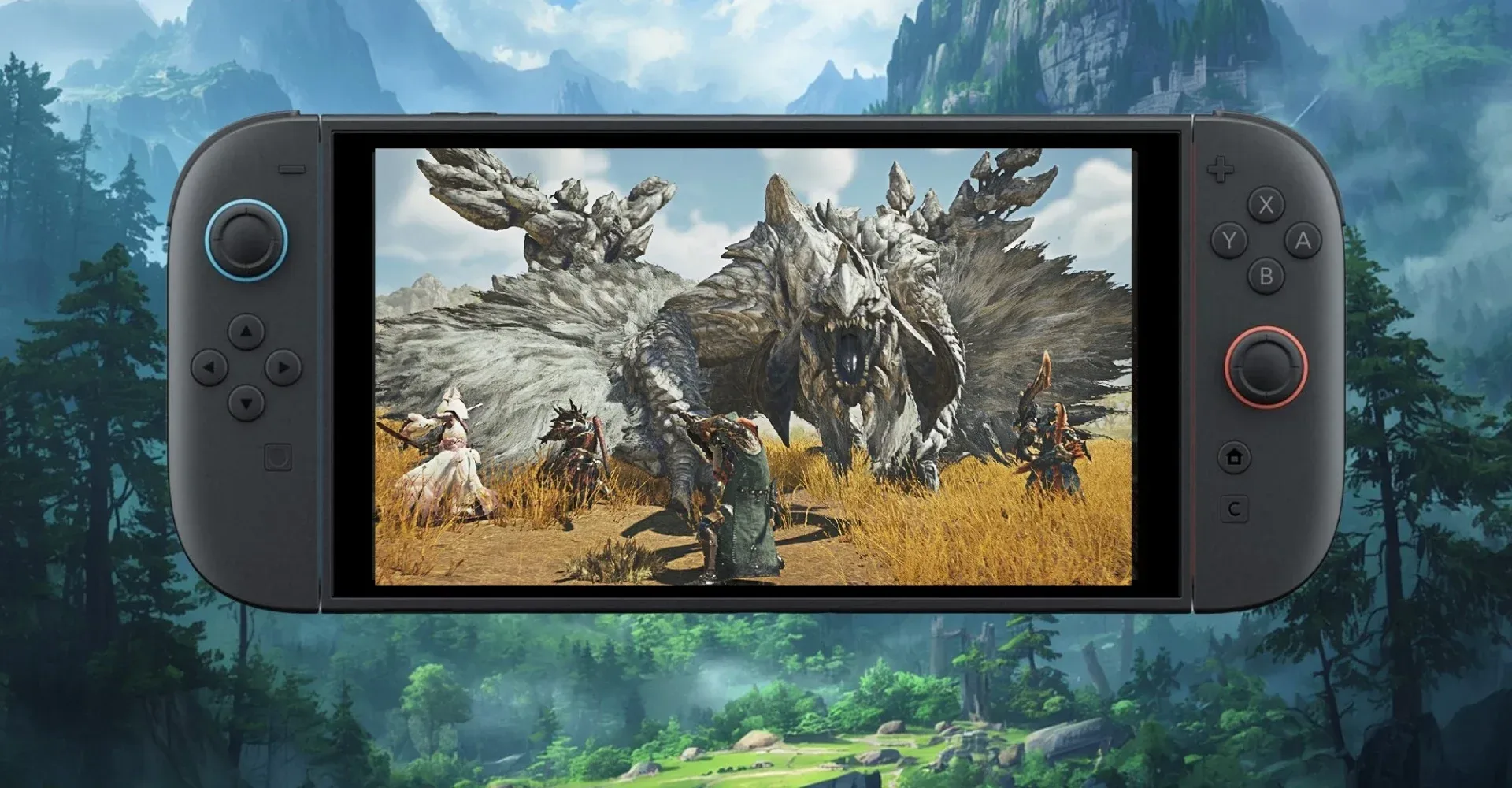
Monster Hunter Wilds is headed to Nintendo Switch 2 on December 4, and the development approach described by Capcom suggests this is more than a matter of reducing resolution and hoping the monster stays inside the frame.
Producer Genki Sunano says the team’s aim is to make Wilds feel natural on Switch 2 rather than deliver what amounts to a visibly diminished version of the game. That has meant examining the game piece by piece: its assets, visual effects, shaders, and underlying processing, then deciding which elements must remain intact and which can be rebuilt or adjusted without changing how a hunt feels.
The stated performance objective is a stable 30 frames per second in handheld mode, including during four-player online hunts. It is a consequential target for a game built around large environments, detailed action animations, and multiplayer encounters against enormous creatures. Capcom is not promising a vague sense of smoothness; it has put a specific baseline at the center of its Switch 2 plans.
A port built around decisions, not one global downgrade
“Port” can cover a very wide range of work. At its simplest, a port brings the same software to a new platform with limited platform-specific alteration. In practice, games designed for different hardware often need a much deeper pass. The Switch 2 edition of Wilds falls into that latter category based on Capcom’s description.
Sunano characterized the work as painstaking and, at times, seemingly endless. That wording fits the kind of optimization being discussed. A large game is not one setting that can be turned from “high” to “low.” It is a web of individual systems that consume processing time and memory in different ways: environmental assets, lighting methods, visual effects, animations, online play, collision checks, and the game logic controlling all of them.
Capcom says it evaluated the assets and internal processing behind each element to determine what had to be preserved and what could change while retaining the overall Wilds experience. The distinction matters. A version can look different in strictly technical respects while still maintaining the behaviors players depend on: readable attacks, reliable hit detection, responsive controls, and a consistent multiplayer hunt.
That is also why this work should not be judged solely through screenshot comparisons. Visual fidelity is important, but it is only one part of the promise. In a Monster Hunter encounter, players need to interpret movement, evade attacks, position themselves around teammates, and trust that the outcome matches what the game communicates. A technical compromise becomes much more serious if it affects that chain of information and response.
What a stable 30 FPS target means
FPS, short for frames per second, is the number of complete images a game produces each second. A stable 30 FPS target means the team is trying to keep the game delivering 30 frames every second instead of allowing frequent drops when a scene becomes demanding.
Related coverage includes Monster Hunter Wilds' Switch 2 Version Targets a Full Handheld Hunt, Not a Simple Downgrade.
Those demanding scenes are easy to identify from Capcom’s target: handheld play during four-player multiplayer hunts. Such a moment can bring together multiple hunters, a large monster, player actions, animations, visual effects, collision calculations, online synchronization, and the surrounding environment. Optimizing for that condition is different from optimizing an isolated early-game vista or a quiet moment between battles.
“Stable” is the key word. A frame-rate target is most useful when it holds up in the situations players actually care about. If a game slows sharply whenever effects build up or a team converges on a monster, the change is felt directly in the flow of combat. Capcom’s goal is therefore less about presenting a number on a specification sheet than preserving a dependable rhythm for portable play.
It is still a target rather than a final performance verdict. Capcom has described what it is working toward, not supplied final public evidence for every circumstance players will encounter. The December 4 release will be the point at which the finished Switch 2 version can be assessed on its own terms.
Shaders and effects are technical work with gameplay consequences
Capcom specifically points to rebuilding certain assets and shaders from scratch. A shader is a small program used in graphics rendering that helps determine how surfaces and effects appear, including how they react to light, color, texture, and other visual conditions. They can be central to a game’s atmosphere, but they also require computing work.
Creating more efficient implementations does not necessarily mean deleting everything that looks expensive. It can mean finding another way to achieve an appropriate visual result while requiring fewer resources. That is the balance Capcom says it is pursuing: preserve Wilds’ original appearance as closely as possible while making the version viable as a handheld experience.
Visual-effect assets received similarly careful treatment. Effects may include the flashes, particles, trails, bursts, and other on-screen feedback attached to attacks and impacts. The danger in altering them is not merely aesthetic. An effect can help tell a player where an attack landed, whether a move connected, or how close they are to danger.
For that reason, Capcom says revised effects were kept aligned with existing hitboxes and collision detection. A hitbox is the invisible area used by the game to decide whether an attack hits something. Collision detection is the wider system that determines when game objects intersect or interact. Keeping revised visual effects consistent with these underlying systems helps ensure that a changed effect does not misrepresent the physical rules of the battle.
That is a practical detail with outsized importance. The studio is not simply saying the Switch 2 version will retain the same broad premise. It says modifications to presentation are being made with the gameplay rules underneath them in mind. For an action game, that is the right priority: an attack must remain understandable, and the result must remain trustworthy.
Why handheld optimization is its own discipline
Wilds includes a big open world, a substantial number of bespoke action animations, and seamless online multiplayer for its major fights. Those features make its Switch 2 conversion notable because they are not easily separated from one another. A player roaming the world still needs the game to stream in the appropriate assets and operate its background systems. Entering a hunt adds combat, effects, animations, and multiplayer demands on top.
Capcom says it re-examined areas that had already been considered sufficiently optimized for home-console hardware. That is a useful reminder that “optimized” is not an absolute label. A technique that makes sense for one hardware target may need reconsideration on another, particularly when a game must offer a comfortable handheld experience.
The studio’s method has been to replace some visual techniques and internal processing with more efficient solutions, while concentrating resources on the areas that directly shape play. Those words describe a set of choices rather than a claim that no compromises exist. Indeed, rebuilding assets and changing technical approaches is evidence that compromises and tradeoffs are being actively managed. The objective is to make the tradeoffs as unobtrusive as possible to the player.
That approach also establishes a useful standard for expectations. The Switch 2 edition should not be treated as a carbon copy of versions made for other platforms at every technical level. Capcom’s stated ambition is more meaningful than that: it wants a version that preserves the character and function of the Wilds experience, especially where performance and combat readability affect the hunt.
The work could inform improvements beyond Switch 2
Capcom plans to use knowledge gained from this project as it develops performance improvements for existing platforms ahead of Monster Hunter Wilds: Ascendance. The producer emphasized that the direct benefits remain specific to work on Switch 2 ports, but the process may still affect how the team approaches development elsewhere.
That does not mean every Switch 2-specific solution will transfer unchanged to other hardware. The company has not made that claim. It does mean that close analysis of assets, rendering approaches, and internal processing can reveal opportunities that were less urgent when development was focused on home-console hardware.
For players on current platforms, the practical takeaway is modest but encouraging: the optimization effort is not being framed as a sealed-off technical exercise. Lessons from the handheld version are intended to contribute to planned performance work before Ascendance arrives.
Cross-platform development often produces this kind of feedback loop, where a platform-specific challenge encourages developers to reassess assumptions made earlier in production. Other releases likewise illustrate how a game’s arrival on a different machine changes the discussion around performance, audience, and design priorities; Dune: Awakening’s PS5 arrival is another example of a platform move becoming part of the game’s wider conversation.
What players can reasonably watch for on December 4
The Switch 2 version’s most important test will be whether it delivers on the conditions Capcom has identified. Players interested in the port will likely focus on handheld performance during four-player hunts, the clarity of effects amid heavy combat, the consistency of online action, and whether the game’s broad visual identity survives the rebuilt shaders and assets.
Capcom has set an ambitious framing: not a basic cut-down port, but a purpose-built version designed to preserve what makes Monster Hunter Wilds feel like itself. The development details supplied so far give that claim some technical substance. Assets have been reconsidered individually, some shaders and effects have been rebuilt, effect changes have been checked against hitboxes and collision detection, and resource use has been redirected toward gameplay-critical areas.
There is no need to pretend this process is effortless. Capcom’s own description stresses exactly the opposite. But the laborious nature of the work may be the most reassuring part of the story. A complex handheld version of Wilds was never likely to succeed through a single broad reduction in quality. It needed a long series of precise decisions about what players see, what the hardware processes, and what absolutely cannot change once a hunt begins.