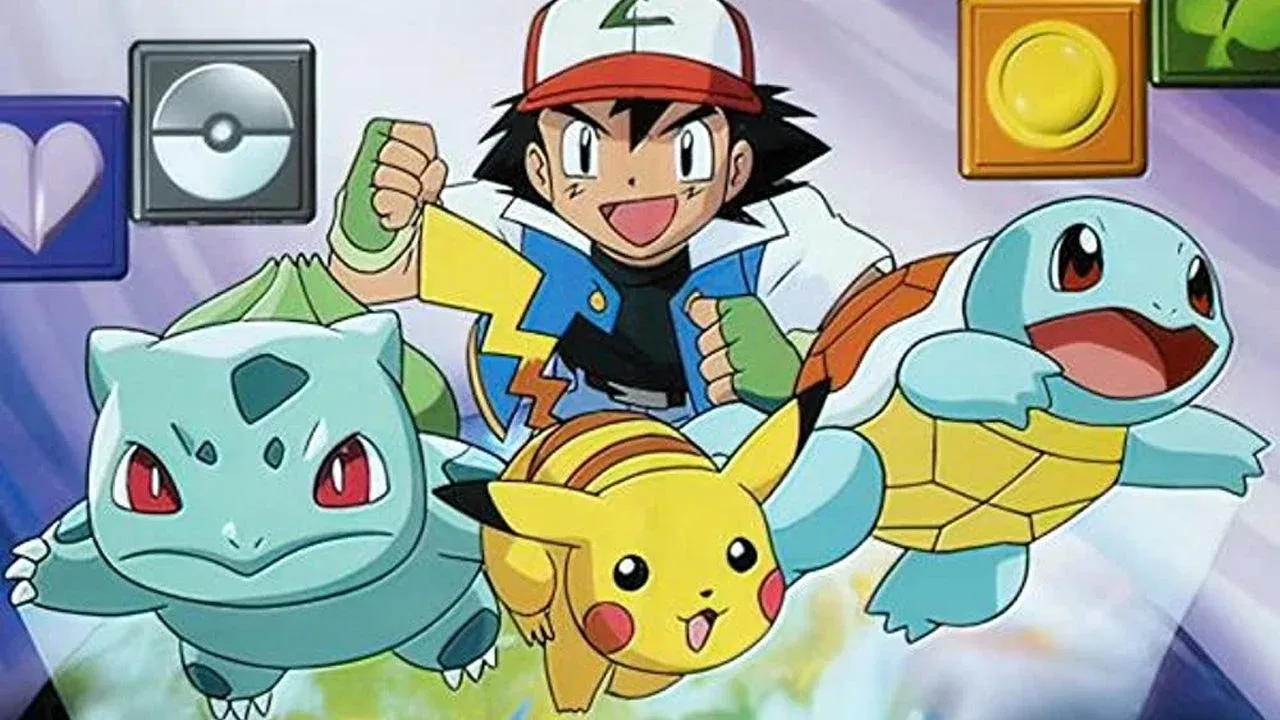
Pokémon Puzzle League is easy to remember as a Nintendo 64 puzzle game that rode the era’s enormous Pokémon momentum. Its deeper history is stranger: it began life as Panel de Pon 64, a sequel to a series whose Western identity had already been rewritten once before. Details recalled by former Nintendo Software Technology employee Ken Christiansen now give that second transformation a more practical shape. This was not simply a case of putting the hottest characters of the moment on an unrelated game. A development path that was reportedly bogged down in art work and approvals may have made a Pokémon reskin the expedient answer.
The resulting game arrived in North America in 2000 and Europe in 2001 as Pokémon Puzzle League. Japan did not receive it under that name, nor did the Nintendo 64 version emerge there as Panel de Pon 64. Yet the original version’s existence is more than a theoretical what-if. It was once referenced under the Panel de Pon 64 name in a small number of 1999 magazines, and an early Nintendo 64 prototype bearing that branding was found by YouTuber GamersManual roughly six years ago. As of 2026, that prototype still appears not to have been dumped publicly.
A franchise that was already used to changing costumes
To understand why the Nintendo 64 game’s shift stands out, it helps to start with the original. Nintendo and Intelligent Systems released Panel de Pon for Super Famicom in Japan in 1995. When the game headed west, it did not retain either its Japanese title or its fairy-tale presentation. It became Tetris Attack, with the world and cast swapped for elements associated with Super Mario World 2: Yoshi’s Island.
That localization decision established a peculiar but important pattern. The game system could travel while the setting, stars, and even public-facing identity changed around it. Later Japan-only Satellaview entries included Yoshi’s Panel de Pon, bringing Yoshi into the Japanese side of the family as well. The underlying puzzle lineage therefore has several names and visual identities, not because the mechanics themselves kept being discarded, but because Nintendo repeatedly found new ways to frame them for particular markets.
The year 2000 brought another key entry: a Nintendo 64 sequel co-developed by Intelligent Systems and the North American studio Nintendo Software Technology, often shortened to NST. In its earlier form, it was known as Panel de Pon 64. But its route to release was apparently proving awkward, especially on the visual side.
When art friction met a finished engine
Christiansen was working at NST at the time but says he was not part of the original Panel de Pon 64 team. He later contributed artwork once the project became Pokémon Puzzle League. His account is therefore a recollection from someone brought into the conversion rather than a claim to have directed the original production. That distinction matters, particularly because he qualifies some specifics as memory rather than certainty. Still, the picture he describes is remarkably clear.
He recalls the project having been brought to North America by people associated with Digipen in Vancouver and developed in cooperation with a Japanese developer. From nearby, he remembers hearing about repeated, painstaking revisions to visual details—down to a fluttering leaf that reportedly had to be redone. The broad implication is not that a single leaf halted an entire Nintendo 64 release. It is that visual assets were consuming time and requiring approval cycles while the project struggled toward completion.
Christiansen’s recollection is that the usable game engine was already in place, while the team continued wrestling with art elements and approval requirements.
Related coverage includes How Panel de Pon 64 Was Reworked Into Pokémon Puzzle League.
That division is central to the eventual outcome. If the engine and puzzle game were functioning, a wholesale mechanical restart was unnecessary. Replacing a setting that was difficult to finish with a more commercially powerful and tightly managed presentation could turn a protracted project into a shippable one. Christiansen remembers a producer advancing essentially that argument: reuse what works, dress it in Pokémon, and move the game over the finish line.
Whether that exact internal conversation happened in precisely those words cannot be independently established from one recollection, and Christiansen himself flags uncertainty on certain timing details. But his description gives a credible production logic to a branding move that can otherwise look completely arbitrary. Pokémon was exploding in popularity, and a completed or near-completed puzzle engine offered a foundation that could accept new character art, menus, and themed block imagery.
The art was not a simple sticker swap
Calling the change a reskin can make it sound effortless, as though someone dragged a Pikachu file over a title screen and rang a dinner bell. Christiansen’s account suggests a faster process than finishing the original art path, but not an ownerless or casual one. He and Adi Granov divided work on character-profile imagery and created icons for the game’s blocks and related interface elements.
Granov would later become widely known for Marvel work, including designing the Iron Man suit used for the films. At NST, however, the task was focused on making supporting art for a Pokémon-branded Nintendo 64 puzzle game. Christiansen says the team made pose sketches, then sent them to Pocket Monsters. Pokémon’s own artists returned the finished character art rather than allowing NST to finalize it itself, a choice Christiansen attributes to the need to keep the characters on model.
That approval structure reveals why the conversion should not be reduced to a marketing department slapping a logo onto existing software. The new version needed material developed for the game, submitted externally, and completed through Pokémon’s own art staff. It was a controlled handoff between an existing game engine and a valuable character property with strict visual standards.
Christiansen estimates the turnaround at around six months, while noting it may have been somewhat longer. Even at the upper end of that uncertainty, the speed makes more sense if the difficult portion of the project had already been solved: the game itself was there. Once final assets came back, they could be integrated into the engine rather than forcing the team to rebuild the design from scratch.
Why the name change matters to retro-game history
For players, Pokémon Puzzle League is its own release, with Pokémon presentation inseparable from how many people first encountered it. For preservation-minded fans, though, Panel de Pon 64 represents an alternate form of a released game whose original artistic direction may tell a different story about development. It is not merely an unreleased sequel in the abstract; it is a version that appears to have reached a prototype stage before being redirected.
The undumped prototype found by GamersManual remains especially tantalizing for that reason. If it eventually becomes available for study, it could help establish how much of the non-Pokémon presentation existed, how close it was to the retail game’s structure, and which elements changed during the conversion. Until then, it should be treated as a reported discovery rather than a version that the wider public can inspect firsthand.
The regional release history adds another wrinkle. North America got Pokémon Puzzle League in 2000, followed by Europe in 2001, while Japan received neither the Pokémon-branded Nintendo 64 version nor the original Panel de Pon 64 release. A Panel de Pon form of the game did later appear in Japan through the GameCube’s Japan-exclusive Nintendo Puzzle Collection in 2003. In other words, the game’s Japanese identity was not erased, but it reached that audience by a different platform and route.
A useful reminder that localization can reshape a game
The story is a sharp example of how localization and licensing can affect more than box art. The original 1995 game became Tetris Attack outside Japan. Its Nintendo 64 successor apparently passed through a Panel de Pon 64 stage before becoming Pokémon Puzzle League. Each change altered the characters, atmosphere, and way audiences understood the game, even as the puzzle design’s lineage persisted underneath.
It also complicates the usual assumption that a recognizable license automatically reflects an idea conceived at the very start. Sometimes a license is the thing that enables a nearly complete game to find its final form. In this case, the available account points to practical production pressure, a functioning engine, and an extremely popular brand converging at exactly the right—or perhaps most deadline-conscious—moment.
For more nostalgia on the unpredictable social contracts of competitive play, revisit the unwritten rules of couch multiplayer. Pokémon Puzzle League, after all, came from an era when a puzzle match could turn a living room calm into a tense negotiation over rematches, controller ownership, and whether a comeback was skill or sorcery.
What is established is the sequence: an early Panel de Pon 64 identity, a transition to Pokémon, NST art contributions, external Pokémon art approval, and a 2000 North American release. What remains uncertain is the exact shape of every internal decision and the prototype’s full contents. That uncertainty is not a flaw in the history. It is precisely what makes the surviving clues, recollections, magazine references, and undumped cartridge so compelling.