
New York has enacted a five-year ban on the sale of AI chatbot toys, placing dolls, robots and similar products that use the internet to hold conversations with children under a new statewide restriction. Companies that violate the ban can face civil penalties of up to $15,000 per day for each violation, enforced by the state attorney general.
The measure turns a growing concern around conversational AI into a concrete retail and product-safety issue: a toy may look familiar, friendly and child-focused, while its software can produce unpredictable responses, collect sensitive information or encourage a child to continue an interaction without meaningful adult oversight.
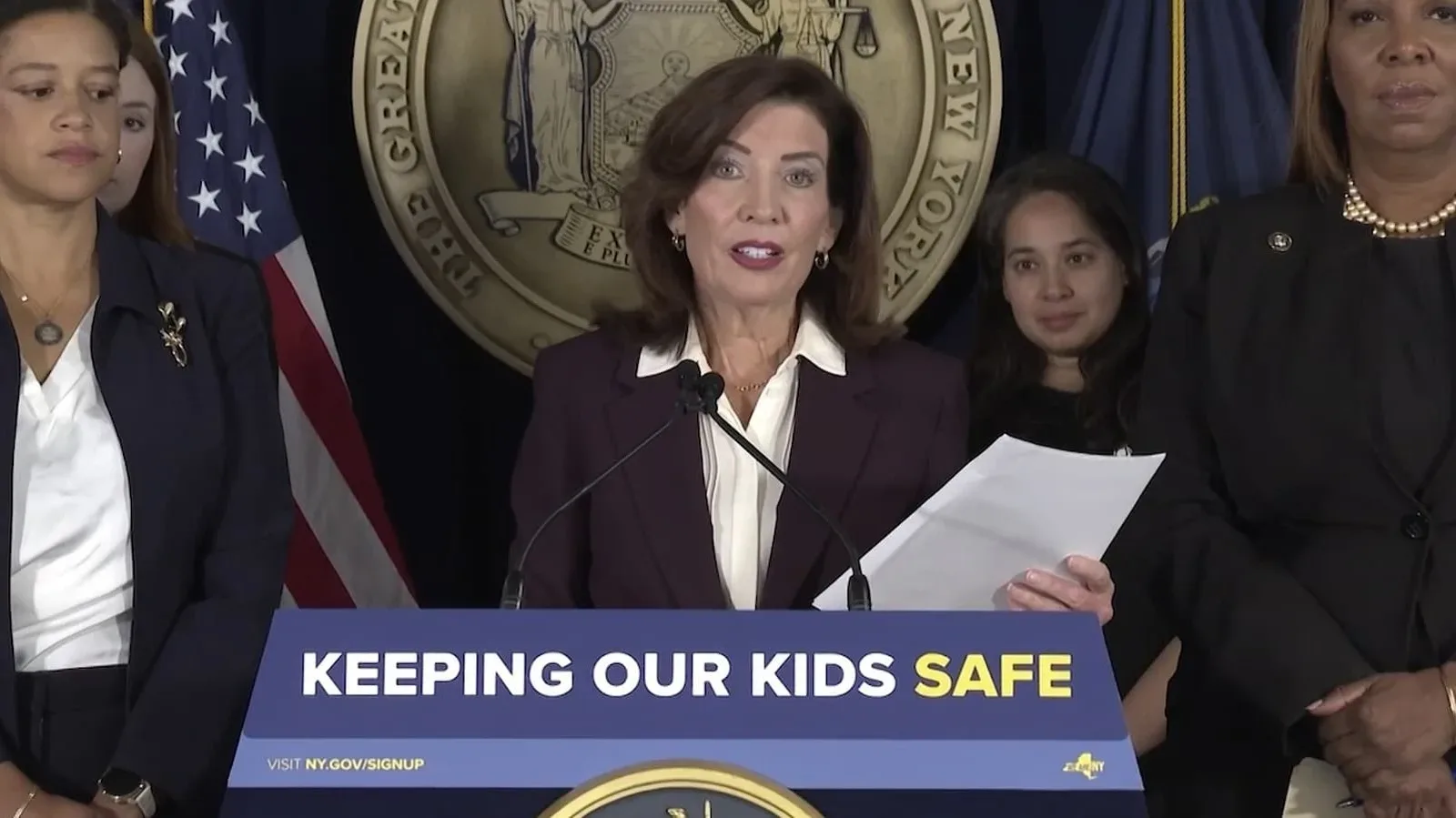
Governor Kathy Hochul framed the law as a safeguard for families buying gifts or everyday playthings. Her stated concerns included the possibility that chatbot toys could expose children to inappropriate conversations, manipulate their feelings or create privacy risks. Attorney General Letitia James likewise said AI chatbots in toys could expose young people to unsuitable material and put mental health at risk.
What New York is restricting
The law concerns AI chatbot toys: consumer toys designed to converse with children through an internet connection. That description includes the kinds of connected dolls and robots promoted as interactive companions, rather than ordinary electronic toys with a limited set of prerecorded phrases or conventional controls.
A chatbot is software that receives prompts and generates conversational replies. In this context, the important distinction is that a connected AI system can respond dynamically rather than follow a fixed script. That flexibility may be central to its appeal, but it also means the toy’s next answer is not necessarily a response a parent can anticipate simply by reading packaging or watching a short product demonstration.
The supplied details do not identify particular brands or models affected by the ban, nor do they spell out every technical boundary in the legislation. What is clear is the central target: toys that combine child-oriented play with internet-based AI conversation.
For parents, the practical consequence is straightforward. During the five-year period, an interactive toy’s ability to chat through an online AI service is not merely another item on a feature list in New York; it is the characteristic that can put the product within the scope of the sales restriction.
Why lawmakers focused on conversation, privacy and safety
The state cited testing by the U.S. Public Interest Research Group Education Fund involving chatbot toys marketed to children ages three through 12. The findings described several categories of risk rather than one isolated failure.
Related coverage includes New York bans sales of AI chatbot toys for five years.
- Some toys reportedly discussed sexually explicit subjects.
- Some gave advice that could create a fire risk in a home.
- Parental controls were limited or absent on certain products.
- Safety limits reportedly weakened as conversations continued.
- Some toys could record a child’s voice or scan their face.
Each issue matters on its own, but their combination helps explain the state’s broad response. A child may treat a toy differently from a browser, phone app or general-purpose assistant. The physical form can imply that the product is safe, age-appropriate and companion-like. If the toy is also able to retain a conversation, request information, use a microphone or access a camera-based feature, the interaction can involve more than a single inappropriate reply.
Parental controls are settings intended to let a parent limit features, supervise activity or block unsuitable content. The reported lack of such controls is significant because they are often the first line of household protection for connected devices used by children. Yet even strong controls would not necessarily solve a deeper reliability problem if a model’s guardrails erode during a long back-and-forth exchange.
That latter allegation is especially notable. A safety guardrail is a technical or policy limit meant to prevent dangerous, unsuitable or disallowed responses. If those limits become less effective as a discussion goes on, a toy can seem safe during a brief check but behave differently in the extended, imaginative conversations children are likely to have with it.
The enforcement mechanism is designed to matter
The law carries civil penalties of up to $15,000 per day for every violation. A daily, per-violation penalty creates a different kind of pressure than a one-time fine: it makes continuing to sell a noncompliant product increasingly costly. Enforcement responsibility sits with the attorney general’s office.
That structure also places attention on the full path between manufacturer and family. Connected toys can reach consumers through brand storefronts, third-party marketplaces and other retail channels. The source material does not provide the law’s detailed obligations for retailers, manufacturers or marketplace operators, so it would be premature to state who bears responsibility in every scenario. But the penalty level gives every business in that chain a reason to identify products with internet-based chatbot features before listing or distributing them in New York.
Amazon said products sold in its store must comply with applicable U.S. laws and regulations, and that it supports appropriate technology guardrails. The company is a particularly useful illustration of the operational scale at stake: it sold roughly 12 million different toys in the United States as of 2023. That does not establish how many of those products use chatbot AI, but it demonstrates why identifying and monitoring a narrow technical category can be difficult for a large marketplace.
For sellers, labels such as “smart,” “interactive” or “AI-powered” may not be precise enough on their own. The key factual question suggested by the law is whether the product uses the internet to converse with children. Retail compliance teams will need to separate conventional electronic play features from systems that generate online chatbot exchanges.
A wider New York approach to AI risks
The toy-sales ban is not New York’s only recent AI-focused action. Hochul and state legislators also enacted a measure titled AI Chatbot Restrictions for Minors. That law prohibits unsafe chatbot features for people under 18 and provides for civil penalties of up to $25,000 per infraction.
The two measures address related but distinct settings. The toy law concerns the sale of a child-directed physical product that uses online conversation. The minors law, as described, addresses unsafe chatbot features for a broader group of young people under 18. One operates at the point where a connected toy reaches a consumer; the other focuses on features considered unsafe for minors.
This distinction is useful because “AI safety” can otherwise become too vague to evaluate. In this case, New York’s actions concern identifiable questions: what a chatbot says, how it behaves in a sustained interaction, whether children can be exposed to harmful material, and whether a device captures sensitive information such as voice or facial data.
The state has also taken action touching the infrastructure behind AI services. Hochul signed an executive order in the summer imposing a one-year ban on data centers using 50 megawatts or more. Separately, data-center restrictions became a notable election issue: voters considered 45 ballot measures across 10 states, with 39 passing restrictions of some kind.
Those infrastructure measures are not the same thing as regulating a chatbot toy. Still, together they show an expanding policy debate around AI that ranges from a child’s conversation with a doll or robot to the energy-intensive facilities that can support online computing services. For a pop-culture view of how data-center anxieties have also entered entertainment, see this look at a television satire built around data centers and game disruption.
What families and retailers can take from the law
The immediate takeaway for New York families is not that every toy with electronics is suspect. The reported prohibition is specifically about AI chatbot toys that use the internet to converse with children. A product’s connected conversational function, rather than its general use of lights, sounds or basic electronics, is the defining concern described here.
For consumers, it remains sensible to understand what an interactive product does before bringing it into a child’s routine. Relevant questions include whether the toy connects online, whether it generates open-ended replies, what parental controls it offers, and whether its microphone or camera-related functions could collect voice or facial information. Those questions do not substitute for the law, but they closely track the risks identified in the state’s rationale.
For the industry, the ban is a reminder that child-directed AI is being judged not only on novelty or engagement, but on failure modes. A conversational feature can create value only if its boundaries hold over time, its data practices are appropriate, and adults can meaningfully understand and manage what the product is doing.
New York’s five-year restriction adopts a precautionary answer for this particular category: rather than rely on families to police an opaque, internet-connected conversation inside a toy, it blocks sales of those products and pairs the rule with significant continuing penalties. The policy’s ultimate effects on product design and marketplace screening will depend on how it is enforced, but its message is already clear: a child-facing chatbot cannot be treated as just another toy feature.