Marvel’s Wolverine has arrived with one particularly pungent point of debate: Logan’s tracking ability apparently makes finding objectives less like detective work and more like following a glowing, blue breadcrumb parade. Insomniac has now suggested it has heard the reaction, though players should treat any expectation of a specific fix as exactly that—an expectation, not a confirmed patch note.
James Stevenson, Insomniac’s director of marketing, wrote on X that the studio had been listening over the previous few days and that the team had been working in response to feedback. He followed that message with a joke about a smell coming from the kitchen and a wink. It is not an explicit promise to alter Wolverine’s scent trails, but the wording is difficult to separate from the conversation around the game’s conspicuous tracking effects.
That leaves the important details unanswered. There is no stated timeline, no list of planned changes, and no confirmation that an on/off setting is coming. But the message does indicate the studio is actively considering feedback at the moment the game launches.
Why the blue trails became such a big issue
The criticism is not simply that Wolverine has a way to track a target. A character with enhanced senses having a tracking mechanic is entirely understandable. The concern is how that information is presented.
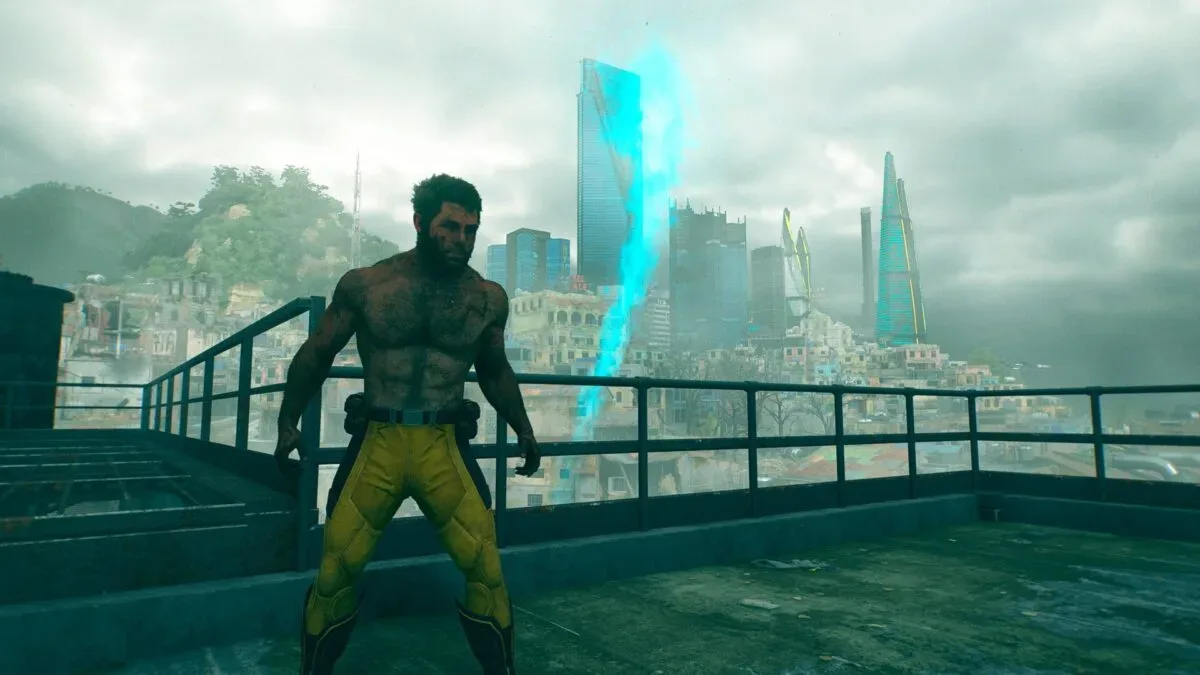
Reports describe large blue particle trails appearing to direct players to objects they are meant to locate. The effect is said to be exceptionally overt, laying out a route rather than supplying a clue that the player can interpret. In a game already characterized as linear and closed-world, that degree of direction can make a search objective feel automatic.
In design terms, this is a question of player guidance: the collection of visual, audio, environmental and interface cues used to keep someone moving through a game. Guidance is not inherently bad. It can prevent a player from getting lost, reduce frustration, clarify objectives, and make a game more approachable for people who do not enjoy opaque scavenger hunts.
But guidance has a trade-off. When an indicator continuously provides the answer and the route, the player has less room to observe the environment, make a deduction, choose an avenue to investigate, or even briefly feel uncertain. Those moments are often where a tracking fantasy becomes engaging. A player wants to feel as though they used Logan’s senses; a highly visible path can instead make them feel as though the interface did it for them.
That distinction helps explain why the response has been stronger than the subject might initially suggest. The trails have become a symbol of wider concerns that the game is too linear, too conservative, and too eager to tell players precisely what to do next.
Related coverage includes Marvel's Wolverine Team Teases a Response to Scent Trail Complaints.
Accessibility and choice are related, but not identical
The conversation also turned to whether the scent trails could be disabled. Initially, some players and reviewers wondered whether the prominent effect was an accessibility option. The conclusion reached in that discussion was that it could not be switched off.
It is useful to separate two ideas that can get muddled in arguments over settings:
- Accessibility support makes information available in forms that suit different needs, such as clearer visual direction for somebody who benefits from it.
- Optionality lets players tailor an experience, including reducing guidance if they want more self-directed exploration.
Those goals need not conflict. A robust option can preserve a clear route for players who want or need it while letting others reduce, hide, or otherwise alter the effect. The supplied information does not establish that such a setting is technically straightforward, nor does it confirm Insomniac will implement one. Still, it illustrates why an option has been the natural request: it would address a presentation complaint without assuming every player wants less help.
A possible adjustment also does not have to mean removing scent tracking. The studio could, in principle, consider changes to visual prominence, frequency, or when the route appears—but those are examples of the kinds of choices a developer might explore, not details that have been announced for Marvel’s Wolverine. Until the team provides proper patch information, it would be premature to promise any one solution.
A small clue, not a patch roadmap
Stevenson’s post matters because it acknowledges a very recent wave of feedback and frames the studio as acting on it. That is more meaningful than silence, especially when the criticism concerns a recurring gameplay system rather than an isolated oddity. Yet the kitchen joke is still a tease, not documentation.
Players hoping to hold off until the experience changes should watch for concrete follow-up: official patch notes, specific setting descriptions, and an indication of when any update will be available. Those are the details that would establish whether the studio is addressing the scent effect itself, broader feedback, or both.
The timing is also notable. The game’s launch follows its reviews by five days, and the feedback now being discussed formed during that review period. Rapid response can be encouraging for players, but it also raises a familiar concern: substantial quality-of-life questions ideally receive a clear answer before or at release, rather than becoming a post-launch scramble.
That concern has surfaced elsewhere when games move quickly from launch to corrective work. Warcraft III: Reforged’s Forsaken Kingdom launch, for example, highlights how speed can leave presentation and polish questions in public view. The parallel here is limited—there is no confirmed Wolverine patch or evidence that either situation has the same cause—but the practical lesson is familiar: clear communication about what is changing and when is often as valuable as the fix itself.
What a change could mean for players
If Insomniac does revise the scent-trail presentation, the impact could be larger than a cosmetic cleanup. Tracking sequences are repeated interactions. Even a small element becomes a major part of a game’s identity if it appears often enough. Making that element less forceful—or giving players a choice over its visibility—could change the perceived rhythm of exploration throughout the campaign.
For players who found the blue trails distracting, an adjustment could restore a measure of atmosphere and agency. For players who appreciated clear navigation, keeping an effective assist available would remain important. That is why a configurable answer would be attractive, although it remains only an unconfirmed possibility.
For now, the firm facts are narrow: Marvel’s Wolverine is launching, feedback has focused in part on its prominent scent guidance, and Insomniac’s marketing director has signaled that the team is listening and working in response to recent feedback. The smell joke strongly suggests the blue trails are on the studio’s mind. Whether they are about to be toned down, made optional, or left untouched while other issues receive attention is the part players still need Insomniac to clarify.