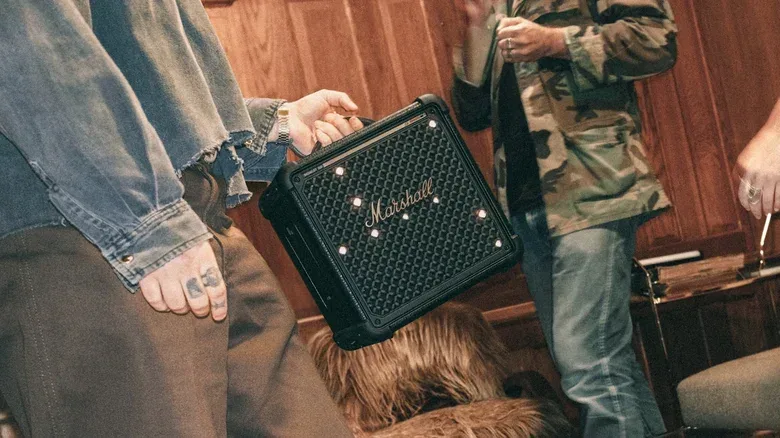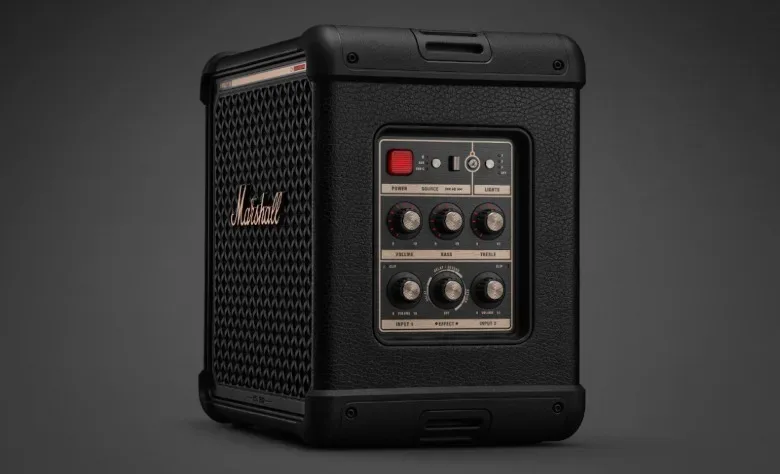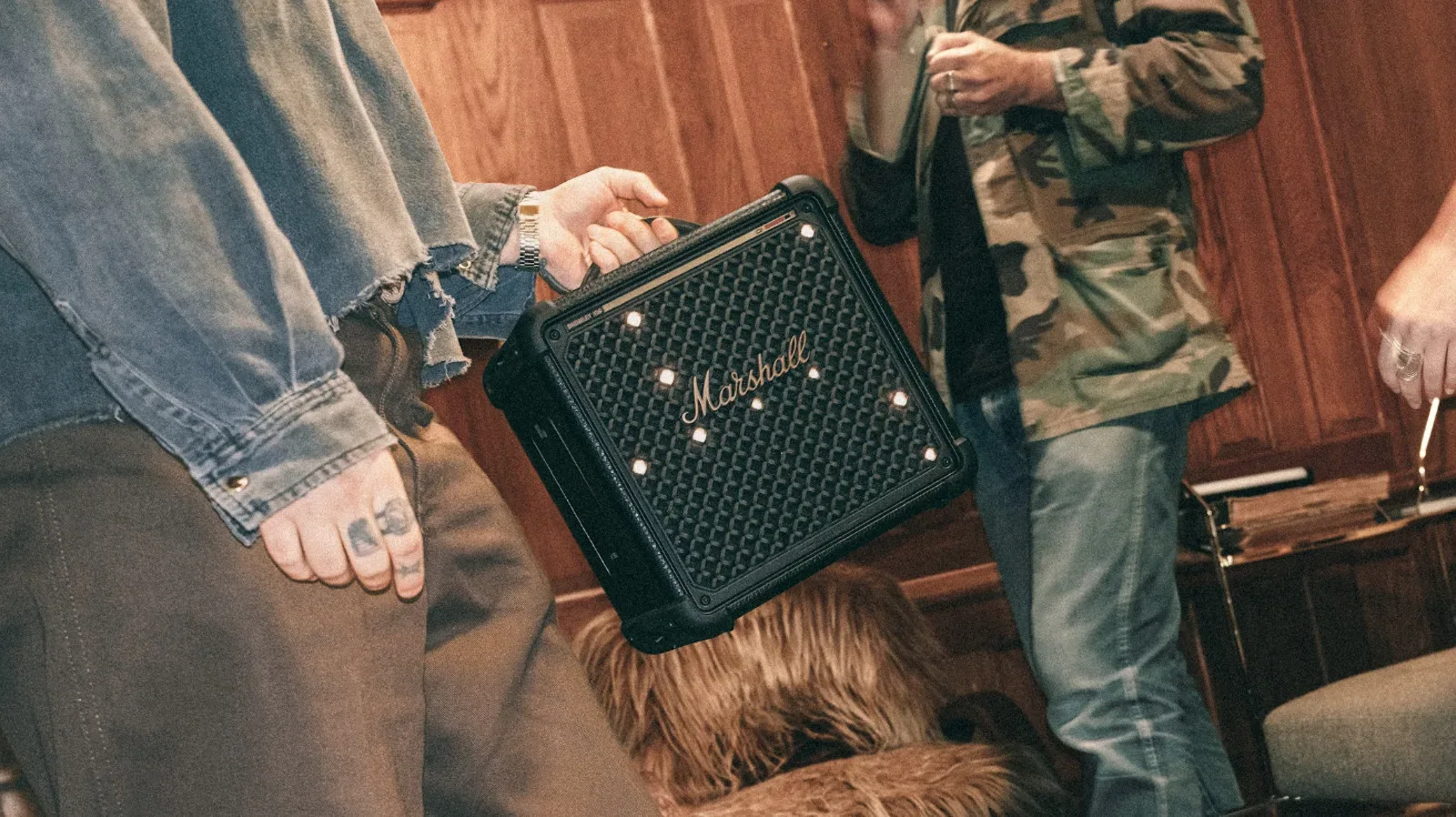
Marshall has added a smaller option to its Bromley party-speaker range with the Bromley 150, a 14-pound model positioned as the company’s smallest and most portable party speaker so far. It is roughly half the size of the Bromley 450, but it keeps several of the characteristics that make the range more than a simple Bluetooth speaker: true stereo audio, front lighting, physical equalizer controls, and separate inputs for microphones or instruments.
The Bromley 150 is available to preorder for $500, with shipments scheduled to begin October 13. That price lands $300 below the Bromley 450, while still placing the new model firmly in premium portable-speaker territory. Buyers considering it should therefore focus less on its smaller footprint alone and more on the particular mix of portability, long stated battery life, and hands-on audio controls it offers.
A party speaker built around moving it
The headline specification is the weight. At 14 pounds, the Bromley 150 is designed to be carried to the patio, rehearsal room, hangout, park, or wherever a compact sound system is wanted. It includes a built-in handle, an important practical inclusion for a speaker that may be comparatively small within its own line but is still intended to deliver party-scale sound rather than disappear into a backpack.
Its approximately half-size relationship to the Bromley 450 helps clarify the product’s place in the lineup. The 150 is not presented as a pocket-sized speaker or as a direct replacement for a small personal audio device. Instead, it is a downsized version of the larger Bromley proposition: a speaker meant to be more manageable when traveling while retaining dedicated party-oriented functions.
That distinction matters for gaming and entertainment setups, too. A portable speaker can be useful for a local multiplayer gathering, a tabletop session that needs music, or a casual outdoor screen setup. But the Bromley 150’s stated role is broader and more social than a TV or desktop soundbar. Anyone specifically trying to improve television or console audio will want to compare its connections and placement needs with alternatives designed for that job, including soundbars with gaming-focused features.
What the audio controls are for
Marshall says the Bromley 150 provides true stereo sound. In plain terms, stereo uses distinct left and right audio channels. That can give music a wider presentation than a single-channel, or mono, speaker when the listener is positioned sensibly in front of it. The eventual result will still depend on room layout, speaker placement and the recording, but stereo support is a meaningful specification on a speaker intended to serve a group rather than only someone sitting beside it.
The speaker also has a physical EQ. EQ, short for equalization, is a way to adjust portions of the sound spectrum, such as bass or treble, so the output better suits a listener’s preference or environment. The notable part here is that the control is on the hardware itself: the Bromley 150 does not require an app for those adjustments.
That approach has straightforward benefits. A guest can alter the sound without installing software, making an account, finding a phone, or negotiating who has control of the playlist device. It can also be useful in a quick setup where the speaker is being moved between rooms or taken outdoors. Physical knobs are hardly a magical cure for bad acoustics, but they can be a more immediate way to make a modest correction when music sounds overly boomy or too dull for the space.
Marshall has also included two inputs, each with its own volume knob, for microphones and instruments. Independent level controls mean a user can balance two connected sources separately rather than treating every plugged-in device as one shared volume signal. A microphone can therefore be turned down without necessarily changing an instrument’s level, or vice versa.
That does not make the Bromley 150 a full live-performance system, and the available details do not establish what kinds of events or setups it is best equipped to handle. Still, the inclusion suggests a more flexible role than music playback alone. Karaoke, informal announcements, a small jam session, or hosting duties at a social event are all the kinds of uses these controls are meant to accommodate.
Battery life is a major part of the pitch
Marshall rates the Bromley 150 for around 40 hours of battery life per charge. That is a substantial claimed figure for a portable party speaker and potentially one of the strongest reasons to consider this particular model. Long battery life is less about chasing a number on a specification sheet than avoiding a routine disruption: a speaker that can last through repeated gatherings without immediately returning to a wall outlet is inherently easier to treat as mobile equipment.
As always, “around 40 hours” should be read as a claim rather than a universal promise for every scenario. Listening level and use of the speaker’s other functions can affect how a battery holds up in real use, and no fuller testing detail is available here. Buyers who need dependable coverage for an all-day event should not assume the maximum estimate automatically maps to every volume level or party environment.
Even with that sensible caution, the stated endurance fits neatly with the device’s built-in handle and reduced size. Portability involves more than pounds and dimensions. It also means not having to plan a day around the nearest plug socket. A speaker that is easy to carry but needs frequent charging is only partly portable; a speaker that can plausibly stay untethered for long stretches is closer to the purpose Marshall is selling.
Prepared for a little outdoor mess, not every disaster
The Bromley 150 is described as both dirt-resistant and splash-resistant. Those are useful qualities for the environments where a party speaker is likely to wind up: a backyard, a garage, a picnic area, or a busy room where drinks and cables may coexist with less grace than anyone intended.
There is an important language difference here. Splash resistance means protection against splashes; it does not mean that a device is invulnerable to water exposure. Likewise, dirt resistance should be treated as a durability-oriented convenience, not an excuse to abandon basic care. The product details supplied do not provide a rating or a broader explanation of its protection limits, so buyers should avoid assuming resistance extends to rainstorms, submersion, or every form of rough handling.
The lights across the front continue the recognizable Bromley look, paired with Marshall’s familiar visual styling. That design will appeal to shoppers who want the speaker to be part of the room’s atmosphere rather than a plain black box hidden near a wall. It also reinforces the product’s intended personality: this is gear made to be seen at a gathering, not merely heard.
Price and the alternatives inside Marshall’s range
At $500, the Bromley 150 asks buyers to pay for a specific balance. It is cheaper than the $800 Bromley 450 by $300, while preserving the Bromley line’s party-first identity in a lighter, smaller package. The central question is not merely whether $500 is less expensive than $800. It is whether the reduced bulk is valuable enough to make the 150 the more usable speaker for the buyer’s own space and plans.
Marshall’s $250 Stockwell III is the lower-cost comparison mentioned alongside the new model. However, it is not a party speaker, so it is likely to offer less volume than Bromley speakers. That makes it a different proposition rather than a clean substitute. Saving money could make sense for listeners who want portable Marshall audio without the demands of filling a party setting, but shoppers seeking the Bromley 150’s louder social-use role should not treat the two products as identical categories.
- Bromley 150: $500, 14 pounds, marketed as Marshall’s smallest and most portable party speaker, with true stereo sound, physical EQ, lighting, two independently controlled mic/instrument inputs, dirt and splash resistance, a handle, and a claimed battery life of around 40 hours.
- Bromley 450: $800, making the Bromley 150 $300 less expensive and roughly half its size.
- Stockwell III: $250, a less costly Marshall portable option that is not positioned as a party speaker and is likely to offer less volume than the Bromley line.
Who the Bromley 150 makes sense for
The Bromley 150 appears most compelling for someone who regularly wants a speaker for groups but does not want the hassle of transporting a larger party-speaker model. Its blend of a carry handle, 14-pound weight, dirt and splash resistance, and the claimed 40-hour battery life points toward people who value setup flexibility. The physical EQ and two independently adjustable inputs make it more appealing to users who actually expect to interact with the speaker during an event, instead of simply pairing a phone and leaving it alone.
It may be less persuasive for listeners whose main goal is low-cost portable music, since the Stockwell III sits at half the price. It also should not automatically be the answer for a dedicated console, PC, or television setup just because it can play loudly. Those uses require their own consideration of inputs, features, and the practical realities of placing a sizable portable speaker near a display.
For the intended buyer, though, the Bromley 150’s case is fairly clear. Marshall is offering the aesthetic and party-centric controls of its Bromley range in a package that should be easier to pick up and take along. The $500 price means it will need to earn its place through those conveniences, but the combination of stereo sound, independent input control, app-free EQ adjustment and extended claimed battery life gives the compact model a more defined purpose than “the smaller one.”