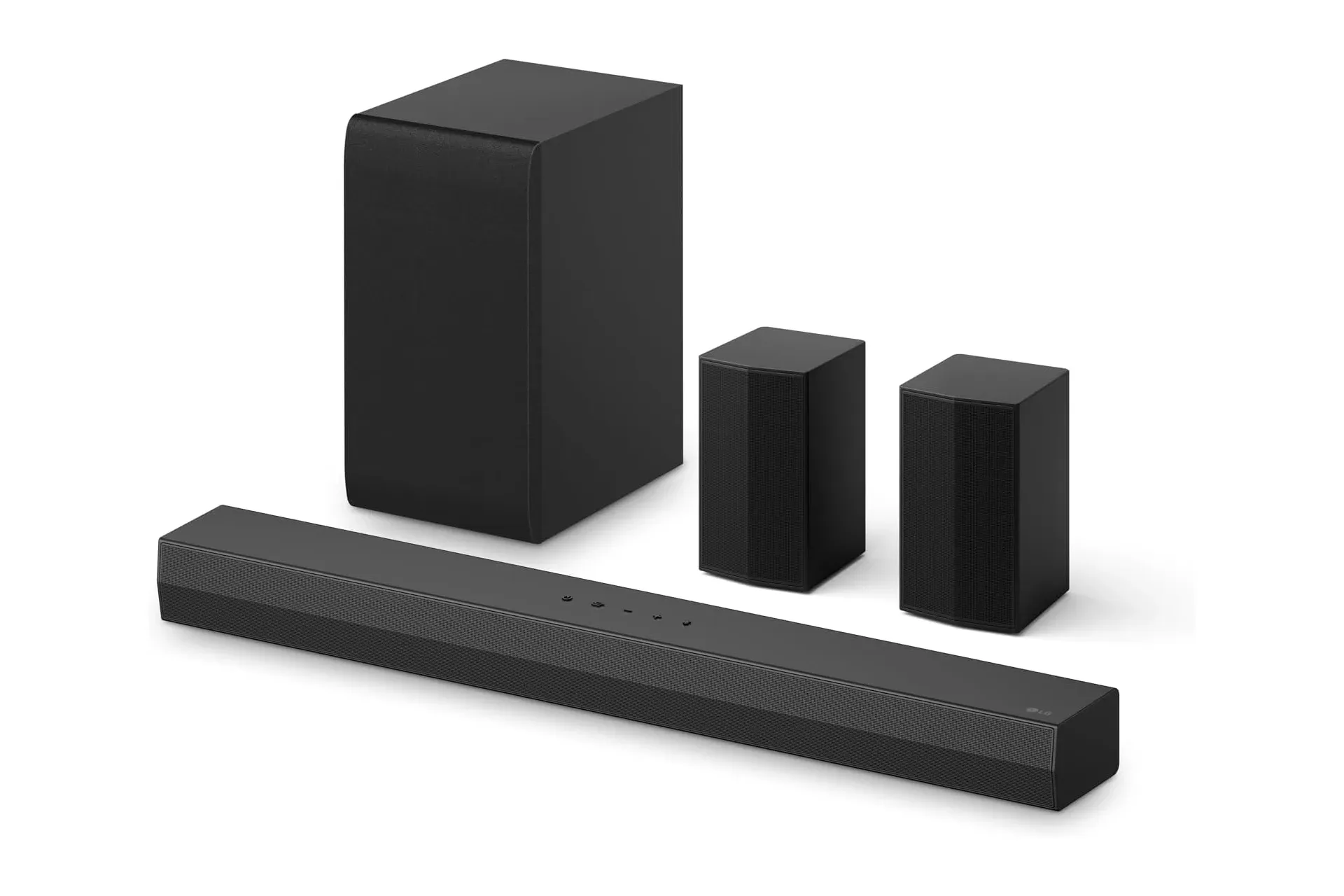
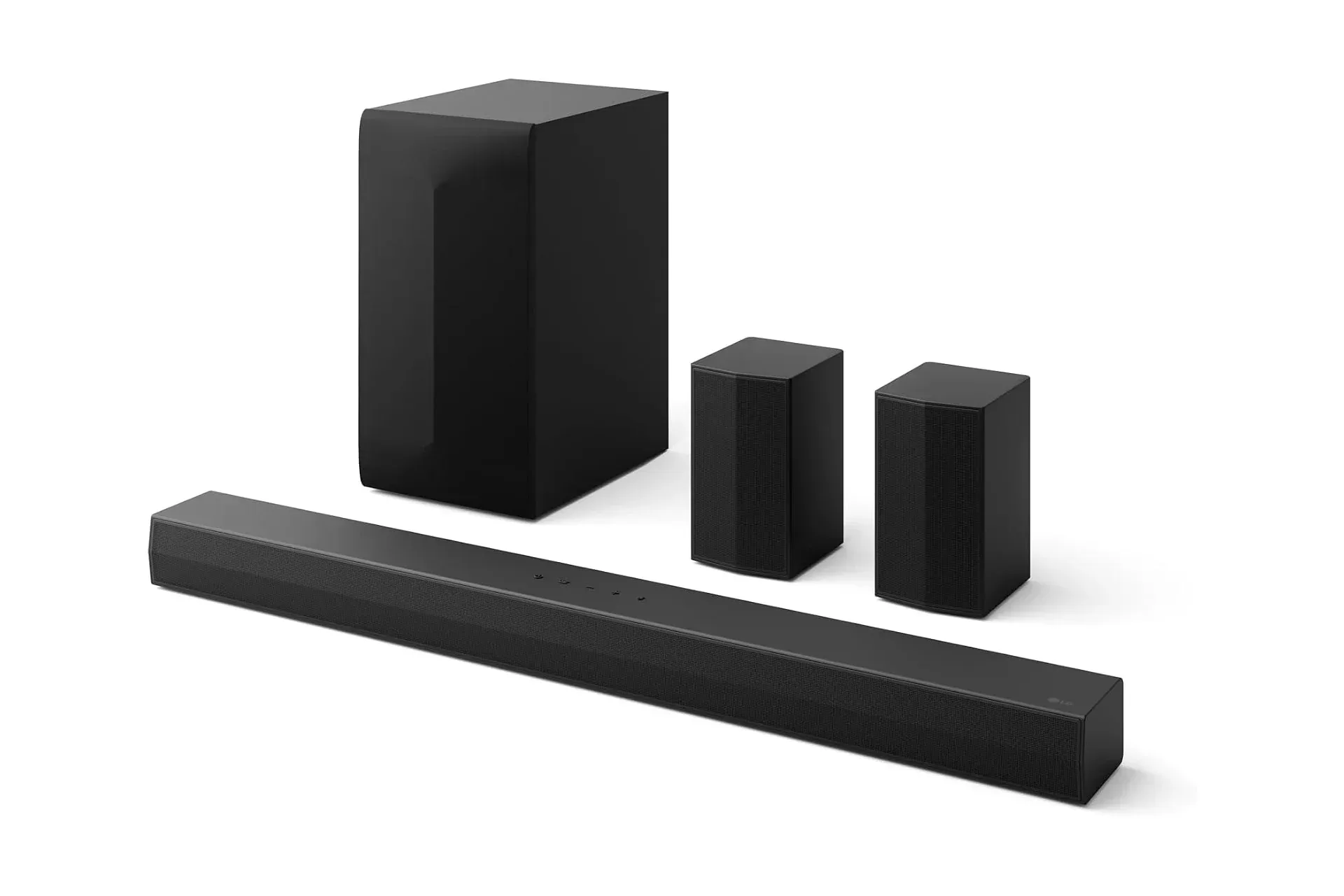
A big TV can make a game world look enormous, but its integrated speakers are often asked to do a job they were never physically positioned to do: project distinct voices, music, effects and low-frequency impact from a slim enclosure behind or beneath the display. An LG 5.1-channel Dolby Audio sound system is currently listed at $250, a $150 reduction from its usual $400 price. The package includes a front soundbar, two rear speakers and a subwoofer.
That makes this more than a conventional single-bar upgrade. The advertised arrangement provides separate front-left, front-right and center channels in the soundbar, plus rear-left and rear-right speakers, while the subwoofer handles the deep bass component. For players building a living-room setup around a console or TV-connected PC, the value proposition is chiefly about separation: putting different parts of a soundtrack in different speaker positions instead of pushing everything through a TV’s small built-in drivers.
The rear speakers and subwoofer connect wirelessly to the main soundbar. That does not eliminate every cable in a room—each component still needs its own power arrangement—but it avoids the particularly awkward prospect of stretching speaker wire from the TV wall to the seating area. For renters, shared living spaces and anyone who does not want to conceal cables inside walls or ceilings, that is a practical installation advantage.
What “5.1-channel” means in this setup
The numbers in 5.1 describe the channel layout. The “5” refers to five full-range speaker positions: left, center, right, rear-left and rear-right. The “.1” refers to the low-frequency effects channel delivered by the subwoofer. It is not simply shorthand for making a soundtrack louder. Its purpose is to divide the mix across a broader set of speakers.
In this LG package, the front soundbar supplies three of those positions. The left and right channels carry much of the front-stage material, while the center channel is principally used for dialogue. The separate rear speakers add the two back positions for a surround effect. The subwoofer is intended to add deep, weighty bass that a television’s built-in speakers generally cannot reproduce in the same way.
That division can matter in games even when the presentation is not trying to imitate a cinema. A busy action sequence can combine character dialogue, score, gunfire, engines, environmental sounds and interface effects. With TV speakers, those elements must compete in a very small acoustic footprint. A multichannel setup gives the mix more physical places to go. Depending on the game and its audio mix, sounds designed for the rear channels can come from behind the player rather than joining the entire soundstage at the screen.
There is an important limit to keep in mind: a 5.1 system can reproduce a 5.1 mix through the relevant speakers, but the available information does not establish how any particular console, TV, game, app or connection will be configured. Buyers should verify their own hardware’s audio-output options and the supported setup details before purchasing. The bundle’s channel count describes the speaker system, not a guarantee about every device connected to it.
The center channel is the quietly useful feature
The most immediately noticeable benefit for many people may not be explosions or bass. It may be intelligible speech. In a typical surround layout, the center channel is largely dedicated to dialogue. That lets voices occupy a more focused part of the mix rather than fighting directly with left- and right-channel effects.
LG also says the individual channel volumes can be adjusted. In practical terms, that can give listeners a way to raise the center-channel level when dialogue feels buried, without raising every other channel by the same amount. That distinction is useful for story-driven games, cutscenes, sports broadcasts and films where the spoken lines are important but the surrounding effects can become intense.
It is also a more targeted answer to the familiar “turn it up, then immediately turn it back down” problem. Raising overall TV volume increases everything: dialogue, music, sudden impacts and the rest. Separate channel adjustment is designed to make the balance more controllable. It will not change the underlying mix created for a game or film, but it can help tailor the system’s playback to a room and a listener’s priorities.
Rear speakers change the placement question
Soundbars are popular partly because they keep a TV area simple. A 5.1 bundle asks for a little more planning, because the rear speakers need a sensible location behind the listener to create the intended surround field. The wireless link addresses the long speaker-run problem, but placement still matters. If the rear units are left at the front of the room, the system cannot provide the same back-channel effect that their names imply.
That is why this deal is likely best suited to a setup with at least some space around the main seating position. A dedicated den is the obvious fit, but a regular living room can work if the couch is not pressed tightly against a wall and the rear speakers can sit to the back-left and back-right. The supplied information does not provide mounting options, dimensions or detailed placement guidance, so those are sensible details to check against the room before treating the bundle as an automatic fit.
The subwoofer deserves similar consideration. Its job is to add low-end presence, giving effects such as impacts, engines and musical bass more body. But a subwoofer is a physical component that needs a place in the room, unlike a basic TV speaker solution. A prospective buyer should make sure there is floor space near the entertainment area and consider nearby neighbors or sleeping household members if louder bass is a concern.
A gaming upgrade that starts with the room, not the screen
Home-theater spending often follows the screen-size-first logic: buy the biggest TV that fits, then make do with its audio. The case for this LG bundle is that a soundtrack has a meaningful role in the overall experience too. Visual detail tells players what they can see, while the sound mix can establish direction, pace, atmosphere and the weight of on-screen action.
A surround package does not need to be framed as a replacement for a good headset. Headphones remain useful for private sessions and can be essential where noise is a concern. A speaker system instead serves a different kind of play: shared sessions, couch co-op, watching a friend play, or settling into a single-player game without wearing anything. It is also relevant to TV and movie viewing, particularly where dialogue clarity has become a frustration.
At $250, this LG system’s pricing is the headline. The stated discount is 38% off the usual $400 price, or $150 less. Deal pricing can change, and the available details do not specify an end date, so anyone interested should confirm the current listing, the contents of the package and compatibility information at the time of purchase.
The broader setup decision still comes down to priorities. Someone who only wants a little more volume from a small TV may prefer a simpler solution. Someone looking for a fuller room-based sound field, however, is getting the components that define 5.1 playback in the box: front channels, a dialogue-focused center channel, rear speakers and a subwoofer. For a TV that has already become the center of a gaming space, that is a more substantive audio change than adding a standalone bar alone.
For more display-side buying context, see our look at TV deals that could matter for gaming setups. The key lesson applies on either side of the screen: evaluate the full system. A larger picture can make games more immersive, but better channel separation, rear effects and clearer dialogue can make the room feel more involved in what is happening on it.
Shop the products
Check current price, model and availability at the retailer.