A living-room audio upgrade can be a much bigger change to game nights and movie sessions than its compact soundbar footprint suggests. LG’s S40TR 4.1-channel home-theater bundle is currently listed at $200 for a limited time, a $50 reduction from its stated $250 regular price.
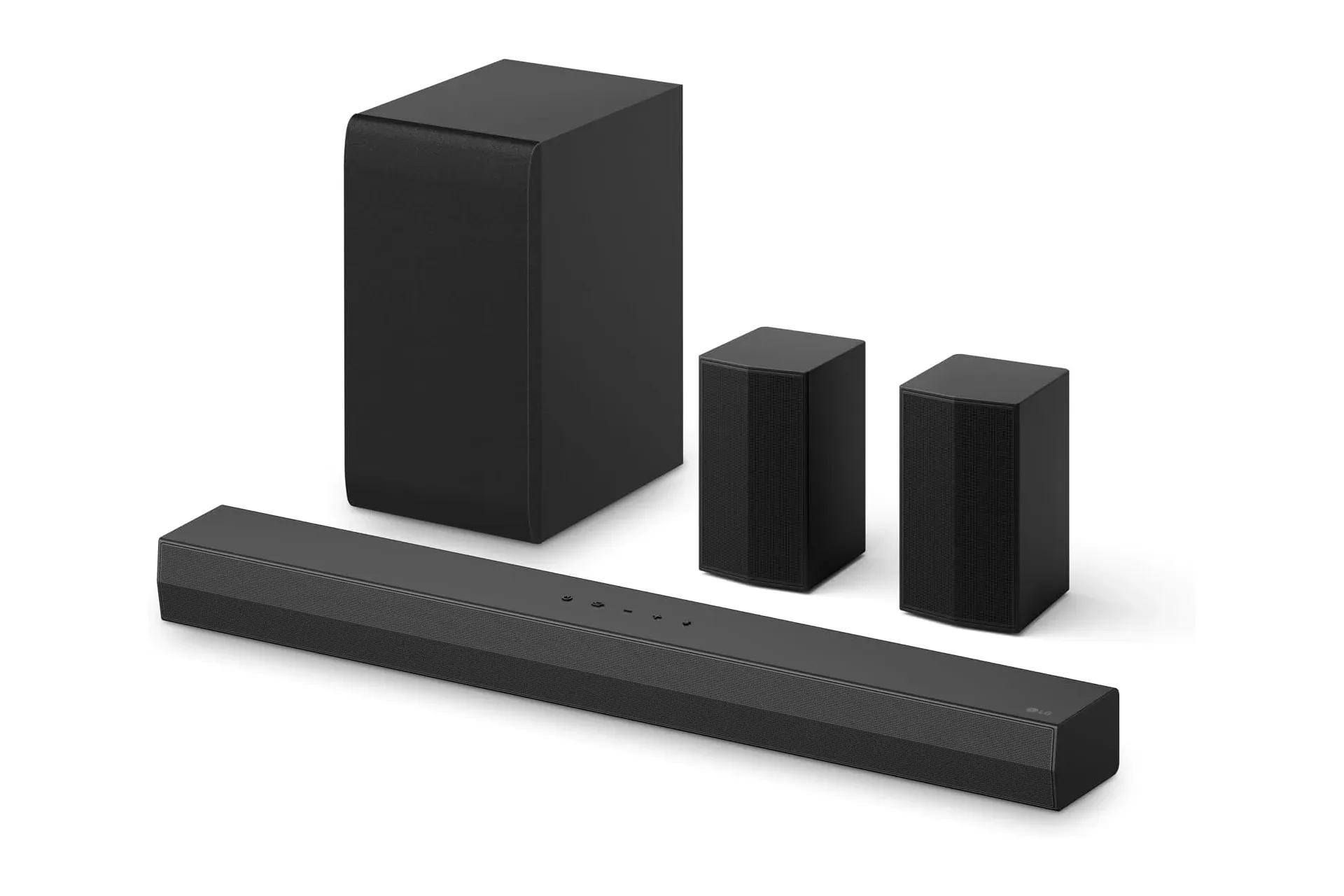
The important detail is that this is not presented as a soundbar alone. The bundle includes the soundbar, a wireless subwoofer and two wireless rear speakers. That makes it a more substantial proposition than a virtual-surround bar: the rear speakers are intended to put actual speakers behind the viewer, rather than relying solely on audio processing to create the impression of sound coming from the rear of the room.
For players who have spent their hardware budget on a TV, console and controller, a $200 package is a notable entry point for a multi-speaker setup. It may be especially worth considering for households where the biggest irritation is not necessarily a lack of volume, but trouble following speech over music, effects and general on-screen noise.
What the 4.1 label means
“4.1” is a channel-count label. The “4” refers to four main audio channels, while the “.1” identifies the dedicated low-frequency effects component supplied here by the subwoofer. In practical terms, this LG package divides the job among a front soundbar, two rear speakers and a separate unit designed to carry the deeper bass material.
That separation is the core distinction between this setup and a TV using only its built-in speakers. The soundbar handles the front presentation, the rear pair can supply sound from behind the seating position, and the subwoofer is meant to add impact to bass-heavy material. Explosions, engines, music and other low-end effects are the obvious beneficiaries, but the broader purpose is to avoid asking a television’s small integrated speakers to do every part of the soundtrack at once.
It is also useful to separate surround sound from virtual surround. Virtual surround uses processing and speaker placement to suggest a wider or more enveloping field. It can be a sensible answer where space is limited. A system with discrete rear speakers, however, has physical speakers at the rear of the room. This LG bundle is framed around the latter approach because its two rear units are part of the package.
Wireless placement could be the practical draw
The subwoofer and rear speakers are described as completely wireless. The potential advantage is less about the word “wireless” as a spec-sheet trophy and more about room layout. Rear speakers are often where a surround plan becomes inconvenient: getting a cable from the front TV area to the back of a sofa can mean crossing open floor space, routing wire around a room or accepting a visibly untidy setup.
LG’s approach is positioned as a way to make placement easier across different room shapes and sizes without the need to run and hide those cables or set up a special receiver. That does not make speaker placement irrelevant—rear speakers still need a sensible place in the listening area—but it can remove one of the most immediate barriers to trying a multi-speaker arrangement.
The wireless subwoofer similarly gives owners more flexibility than a front-only wired layout. The supplied information does not set out connection methods, exact placement requirements or room-calibration options, so prospective buyers should avoid assuming those details. The supported case is simpler: the package is designed to reduce cable-management friction while providing separate bass and rear channels.
Dolby Audio, DTS Digital and why dialogue is central to the pitch
The S40TR is described as supporting Dolby Audio and DTS Digital. These names refer to audio formats and processing ecosystems commonly associated with home entertainment playback. Their presence indicates that the system is built to handle those forms of audio output; it should not be read as a promise that every film, show or game will use the same mix or deliver the same result in every room.
The more immediately relatable feature is Clear Voice Plus. LG says the feature analyzes audio output to improve voice clarity and deliver more realistic sound to the center speakers, where dialogue commonly goes. The goal is straightforward: make conversations easier to understand when other parts of a soundtrack compete for attention.
Dialogue clarity is a practical quality-of-life issue, not a tiny enthusiast concern. Modern TV viewing can involve quiet voices set against background score, crowd noise, environmental effects or action sequences. Built-in television speakers can leave speech sounding muffled or blended into that activity, pushing viewers toward subtitles even when they would rather not use them. A dedicated system with a dialogue-oriented mode could be a meaningful upgrade if that is the household’s main complaint.
There is a useful distinction here between a feature designed to emphasize voices and a guarantee that every line will become perfectly clear. The supplied details support the former. The result will still depend on the original mix, volume choices and the listening environment. But Clear Voice Plus is directly relevant to people shopping because they are tired of raising the volume for a conversation, then reaching for the remote when the next effect arrives.
An extra incentive for LG TV owners
LG also describes added integration for people already using an LG television. The cited capability allows the TV’s built-in speakers to work together with the LG soundbar, and lets users control volume and other audio settings through a single remote.
That matters because a home-theater upgrade should ideally simplify the everyday routine rather than introduce another controller and another round of settings. Using the television speakers in unison with the soundbar is also a distinct proposition from simply replacing the TV’s audio outright. The precise effect will depend on the compatible TV and configuration, but the stated objective is a combined presentation rather than treating the television’s speakers as automatically redundant.
For anyone building a broader living-room setup around gaming hardware, control convenience can matter nearly as much as speaker count. The same room may serve a console, a streaming app and a film night, and it is easier to use an upgrade when switching among those activities does not require relearning the controls. Players weighing wider hardware purchases can also compare the cost of audio against other accessories, including this pro-style controller option for Switch 2 players.
Who this deal best suits—and what to verify
At the listed $200 price, the S40TR looks most compelling for someone who wants real rear speakers and a separate subwoofer without stepping into a more elaborate receiver-based arrangement. It is also a particularly clear fit for viewers who want to address muddy dialogue and LG TV owners who value the stated single-remote and combined-speaker options.
It is less straightforward for shoppers with no usable space behind their main seating area, or for those whose priority is a particular connection, advanced format or feature not described in the available listing. Those specifications are not established here, so they should be verified on the retailer page before ordering. The same caution applies to the time-sensitive price: the $200 figure is described as a limited-time listing, rather than a permanent new price.
Still, the bundle’s appeal is easy to identify. Instead of selling only a front-facing soundbar and simulated spaciousness, it packages the hardware needed for a four-channel-plus-subwoofer arrangement: front sound, rear speakers and dedicated low-end output. For a living room that doubles as a gaming space, that is a more tangible route to immersion—and potentially clearer speech—than relying on the television alone.
Shop the products
Check current price, model and availability at the retailer.