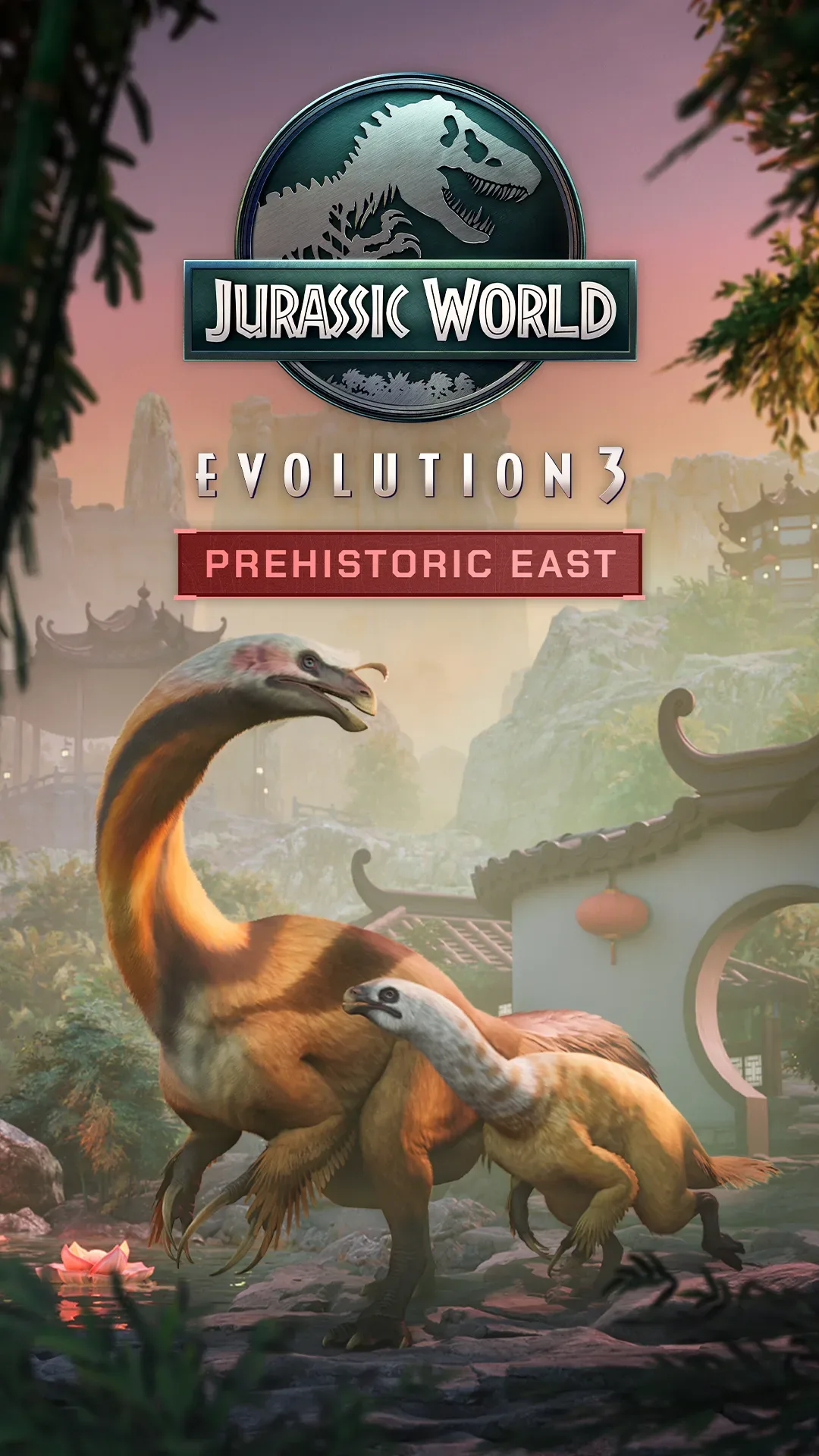
Jurassic World Evolution 3: Prehistoric East is now available on PC, PlayStation 5 and Xbox Series X|S. The paid expansion adds five species, a substantial collection of East-Asia-inspired decorative construction parts, animated holographic dinosaur statues and a set of ready-to-place building blueprints. It arrives alongside Update 1.5.0, a free game update that introduces raised Walkways, additional Sandbox weather settings and Carcharodontosaurus as a full family unit.
The expansion has a suggested retail price of £11.99 / $14.99 / €14.99 and requires the base game. For players building parks around a visual identity rather than merely filling enclosures, its scenery catalogue may be as significant as the new dinosaur list. More than 230 scenery pieces, plus 15 blueprints, create a considerably clearer construction kit for parks with an East-Asia-inspired district or a full-site theme.
Five additions to the dinosaur roster
Prehistoric East adds Nanshiungosaurus, Gobisaurus, Yangchuanosaurus, Sinosauropteryx and Tarbosaurus. That group spans different exhibit possibilities, from a peaceful attraction led by a feathered dinosaur to a headline predator habitat.
- Nanshiungosaurus is presented with colourful plumage and positioned as a suitable resident for calm exhibits.
- Gobisaurus joins the roster as another new species in the pack.
- Yangchuanosaurus is described as a top predator, giving builders a new carnivore around which to plan a high-profile enclosure.
- Sinosauropteryx arrives as a full family unit.
- Tarbosaurus also arrives as a full family unit.
A full family unit means the species is represented as a family grouping rather than being limited to one individual form. That matters for park presentation: a display can communicate more than an isolated specimen, with the potential visual appeal of a population built around different family members. The supplied details do not set out husbandry requirements, social limits or enclosure needs for these animals, so builders should avoid assuming that the new species share identical management rules.
The mix is notable because it is not built solely around one familiar blockbuster dinosaur. Tarbosaurus and Yangchuanosaurus provide obvious dramatic focal points, while the smaller-scale visual character implied by Sinosauropteryx and the colourful plumage of Nanshiungosaurus give the package room for exhibits that are not simply “largest teeth wins.” Gobisaurus rounds out a five-species selection that can be distributed across multiple park areas instead of being treated as one new mega-paddock.
Scenery is the centrepiece for dedicated park designers
The DLC includes more than 230 East-Asia-inspired scenery items. The named pieces cover architectural structure, garden dressing and landmark decoration: dragon statues, guardian lions, paper lanterns, lotus flowers, walls, roofs, trims and rock formations. In practical park-building terms, walls, roofs and trims are especially useful because they support a coherent silhouette across several structures; a themed space tends to feel more deliberate when entrances, shops, viewing areas and enclosure borders use compatible materials.
The decorative pieces can then do the environmental work. Lotus flowers and rock formations are suited to breaking up hard building lines, while lanterns, statues and guardian lions can establish thresholds around gates, plazas or viewing routes. The supplied information does not claim that these items alter guest behaviour or animal welfare. Their role is visual and compositional: they give creators more tools for making a section of a park look intentionally connected.
Fifteen blueprints lower the barrier to a themed park
There are also 15 ready-made blueprints featuring pagodas, gates and walled gardens. A blueprint is a prebuilt design that can be placed as a prepared structure, rather than requiring every component to be assembled individually. That is valuable for two very different kinds of player:
Related coverage includes Jurassic World Evolution 3 Expands East With Five-Dinosaur Prehistoric East DLC.
- Players who want a park area to look themed quickly can begin with a prepared landmark or garden layout.
- Players who prefer detailed construction can use the blueprints as visual anchors, then extend the surrounding space with individual walls, roofs, trims and ornaments.
That split is important in a management-builder. The best scenery packs are not necessarily those with the most isolated decorations; they are the ones that offer both a quick starting point and enough individual components to avoid a park becoming a repeated row of identical prefabs. With gates, pagodas and walled gardens specifically identified, Prehistoric East appears structured around entrances, vertical landmarks and enclosed landscaped spaces.
Animated hologram dinosaurs add a non-enclosure attraction option
Alongside physical scenery, the expansion introduces animated holographic dinosaur statues. Each has selectable behaviours, allowing players to animate the display rather than treating it as a fixed ornament. The feature creates a way to put dinosaur imagery into high-footfall areas without placing a living animal there.
That distinction has practical design value. A hologram can act as a focal point in an entry plaza, outside a facility or near a path junction, while actual animals remain inside their proper exhibits. Selectable behaviour gives these display pieces an element of customization, although the available behaviour choices have not been detailed. It is therefore safest to view the statues as animated scenery, not as a newly described management system or a replacement for animal exhibits.
Free Update 1.5.0 adds Walkways and more
Every Jurassic World Evolution 3 player receives Update 1.5.0 for free, whether or not they buy Prehistoric East. Its headline addition is the Walkway attraction, which supports raised paths through aviaries and above land and lagoon enclosures.
Raised walkways are a straightforward idea with broad design consequences. Rather than only viewing animals from the edge of a habitat, a park can potentially route visitors across or through selected spaces. In an aviary, that changes the geometry of the visitor route from perimeter observation to a path within the broader exhibit volume. Above a land or lagoon enclosure, it provides an elevated viewing line and can help connect areas without relying on a ground-level route through the surrounding park.
The details provided establish where Walkways can go, but do not describe costs, placement restrictions, guest ratings or how animals react. Those questions remain open. Still, the feature should matter to builders because circulation is one of the central challenges in any park layout: guests need routes, exhibits need sightlines, and themed areas need transitions that do not flatten everything into a single path around a fence.
Update 1.5.0 also returns Carcharodontosaurus as a full family unit. Like the new family-unit species in the DLC, this expands its presentation beyond a single form. Because it is part of the free update, it is available separately from the paid expansion.
Finally, the patch adds new weather settings for Sandbox mode. Sandbox refers to a mode centered on flexible creation and experimentation, rather than a fixed progression goal. Extra weather controls can be relevant to a build’s atmosphere and presentation, but the specific weather options have not been listed. Players should therefore expect expanded settings, not assume a particular set of climates or visual effects.
What is paid, what is free, and what is required
The cleanest way to separate the release is simple: Prehistoric East is the paid add-on; Update 1.5.0 is the free accompanying update. The expansion supplies the five new species, holographic statue feature, 230-plus scenery pieces and 15 East-Asia-inspired blueprints. The update supplies Walkways, Carcharodontosaurus family units and Sandbox weather settings.
Jurassic World Evolution 3 is required for the DLC. The listed suggested retail prices for the base game are £49.99 / $59.99 / €59.99 for the Standard Edition and £64.99 / $74.99 / €74.99 for the Deluxe Edition. Those are suggested prices rather than a statement about any temporary storefront promotion or regional discount.
For anyone tracking the day’s wider software slate, see games releasing on September 29, 2026.
A pack designed around park identity, not only creature count
Five dinosaurs is a meaningful roster increase, particularly with two of them described as full family units. Yet Prehistoric East’s broader proposition is its combination of animals with an extensive scenery set and ready-made architectural blueprints. The creatures give a new district something to exhibit; the walls, roofs, garden pieces, lanterns and landmarks give it a visual language; and the free Walkway update offers a new way to lead guests around and above the result.
For players who chiefly want new animals, Tarbosaurus, Yangchuanosaurus and the smaller feathered Sinosauropteryx may be the immediate draw. For players who spend hours shaping paths, entrances and exhibit backdrops, the larger question is likely how the more than 230 scenery items interact with the existing construction toolbox. The supplied feature list supports a clear expectation of greater thematic variety, while leaving the finer details of placement, customization and park-management effects to be explored in-game.