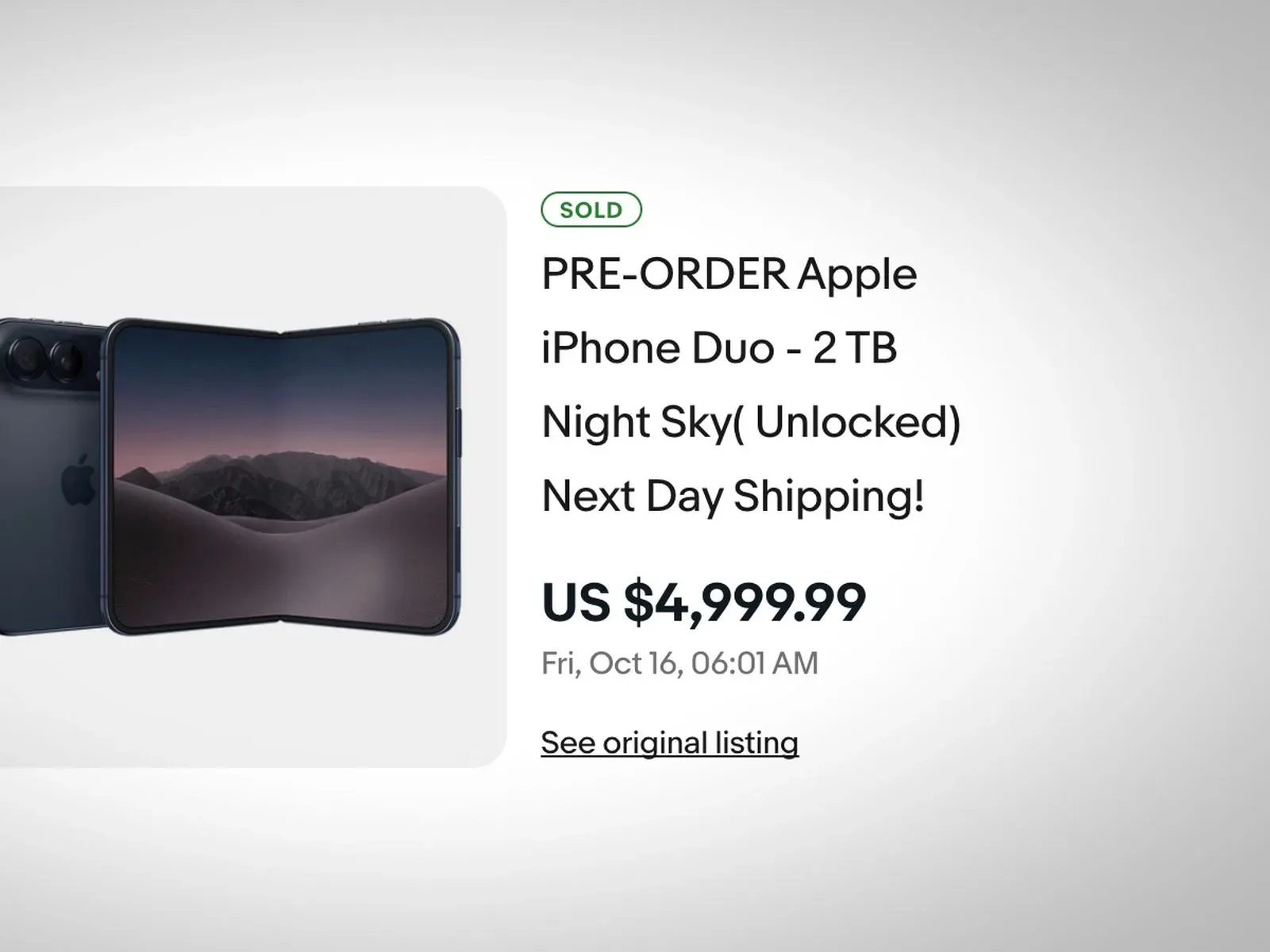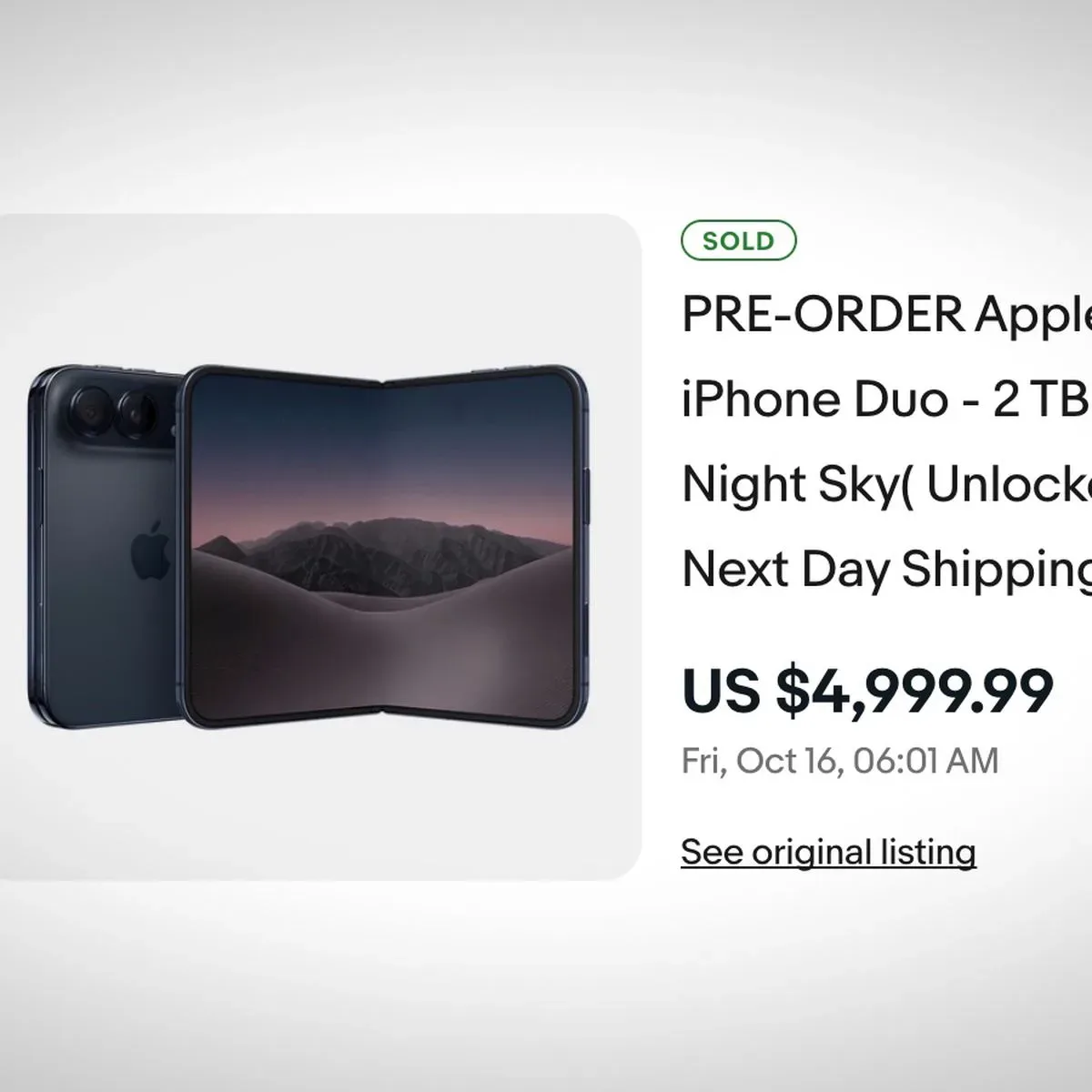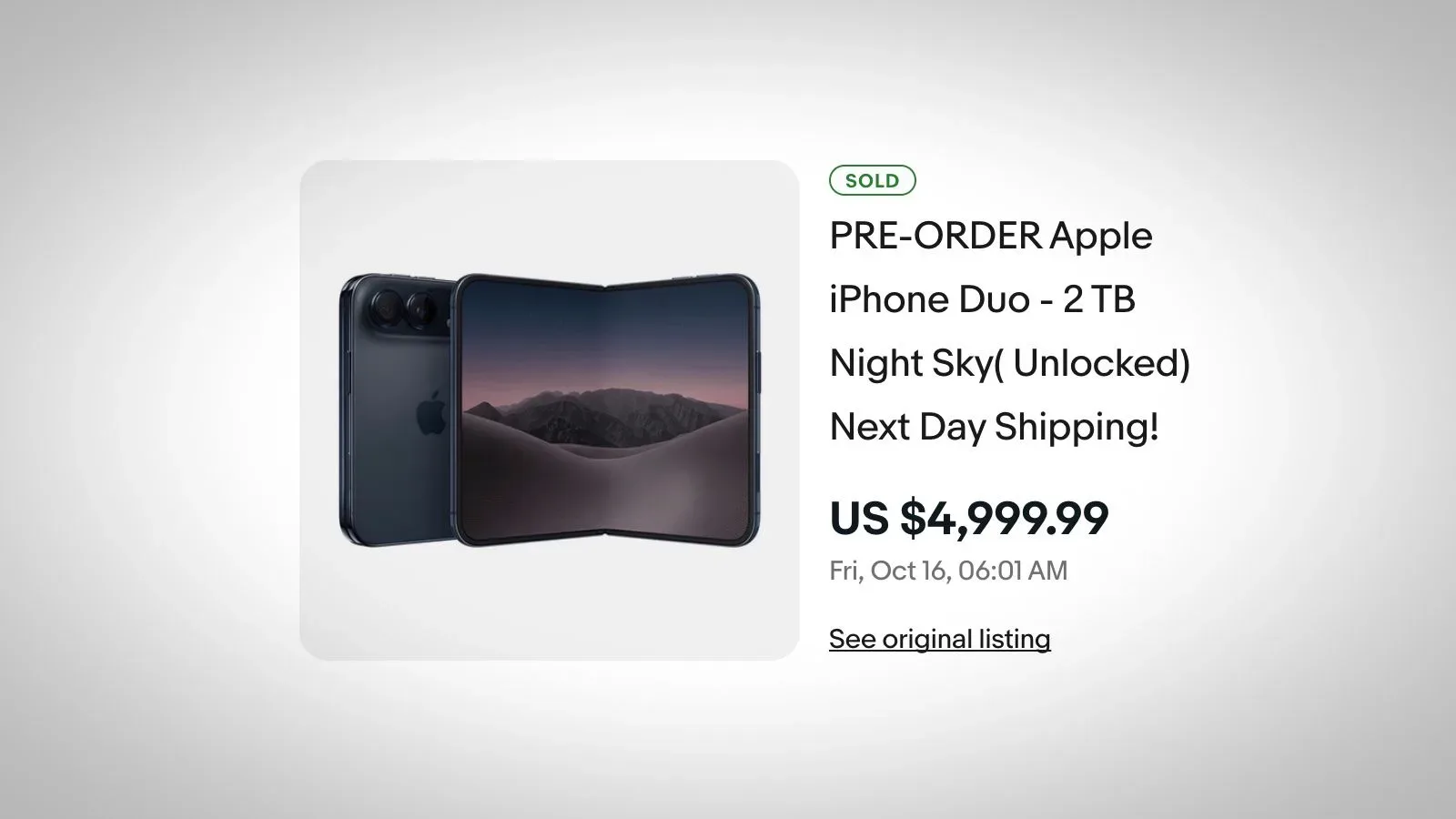
The first rush for Apple’s iPhone Duo appears to have created an immediate resale market, with eBay listings marked sold reaching as high as $5,000. That top listing was for a Night Sky iPhone Duo with 2TB of storage, a configuration Apple lists at $3,199 in the United States. The apparent difference: $1,800.
A second listing, for a “confirmed pre-order” of the Night Sky model with 1TB of storage, is also marked sold on eBay. Its listed sale price was $4,400, against Apple’s U.S. price of $2,599 for that configuration—again, an $1,800 premium.
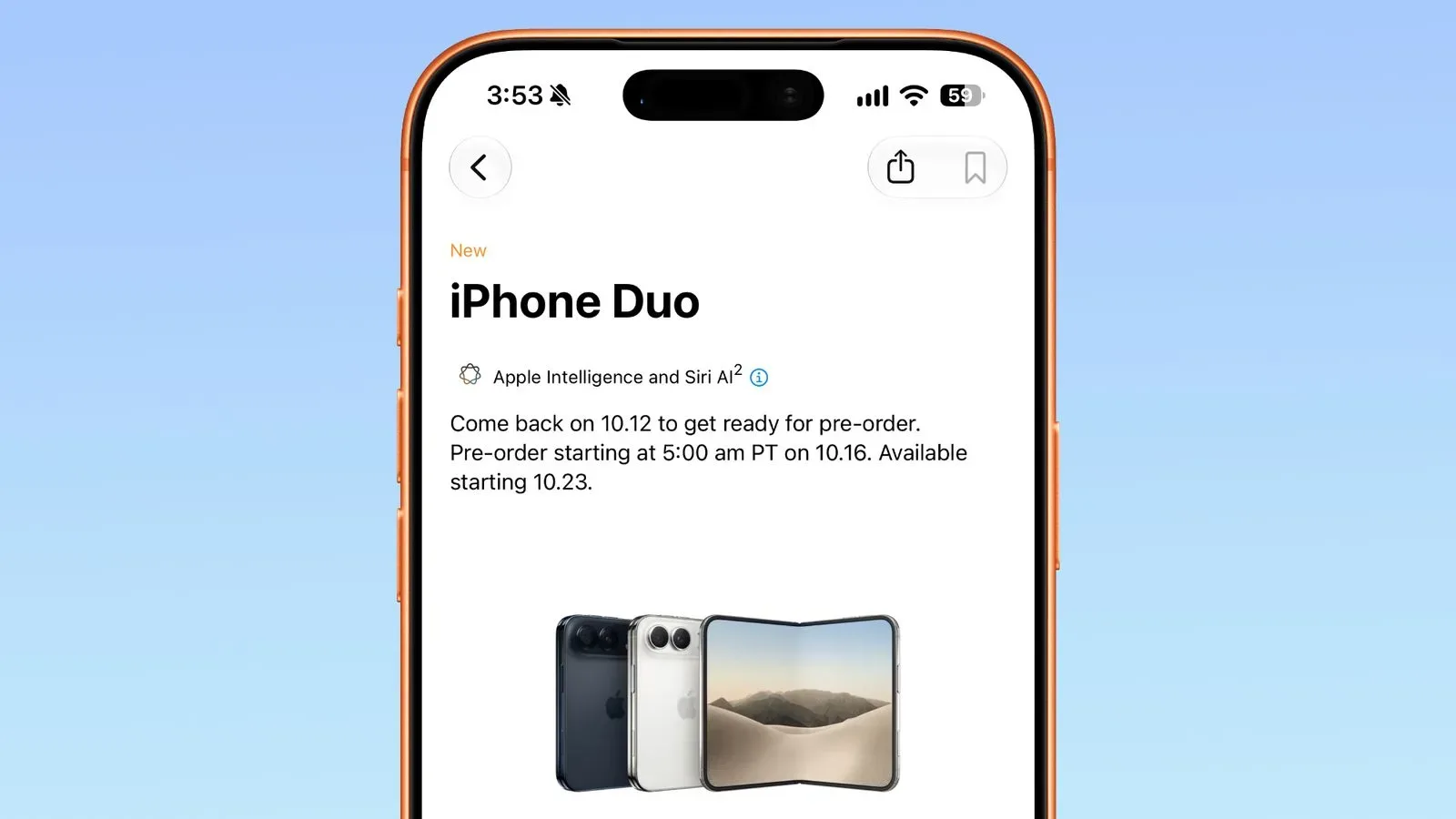
The activity arrived as Apple’s U.S. online store showed a January 25 estimated shipping date across iPhone Duo configurations. Delivery estimates reportedly moved into 2027 within minutes of pre-orders opening, creating the core condition that often drives short-term resale pricing: shoppers who want an item earlier than the standard retail channel can provide it.
What the two sales suggest—and what they do not
The reported figures are striking because the premium is the same in dollars despite the two phones having different base prices. At $5,000, the 2TB model was listed at roughly 56% above its $3,199 retail price. At $4,400, the 1TB model was listed at roughly 69% above its $2,599 retail price.
That does not establish a stable market price for the iPhone Duo. Two listings marked sold are useful evidence that buyers and sellers met at those displayed amounts, but they are only a small snapshot from the opening wave of pre-orders. They do not show how many units changed hands, whether comparable listings will receive the same prices, or whether the premium will remain once delivery estimates improve.
It is also important that one listing concerned a confirmed pre-order rather than a phone already in the seller’s possession. A pre-order resale is fundamentally an agreement tied to a future fulfillment process. The buyer’s practical interest is not merely the hardware; it is the seller’s claimed place in the queue and their ability to transfer, ship, or otherwise complete the transaction as promised.
Why shipping estimates matter so much
Retail price and availability are different things. Apple’s listed price establishes what a buyer pays through its own store, while the estimated shipping date indicates when an order may leave for the customer. When that estimate stretches far beyond the initial pre-order window, the immediate-supply advantage held by early buyers can acquire a separate value on resale marketplaces.
In this case, the visible gap is especially stark. A buyer choosing the standard storefront was seeing a January 25 estimate, while resale listings were offering the prospect of getting access through someone who had already secured a pre-order. The $1,800 difference reflects that perceived timing advantage, not a change in Apple’s official U.S. retail price.
For shoppers, the distinction is more than semantic. A high resale figure should not be read as evidence that Apple has raised the price, that every configuration has sold at that amount, or that the device will permanently command a collector-style premium. It indicates that scarcity at one moment has produced listings at a much higher asking-and-sale level on a secondary marketplace.
Storage and color details in the early listings
Both reported listings were for the Night Sky color, but their storage capacities differed: one carried 2TB and the other 1TB. The shared color makes it impossible to draw a broad conclusion about whether Night Sky itself is driving the premium. The available information instead points more clearly to constrained early access, because both configurations landed at the same $1,800 amount above Apple’s stated U.S. price.
The storage difference does show how a flat dollar markup can produce very different percentage markups. The higher-capacity model began with the larger retail price, so the same $1,800 surcharge made up a smaller share of its total. Buyers comparing listings should look at both measurements:
- Dollar premium: the amount above the official retail price. Here, each reported listing carried an apparent $1,800 premium.
- Percentage premium: the additional amount expressed relative to retail. This helps compare configurations with different starting prices.
- Fulfillment status: whether the seller has the item in hand or is selling a pre-order position.
- Retail delivery estimate: the wait a buyer avoids, assuming the resale transaction is completed successfully.
Practical caution for anyone weighing a resale purchase
A marketplace listing marked sold can be a useful signal of demand, but it should not be treated as a guarantee that another purchase will have identical terms or outcome. The early iPhone Duo market contains two different propositions: acquiring a physical device and acquiring a seller’s pre-order. Those carry different questions.
For an in-hand item, buyers can focus on the exact configuration, condition and shipment arrangement. For a pre-order, the key issue becomes whether the seller can fulfill what was described after Apple processes the order. The reported listing explicitly described itself as a confirmed pre-order, which makes the delivery timeline and transaction details especially central to its value.
The simplest comparison remains the official retail route. Apple’s U.S. store was showing January 25 as the estimated shipping date when the listings were observed. A buyer considering a four-figure premium is effectively deciding how much avoiding that wait is worth to them. In the examples reported here, that decision meant paying $1,800 above Apple’s listed price—before any other marketplace-specific considerations that may apply to a transaction.
There is a parallel here with the wider technology ecosystem: access, distribution rules and timing can have consequences beyond the hardware itself. The same broader questions matter in games and apps, where iPhone platform policies remain a live industry concern, as explored in this look at Apple antitrust settlement talks and potential implications for game developers.
An early-market price, not a verdict on long-term value
The available evidence supports a narrow but notable finding: at least two iPhone Duo eBay listings were marked sold at prices $1,800 above the corresponding U.S. retail configurations, with the highest reaching $5,000. The listings emerged after online shipping estimates reportedly extended into 2027, while Apple’s store displayed a January 25 estimate across the lineup.
What happens next depends on supply and delivery timing, neither of which can be determined from two completed-looking listings. If official availability changes, the rationale for paying a large early-access premium can change with it. For now, the iPhone Duo’s opening hours have produced a familiar secondary-market story: a long retail wait has given early pre-orders a costly, if uncertain, shortcut.
Shop the products
Check current price, model and availability at the retailer.