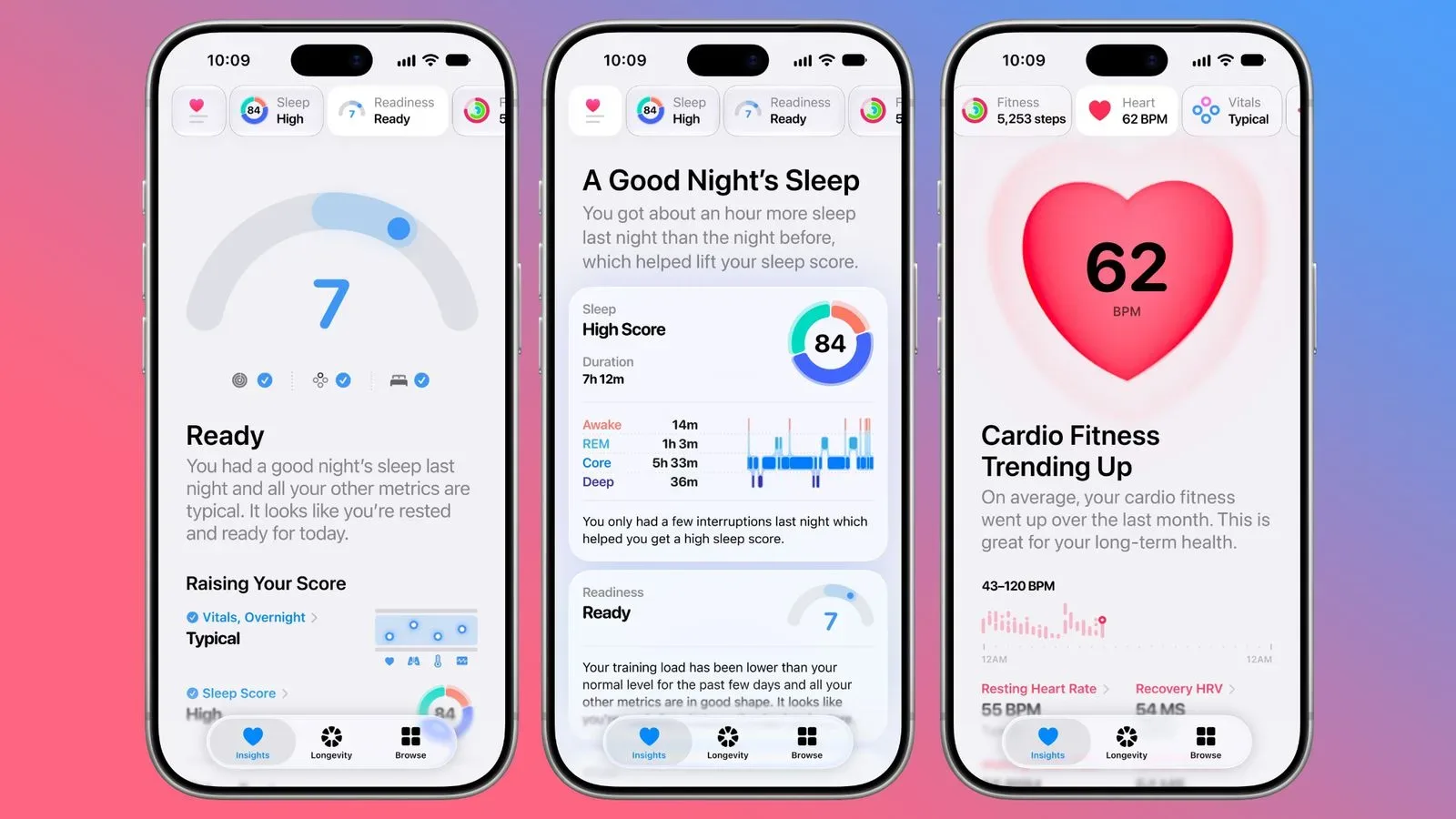
Apple’s first iOS 27.2 beta offers an early look at a redesigned Health app built around a more interpretive use of iPhone and Apple Watch data. The central idea is not simply to show more charts. Apple Intelligence is intended to turn measurements such as sleep, activity, heart-related readings and fitness changes into individualized summaries and suggestions.
There is an important availability distinction, though. The redesigned Health experience is being tested in the beta, but it is not set to ship with the initial public release of iOS 27.2. Its features are planned to arrive later in the year, progressively rather than all at once. In particular, lab ordering, personalized health information in Insights and personalized recommendations are not expected to be available during this beta period.
That makes this a preview of a direction rather than a finished health-service launch. It also means users should be cautious about treating a beta’s visible menus as confirmation that every promised feature will be usable immediately, or that the final rollout will land in one package.
From tracked data to an Insights feed
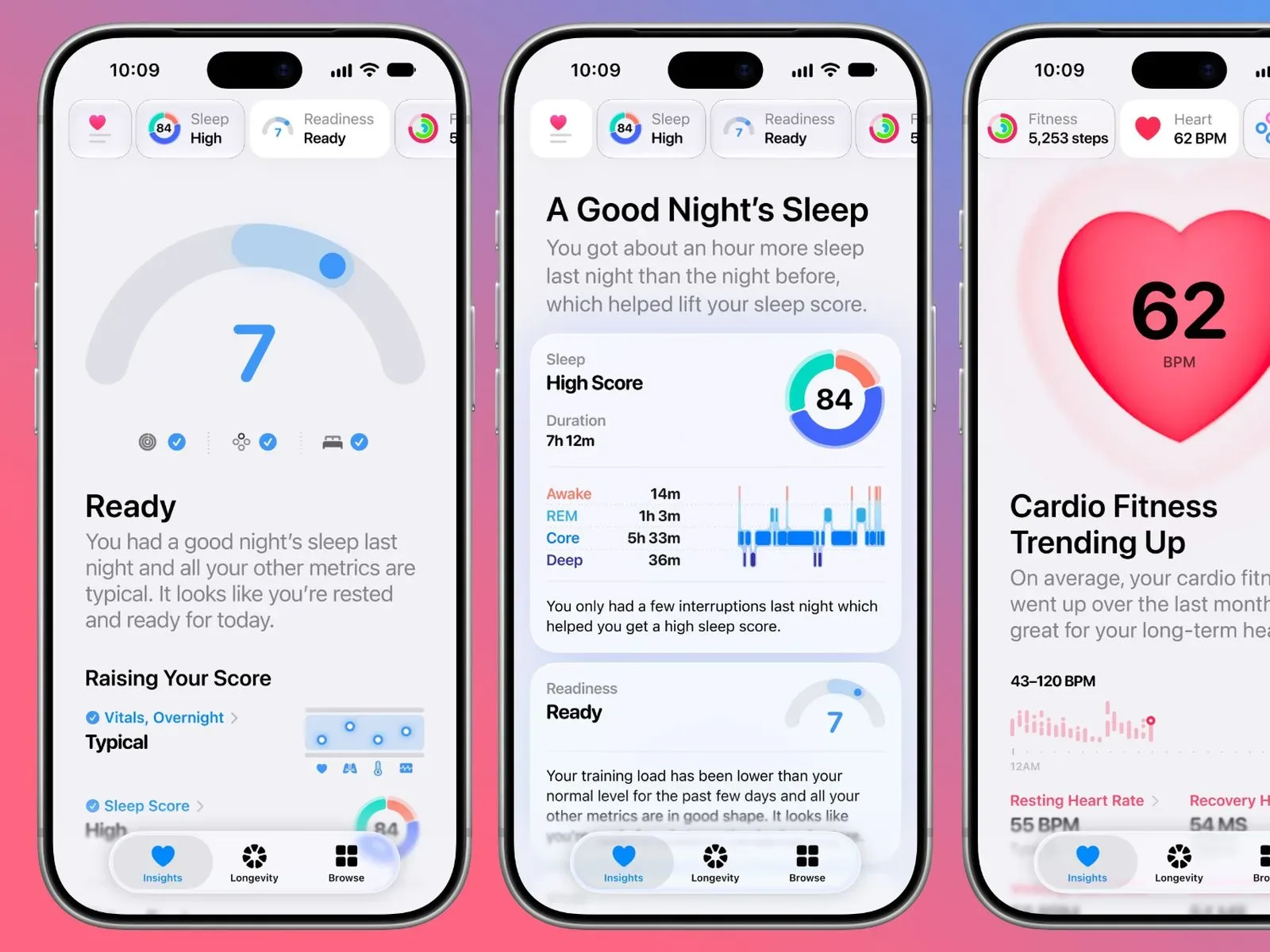
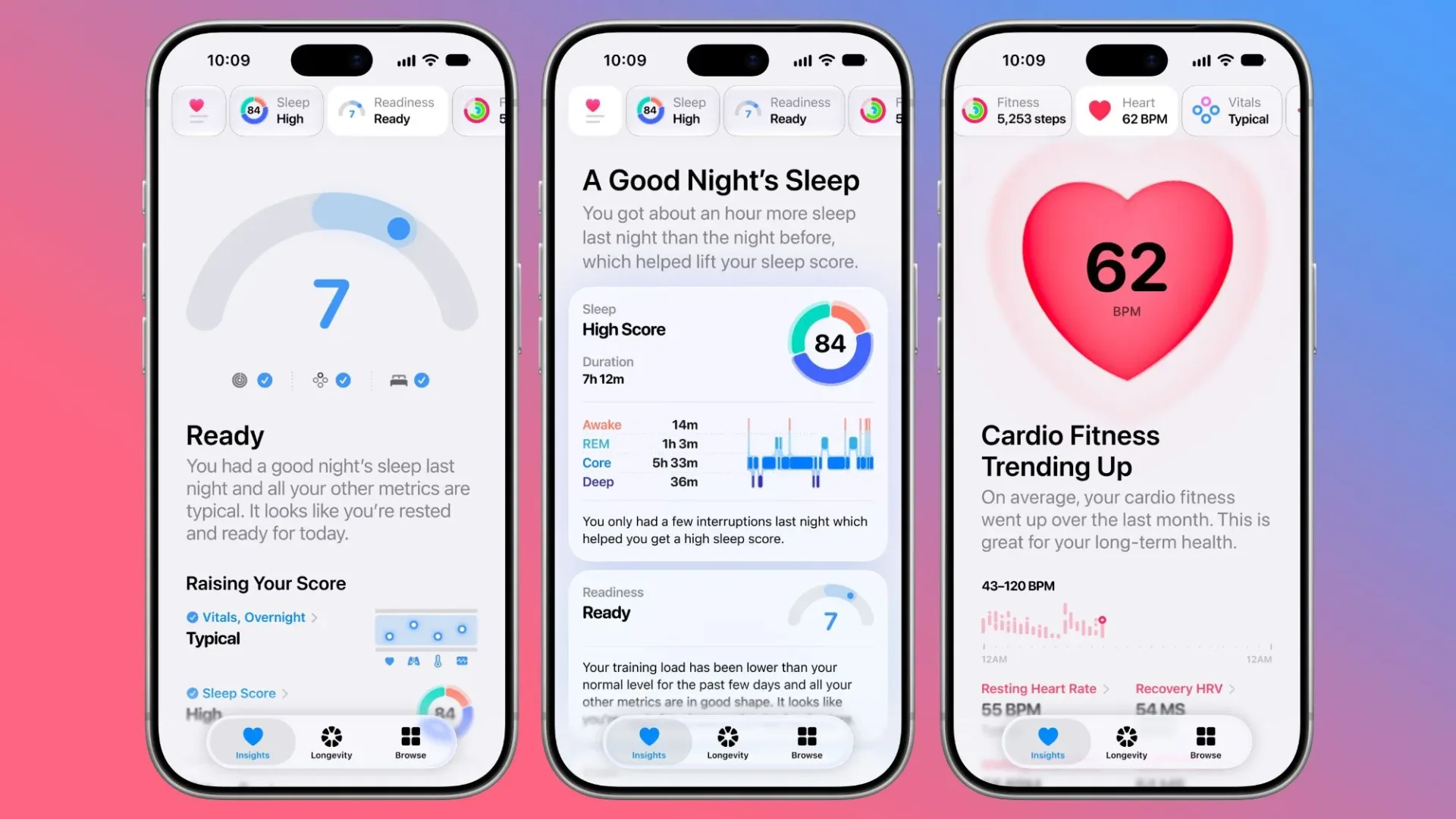
The most significant proposed addition is an Insights tab. Its job is to surface timely information, including recent sleep metrics or a new peak in VO2 max, using Apple Intelligence-generated summaries. A For You area is planned to offer advice across readiness, fitness and heart health.
This is a shift in emphasis. Health data can be difficult to act on when it is divided among individual measurements and time ranges. An insights system attempts to provide context: which change is recent, which metric deserves attention and what kind of action might fit a user’s stated goals. The planned Fitness portion also incorporates daily activity and updates throughout the day.
Apple describes the accompanying Personal Guidance feature as goal-aware and adaptive to the person’s own data. Someone concentrating on cardiovascular work, for example, could be shown a suggestion to include intervals in a morning run. The meaningful detail is the intended personalization: recommendations are meant to reflect what matters to a particular user, instead of functioning as a fixed list of wellness prompts.
That promise will need to be evaluated carefully when it is actually available. A recommendation is useful only if its timing, explanation and level of confidence are clear enough for a person to understand why it appeared. The supplied details establish that the system will adapt suggestions to user data; they do not establish how it will present uncertainty or how much control users will have over those recommendations.
Readiness turns several signals into one daily score
New Apple Watch models are set to calculate a readiness score from recent activity, vitals and sleep score. The result is a 0–10 score paired with an activity-level recommendation: Recover, Pace Yourself, Ready or Go For It. It is planned to appear on the watch, in the Fitness app and in Health’s Insights tab.
In practical terms, readiness is an attempt to compress several recent signals into a fast answer to a familiar question: should today be a recovery day, a normal training day or a day to push harder? The labels matter because they translate a numeric result into a proposed level of effort. A 0–10 scale alone can look precise without communicating what behavior should follow; the four status messages supply that missing interpretation.
It is still best understood as guidance rather than a clinical verdict. The available information says the score accounts for activity, vitals and sleep score, but does not define a universal threshold for exercise, illness or medical decisions. Users with concerns about their health should not assume that a favorable score resolves them, nor that a lower one independently identifies a medical cause.
New Vitals views put HRV in focus
The redesigned Vitals area is planned to add both overnight and daytime views. It will incorporate HRV, or heart rate variability, as a metric intended to provide a clearer view of recovery from stress. Apple’s planned presentation includes overall HRV and recovery HRV.
HRV refers to variation in the timing between heartbeats. Within this Health design, its stated role is recovery context: a user can see it alongside other signs gathered through sleep, activity and vitals rather than treating a single reading as the entire story. Separating an overall measure from recovery HRV could also make the app’s recovery-oriented framing more legible, provided the eventual interface explains what each view is showing.
Overnight and daytime views point to another practical change. Health signals do not only matter while someone is asleep or exercising. Showing both windows could help distinguish a nightly pattern from changes encountered across a day. However, the beta preview does not specify the final layouts, the time periods used in each view or which devices will support every display.
Longevity and the proposed Health Age comparison
A new Longevity tab is also planned. It will assess overall health using iPhone and Apple Watch metrics across heart health, sleep, mental wellbeing, movement health, metabolic health, hearing and nutrition. Each category is expected to show how the user is doing and classify relevant metrics against the latest clinical guidance.
The breadth of that list is notable. Rather than isolating fitness or cardiac data, Longevity is designed as a dashboard connecting several aspects of health in one place. The classification element is especially important: raw measurements are often hard to interpret without a frame of reference. In this case, Apple plans to relate them to current clinical guidance. The supplied information does not identify the specific guidance or explain how classifications could change over time, so those details remain for the final implementation.
Health Age sits within the Longevity tab. It is intended to compare health metrics with a user’s actual age, drawing on VO2 max, resting heart rate, HRV, sleep and biomarkers from blood work. Apple says this feature will help identify the habits with the greatest potential impact and ways to improve.
VO2 max is a measurement used here as part of fitness context. Resting heart rate is the heart rate measured at rest. Biomarkers are measurable indicators from blood work. Grouping these with sleep and HRV means Health Age is not described as a single-test result; it is a composite comparison based on multiple data points.
That is a useful distinction for anyone tempted to reduce health to one age-like number. The stated purpose is comparison and habit-focused guidance, not a replacement for individualized clinical assessment. The preview does not state how Health Age is calculated, what inputs are required before it appears or how missing blood-work data affects it. Until those details are available, the score should be viewed as a planned app feature with defined inputs, not a fully documented measure.
Camera-led assessments broaden the app’s role
Apple also plans at-home health assessments inside Health. A VO2 max test is among the examples, using the iPhone camera to track a person’s movements while they follow a trainer’s instructions. Additional in-depth assessments are planned for flexibility, strength, balance and movement mechanics.
This proposal expands the app beyond passively collecting watch and phone measurements. It asks users to complete guided movements, with the camera helping track them. The potential benefit is straightforward: structured assessments could give people another way to establish or follow changes in physical capabilities without requiring a separate recording process.
But the supplied information does not spell out the assessment protocols, supported iPhone hardware, results format or availability schedule. Those omissions matter, because consistency in following a trainer’s instructions can affect any movement-based assessment. For now, the reliable takeaway is that the Health app is planned to support guided, camera-assisted evaluations in addition to its existing data-oriented approach.
A future Quest bloodwork option for U.S. users
Separately, Apple plans to let U.S. users purchase a Quest bloodwork panel through the Health app. The panel is described as covering more than 50 biomarkers and carrying a $119 price. It would be ordered directly in the app.
This prospective option is relevant to Health Age because blood-work biomarkers are among the inputs named for that feature. It could therefore give eligible users a route for adding a broader category of measurements to the Health ecosystem. Still, ordering labs is explicitly among the features not available in the current beta and is planned for later in the year.
Regional scope is also clear: the stated plan applies to U.S. users. No wider availability, ordering details or timing has been established here. The price and the number of biomarkers describe the planned Quest panel, not a general statement about every test a user might encounter in Health.
What to watch as the rollout progresses
The iOS 27.2 beta establishes the broad shape of Apple’s Health redesign: an Insights feed, adaptive guidance, a cross-app readiness score, expanded HRV views, a Longevity dashboard, Health Age, camera-supported assessments and a prospective lab-ordering route. Yet the most personalized parts of that vision are among the components still waiting for a later release.
For developers and users following iOS 27.2, the immediate value is visibility into the planned structure and vocabulary. For everyday users, the more consequential moment will be when the delayed capabilities actually arrive: whether Insights explain changes usefully, whether recommendations fit real routines and how clearly the app separates helpful wellness coaching from information that warrants professional care.
Apple’s broader iOS 27.2 beta work also includes changes to Siri language support, covered in our look at the update’s five additional Siri AI language options. In Health, though, the key message is patience: the beta previews an ambitious set of tools, while the personalized experience and lab integration remain a staged, later-in-the-year rollout.