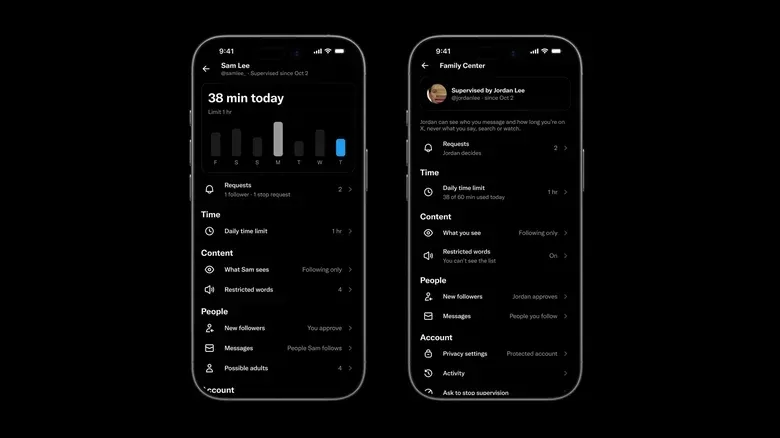
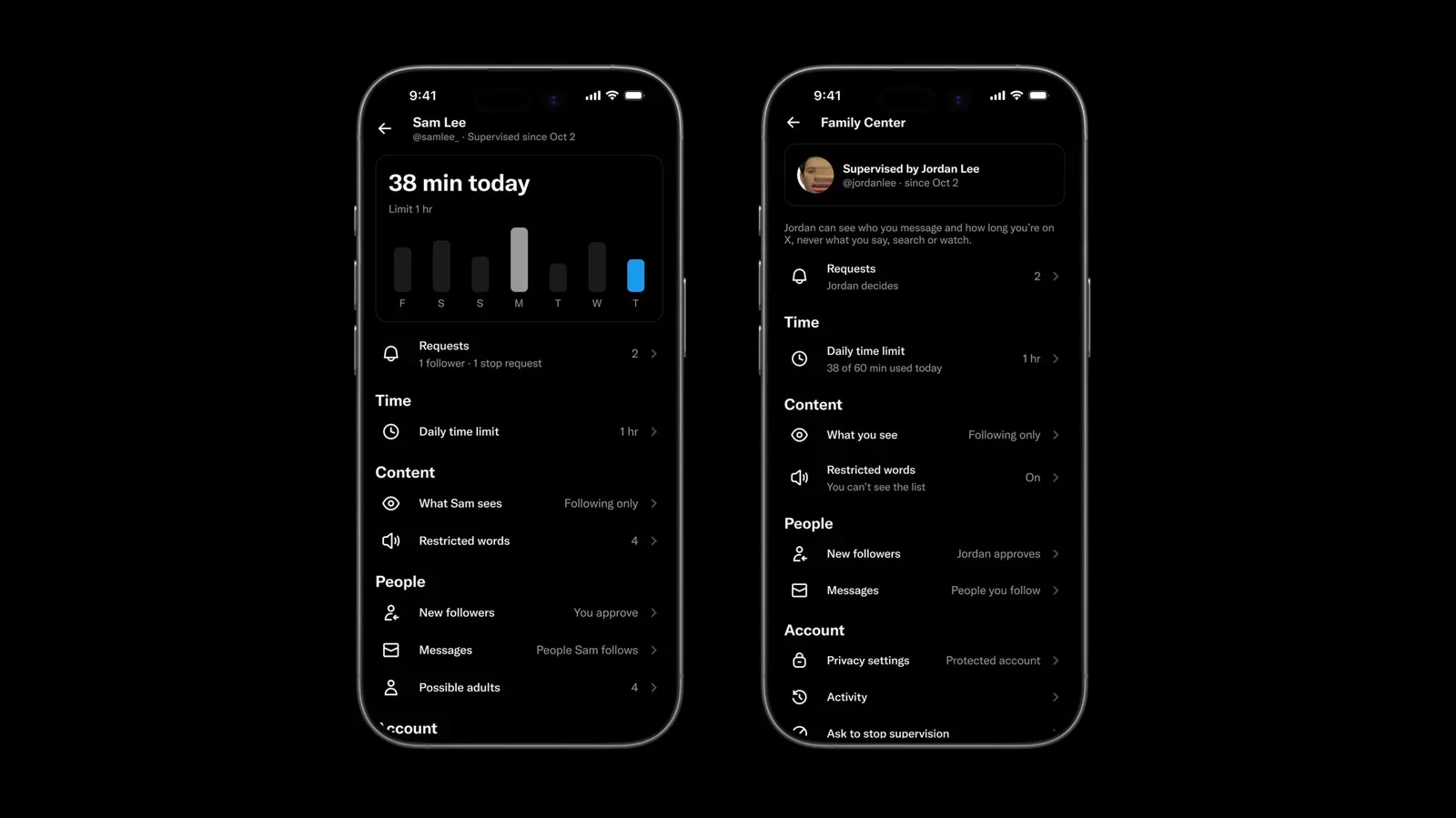
X has introduced parental controls for users aged 13 to 17, adding a family-management layer to a service that says it is not designed for or promoted to children. The tools begin with stricter defaults for teen accounts, then give a linked parent or guardian options to impose further limits on time, discovery, messages and content.
The rollout matters because the settings are not simply a screen-time timer bolted onto an existing account. X says teen accounts will default to protected mode, restricted sensitive media and blocked targeted advertising. Adults who link their own account can then manage as many as five teen accounts, provided both sides agree to the connection.
That last condition is notable. Family safety software can sound like a tiny digital surveillance van parked outside a teenager’s bedroom. X is framing this system as a more bounded arrangement: guardians can regulate certain parts of the experience, but they cannot enter the account and start rummaging through private activity.
What changes by default for teen accounts
The initial protections apply to accounts belonging to users between 13 and 17. X says these accounts will have three defaults:
- Protected mode: an account setting intended to place tighter limits around the teen’s posts and audience.
- Sensitive-media restrictions: material classified as sensitive is restricted by default.
- No targeted advertising: ads targeted to the teen are blocked.
Those measures establish a baseline before a guardian changes anything. That distinction is important in practice. A parent who has not yet linked an account should not have to rely solely on a teen finding, understanding and enabling every available safety setting. Defaults are the platform’s starting rules; parental controls are the extra controls a family can elect to use.
None of this makes the service a child-focused space. X explicitly says it is not designed for or promoted to children, while maintaining a minimum age of 13 where the law requires it. So this is best understood as risk reduction for teens who are already on the service, rather than a statement that its broader public conversation, recommendation systems or culture have suddenly been rebuilt for younger users.
The additional controls, explained
Once a guardian and teen link their accounts, the adult can see time spent on X and set a daily time limit. A daily limit is a ceiling on how long the teen can use the platform in a day. It can be useful for turning an abstract family rule—“maybe log off at some point, pal”—into a setting with an actual boundary.
Adults can also require approval for new followers. On a social network, a follower is an account that subscribes to a user’s posts. Requiring approval gives the teen’s household a gate before a new audience connection is added, which may be especially relevant for an account using protected mode.
The controls further allow guardians to limit For You recommendations to accounts the teen already follows. For You is X’s recommendation feed: rather than only displaying posts from people a user has chosen to follow, it can surface material selected by the platform’s systems. Restricting it to followed accounts narrows that discovery route. It does not mean every post from followed accounts will be suitable, but it can reduce exposure to posts from unfamiliar accounts introduced through recommendations.
Additional options include filtering specified words and switching off sensitive media. A word filter gives a household a way to target terms it considers unwanted. It is a focused content-management tool, not a guarantee that a subject cannot appear through alternate spelling, images, video or other context. Likewise, an option to turn off sensitive media is a content setting, not a claim that every troubling or misleading post on a social platform can be perfectly categorized before a teen sees it.
Guardians may also control who can send direct messages to the teen. Direct messages, often abbreviated to DMs, are private one-to-one communications within the service. This is paired with a more limited visibility feature: the adult can see which accounts the teen has exchanged one-on-one messages with, but not the content of those messages.
What a guardian still cannot see
X has drawn explicit lines around account access. A parent or guardian cannot read private messages, view searches or viewing history, post as the teen, or otherwise access the teen’s account. The system therefore offers oversight of communication connections without delivering the messages themselves.
The arrangement is intended to let families manage exposure and contact settings without handing an adult the keys to the teen’s account.
That privacy boundary is likely to be one of the most consequential parts of the feature. A teen may reasonably feel that seeing DM partners is meaningful oversight, while a guardian may reasonably want more context if they are concerned about a particular interaction. X’s setup does not attempt to settle every family’s comfort level. Instead, it provides controls over who can reach the account and an indication of one-to-one contacts, while leaving the messages private.
For families, the practical conversation is therefore bigger than a menu of toggles. Before linking accounts, it may help to agree on what the time limit is meant to accomplish, what types of followers should need approval, which words warrant filtering, and why a guardian may look at the list of DM contacts. A control that arrives as a surprise can become a fight; a control with an understood purpose has a better chance of being used consistently.
Linking requires agreement from both accounts
X says the connection begins with the parent or guardian and ends with the teen, and both users must consent. The service’s help center provides the setup instructions. This two-party design means a guardian cannot unilaterally attach controls to a teen account through this process.
There are a few straightforward points to keep in mind from the announced structure:
- The controls are for users aged 13 through 17.
- A parent or guardian initiates the linking process, but the teen must complete it by agreeing.
- One adult can manage up to five teen accounts.
- The linked adult receives management tools, not the ability to impersonate the teen or inspect private messages.
That cap of five accounts makes the feature clearly family-oriented rather than a broad administrative tool for a school, team or other group. It also reinforces that X is treating each linked relationship as a specific guardian-and-teen arrangement.
Why the defaults should not be mistaken for a complete safety solution
The new options give families meaningful levers, especially around recommendation exposure, unwanted contacts and time use. But the scope described by X is also specific. Protected accounts, follower approvals, word filtering and media restrictions each address a particular route by which content or contacts may reach a teen. They are not a promise that a public-facing social platform will contain no harmful material.
That limitation deserves emphasis given the concerns surrounding X in recent years, including hate speech, misinformation, deepfake imagery, AI-generated child sexual abuse material, weak moderation, propaganda, bots and human trolling. Some of those problems involve what appears in a feed. Others concern who is posting, how content is amplified, and whether moderation systems act quickly and reliably. A daily timer cannot adjudicate a false post. A word filter cannot independently establish whether an image is manipulated. Limiting a recommendation feed to followed accounts reduces a discovery pathway, but familiar accounts can still share dubious material.
This is part of the larger platform challenge as AI tools reshape online content. The issue is not only whether a post is unpleasant; it can also be whether it is synthetic, deceptive or strategically amplified. The wider technology sector is grappling with similar questions about AI systems and public information flows, as reflected in proposals such as a proposed AI data-center satellite network. For a family managing a teen account, the immediate lesson is more modest: platform settings can reduce some exposures, but they do not replace discussion about dubious claims, manipulated media and unfamiliar contacts.
A useful control panel, with responsibility still shared
X says child safety is a priority and has positioned the new system as added protection for young people who use the platform. The company may also face present or future regulatory pressure across states and countries, but the announced controls should be evaluated for what they do, not as a substitute for trust.
The strongest elements are clear and concrete: teen accounts receive safer defaults; adults can set a time boundary; follower requests can require approval; the recommendation feed can be narrowed to followed accounts; direct-message access can be restricted; and private-message contents remain private. That combination gives families more structure than a simple “be careful online” speech, a phrase that has never defeated an algorithm in recorded history.
For guardians, the sensible approach is to treat the controls as a starting point. Review the defaults, decide whether the extra limits fit the teen’s use of X, and be candid about what the linked adult can and cannot see. For teens, the privacy limits may make the setup less intrusive than full account access, while the approval requirement makes participation in the arrangement part of the process. The feature does not erase the platform’s risks. It does, however, give households a clearer set of tools for deciding how much of X they want in a teen’s day and how that access should be managed.