Artificial intelligence is already a working tool for many film editors, but the most revealing part of new survey data may be where they are using it. The leading applications are not automatically constructing scenes or handing a machine the creative cut. They are the time-consuming support jobs around the cut: transcribing dialogue, cleaning audio, organizing material and locating a specific moment inside enormous pools of footage.
Avid surveyed 120 members of American Cinema Editors, an organization with roughly 1,200 members. Of those respondents, 77.5% said they use AI in some capacity during post-production. Transcription was the most common stated use at 60%, followed by audio cleanup at 55%. Another 39.2% said they use it to search for particular shots.
That is a significant finding, but it needs to be read precisely. It describes a relatively small, self-reporting group of 120 editors, not every editor in the organization and certainly not all post-production workers. It also measures any level of AI use, rather than proving that AI is central to every respondent’s daily workflow. Still, the responses offer a useful corrective to the idea that screen editors are uniformly refusing the technology. For many, AI is already part of the toolkit—just not necessarily the author of the edit.
The distinction: workflow assistance versus editorial judgment
Editing is often discussed as if it begins when someone places a shot after another shot. In practice, that creative decision rests on a much larger foundation of administrative and technical work. Productions can generate vast quantities of footage. Editors and their teams need to ingest it, synchronize it, label it, review it, find relevant takes and navigate it again when a producer or director asks for a particular reaction, action or line.
Two pieces of jargon help explain why the reported uses matter:
- Dailies are the footage made available for review after filming. Preparing, syncing and organizing that material is essential work, but it is not the same thing as deciding what a scene means.
- Metadata is descriptive information attached to media: who appears in a shot, what happens in it, where it was filmed, what is said, or other searchable labels. Better metadata can turn a needle-in-a-haystack search into a much shorter task.
AI-assisted transcription converts spoken dialogue into searchable text. Audio-cleanup tools can help reduce unwanted noise or otherwise improve usable sound. Visual search and tagging systems aim to recognize people, actions or other elements within shots, letting an editor query a library instead of manually scrubbing through material.
Those functions do not eliminate the need for an editor to verify results, understand continuity, protect performance, judge pacing or interpret a director’s intent. But they can reduce the time spent on repetitive navigation. Matt Feury, Avid’s vice president of artist relations, characterized the appeal as reducing manual media-management and metadata-management work so that editors can concentrate on creative decisions.
A practical example: finding the clock shot
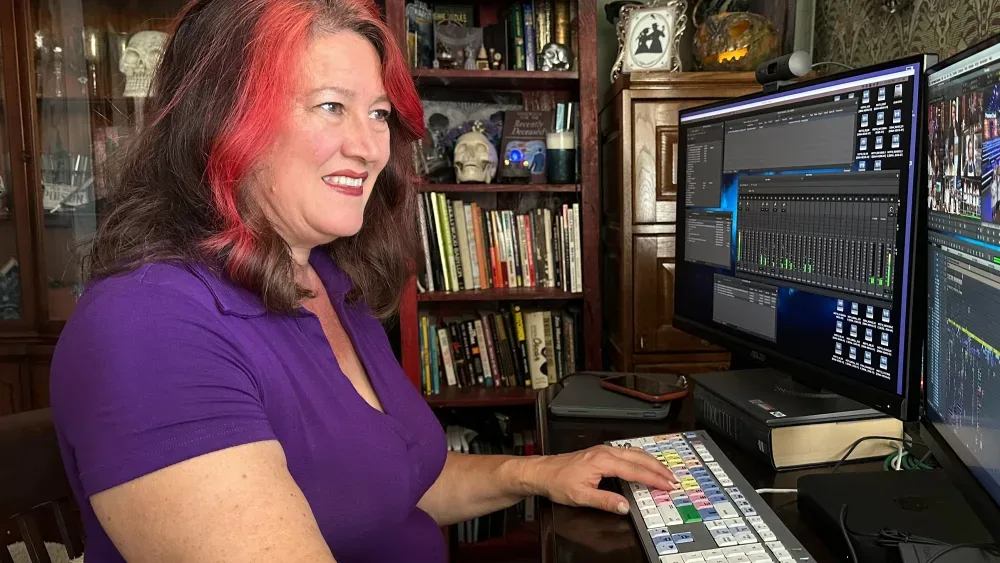
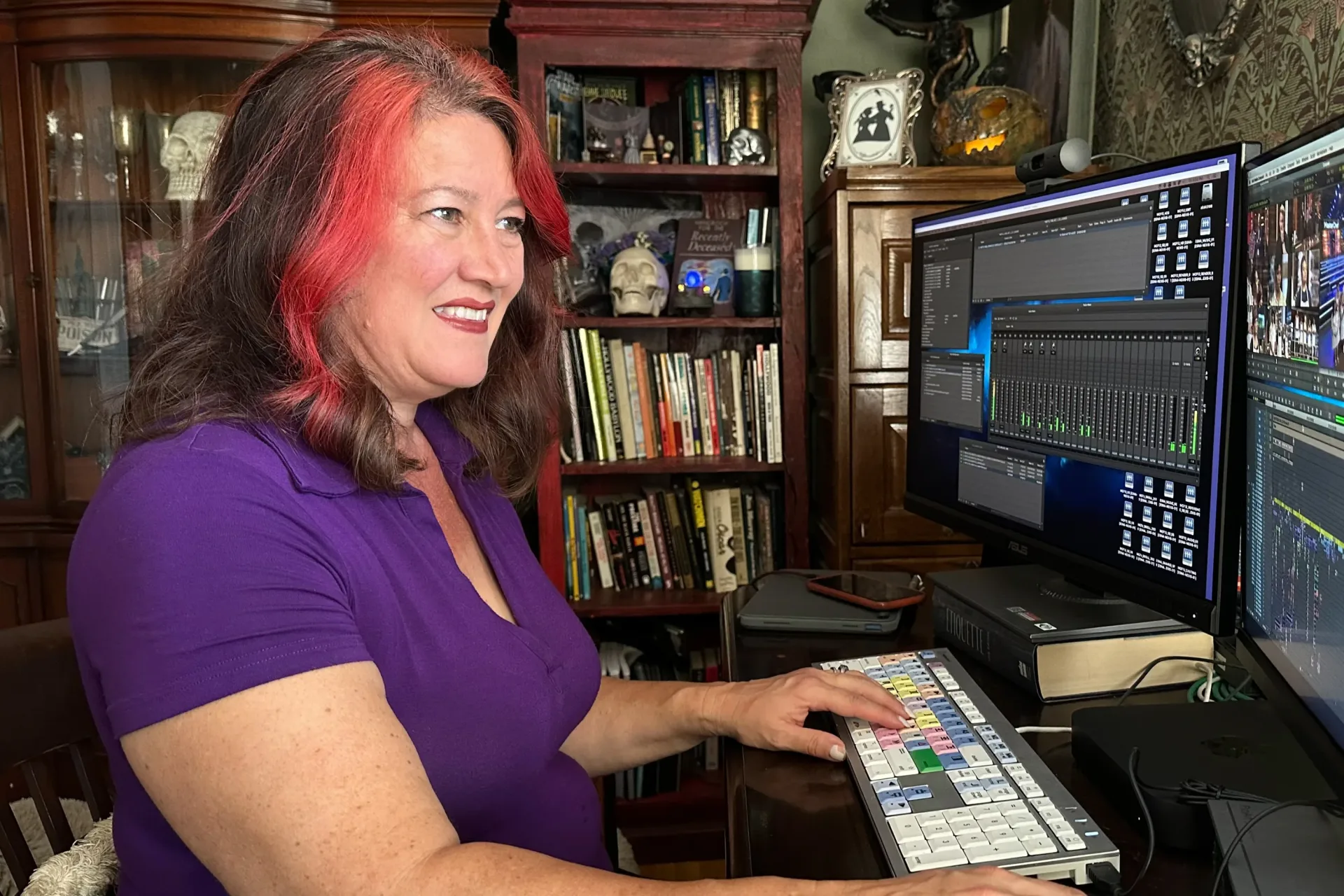
Emmy-nominated editor Molly Shock described a concrete example from a recent season of MasterChef. Producers needed footage of a contestant looking at a clock during a time check. In an earlier workflow, identifying that moment could mean searching through thousands of hours of footage for several hours. With AI tools available, Shock and her colleagues found multiple possibilities in seconds.
The example is modest on its face, but it illustrates the practical promise of searchable footage. A request such as “a particular contestant checks the time” is not an artistic command like “make this scene more tense.” It is an information-retrieval problem. When the system can identify the contestant and the relevant action well enough to return likely clips, the human editor can choose the usable moment and then decide how, or whether, it belongs in the sequence.
Shock said that tasks which could consume half a day have at times been reduced to around 15 minutes. Her framing is important: the saved time does not automatically mean the creative work itself has become easier or less valuable. It can mean more time to refine the finished program. In other words, speed at the search stage can be reinvested in the parts of editing that need taste, context and communication.
Editors are not asking AI to make the rough cut
The survey’s clearest limit on enthusiasm appears in the results around assembling material. Only 7.5% of respondents said they wanted AI help with putting together shots or rough cuts. Nearly all daily or weekly AI users said the technology should enhance a project’s creative vision rather than supersede it.
That divide makes sense when separating two meanings often packed into the phrase “AI editing.” One meaning is AI that helps locate and prepare media: a tool that can transcribe, tag, search or clean. The other is AI that makes editorial choices: selecting shots, ordering them, forming a rough cut or determining the emotional rhythm of a scene. The first category is where respondents reported most of their usage. The second is where support is far thinner.
A rough cut is an early edited version of a project, assembled so its structure, scene order and general shape can be evaluated. Calling it “rough” should not obscure its importance. Early choices establish what is being emphasized, whose reactions matter, what information arrives when and what a viewer is meant to feel. The survey suggests editors see a meaningful line between accelerating preparation and delegating those choices.
For audiences, that distinction is worth keeping in view whenever a production claims to be “using AI.” The phrase alone says very little. A searchable transcript, an audio-repair function and an automated first-pass scene assembly have very different implications for the people making the work—and for the final work itself.
Why adoption does not erase the concern
The data also makes clear that use and comfort are not identical. Ethical, copyright and security worries accounted for nearly half of the stated barriers to AI adoption. Those concerns are especially consequential in post-production, where footage, scripts, performances and unreleased story information can be highly sensitive.
Copyright concerns address questions surrounding ownership and permissible use of material, including the inputs and outputs associated with AI systems. Security concerns involve whether production assets and confidential information are adequately protected. Ethical concerns are broader, reaching issues such as creative credit, consent, labor effects and who gets to decide how tools are introduced.
None of those problems are answered merely because a tool can return a clock shot quickly. An efficient workflow may be attractive while the rules governing the workflow remain unsettled. That is why the survey should not be reduced to a simplistic headline about editors embracing AI or rejecting it. The results show both: widespread experimentation with narrowly useful functions, alongside serious caution about how far the technology should reach.
Shock emphasized that editors want to be part of decisions about deployment, rather than being treated as interchangeable operators of a button. That position also speaks to career development. If organizations use automation only to remove entry points and lower-level responsibilities, they may affect the pathways through which assistants and editors build experience. The concern is not simply whether software is helpful today; it is what kind of production workplace is being built around it.
What this could mean for screen production—and game-adjacent media
The immediate evidence concerns film and television post-production, not game development. Still, it has relevance for the broader entertainment industries that increasingly share technology conversations. Cinematics, trailers, documentary-style game features and other screen-based promotional work all depend on handling large amounts of audiovisual material. The lesson is not that one workflow will transfer cleanly to another. It is that claims about AI need to name the task being automated.
For creators and production teams, the most defensible near-term use case indicated by the survey is targeted assistance with burdensome, repeatable work: searching, transcription, tagging and cleanup. Any use involving creative assembly calls for a more direct conversation about authorship, oversight and the project’s intended voice.
For viewers and players, the practical question is less “was AI involved?” than “what did it do?” Tools that make footage easier to search may give human editors more room to polish a program. Tools positioned to replace editorial judgment raise a different set of questions. That distinction matters across an entertainment landscape already wrestling with AI’s uneven results, including the consumer-facing concerns around uneven AI experiences in home entertainment technology.
A survey of adaptation, with boundaries
The survey began in part as an attempt to test reports of resistance among editors. Its results point to a more complicated reality. Many respondents are already adapting, in part because keeping current can matter in a tighter jobs market. Yet adaptation is not surrendering control over the creative role.
AI is presently most popular among these respondents when it shortens the route to the creative work rather than claiming to perform that work itself. Finding clips, generating transcripts, handling metadata and cleaning sound are all tasks with clear utility when editors remain accountable for the output. The much lower interest in AI-generated shot assemblies or rough cuts shows where a major boundary currently sits.
That boundary may shift as tools change, but the survey captures an important moment: post-production professionals can recognize useful automation while insisting that efficiency, consent, security, rights and creative intent remain part of the same conversation.