A newly released party game has prompted a difficult creative-credit question for Jackbox Games. Solo board-game designer Sam Greszes says Debate and Switch, included in Jackbox Party Pack 12, bears a striking resemblance to Die On This Hill, the physical party game he previously sent to the studio while discussing the possibility of a digital adaptation.
The available account is an allegation from Greszes, not a finding that Jackbox copied his work. It is also an unusually nuanced dispute: Greszes has said there was no signed deal, no verbal agreement, and that he understands game mechanics themselves generally are not protected by copyright. He has raised the possibility that the overlap could be an instance of independent, convergent design rather than deliberate appropriation. Even so, the timing and the specific combination of systems have left him feeling that a game he wanted more people to play may have arrived in a very similar form without his involvement or acknowledgement.
What Greszes says the two games share
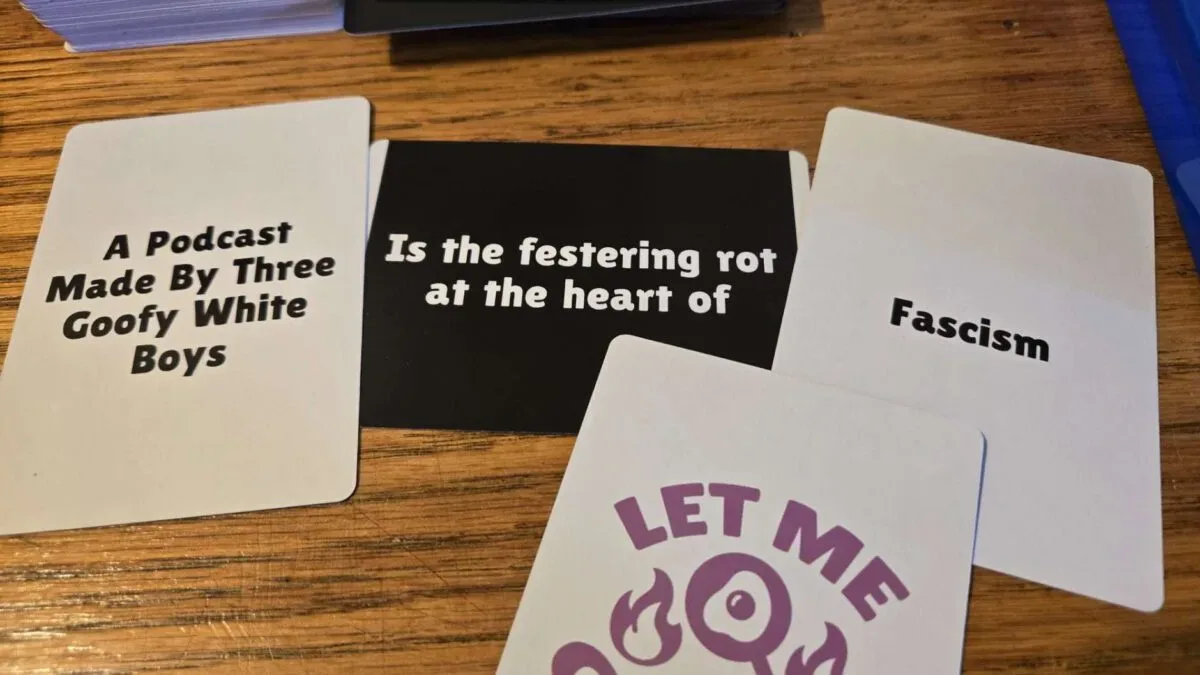
Both Die On This Hill and Debate and Switch turn deliberately silly propositions into social competition. Players assemble a topic, participants argue in favor of or against it, and other players vote for the argument they prefer. Crucially, both also allow words in the proposition to be swapped, changing the meaning of the debate after it begins.
That combination is the heart of Greszes’ concern. A debate game alone is a broad premise. Audience voting is likewise a familiar party-game device. Word substitution and fill-in-the-blank prompts are common structures, especially in games designed to generate absurdity. But Greszes argues that the shared package of mechanics—building a ridiculous proposition, debating it, voting, then altering its wording—looks far more specific when viewed together.
In Die On This Hill, players use word cards to construct mad-lib-style phrases. One example offered by Greszes is “math paved the way for ketchup.” Two players then take opposing sides, while those not arguing decide whose case was more convincing. The comic objective is not to establish truth; it is to defend nonsense with enough commitment and creativity to win over the room.
Footage Greszes found of Debate and Switch showed players creating a subject from fill-in-the-blank prompts, two players debating the resulting topic, an audience vote, and subsequent changes to words in the prompt. Those observed elements are the basis for his comparison.
A pitch that never became a deal
Greszes developed Die On This Hill after being laid off in 2024. He has described the central idea as a way to turn the exhausting experience of internet argument into something enjoyable: an invitation to make and defend ludicrous claims rather than fight over real ones.
By summer 2024, he had a working prototype. He launched a Kickstarter in November of that year, and the campaign met its funding target the following month, with some money beyond the goal. The project was not a major profit-maker for him after production and shipping expenses, he said. Its larger purpose was to make a finished game and put it in players’ hands.
Related coverage includes Solo Creator Says Jackbox's Debate and Switch Resembles His Board Game.
Greszes, who lives in the Chicago area near Jackbox Games’ headquarters, was already a devoted player of the company’s party packs and regularly hosted game nights. He thought a digital version could help Die On This Hill reach a much bigger audience, while recognizing he did not have the technical background to build that version alone.
He contacted Jackbox before physical copies went out to backers. Greszes says the parties had two lengthy meetings and discussed possible financial terms. He understood that his cut under a potential licensing arrangement would be small and that a digital version would need a lower price than the board game. He says those limits did not bother him; being recognised as the game’s creator and seeing it reach players mattered more.
There was, however, no agreement. Greszes says Jackbox asked to see a copy, and he asked whether the company would sign a document ensuring he would be involved if it chose to make a game based on his design. The company declined. Greszes says that response sounded reasonable at the time, and he proceeded without a contract.
When copies began shipping to backers in March 2025, he sent one to Jackbox. The company confirmed that it had received the game, Greszes says. In later follow-ups, he was told that nobody had had time to play it. After several emails spanning spring through winter, he concluded the prospective adaptation was not moving forward.
Why the calendar has become part of the debate
The reported sequence is central to why Greszes believes the similarity warrants an explanation. Die On This Hill arrived at Jackbox in March 2025. Greszes later saw videos about Debate and Switch, including a development discussion posted as a short video and footage from a live demonstration at PAX West 2026.
Jackbox releases party packs annually. Its catalog combines entirely new concepts with new entries built around returning favorites, such as Quiplash and Trivia Murder Party. In a 2021 GDC presentation, Jackbox CTO Evan Jacover described a yearly process with six months of active production. Greszes believes the March 2025 delivery would have been too late for that year’s pack but potentially early enough to fit a 2026 cycle.
That timeline may make the concern understandable, but it does not, by itself, establish how Debate and Switch was conceived or developed. A finished release date cannot reveal when a concept began, how far it had progressed before a pitch arrived, what internal prototypes existed, or whether its developers saw the submitted board game. Those are the important unanswered factual questions.
Jackbox Games was contacted for comment, but no response is included in the available information. Until the company addresses the matter, its account of the game’s origin, internal development timeline, and handling of Greszes’ copy is not public here.
Mechanics, expression, and the gap between legal rights and credit
Greszes has been clear that he does not see a straightforward legal route. That distinction matters. A game mechanic is a rule or system: voting after a debate, making prompts from cards, or replacing one word to change a prompt. An expression is the particular creative form in which an idea appears, such as written prompts, artwork, interface presentation, character work, audio, or specific text.
In broad terms, copyright is not a mechanism for owning an abstract game idea or a general ruleset. That does not make the underlying creative concern meaningless. It means there is a significant difference between proving a legal claim and explaining why a creator feels their contribution should be credited, discussed, or treated with care after they shared a prototype during exploratory business conversations.
Greszes is not asking for payment and has said he is not even seeking an apology. His preferred outcome is telling: he says he would have been thrilled by a heads-up, a special-thanks credit, and social promotion for Die On This Hill if the company believed its own version was sufficiently distinct. For him, this is substantially about attribution and professional respect, not simply ownership.
That distinction is useful for anyone pitching a game. An early conversation, a request for a sample, or a promising meeting is not the same thing as a licensing deal. A signed agreement can establish obligations and expectations; absent one, a creator may have little leverage even if a later project feels uncomfortably familiar. At the same time, companies routinely need the ability to evaluate pitches without accepting broad obligations, particularly in fields where overlapping concepts can emerge independently.
The difficult possibility of parallel design
“Convergent evolution” is the term Greszes used for the chance that two creators reach similar ideas on their own. In design, that can happen because constraints point people toward the same answer. Party games often need rules that are quick to explain, entertaining to watch, flexible across different group sizes, and capable of creating memorable nonsense. Prompts, performers, spectators, voting, and unpredictable word changes naturally serve those aims.
Yet independent creation is not a blanket answer to every concern. The closer two works appear in their sequence of play and combination of elements, the more reasonable it is for observers to ask for clarity about the chronology and the development process. It is possible to hold both thoughts at once: similarities do not automatically prove copying, and a creator who sees a familiar design appear after submitting their own game has a legitimate reason to be unsettled.
Creative-credit disputes are also a recurring industry pressure point, whether the conversation concerns a new party-game format or competing recollections of how a landmark multiplayer mode took shape. The recently reported disagreement between Doom veterans John Romero and Sandy Petersen over early deathmatch certainty shows how development histories can remain contested long after work begins. Read more about that Doom development dispute here.
What remains unresolved
The known facts establish that Greszes created and crowdfunded Die On This Hill, discussed a possible adaptation with Jackbox, and sent the company a physical copy in March 2025. They also establish that Debate and Switch includes several mechanics that he considers closely comparable. They do not establish intent, access by the eventual development team, or whether Jackbox had independently developed the concept before receiving the board game.
For now, the story is best understood as a dispute over resemblance, timing, and recognition—not a proven plagiarism case. Greszes’ reaction is nevertheless a reminder of the vulnerability felt by small creators who pitch work to much larger companies. His game began as an effort to make arguing fun. The argument now surrounding it is much less playful.