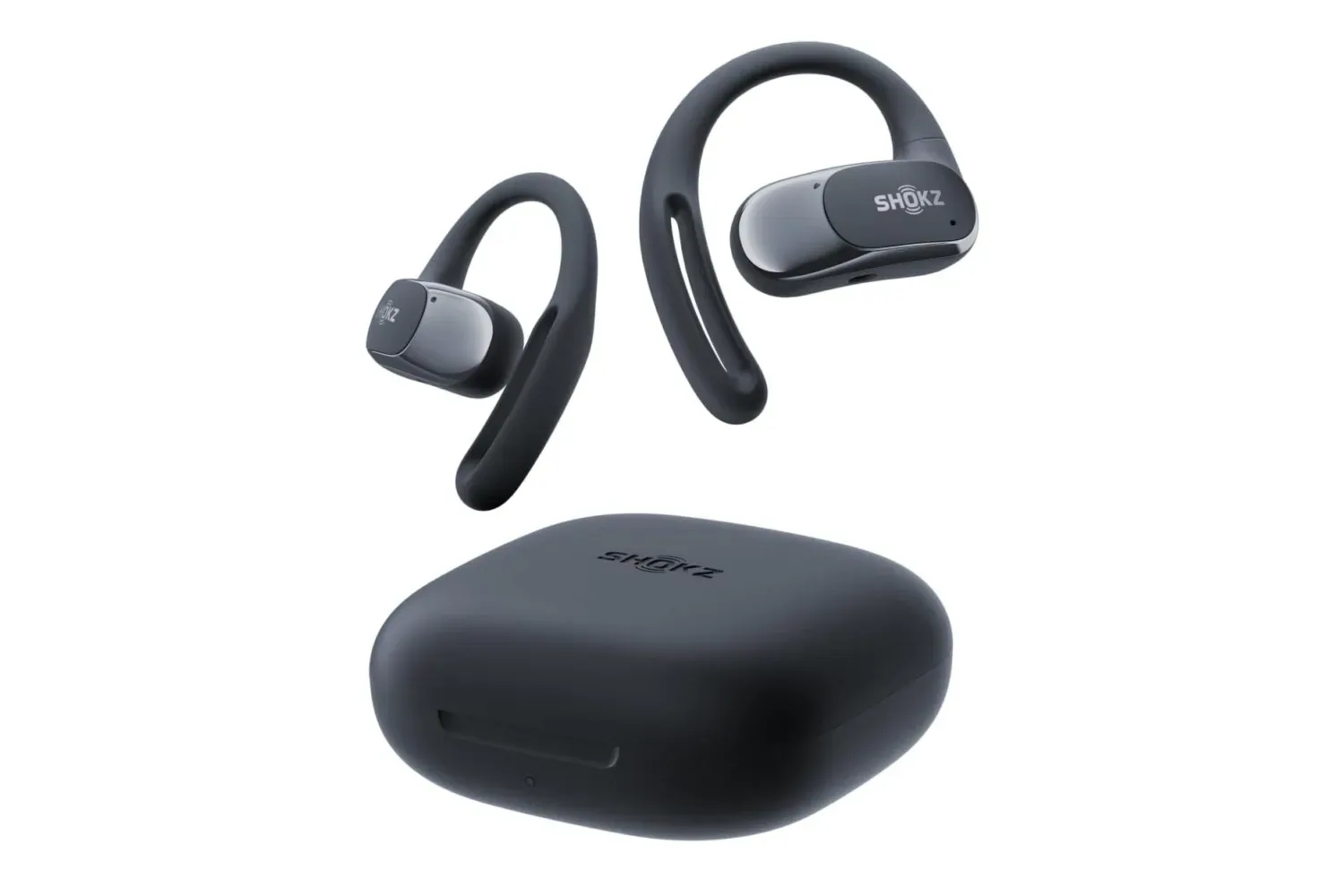
Shokz OpenFit Air wireless earbuds are listed at $90 in both black and white, a $30 reduction from their stated $120 regular price. The 25% reduction is described as an automatic cart discount rather than an offer requiring a coupon.
The price is the immediate headline, but the more meaningful distinction is the product category. OpenFit Air is an open-ear design: instead of sealing a speaker tip inside the ear canal, each bud uses an earhook and leaves the ear canal unobstructed. That makes these a very different proposition from conventional in-ear wireless buds, particularly for people who want to continue hearing their surroundings while music, a podcast, game audio, or a call is playing.
For a player who jumps between a phone, a handheld, a PC and a console setup, audio equipment can easily become another small point of friction. The OpenFit Air’s reported multipoint support, customizable controls and awareness-focused fit suggest that it is aimed more at flexible everyday listening than at shutting out the world. The trade-off is equally important: open-ear listening is not the choice for anyone whose main priority is isolating outside noise.
What the $90 listing includes on paper
The OpenFit Air’s listed specifications combine a lightweight adaptable earhook with Shokz’s DirectPitch audio technology and tuning holes. Shokz says this arrangement is intended to provide balanced sound while limiting leakage. In plain terms, sound leakage is audio that escapes the headphones and becomes audible to people nearby. It is an especially relevant concern with open designs, because the speaker sits outside rather than within the ear canal.
“Minimal” leakage should not be read as “no” leakage. There is a practical limit to what any awareness-preserving design can do: if listeners raise the volume substantially, people in very close proximity may still hear some of the audio. Buyers who regularly listen in silent libraries, shared offices or on quiet transit should keep that basic physical reality in mind. The OpenFit Air’s design is meant to balance personal listening with environmental awareness, not recreate the isolation of sealed buds.
The package of stated features includes:
- Open-ear construction that leaves the ear canal clear.
- Lightweight earhooks intended to remain stable while running, exercise or other movement.
- DirectPitch technology and tuning holes for audio tuning and reduced leakage.
- Four built-in microphones for calls.
- Multipoint pairing with up to two devices.
- An IP54 dust-and-water resistance rating.
- App-based EQ and button customization.
- Up to six hours of playback on the buds, with 28 hours total when the case is included.
- A quick-charge claim of two extra hours of playback from 10 minutes of charging.
Open-ear listening: useful awareness, different expectations
The chief attraction here is not simply comfort. An open-ear setup lets the listener remain aware of nearby traffic, announcements, colleagues, family members or a gym instructor without taking the earbuds out. That can be valuable for a walk or run, but it can also be useful at a desk when someone may need to get your attention, or during chores when full environmental isolation would be inconvenient.
It is worth separating awareness from active noise management. The supplied details describe an earbud that physically leaves the ears open; they do not establish active noise cancellation. Active noise cancellation, commonly abbreviated to ANC, uses microphones and processing to reduce outside sound. By contrast, OpenFit Air’s approach is primarily structural: ambient sound can reach the listener naturally because there is no in-ear seal blocking it.
Related coverage includes Shokz OpenFit Air Open-Ear Headphones Drop to $90 in Amazon Deal.
That distinction should guide buying decisions. Someone working near a busy road, traveling frequently, or seeking a private, immersive soundtrack may prefer the more enclosed feel of traditional earbuds. Conversely, someone who finds sealed tips uncomfortable or dislikes repeatedly removing one bud to talk could find the open format more natural. Neither approach is categorically better; they address different listening conditions.
The earhook design is also consequential. Earhooks are meant to distribute the bud’s weight around the outer ear and provide a more secure hold during motion. That may make more sense for exercise and walking than a loose, stem-style bud that depends largely on an ear-canal fit. Comfort remains personal, however. “Lightweight” and “secure” are useful goals, not universal guarantees, because ear shape and glasses use can affect how any hook-based design feels.
Calls, controls and two-device pairing
OpenFit Air has four built-in smart microphones, with the stated purpose of carrying a caller’s voice clearly. Multiple microphones can help a headset collect voice information and distinguish it from surrounding sound, but call quality still depends on the environment, connection and how much wind or background noise is present. The available information supports a calls-focused feature set, not a promise that noisy locations will disappear from every conversation.
Multipoint pairing is one of the more useful practical features. It means the earbuds can connect with two devices at the same time. For example, a listener could keep them linked to a phone and a computer, avoiding the ritual of manually disconnecting and reconnecting each time they swap devices. It does not necessarily mean two sound sources play simultaneously; its real convenience is allowing the earbuds to remain available to more than one paired device.
That flexibility is relevant to gaming-adjacent routines, even though these are not positioned here as a dedicated gaming headset. A player may use a phone for a call or music while working at a computer, then move to another device without treating the earbuds as a single-device accessory. Those who need platform-specific features, a boom microphone, wired latency options or detailed positional-audio controls should still compare purpose-built headsets rather than assuming any general wireless earbud will fill every role.
Button functions and EQ modes can be personalized through the Shokz app. EQ, short for equalization, lets a listener alter the balance between frequency ranges. Put simply, an EQ setting can emphasize or reduce parts of the sound such as bass or treble. It cannot turn one headphone design into another, but it can be useful for adjusting a default sound profile toward a listener’s preferences or for making speech-focused audio easier to follow.
The option to customize controls has a smaller but real quality-of-life benefit. Physical or touch-button shortcuts are most useful when they handle the actions a listener actually uses—such as play/pause, volume or skipping a track—rather than a fixed command that sits unused. App customization makes the OpenFit Air feel less locked into a one-size-fits-all setup.
Battery claims and what IP54 actually means
Shokz lists up to six hours of playback from the earbuds on one charge. The charging case contributes another 22 hours, for a stated total of up to 28 hours. The quick-charge figure is two additional hours after 10 minutes of charging.
“Up to” is the key wording in every battery specification. It signals a maximum claim rather than an unconditional result. Listening volume, call use and other usage variables can influence runtime, so prospective buyers should treat six and 28 hours as the manufacturer’s stated ceilings. Still, the combination of a six-hour single-charge figure and an additional 22 hours in the case gives a clear outline of the intended use: several shorter sessions before the case itself needs power, rather than a product designed for a single uninterrupted all-day session.
The IP54 rating needs similar context. IP stands for Ingress Protection, a rating that describes resistance to the intrusion of solids and water. In this case, the 5 indicates protection against dust, while the 4 indicates resistance to water splashes. That makes the rating relevant to sweat, workouts and ordinary outdoor use, but it is not a claim of waterproofing. It should not be interpreted as a reason to submerge the earbuds or use them as though they were protected for every water-related activity.
Who should consider the discounted OpenFit Air
At the listed $90 price, OpenFit Air looks most straightforwardly suited to listeners who specifically want open-ear comfort and awareness. That includes runners and gym users who want to hear instructions or activity around them, people who take calls while moving about, and listeners who prefer not to place a bud inside the ear canal. The adaptable earhook, app controls, dual-device connection and fast-charge claim reinforce that everyday-use focus.
It is less clearly suited to someone shopping purely for maximum seclusion, powerful isolation in loud locations, or an all-purpose competitive gaming headset. Open-ear audio’s advantage is its openness, which is also its inherent limitation when the surrounding environment is noisy. It is therefore best to decide on the format first and the discount second.
Anyone building a wider entertainment setup may also want to weigh audio choices alongside display and connectivity needs. For example, a recently listed Sony Bravia 6 OLED deal focuses on four HDMI ports for console setups, a very different kind of purchase but one that illustrates how device roles matter more than a headline discount alone.
For buyers whose use case matches the OpenFit Air’s awareness-first design, the present $30 reduction is simple: both colors are listed at $90, and no coupon step is described. As with any retailer price, availability and the listed amount can change, so it is sensible to verify the final cart total and the color selection before checking out.
Shop the products
Check current price, model and availability at the retailer.