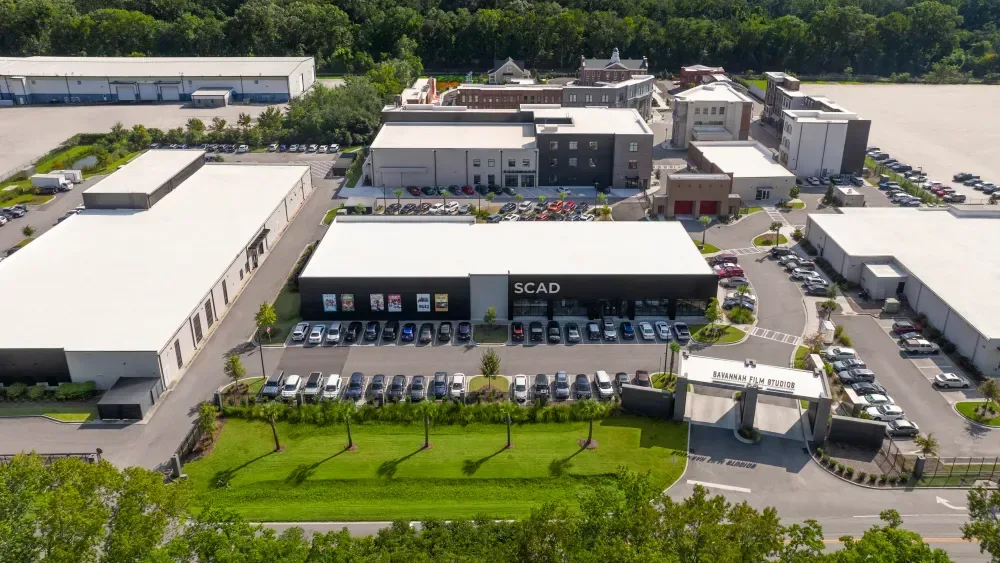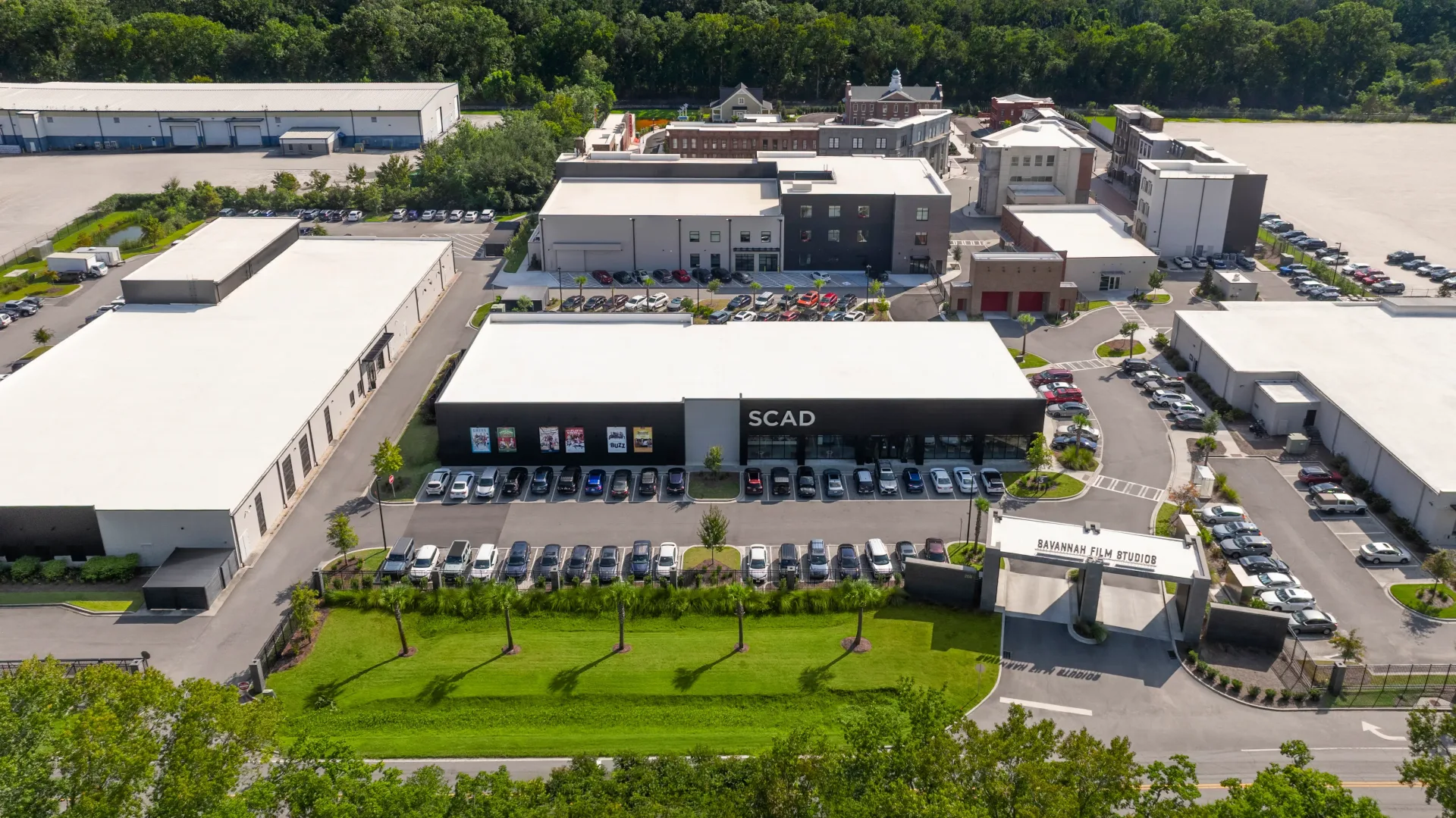
Savannah College of Art and Design has completed an expansion of SCAD Film Studios in Savannah, Georgia, creating a much larger production environment designed to serve both professional crews and students. The 16-acre complex now includes more than 50 backlot façades, practical interior spaces, two purpose-built soundstages of nearly 9,000 square feet, and a 17,000-square-foot building for production design and costume design.
The school describes the site as the world’s largest university film studio complex. Its central proposition is straightforward: students can learn in facilities intended for working productions, while productions can access emerging performers and below-the-line creative talent within the same campus environment.
That matters beyond the headline size of the build. Film and television work is collaborative, and the expansion combines several parts of a production pipeline that are often separated: controlled stages, exterior-looking street sets, interior sets, and departments that design scenery and costumes. In practical terms, the facility is intended to let a project move among those needs without leaving the broader studio complex.
A backlot built for adaptable locations
The heart of the Savannah expansion is a Hollywood-style backlot with more than 50 façades. A façade is the outward-facing side of a constructed building or set. For filmmaking, it can provide the visual identity of a location—such as a row of city homes or a commercial street—without requiring a production to use a real public location.
SCAD says its collection can stand in for settings ranging from historic Savannah to New York City streets and small-town America. The named elements include brownstones, storefronts, restaurants, urban alleyways, a subway entrance and a suburban neighborhood. This variety is significant because a single story may require sharply different-looking places, even when its schedule and budget do not allow extensive company moves.
The facility also includes practical interiors. In screen-production language, “practical” generally means an element that physically exists and can be used on camera, rather than being only a flat visual surface or something added later through digital effects. A practical interior can allow performers and crew to continue a scene from an exterior-facing setting into a usable indoor room.
That exterior-to-interior continuity is among the most functional aspects of the new lot. A production may film a character approaching a storefront, entering the doorway and continuing the action inside with fewer changes in visual logic. It does not eliminate planning, lighting work or set dressing, but it gives filmmakers a physical environment built to support such transitions.
Why soundstages remain a core production tool
The final phase of the project brings two professional soundstages, each described as nearly 9,000 square feet. A soundstage is an enclosed, controlled studio space where a production can build sets and manage lighting, sound and shooting conditions more predictably than it can outdoors.
For an institution that wants to accommodate professional work, this controlled space is not simply an add-on to the visible backlot. Exterior sets offer recognizable architecture and streetscape texture, but they remain subject to the needs of outdoor filming. Soundstages provide a different kind of flexibility: a production can construct a setting, rehearse it, light it and alter it for successive scenes within a more contained environment.
The adjacent 17,000-square-foot production design and costume design building ties that work to the departments responsible for a production’s visual world. Production design covers the overall look and physical environment of a screen project, while costume design concerns what performers wear and how wardrobe supports characters and story. Housing facilities for those disciplines alongside stages and sets creates a closer relationship between preparation and filming.
SCAD has framed the development as a place where productions can locate professional soundstages, a large backlot, technology and emerging artists in one destination. Andra Reeve-Rabb, dean of the SCAD School of Film and Acting and executive director of SCAD Casting, said the school’s model is to bring industry work directly to students rather than waiting until after graduation to make those connections.
“Our students aren’t watching the industry from the sidelines,” Reeve-Rabb said. “They’re working alongside the professionals who will become their future colleagues.”
Professional projects are already using the space
The new stages have already been tied to named entertainment projects. Leslie Odom, Jr., who recently joined SCAD as an artist-in-residence with actor and singer Nicolette Robinson, will develop and rehearse his upcoming national holiday tour on one of the new soundstages.
Students are helping build sets for that production and will observe the creative and rehearsal process as Odom prepares for a tour running from November 27 through December 22. The detail is a concrete example of the campus-production model the studio expansion is intended to support: students are not only studying the finished work, but participating in a specific production task before it goes on the road.
American Idol is also using SCAD Film Studios facilities. The school says the project creates opportunities across disciplines including acting, on-camera performance, production design and behind-the-scenes work. No further detail on the scope of that use was provided, but the involvement of a major television program shows the complex is being used for more than internal coursework or student shoots.
For students, proximity to professional activity can have practical value precisely because the departments mentioned are different from one another. A performer, a set builder, a costume designer and a production-design student may all be working toward the same on-camera result, but each sees a different piece of the process. A facility that brings those roles together can make those dependencies more visible.
Savannah and Atlanta form a wider SCAD production footprint
The Savannah site is complemented by SCAD Film Studios in Atlanta, which includes an LED volume stage, broadcast studios and editing facilities. An LED volume is a production setup that uses large LED screens to display digital backgrounds around performers and sets. It is a different tool from a physical backlot: rather than shooting against a constructed street or neighborhood, a production can display a digital environment in camera.
The two locations therefore represent different production resources. Savannah’s expansion emphasizes physical façades, usable interiors, soundstages, production design and costume work. Atlanta adds broadcast, editing and LED-volume capabilities. Together, they give SCAD a broader set of settings in which students and visiting productions can work.
The expansion also arrives at a time when studio infrastructure itself is an important part of entertainment-industry capacity. Productions need more than a camera-ready exterior: they require locations, stages, skilled craftspeople, technical spaces and post-production resources. A university complex cannot be assessed solely by the number of façades or square footage, but those details indicate the types of work the site is designed to handle.
For readers tracking the business side of media, studio facilities and the people who support them remain central to how entertainment projects are made. That wider industry infrastructure is also reflected in recent media-industry leadership news, though SCAD’s announcement is focused on physical production capacity and education rather than corporate staffing.
What the expansion changes—and what remains unspecified
The completed project gives SCAD Savannah a sizable, purpose-built film environment with physical locations and professional stages in one complex. Its most tangible additions are clear: a 16-acre setting, more than 50 backlot façades and practical interiors, two stages nearing 9,000 square feet each, and a 17,000-square-foot building supporting production and costume design.
It also establishes a stated educational purpose. The university is positioning access to professionals and active productions as part of the student experience, with Odom’s tour preparations and American Idol facility use serving as early examples.
What has not been detailed is just as worth separating from the confirmed information. There is no stated project cost, booking calendar, roster of additional productions, or breakdown of how the stages and backlot will be allocated between outside productions and student work. There are also no technical specifications given for the stages beyond their approximate size. Those questions may matter to prospective productions and students, but they cannot be answered from the information currently available.
Still, the expansion gives Savannah a newly enlarged screen-production venue whose main assets are unusually visible: streets, storefronts, brownstones, alleys, a subway entrance, suburban spaces and interiors that can connect directly to exterior scenes. Combined with dedicated stages and design facilities, that is a deliberately broad foundation for productions and for students learning the crafts that make screen worlds feel complete.