
Rockstar says roughly 1,000 employees, representing 21% of its workforce, have been at the company for more than a decade. It is a striking number in an industry where restructurings routinely remove experienced people alongside newer hires, and where the human cost of a major release can be obscured by the size of the game itself.
The statistic lands in the enormous shadow of Grand Theft Auto 6. A project of that scope is often discussed in terms of budget, years in production, technical spectacle, and commercial expectations. But the company’s long-tenured staff points to a less flashy ingredient: people who have spent years learning how one studio plans worlds, solves production problems, moves work between disciplines, and decides what belongs in a Rockstar game.
That is not a claim that longevity alone makes a game successful, nor does it mean every person with extensive tenure worked on every release. Rockstar’s own figure does, however, put a number on something that is unusually difficult to preserve: a deep bench of people with long familiarity with a studio’s methods and standards.
It also does not make Rockstar a simple good-news story. The company fired 34 employees associated with a union in 2025, and disputes around those dismissals and the union remain unresolved. Allegations of continued crunch have also resurfaced, while GTA 6 developers have reportedly worried about possible layoffs. The same moment can therefore contain two truths: a studio may retain a substantial veteran workforce, and workers may still lack security or face serious workplace concerns.
What a decade at one studio can mean
“Institutional knowledge” can sound like business jargon wearing a lanyard, but it describes practical knowledge that rarely fits neatly into a design document. It includes knowing why a technical pipeline works in a particular order, which compromises created problems on an earlier project, who can diagnose a difficult issue, and how a team’s creative intentions survive the journey from an early idea to a shippable feature.
For a studio making vast open-world games, that knowledge can exist across many roles. Artists may understand the conventions used to build environments efficiently. Programmers may know the assumptions behind tools and systems that have evolved over multiple projects. Designers, producers, testers, writers, audio teams, and support staff may each carry a different portion of the map—sometimes literally, often metaphorically.
A lengthy development cycle can help a team develop complex work, but continuity changes the character of that time. New employees can bring essential skills and fresh perspectives. Long-serving staff can supply context: what was tried before, what proved expensive, what a particular system was designed to accomplish, and where a seemingly small adjustment might have unexpectedly wide effects.
This is especially relevant to games built from interlocking systems. Open-world production is not simply making a large number of separate missions or locations. Traffic, pedestrians, animation, physics, missions, sound, user interface, performance, and countless supporting tools must coexist. A change in one area can force revisions in another. Familiarity with that chain of dependencies is valuable even when the result is invisible to players.
Related coverage includes Rockstar Says Around 1,000 Employees Have Stayed for More Than a Decade as GTA 6 Dominates.
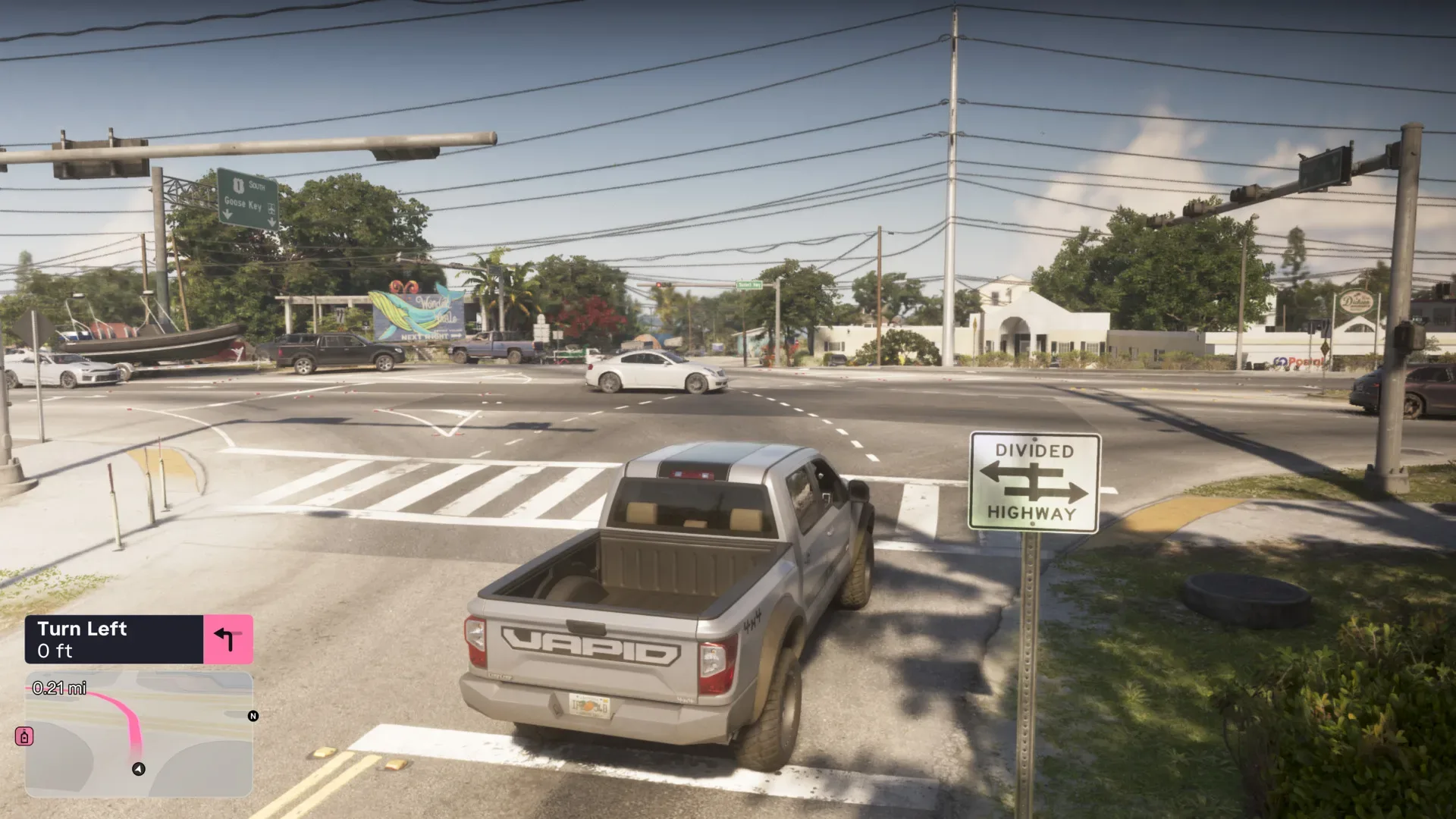
Joking Joystick has previously considered how GTA 6’s Leonida traffic could function as a source of systemic chaos. Whether players notice it as a technical system or simply as an entertainingly inconvenient roadblock, work of that kind depends on many connected decisions. Veteran staff are not the only people capable of making those decisions, but their accumulated context can reduce the need to rediscover old lessons in the middle of a giant production.
A useful number, not a complete verdict
The 21% figure is meaningful, but it needs careful reading. It says about one-fifth of Rockstar’s workforce has more than 10 years at the company. It does not establish the tenure of every team, whether those employees all worked directly on GTA 6, or how the company treats the remaining majority of staff.
Nor should two big releases over that span—Red Dead Redemption 2 and Grand Theft Auto 6—be treated as a small amount of work merely because the list is short. Games of that size demand years of planning, iteration, coordination, and support. The point is not that a decade at one company automatically produces masterpieces. The point is that a studio’s identity and production memory are built through sustained work, including the less visible work between launches.
There is a broader industry lesson here. Companies often describe layoffs as a response to changing budgets, schedules, or strategy. Those pressures can be real, but headcount is not interchangeable in the way a spreadsheet can imply. Replacing a role may be easier than replacing the history attached to it. A departure can mean the loss of someone who knows a particular tool, a difficult relationship between systems, a past production failure, or the informal network that helps teams unblock work quickly.
That does not mean studios should become closed shops in which only veterans matter. Healthy teams need hiring, mentorship, and room for new voices. The stronger model is not “keep everyone forever” as an empty slogan; it is treating experience as an asset worth transferring, renewing, and retaining rather than as an easy line item to cut after a project reaches the finish line.
Why the comparison with Nintendo resonates
Long careers in game development are not unheard of. Nintendo provides a particularly memorable example: five developers credited on the original Super Mario Bros. were still credited on Super Mario Bros. Wonder nearly four decades later. Rockstar has not existed for that length of time, but its credits include people whose time at the company reaches back to the PlayStation 2 era, when the GTA series was rapidly becoming a cultural force.
The comparison should not erase the major differences between companies, franchises, and creative structures. It does illustrate the same underlying point, though: continuity can survive multiple hardware generations and shifts in game design. When it does, the benefit is not necessarily nostalgia. It is a reservoir of craft knowledge paired with a current team’s ideas and technologies.
That reservoir is hard to quantify. A percentage of tenured workers is a useful snapshot, not a measurement of morale, quality, or working conditions. Still, it offers a counterweight to the belief that blockbuster production is powered solely by scale. More money and more staff can expand what a project attempts. They cannot instantly manufacture a shared understanding of how a particular studio brings an ambitious game together.
The contradiction facing GTA 6 staff
Rockstar’s reported veteran retention makes the anxiety surrounding layoffs more pointed, not less. A major release can be a period of heightened vulnerability because a company’s needs change after a huge development push. Employees who helped build a project may reasonably fear that their role will be reassessed once that project is out the door, even if the game is commercially successful.
This is why commercial scale is not the same as employment protection. Being associated with a blockbuster does not guarantee that a worker will be kept, and a company’s ability to retain many veterans does not settle questions about which workers get stability, who has a meaningful voice at work, or whether intense production schedules are sustainable.
The 2025 firings of 34 union-associated employees remain central to that distinction. Any discussion of Rockstar’s long tenure should include it rather than using the 1,000-person figure as a convenient victory lap. Retention is valuable; workers’ ability to organize and raise concerns is also valuable. These are not competing concepts.
The practical takeaway for the wider industry
Rockstar’s number does not provide a universal formula for making a hit. It does offer a reminder that experienced teams are part of the infrastructure behind games that appear impossibly large from the outside. Executives can count years of service, but the more important question is whether their decisions preserve the conditions that let expertise compound.
- For studios: veteran staff can anchor tools, production practices, and mentorship during long projects.
- For workers: tenure is meaningful experience, but it is not a substitute for fair labor practices or genuine job security.
- For players: the polish and coherence of a massive game are often connected to years of largely invisible collaborative knowledge.
GTA 6 may be an extreme example because of its scale, but the principle is ordinary: experienced people make difficult work more achievable. The uncomfortable part is that the games business still too often treats that experience as disposable precisely when it has become most valuable.