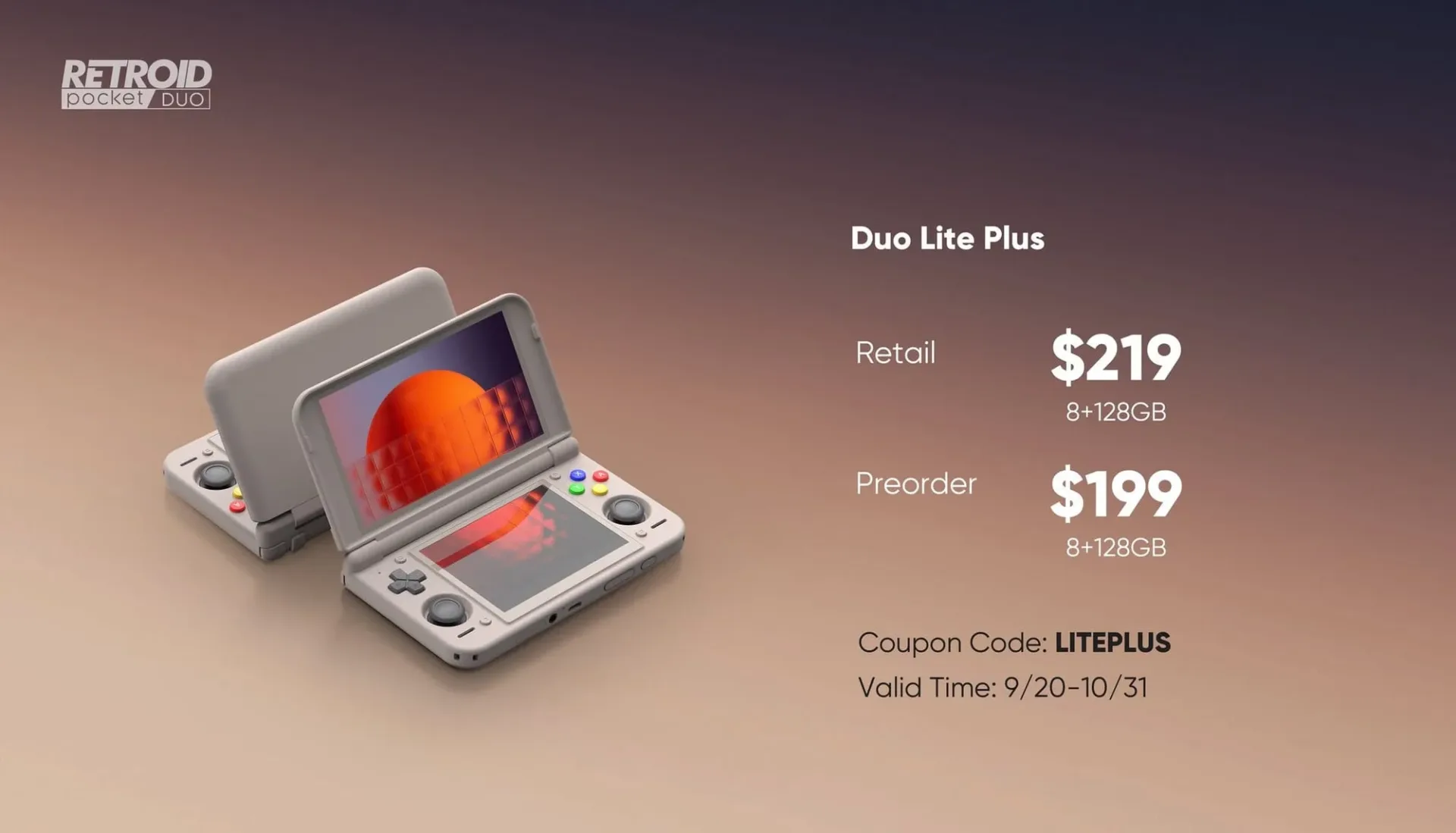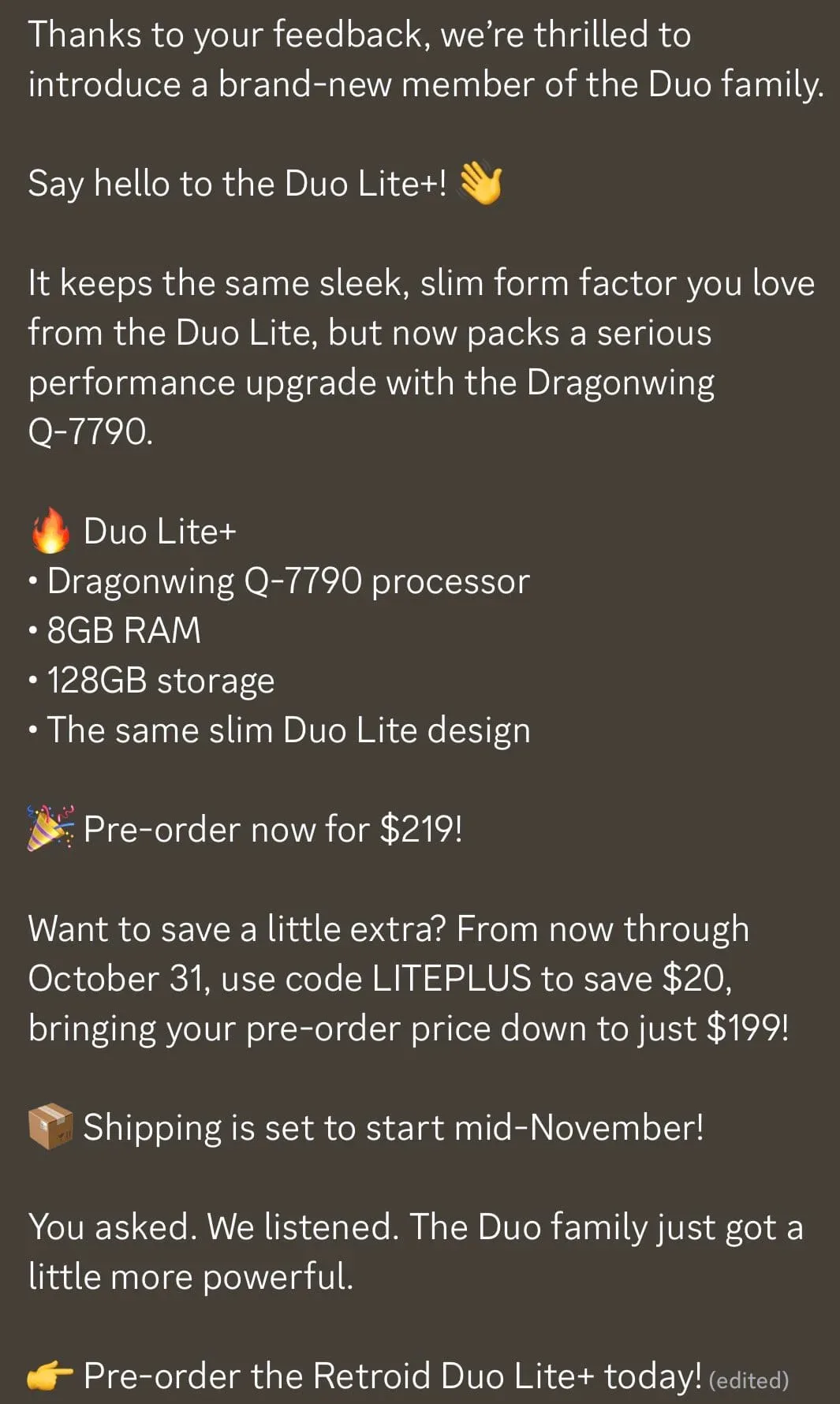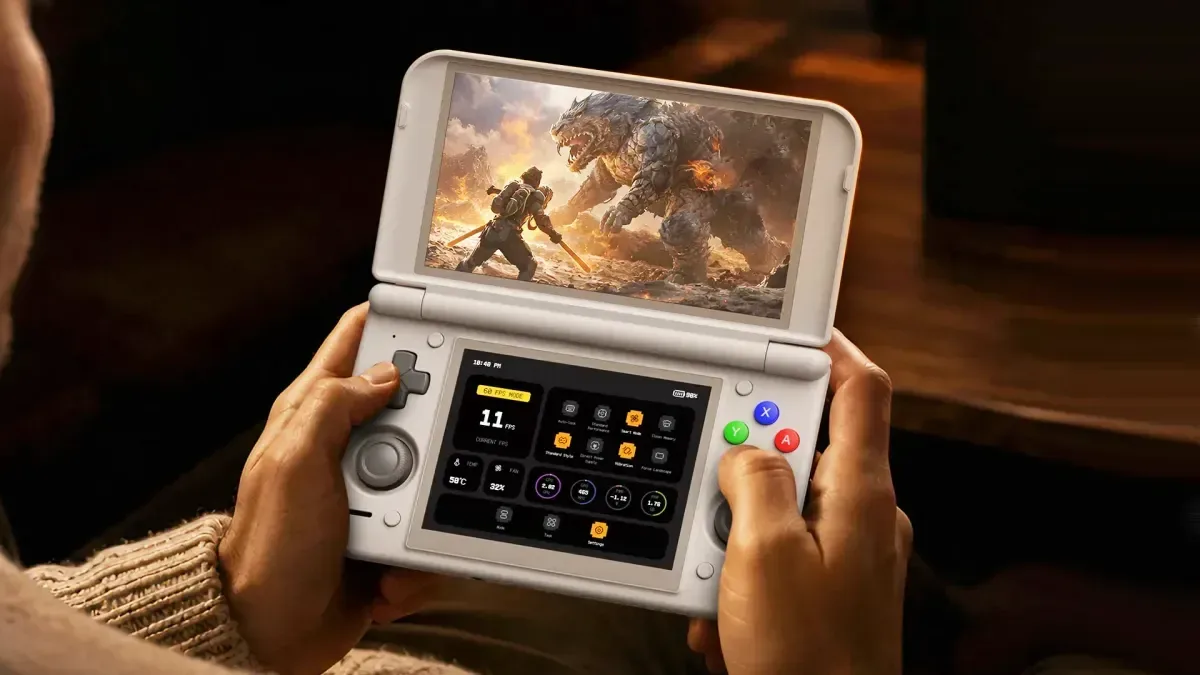
Retroid has expanded its upcoming Duo handheld range with the Duo Lite+, a higher-spec version of the slimmer dual-screen Duo Lite. It retains the Lite model’s compact physical design and Dragonwin Q-7790 processor, while increasing memory and storage to 8GB of RAM and 128GB of internal storage.
The new configuration is listed at $199 during pre-orders through Retroid’s official website and $219 at retail. It is expected to begin shipping in mid-November, later than the previously revealed Duo and Duo Lite models.
On the face of it, the Lite+ is a straightforward additional choice: more memory and storage for people who prefer the Lite’s design. But the reaction has focused less on whether an 8GB option should exist and more on when it was introduced. The original Duo Lite offering comprised 4GB/64GB and 6GB/128GB variants, and customers had already been able to pre-order those machines before the Lite+ appeared.
That distinction matters in a pre-order market. Buyers are not only selecting a device; they are committing money based on an available specification list and a perceived place within a product line. When a stronger option arrives before the earlier orders have all reached customers, some will understandably ask whether they made a decision with the complete set of choices in front of them.
What the Duo Lite+ changes
The Duo Lite+ does not appear to be a new chassis or a processor revision. Its stated specifications keep the Dragonwin Q-7790 used by the other Lite versions, along with the same overall Duo Lite design and more compact shoulder buttons. The key changes are its 8GB of RAM and 128GB of storage.
RAM, or random-access memory, is the fast working memory used by a device while programs are running. It is separate from permanent internal storage. More RAM can provide additional breathing room for the operating system and applications running at once, though the supplied details do not establish a specific performance result in any game or emulator. Because the processor remains the same, it would be a mistake to present the Lite+ as proof of a fundamentally faster platform solely on the basis of its RAM figure.
Internal storage is the space available for installed applications, files and system data. The Lite+’s 128GB capacity matches the previously announced 6GB Duo Lite rather than increasing the line’s maximum storage figure. In practical buying terms, the Plus model’s meaningful capacity difference is therefore against the 4GB/64GB Lite, while its main step above the 6GB/128GB Lite is memory.
Its display arrangement remains part of the broader Duo proposition. The Duo Lite has a 4.2-inch TFT secondary screen, while the standard Duo has a 4.5-inch AMOLED secondary display. TFT is a common LCD display technology. AMOLED refers to a display type in which pixels emit their own light; that is a different panel approach, not merely a different size label. The available information identifies the panels and their sizes but does not provide enough detail to make broader claims about real-world image quality, brightness, colour, or battery behaviour.
Related coverage includes Retroid Adds Duo Lite+ With 8GB RAM and 128GB Storage.
Where the Lite+ sits beside the standard Duo
Retroid’s revised lineup gives potential buyers a more crowded decision than it initially did. The Lite+ has 8GB of RAM and 128GB of storage, but the standard Duo is positioned as the more powerful model and has dual AMOLED displays, larger secondary-screen dimensions, and flared shoulder buttons. The Lite family, meanwhile, is framed around a slimmer body and more compact shoulder controls.
There is also an awkward value question at the stated retail prices. The Duo Lite+ is $219 at retail, which puts it only $50 below the standard Duo. That does not automatically make the Lite+ a poor fit. A smaller or more minimal physical design can be a legitimate preference, particularly when control shape and portability matter more to an individual than display technology. Still, the narrow difference means buyers should compare the whole hardware package, not merely treat the Plus name or the 8GB RAM number as a shorthand for the best option.
- Choose by design first: the Lite line is the slimmer option with compact shoulder buttons, while the standard Duo has flared shoulder buttons.
- Separate memory from processing power: the Lite+ has more RAM than earlier Lite configurations, but it still uses the stated Dragonwin Q-7790 processor.
- Compare the panels directly: the Lite’s secondary screen is 4.2-inch TFT; the standard Duo’s secondary screen is 4.5-inch AMOLED.
- Check the timing: mid-November shipping is stated for the Lite+, later than the earlier Duo and Duo Lite models.
- Price the complete choice: the Lite+’s $219 retail price is $50 below the standard Duo’s stated comparison point.
The bigger issue is confidence, not the extra configuration
Retroid has said the new Lite+ was created in response to customer feedback. An additional specification can certainly be read as an attempt to address demand. The trouble is that buyers who selected an original Lite variant may see the move differently: as a late upgrade path announced after they had already committed to a lower-memory device.
This concern is heightened by criticism surrounding earlier Retroid product decisions, including changes to D-pad arrangements and the arrival of newer models only months after shipping started. Those past issues do not determine the Lite+’s hardware quality, and an expanding catalog is not inherently anti-consumer. Hardware companies routinely revise configurations as components, demand, and product plans change. But repeated surprises can create a pattern in customers’ minds, especially among people who buy early.
For a manufacturer, “more choice” works best when customers can understand the roadmap early enough to act on it. Clear distinctions between variants, a candid explanation of why a new option is being added, and an obvious way to adjust an unfulfilled order can all reduce the feeling that early buyers were penalized for moving first. The supplied details do not indicate whether existing Duo Lite pre-orders can be altered, so prospective customers should not assume an upgrade or cancellation route without checking the terms of their own order.
There is a further uncertainty around fulfillment. The Lite+ announcement came before the stated mid-November shipping window for that version, but social-media posts have claimed that some original Lite units may already have shipped. Those claims are not enough to establish a complete shipping status. They do, however, explain why the announcement has landed differently for different customers: a buyer still awaiting dispatch may see time to reconsider, while a buyer whose order is already in transit may have no realistic opportunity to change course.
How prospective buyers can read the announcement
The sensible response is not necessarily to wait indefinitely for a hypothetical “Duo+.” It is to buy the model whose disclosed combination of controls, screens, memory, storage, price, and delivery timing already suits the intended use. Hardware planning always involves uncertainty, but consumers should not need to buy on faith that a better configuration is not around the corner.
Anyone considering the new model should first decide whether the Lite’s compact design is the actual priority. If it is, the Lite+ provides the highest stated memory specification in that design. If display technology, the larger secondary screen, and flared shoulder buttons are more important, the comparatively small retail-price gap to the standard Duo deserves careful attention. Buyers weighing broader portable gaming software developments can also follow recent work on touch controls and texture-pack handling in ARMSX2, though the Duo Lite+ announcement itself does not specify compatibility or performance for that software.
The Lite+ therefore represents two things at once. It is a legitimate new configuration with 8GB of RAM and 128GB of storage in Retroid’s slimmer dual-screen design. It is also a test of whether the company can persuade pre-order customers that product flexibility is being delivered with sufficient transparency. The hardware may broaden the range; the timing has made trust the more consequential specification.