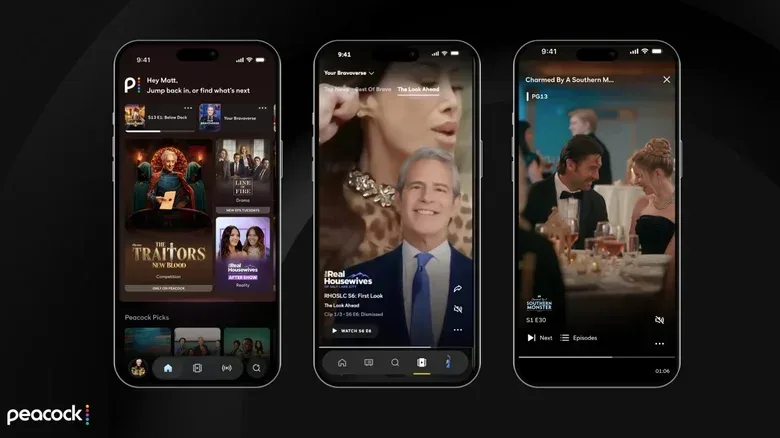
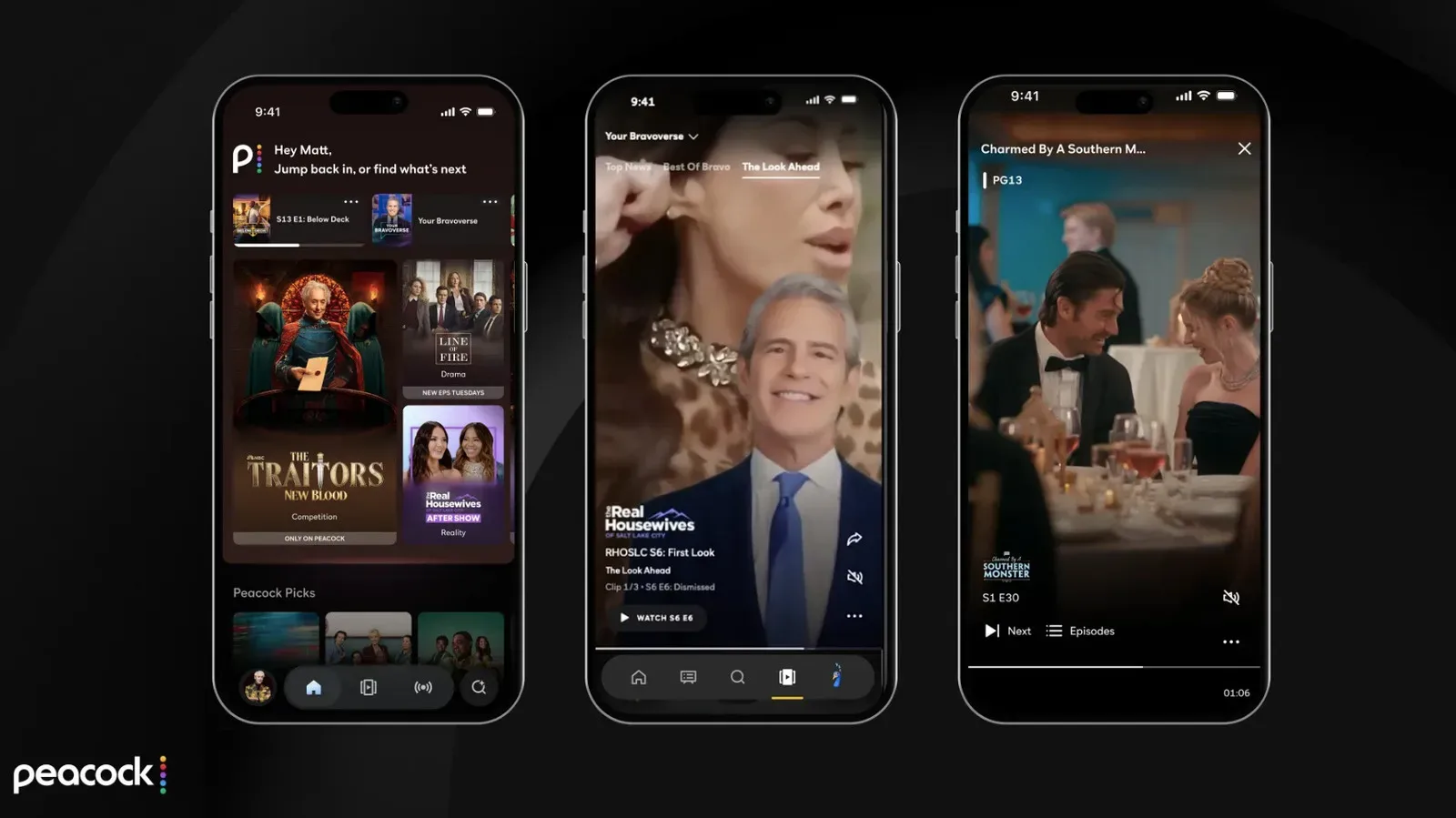
Peacock is reshaping its mobile app around an increasingly familiar proposition: if people spend more time watching short, vertically framed video on their phones, a streaming service should meet them there instead of waiting for them to choose a full episode on a television.
The NBCUniversal service is rolling out a substantial mobile redesign in phases, a process that could extend until next year for all users. Vertical video is a major component, but the planned update reaches beyond a TikTok-style clip feed. Peacock also intends to build franchise-specific hubs, add interactive experiences including small games, develop a membership program with external perks, experiment with live vertical programming and introduce generative-AI-powered conversational search.
It is a broad attempt to make a subscription video app feel more like a destination users open repeatedly throughout the day. Company chairman Matt Strauss framed the goal in direct engagement terms: Peacock is trying to gain another hour per user each month.
“We recognize that we have to start thinking of ourselves less as a streaming platform and more of an entertainment platform,” Strauss said. “How do we super serve our franchises and our fandoms where the best experience is on our app?”
That language matters because it describes a shift in what Peacock is asking mobile viewers to do. A conventional streaming interface is primarily organized around finding a movie, show or live event, then pressing play. The redesign instead suggests a cycle of discovery, short-form viewing, franchise exploration, interactive features and, ideally for Peacock, eventual viewing of full episodes or live programming.
Vertical clips are meant to be a bridge, not just a feed
Short vertical clips are the most visible part of Peacock’s strategy. The format is designed for a phone held upright and is already central to social video services. Peacock’s apparent hope is that clips can hold subscribers’ attention in the app while also pointing them toward longer shows on a TV.
That makes vertical video less of a replacement for conventional streaming than a funnel into it. A quick scene, highlight or franchise-related clip may be easier to sample than committing immediately to an episode. If it works as intended, the mobile app becomes a place for casual discovery and the television remains a place for longer viewing.
There is an important distinction between this use of short video and merely posting promotional material elsewhere. Peacock is building the experience inside its own app, where a clip can sit alongside an associated show, a franchise page or other app features. That gives the service a more direct route from a brief viewing session to its wider catalog.
The plan also includes continued experiments with live vertical video. In simple terms, that means a live presentation adapted for portrait-oriented phone viewing rather than presented only in the traditional widescreen shape associated with TV broadcasts. The supplied details do not specify which events or programs will receive that treatment, so viewers should not assume every live offering will be available in that format.
A coming dynamic video player is intended to automatically choose vertical or horizontal presentation depending on the device. The practical purpose is to reduce friction: portrait video fits a handset held upright, while landscape video better suits wider screens and conventional video framing. The exact rules that will determine those switches have not been detailed.
Franchise hubs turn titles into ongoing destinations
Peacock is also creating fandom hubs for franchises including the Bravo-verse and The Office. These will combine short videos with affiliated experiences. Rather than treating a series as a single tile that leads to a season list, a hub can give fans several reasons to remain within a particular fictional, sports or reality-TV corner of the app.
The most notable example is Law & Order, whose page is planned to include small video games. Peacock has not identified the games or explained their mechanics, so it would be premature to describe them as full games or to assume they will be available across every platform. Still, their presence signals an interest in low-barrier interactivity: something a person can play with between clips or while browsing a favorite franchise.
For Joking Joystick readers, that is the particularly interesting wrinkle. A mini-game embedded within a television franchise page is not necessarily an attempt to compete with a console game. It is better understood as an engagement tool: an activity linked to a fandom that can make the page feel less static. The key question will be whether these experiences have enough personality and replay value to feel additive rather than promotional.
The approach places Peacock in a wider entertainment pattern where shows and brands are treated as expandable spaces rather than discrete videos. A fan may watch a clip, browse related material, interact with a small game, search for an actor or character, then move into a complete episode. For a recent example of how streaming franchises can encourage viewers to navigate connected screen stories, Peacock’s broader television competition includes projects discussed in this guide to the WandaVision trilogy’s watch order.
Sports information is planned alongside the live feed
The NBA hub is intended to take a different route. Peacock says it will provide easy access to player statistics and deeper game information directly beneath a live feed in a dual-screen view.
A dual-screen view, in this context, means the live video and accompanying information are visible in the same app layout rather than requiring viewers to leave the game and search somewhere else. On a phone, that could be useful for a viewer who wants context without surrendering the live stream. The source material does not detail the layout, the full list of statistics or how broadly the feature will be offered.
The idea is straightforward: sports audiences often seek facts while watching—player numbers, game context and other information—but mobile viewing has limited screen space. Putting information beneath the feed aims to preserve the match or game as the focus while making the app a more useful companion. Whether it is genuinely convenient will depend on readability and how much of the video it occupies, details that have not yet been provided.
AI search could change how users ask for a show
Peacock is integrating generative AI for conversational AI search. Traditional streaming search asks users to enter the exact title, performer or keyword they have in mind. Conversational search is meant to accept a question or more natural-language request.
For example, the concept is designed around describing what one wants rather than necessarily knowing the precise name of a program. Peacock has not provided examples of prompts, performance claims or a launch timetable for the feature, so its practical capabilities remain unclear.
Generative AI is the technology label commonly used for systems that generate responses from patterns in data. In a search setting, the promise is flexibility: users may be able to phrase requests conversationally. The obvious test is accuracy. A useful system needs to return relevant results and make it clear how those results connect to the request. That will matter especially in a service built around a mixture of entertainment franchises, movies, shows and live content.
There is also a product-design reason for adding this feature to a mobile overhaul. Small phone keyboards make typing exact titles less convenient, while a conversational request can potentially speed up discovery. But the redesign’s stated aim is engagement, not simply reducing search time, so this tool appears to be one piece of a larger effort to keep navigation, recommendations and fandom activity within Peacock.
A membership program adds rewards, but the details are still thin
NBCUniversal is teasing a membership program for eligible Peacock subscribers. It is expected to offer exclusive rewards, benefits and activities tied to the movies and shows people enjoy. The available information indicates that eligibility may be linked to how long someone has subscribed.
Named examples of perks include temporary Instacart memberships and a subscription to New York Times Cooking. Those are external benefits rather than additional details about Peacock programming itself, and the scope, duration and qualification requirements have not been specified.
The practical implication is that Peacock may be looking at retention as well as viewing time. A reward system based in part on subscription tenure can give people another reason to keep an account active, even during a period when they are not watching a particular series. Until eligibility and terms are spelled out, however, subscribers should view the program as an announced direction rather than a defined benefits package.
Microdramas fit the phone-first strategy
The company also plans to continue investing in microdramas: serialized dramas made from very short installments, often around a minute each, that combine into a larger story. Peacock has already released Charmed by a Southern Monster, described as its first scripted microdrama.
Microdramas are naturally compatible with a mobile strategy because their individual episodes are built for brief viewing windows. A person need not set aside the time associated with a standard television episode to follow one installment. Paired with vertical video, they could give Peacock original material that is designed around quick mobile visits rather than being clipped down from a traditionally formatted show.
That does not mean every short clip is a microdrama. A clip may be a standalone excerpt or promotional item; a microdrama is a deliberately serialized story told through short chapters. Peacock’s move toward both formats suggests it wants material for multiple forms of mobile attention: quick browsing, short narrative follow-through and eventual longer-form viewing.
Why Peacock is making the change now
The overhaul arrives after Peacock reached profitability for the first time and recorded two consecutive profitable quarters. No financial figures are provided here, and there is no basis yet to connect those results directly to the redesign. The mobile release is still phased, and its impact on watch time, retention or profitability will only become clear after it reaches users and operates at scale.
What is clear is the intended measurement: more time per user. Peacock is not presenting vertical video, franchise hubs, mini-games, sports data, membership rewards and AI search as unrelated features. Together, they form an effort to turn a mobile streaming app into a flexible entertainment environment—one that can offer a quick clip, a tiny interactive diversion, a live sports companion or a route back to a full episode without asking the user to go elsewhere.