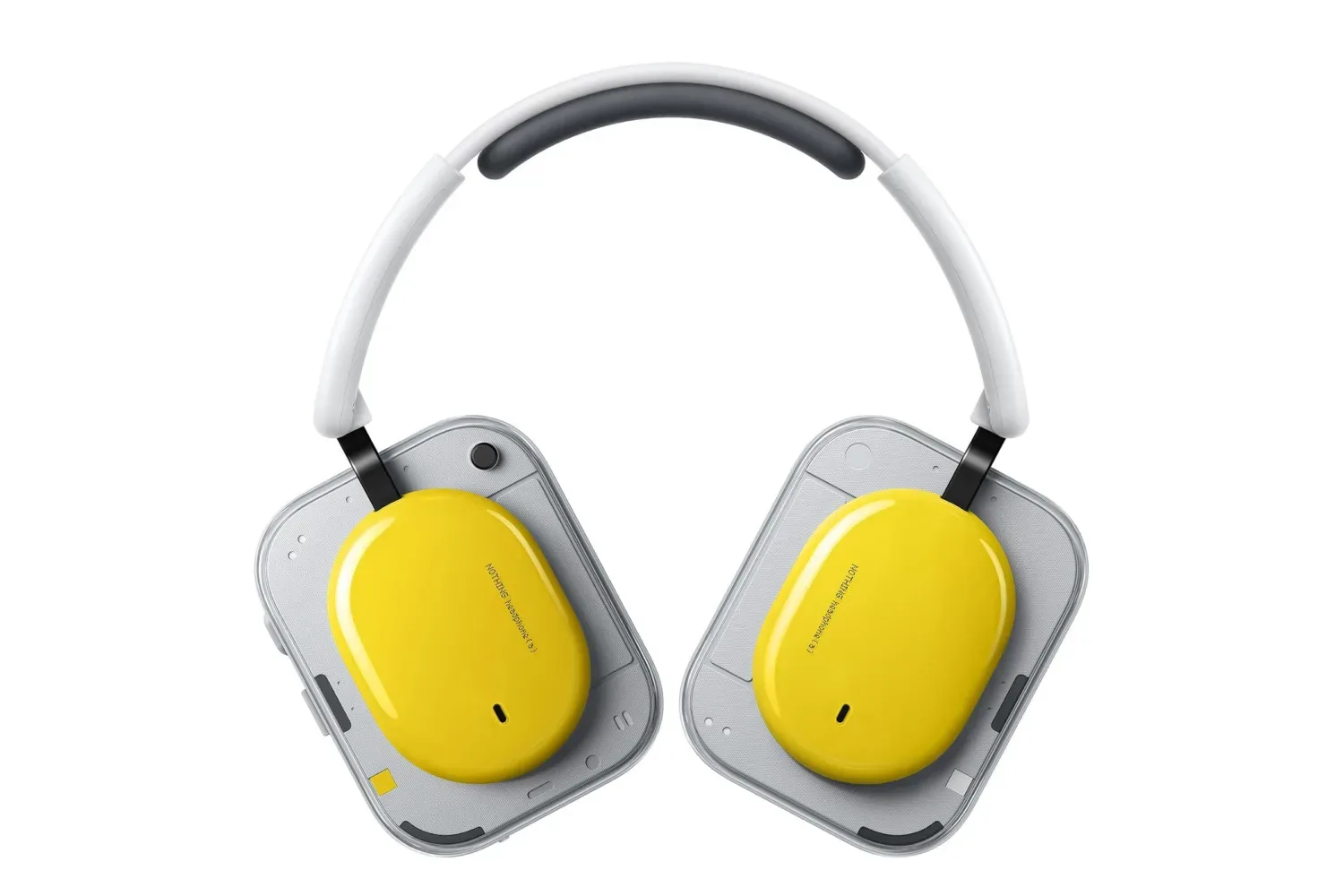
Nothing’s Headphone (a) is currently listed at $109, a $90 reduction from the stated $199 regular price. The discounted price applies to yellow, black and white versions, with free shipping and a three-month Amazon Music Unlimited trial described as part of the offer. As with any time-limited retail listing, the price, colour availability and bundled trial can change before checkout.
That $109 figure makes the full-size headphones notable less for a single headline specification than for the combination being advertised: Hybrid Active Noise Cancellation, a Smart Adaptive setting that responds to surrounding noise, a Transparency mode, Spatial Audio support, Hi-Res Wireless certification and unusually large quoted battery endurance in standard mode.
There is one detail shoppers should check especially carefully. A portion of the deal material refers to a $129 price, while the main listing information identifies the active price as $109. The latter is consistent with the stated $90 reduction from $199, but it is still sensible to treat the live product page and cart total as the deciding figures.
What the noise-control modes are meant to do
The Headphone (a) is described as using Hybrid Active Noise Cancellation, often shortened to ANC. Active noise cancellation uses microphones and electronic processing to reduce unwanted external sound before it reaches the listener. “Hybrid” generally denotes a setup intended to account for sound detected both outside and inside the earcups.
In practical terms, the feature is positioned for steady interruptions such as traffic, aircraft cabin noise and nearby conversations. It is not the same as creating total silence: abrupt, irregular sounds and voices can still be noticeable. The useful question for a prospective buyer is whether reducing the constant sonic clutter of a commute, shared work area or flight is worth paying for—and this model is being sold specifically on that kind of day-to-day utility.
Smart Adaptive mode is presented as the more automated option. Rather than requiring the listener to continually choose a cancellation level, it adjusts the amount of noise reduction in real time based on the environment. The appeal is convenience: moving between quieter indoor spaces and busier streets should require less manual management.
Transparency is the opposite kind of tool. Instead of minimizing the world outside the headphones, it allows ambient sound through while audio continues to play. That can be useful when someone needs awareness of nearby activity without taking the headphones off. Neither ANC nor Transparency should be treated as a replacement for paying attention in situations where hearing the environment matters.
Audio claims: Spatial Audio and Hi-Res Wireless
The product listing highlights rich, bold and clear sound, along with Spatial Audio support and Hi-Res Wireless certification. These are related to listening quality, but they mean different things.
Spatial Audio is designed to make a compatible track or soundtrack feel more dimensional, creating an impression that elements are positioned around the listener rather than simply appearing as a conventional left-and-right stereo image. Its impact can depend on the audio being played, the device and the listener’s own preferences. It may be attractive for people who want a more enveloping presentation for music, movies or games, but it should not be mistaken for a guarantee that every recording will sound dramatically different.
Hi-Res Wireless is a certification claim relating to wireless audio capability. It signals that the headphones are intended to support higher-resolution wireless listening under compatible conditions. The practical benefit still relies on the rest of the playback chain: the phone or other source device, the connection and the music service or audio files all play a role. A badge alone does not tell a shopper exactly how a favorite library will perform.
The bigger point is that the Headphone (a) is pitched as more than a basic wireless pair. Its advertised feature set targets listeners who want environmental control and immersive playback alongside long endurance, rather than choosing only on style or the lowest possible sale price.
The battery claim is the standout number
The quoted battery figure is up to 135 hours of listening on one charge in standard mode. “Up to” matters: it is a maximum claim tied to that mode, not a promise that every combination of settings will reach the same result. Using noise cancellation, adaptive features or other functions may result in different endurance, and individual usage varies.
Even with that qualification, the number suggests a product aimed at minimizing charging interruptions. For someone who listens in several long stretches across a week, battery capacity can be more valuable than a marginal difference in styling or an extra app setting. The listing also says that a five-minute charge can provide up to eight more hours of playback, which is the kind of quick top-up intended for a forgotten charge before leaving home.
Long battery life has a simple practical effect: the headphones are more likely to be ready when needed. That is particularly relevant for a full-size model that may spend time at a desk, in a bag or beside a console rather than being returned to a small charging case after each session.
A camera shortcut adds a small convenience feature
Beyond audio and battery specifications, the Headphone (a) includes a remote camera shutter function. A single press on the headphones can control a phone’s camera, offering a way to take photos or start filming without reaching for the handset at the moment of capture.
It is not a core reason to buy headphones, but it is a clear example of an accessory doing something other than playing sound. It could be useful for solo photos, group pictures or recording from a distance, assuming the connected phone and camera setup support the interaction as expected.
How to assess this deal without overreading it
At the stated $199 normal price, buyers would reasonably weigh the Headphone (a) against a wide range of full-size wireless options. At $109, the calculation changes: the listing bundles a broad set of premium-leaning claims—adaptive noise handling, transparency, Spatial Audio, Hi-Res Wireless and high quoted battery life—at substantially less than the stated regular price.
Still, a sale headline is not a specification sheet. Shoppers who care about one particular trait should identify that priority first:
- Frequent travelers or commuters: focus on ANC and how important the adaptive mode is to your routine.
- People who dislike charging: the 135-hour standard-mode claim and eight-hour rapid-charge claim are the central considerations.
- Listeners chasing immersion: investigate whether your devices and preferred audio support Spatial Audio and high-resolution wireless playback.
- Anyone buying for a particular colour: check the live listing, since yellow, black and white are all said to be discounted but stock can differ.
- Bundle-minded buyers: verify the Amazon Music Unlimited trial terms before assuming it has standalone value for your account.
The deal arrives in a consumer-tech market where phone-platform preferences remain a major factor in buying accessories; smartphone shipment trends and budget Android pressure provide useful context for why broadly compatible, feature-heavy wireless accessories compete so aggressively on price.
For now, the straightforward takeaway is that the Nothing Headphone (a) is being advertised at $109, across three colours, with specifications that put noise management and battery longevity at the center of the proposition. Confirm the final price and bundle details at purchase, especially given the conflicting $129 mention in the promotional material.
Shop the products
Check current price, model and availability at the retailer.