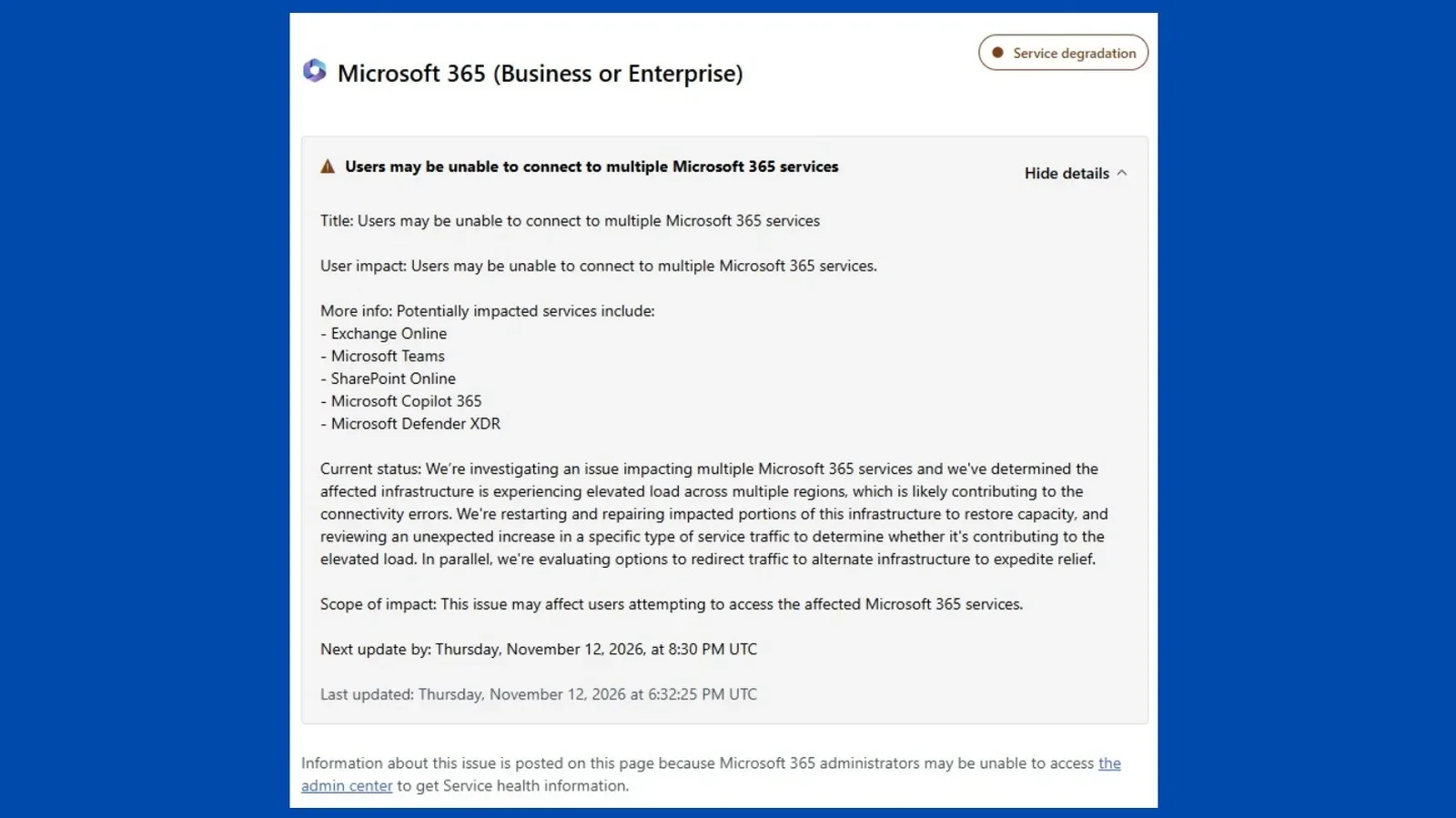

Microsoft has apologized for a worldwide disruption that prevented Outlook users from accessing their mailboxes and also affected other Microsoft 365 services, including Teams. The incident began affecting users at about 12:30 p.m. ET on Nov. 12 and, for some customers, continued for more than 18 hours.
The company said service recovery began Friday morning in the Asia-Pacific region before extending through Europe and North America. It described the recovery as broad, while noting that restoration was continuing for remaining customers and regions.
“We are deeply sorry for the disruption this incident has caused our customers and partners,” Microsoft said, adding that it was seeing broad recovery and stability across its services.
Microsoft attributes the disruption to a technical network issue
Microsoft said the event was not a cyberattack and was not related to AI or agents. Its stated explanation is a technical issue introduced during an earlier network-capacity upgrade, which surfaced after a more recent network change.
That distinction matters. A cyber incident generally refers to unauthorized activity, such as a breach or malicious attack, that compromises or disrupts systems. Microsoft’s description instead points to an operational problem: a change to underlying network infrastructure exposed an issue connected to earlier capacity work. The company has said it addressed the underlying problem.
It is also notable that Microsoft specifically ruled out AI agents. That does not by itself explain every technical detail of the outage, and the company has not yet released the promised full post-incident report. But it does establish what Microsoft says the incident was not, amid an environment where major service interruptions can quickly lead to speculation about security events or automated systems.
A network capacity upgrade is work intended to increase the amount of traffic or demand a network can handle. A subsequent network change can alter how systems communicate or route requests, potentially revealing a compatibility, configuration, or scaling issue that was not apparent before. Microsoft has not provided further technical specifics in the information available so far, so it would be premature to assign a more precise cause.
Why the restoration was gradual
Microsoft said it restored services gradually because of the scale of demand, validating stability at each stage. That approach lengthened recovery, it acknowledged, but was intended to produce a stable restoration rather than risk another interruption by bringing every affected region or customer back at once.
In practical terms, staged restoration means a provider brings portions of a service back online, checks whether the repaired environment remains stable under demand, then expands access. For customers waiting to receive mail or use collaboration tools, this can be frustratingly slow. However, it is a recognizable way to manage a large-scale outage where returning all traffic simultaneously could place renewed pressure on the affected infrastructure.
Microsoft’s recovery sequence began in Asia-Pacific, then moved across Europe and North America. That ordering is relevant for organizations that operate across multiple regions: colleagues in different locations may have seen different recovery times even while using the same suite of services.
Outlook and Teams disruption can affect more than email
Outlook access is central to daily communication for many organizations, but the disruption also reached Teams, which makes the impact broader than a mailbox-access problem. Email can carry scheduling, customer contact, approvals, invoices, account notifications and internal decisions. Collaboration platforms can add meetings, chat and team coordination to that list.
For game studios, publishers, esports operations and other teams that use Microsoft 365, the immediate takeaway is less about a particular game platform and more about operational dependency. An outage affecting email and collaboration can complicate routine business tasks around launches, remote work, partner communication, support coordination and scheduled meetings. That does not mean every organization experienced the same consequences; the available information identifies impacted services but does not detail individual customer effects.
Microsoft said in January that Microsoft 365 commercial seats had increased 6% year over year to more than 450 million for the quarter ended December 2025. That scale helps explain why a disruption to core Microsoft 365 services can have wide visibility. It also explains why restoring demand gradually, while inconvenient, can be a significant technical and operational exercise.
Businesses using Windows PCs alongside Microsoft 365 may also be weighing how their cloud-service workflows fit together. For related consumer hardware and service context, see this Windows 11 and Microsoft 365 bundle overview.
Customers may be able to request service credits
Customers affected by the outage may be eligible to request credits under Microsoft’s service-level agreement, or SLA. An SLA is a contractual commitment that defines service expectations and can set out remedies when a covered service does not meet those commitments. A credit is not automatically the same thing as a refund for every consequence of an interruption; it is a remedy calculated under the applicable agreement.
Microsoft’s partner-center guidance says that any SLA credit is based on the specific service affected and is prorated according to both the service and the length of the outage. “Prorated” means the value is calculated proportionally rather than as a flat, universal amount.
The guidance also sets evidence requirements for a request:
- The requester must provide evidence that the outage affected the customer.
- The email submitted as evidence must come from the domain of the affected tenant.
- Personal email addresses are not accepted for that evidence requirement.
In Microsoft 365 terms, a tenant is an organization’s dedicated environment within the service. The domain requirement therefore links the claim to the organization that was affected, rather than to an unaffiliated personal account.
Organizations considering a claim should carefully preserve relevant records of the service impact and use an email address from the affected organization’s domain when supplying evidence. The exact credit outcome depends on the affected service, outage duration and applicable SLA terms. Nothing in the available information suggests a single identical credit for every affected customer.
What to look for in the post-incident report
Microsoft says it will publish a full post-incident report once its review is complete. That report should be the more useful document for customers looking beyond the immediate apology and recovery status.
The key issue is the chain between the earlier capacity upgrade and the recent network change that Microsoft says surfaced the incident. A detailed report could clarify the scope of the disruption, the safeguards involved, why the impact persisted for some users, what determined the staged recovery process and what changes are being made to reduce the chance of a recurrence.
Until then, the supported picture is straightforward: Outlook and other Microsoft 365 services, including Teams, experienced a worldwide disruption starting Nov. 12; some customers lacked mailbox access for more than 18 hours; recovery began the following morning and rolled from Asia-Pacific through Europe and North America; and Microsoft says the root issue was technical, tied to network capacity work and a later network change, rather than cyber activity or AI agents.
For affected customers, the near-term practical items are confirming that service has fully returned for their region and organization, documenting any impact that may support an SLA request, and watching for Microsoft’s post-incident account of what happened and what remediation follows.