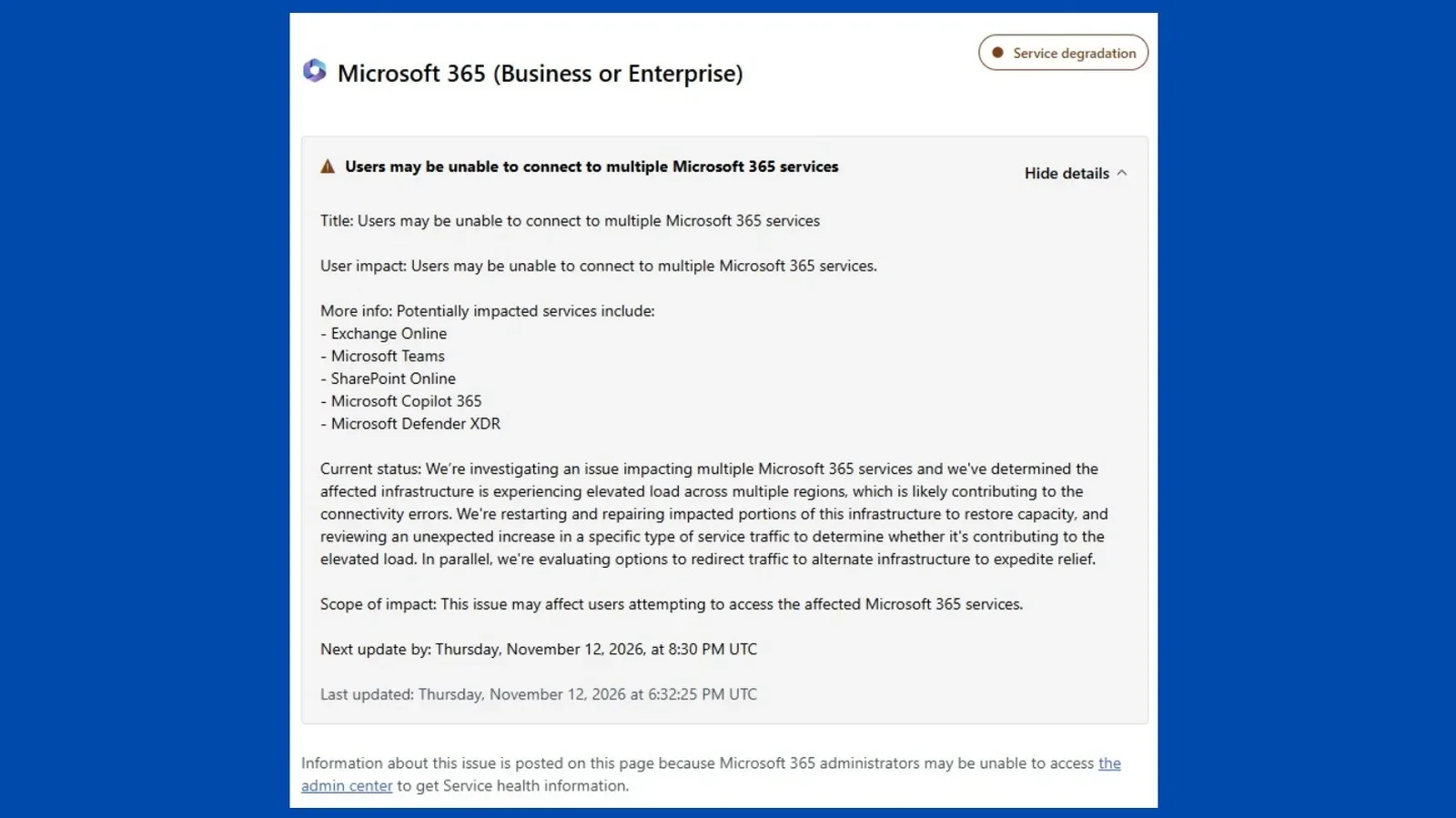

Microsoft 365 users encountered widespread connectivity problems on Thursday, with Outlook and Exchange Online mailboxes among the most visible services affected. The disruption reached individual Outlook accounts as well as enterprise users, while Microsoft also warned that people could be unable to connect to Microsoft Teams, Copilot 365 and SharePoint Online.
The initial scope centered on the Americas, although the incident’s infrastructure explanation pointed to effects across multiple regions. Microsoft said it was investigating access problems involving Exchange Online mailboxes through more than one connection method. At the time of the updates, the company did not provide a restoration estimate.
For organizations that run work through Microsoft 365, the practical issue is broader than a single inbox failing to load. Exchange Online is the cloud-hosted email and calendar component behind many Outlook deployments. Teams handles collaboration and meetings, SharePoint Online is used for shared files and internal sites, and Copilot 365 is Microsoft’s AI service within the suite. When several of those services have connection errors at once, staff can lose access to messages, calendars, conversations, files and AI-assisted workflows simultaneously.
Reports rose quickly as access issues spread
User reports began rising at roughly 12:39 p.m. ET. By 1:09 p.m. ET, Downdetector had logged more than 129,000 reports associated with Outlook problems. Those reports are an important signal of user-facing disruption, but they do not by themselves identify a technical cause or represent a confirmed count of every person affected.
Microsoft’s own status messaging established that the issue went beyond isolated login trouble. It warned that users may be unable to connect to multiple Microsoft 365 services, and later identified infrastructure load as the likely driver of the connectivity errors.
At 1:35 p.m. ET, Microsoft said a portion of its infrastructure was experiencing elevated load across multiple regions. Its immediate response was to redistribute connection traffic across its wider global infrastructure in an effort to balance that load.
In plain terms, traffic redistribution is a resilience measure. Rather than directing new requests through systems under the most pressure, an operator shifts them toward other available infrastructure. It can reduce congestion and preserve capacity, but it does not necessarily make the unavailable servers healthy again. Users can therefore still see failed sign-ins, delayed connections or intermittent access while the rerouting work is underway.
Microsoft said unavailable servers—not a traffic surge—were straining capacity
Microsoft’s later explanation added a key distinction: the elevated load was not caused by a rise in overall traffic. Instead, the company said a number of servers had become unexpectedly unavailable, putting added strain on the infrastructure that remained in service.
That matters because “high load” can sound like a sudden rush of users. In this case, Microsoft indicated the pressure came from reduced available capacity. If a portion of a large system is unavailable, the same amount of ordinary demand must be handled by fewer working servers. That can create bottlenecks and connection failures even without an unusual spike in customer activity.
By 2:12 p.m. ET, Microsoft said it had paused all deployments, moved further traffic away from the affected infrastructure and restarted affected servers to bring them back into service. A deployment generally means a planned change or release to software or infrastructure. Pausing those changes during an incident can limit variables while engineers stabilize the environment and investigate recovery.
Restarting servers is likewise a recovery action, not a complete public diagnosis. The information available establishes that servers were unexpectedly unavailable and that Microsoft was working to restore them safely. It does not establish why those servers became unavailable, nor does it confirm a final time for full recovery.
Why a suite-wide interruption has outsized consequences
The incident illustrates the dependency built into cloud productivity suites. Email may be the first failure employees notice, but a connected workplace often relies on the same service family for documents, internal portals, meetings and collaboration. A team unable to retrieve a calendar invitation may also be unable to reach a shared SharePoint file or participate in a Teams discussion without disruption.
That dependency extends to businesses whose operations touch gaming and entertainment. Development, publishing, community, marketing and support teams commonly need reliable communication and document access to coordinate work. The available information does not identify any particular game company, studio or player service as affected. Still, the incident is a reminder that business tools behind games can be just as operationally important as the consumer services players see.
Microsoft 365 operates at considerable scale. In its January earnings call covering the December 2025 quarter, Microsoft said commercial Microsoft 365 seats had grown 6% year over year to more than 450 million. That figure concerns commercial seats rather than a direct count of users affected by Thursday’s interruption, but it provides useful context for why availability issues in the suite can attract intense attention so quickly.
What users and administrators can take from the updates
Microsoft’s public updates described active mitigation rather than a finished incident report. For users, that means a failed sign-in or unavailable mailbox during the event should not automatically be treated as a problem with an individual account, local device or password. The company had acknowledged a broader connectivity event involving several services.
For administrators, the most relevant confirmed details were the multi-service nature of the issue, the focus on the Americas, and the recovery steps already underway: traffic was being rerouted, deployments were paused, and affected servers were being restarted. Because no estimated restoration time was supplied in the available updates, organizations would need to plan around uncertainty rather than assume a short interruption.
It is also useful to separate service availability from data loss. The disclosed information described access and connectivity errors. It did not say that mail, files, chats or other customer data had been lost. Likewise, nothing in the available updates attributes the incident to a cyberattack, a deployment failure or increased demand. Those explanations would go beyond what Microsoft had confirmed.
Microsoft said it was pursuing multiple avenues to reduce impact and safely return unavailable servers to service. Until the company releases a fuller account, the clearest picture is of a significant Microsoft 365 capacity problem: servers unexpectedly dropped out of availability, remaining infrastructure came under strain, and Outlook, Teams, Copilot 365 and SharePoint Online users experienced connection trouble as mitigation work proceeded.
For more technology and business coverage across entertainment, see our industry news report on changes at NBC News Now.