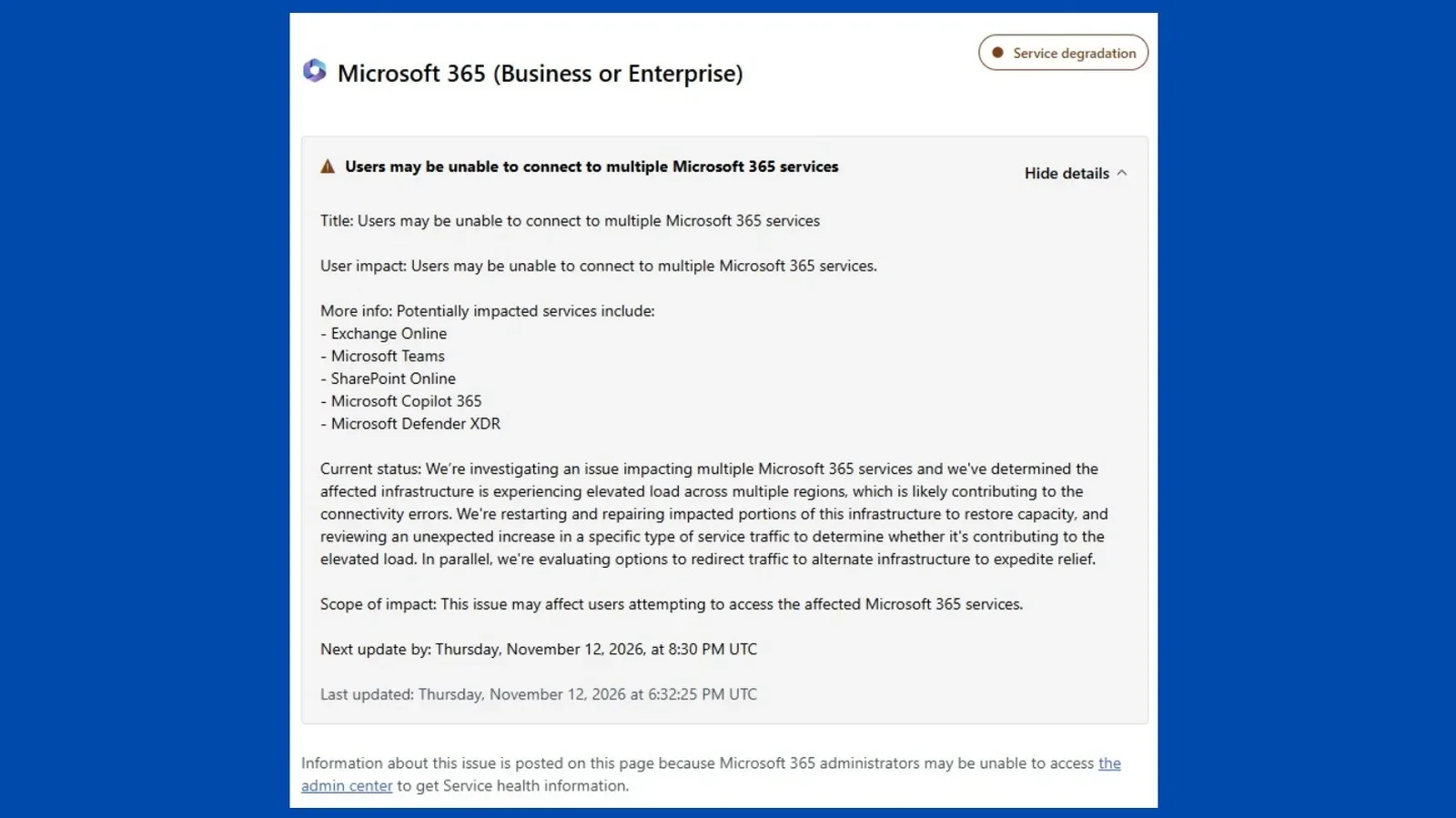

Microsoft says it has addressed the underlying problem behind a Microsoft 365 outage that stretched for nearly 24 hours, with broad recovery and stability now being reported across its services. That is welcome news for organizations whose workday had been interrupted by inaccessible email, calendar problems and limited functionality in collaboration and AI tools.
The disruption began at about 1 p.m. Eastern Time on Thursday and affected customers around the world, including businesses, educational institutions and governments. Outlook email was among the most visible casualties. Some Teams and Copilot features were also unavailable, while Exchange accounts configured in Apple Mail were affected as well.
Microsoft’s current message is cautiously encouraging rather than an all-clear for every user. The company says it is continuing to restore service for remaining customers and regions, and its Service Health Status page still indicates that some services may be unavailable. In short: broad recovery does not necessarily mean every mailbox, calendar or tenant is immediately back to normal.
What stopped working, and what largely stayed up
The outage did not take every Microsoft 365 function offline. Most calling, meeting and messaging capabilities remained available. That distinction matters for teams that could still communicate in a meeting or chat, but could not reliably schedule a new meeting, add a calendar event or access the email needed to keep work moving.
The reported effects included:
- Inability to access Outlook email for some customers.
- Disruption to certain Teams and Copilot features.
- Problems with Exchange accounts used through Apple Mail.
- Errors when scheduling meetings or creating calendar entries for some users.
For a modern organization, those may look like separate inconveniences, but they are tightly connected. Email handles formal communication and external correspondence. Calendars turn decisions into scheduled work. Teams supports meetings and ongoing discussion. When email and calendar systems falter while chat remains online, employees can still ask one another what is happening—but may have no dependable way to reach people outside the organization or confirm what is on the day’s agenda.
That is also why a service interruption can feel wider than its individual feature list. A missed calendar entry can lead to a missed meeting; an inaccessible mailbox can delay an approval, support response or document handoff. Educational institutions and governments face the same basic issue at a different scale: systems that are usually background infrastructure become immediately visible when their normal flow breaks.
Microsoft attributes the incident to a network capacity upgrade issue
Microsoft has explicitly said the incident was not related to a cyberattack or AI agents. Instead, it traced the outage to an issue introduced during an earlier network capacity upgrade, which surfaced following a more recent network change.
“We have addressed the underlying issue and continue to restore service to remaining customers and regions,” Microsoft said, adding that it restored services gradually while validating stability at each stage.
That explanation is technical, but its basic meaning is approachable. A network capacity upgrade is work intended to ensure a network can handle demand reliably. It can involve changes to the systems that carry traffic, distribute requests or provide room for more users and data. A network change is a broader term for an adjustment to that infrastructure. Microsoft’s account indicates that a previously introduced problem was not apparent—or did not cause this incident—until a later change brought it to the surface.
This is an important distinction from a sudden, isolated failure. Microsoft is describing a chain of conditions: an earlier upgrade introduced the issue, then a recent change exposed it. The company has not yet published the full technical account, so it would be premature to infer which components were involved or why particular Microsoft 365 features were affected as they were.
Microsoft says it chose a gradual restoration because of the scale of demand, validating stability at each stage. A staged recovery means returning capacity or access in steps rather than switching everything back on at once. The practical goal is to avoid turning a repair into another disruption: if a system is reopened too quickly, demand can reveal additional instability. The tradeoff is that recovery can take longer for users in later stages or different regions.
Why “broad recovery” is not the same as “nothing left to do”
Users who can sign in again should still distinguish between service access returning and every delayed task being resolved. The available information does not establish what happened to specific messages, invitations or attempted calendar changes during the disruption. Microsoft has said it will provide a full post-incident report after its review is complete.
Until then, organizations dealing with time-sensitive work can sensibly check the basics without assuming the outage erased or completed any action:
- Confirm that Outlook mail can be sent and received.
- Verify whether meetings and calendar changes made during the incident appear correctly.
- Check Teams and Copilot access if those tools are central to the workflow.
- Use the official service-health information to determine whether a remaining issue may be regional or still under restoration.
- Keep a record of business-critical errors or missing actions for internal follow-up if problems continue.
These are not fixes for the platform-level problem; Microsoft is responsible for that recovery. They are practical checks for the aftermath of an outage in services that many organizations use as a shared record of communication and schedules.
The AI angle: mentioned, but ruled out as the cause
Microsoft went out of its way to say that neither cyber activity nor AI agents caused this incident. That clarification is notable because Copilot was among the affected products and because AI has become a frequent lens through which users interpret major technology problems.
In this case, Microsoft’s stated cause is a network issue. There is no basis in the available details to connect the outage to AI workloads, autonomous agents or a security attack. The company’s wording instead places the event in the less sensational but still consequential category of infrastructure change and recovery.
That does not make the disruption minor. It does mean the eventual incident report should be read for the concrete operational questions: what part of the earlier capacity work created the vulnerability, how the later change caused it to surface, why the affected services experienced the failures reported, and what safeguards will be added. Those answers matter more than attaching a fashionable explanation to an outage before the technical review is complete.
AI remains a major part of the broader technology conversation, including its role in creative and workplace workflows. For example, a recent survey of film editors found widespread AI use in post-production, mainly for routine work. But Microsoft’s own account makes clear that AI was not the explanation for this particular service failure.
Workforce context raises questions, but does not establish a connection
The outage arrives shortly after Microsoft announced plans to eliminate thousands of jobs and offered voluntary buyouts to 60,000 people, described as a quarter of its global workforce. The stated context was cost cutting while AI spending increases.
It is understandable that users may view staffing news and a large outage side by side, especially when the affected software is central to daily work. But the facts currently available do not establish any connection between the job plans and this incident. Microsoft has attributed the outage to a problem arising from network capacity work and a subsequent network change—not to staffing levels, budget decisions or its AI investment.
Keeping those claims separate is essential. An outage may prompt legitimate questions about resilience, change-management processes and how organizations communicate during recovery. Yet answers require the promised post-incident report, not assumptions drawn from unrelated corporate developments.
What to watch for next
The immediate story is recovery: Microsoft says the core issue has been fixed, broad stability is returning, and remaining customers and regions are still being restored. The next meaningful development will be the post-incident report. Microsoft has committed to releasing one after its review is complete.
That report should provide the detail missing from the present picture. For customers, the key questions are straightforward: whether any residual unavailability remains, whether interrupted email or calendar actions require attention, and what changes Microsoft will make to reduce the chance that an infrastructure upgrade can produce a similarly broad interruption.
For now, the incident is a reminder that cloud software is more than a set of apps on a screen. Outlook, Teams, Exchange, Apple Mail integrations and Copilot can appear distinct to users, yet they depend on shared systems underneath. When those foundations stumble, even services that remain partially functional can leave a workday feeling stuck at the loading screen.