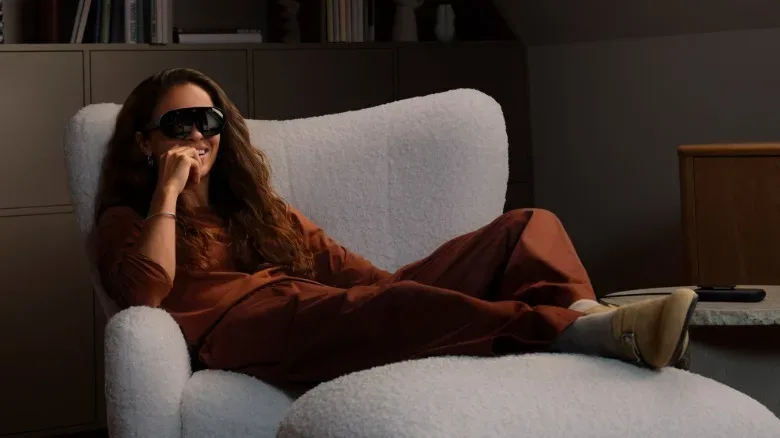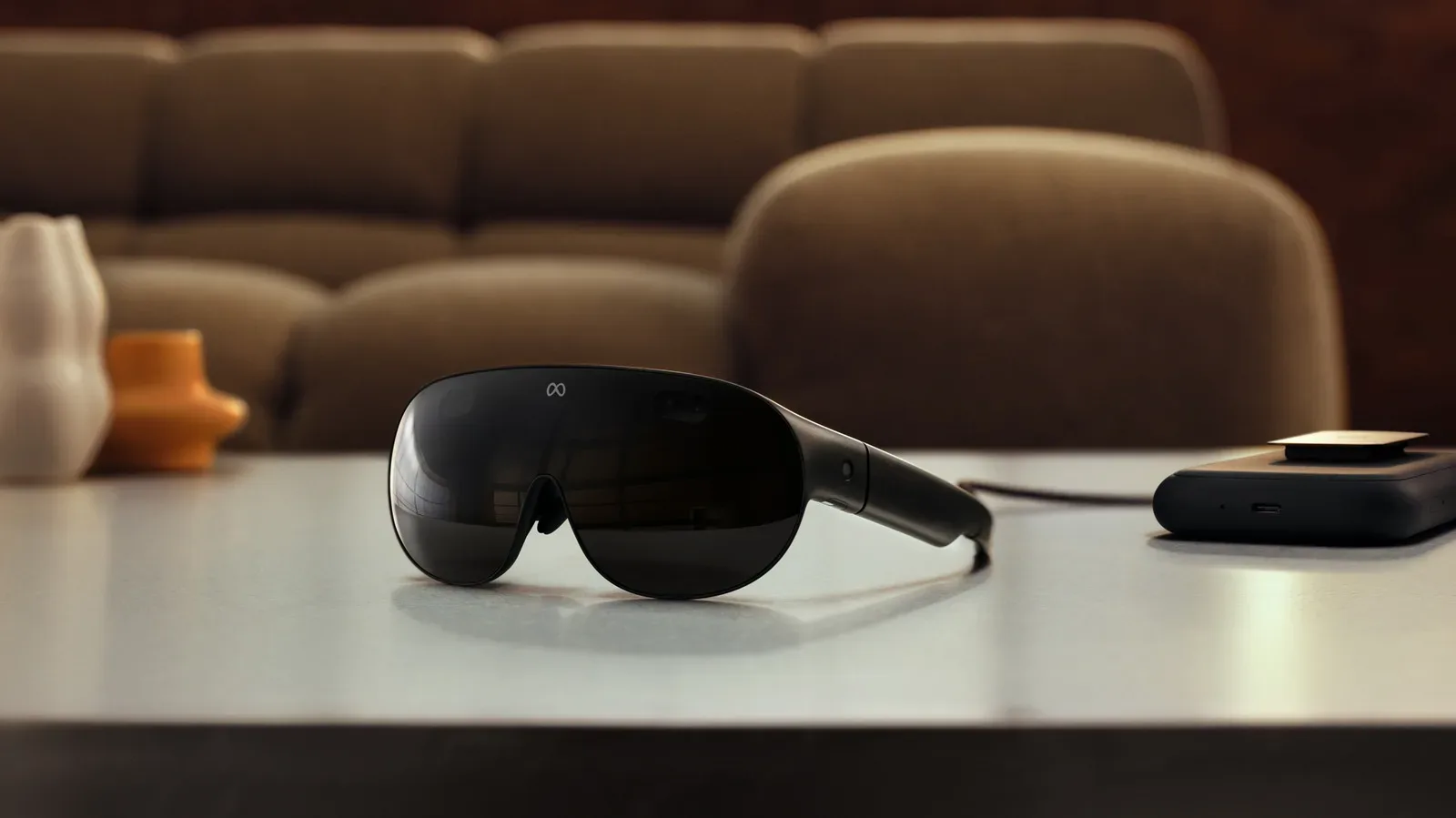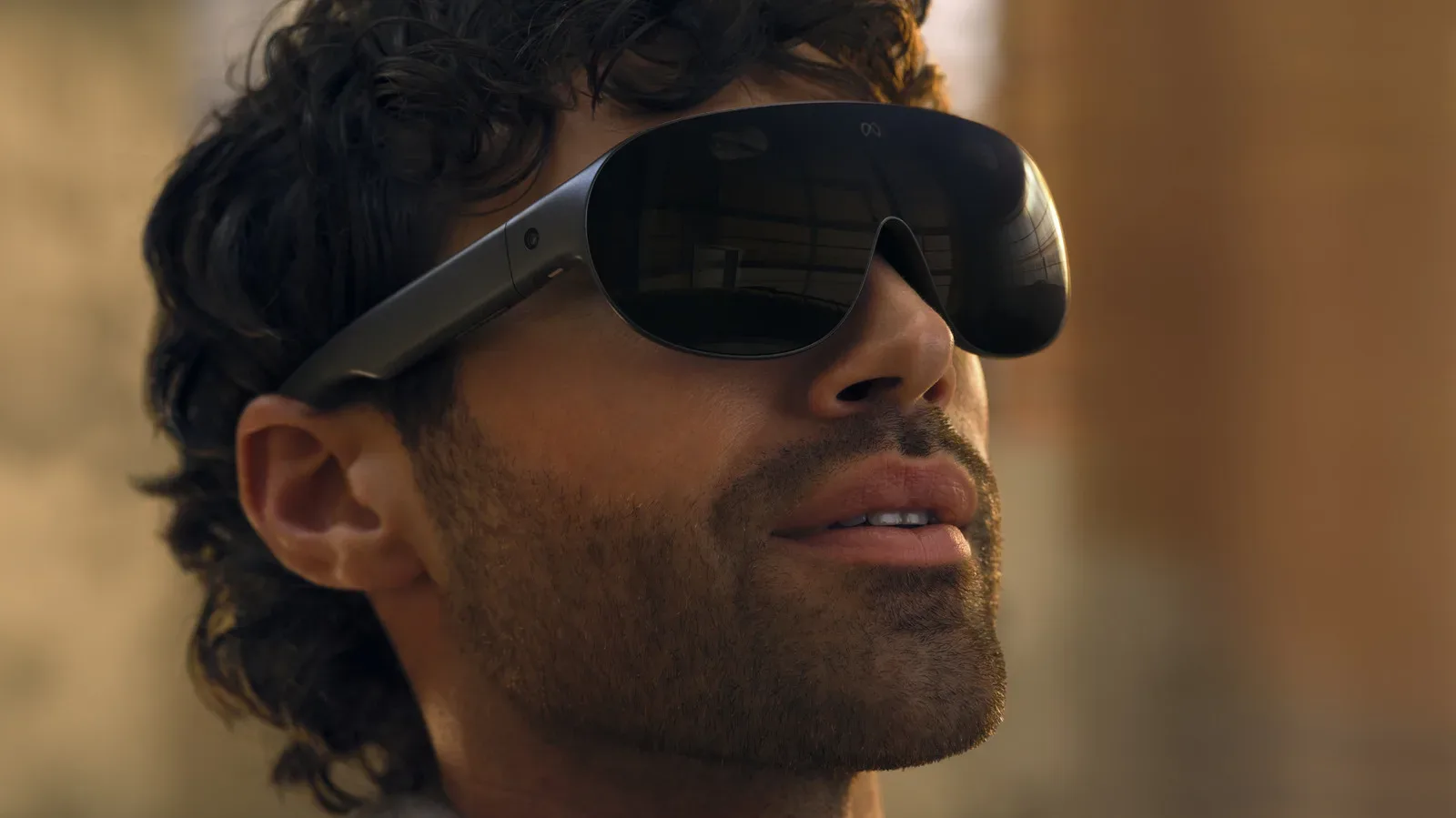
Meta’s newly revealed VR Glasses have a remarkably simple answer to virtual reality’s oldest fashion problem: put less of the computer on the person’s face. The device is scheduled for spring 2027 at $1,300, and its defining design choice is to split the system in two. The glasses themselves hold the displays, cameras and sensors, while a wired external puck carries much of the computing hardware, memory and storage.
That does not make them cheap, nor does it turn a camera-equipped computer into an inconspicuous everyday accessory by default. But the hardware proposition is unusually clear. Meta is aiming for a device that can play games, show giant virtual screens for movies, and support computer multitasking without requiring the wearer to balance a conventional headset across their forehead and cheeks.
For games, the interesting question is not simply whether the Glasses can run virtual reality. It is whether this form factor can make VR feel easier to pick up often enough that its software library matters. Meta says the launch will include more than 75 games built around hand input, while Touch Plus controllers can connect for existing Quest VR games. That combination acknowledges a basic reality of VR: hand gestures are appealing for simple, direct interactions, but controllers remain useful for games designed around buttons, sticks and more exact inputs.
A VR system designed around weight distribution
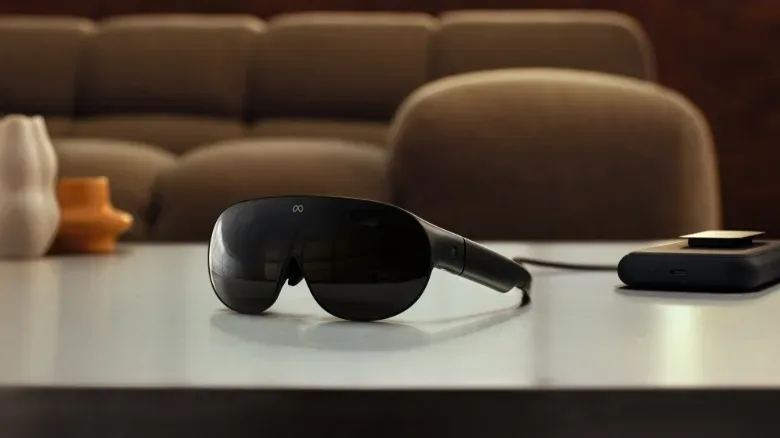
Meta lists the glasses unit at 100 grams, or about 0.2 pounds. The connected compute puck adds 300 grams, or 0.6 pounds. Rather than eliminate weight, the design relocates a substantial share of it away from the head. That is the central practical difference between these glasses and a self-contained headset.
For context, Apple’s Vision Pro headset is listed at roughly 1.3 to 1.7 pounds, depending on configuration. Its strap helps distribute some of that mass, but Meta’s approach is fundamentally different: the face-worn piece is much lighter, while a compact wired pod is intended to be carried separately. Product imagery suggests a pocket-sized puck, though real-world comfort will naturally depend on cable routing, where the pod is placed and how freely a wearer can move.
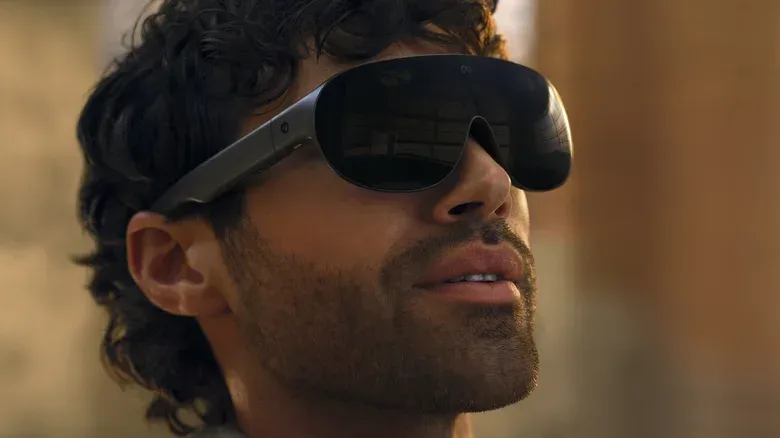
The glasses resemble oversized sunglasses more than a wrapped-around headset. That is important beyond aesthetics. A system that is faster to put on and does not press as much mass against the face could be better suited to shorter sessions, media viewing and work tasks. At the same time, the physical compromise may be immediately felt in immersion. The Glasses have a 70-degree horizontal field of view, compared with 100 degrees for Vision Pro. Field of view is the width of the virtual scene visible at once; a wider field can make digital environments occupy more of a user’s vision. Meta’s number is considerably broader than that of many display glasses, but it does not promise the more enveloping view associated with larger VR headsets.
The design also brings a limitation for people who wear prescription spectacles. The product imagery indicates users will not simply put the Meta VR Glasses over their everyday frames. Meta plans to offer custom prescription frames instead. For potential buyers, that makes vision correction part of the buying decision rather than a later accessory question.
What is inside the glasses, and what is inside the puck
The system uses Qualcomm’s Snapdragon Reality Elite processor, also called XR2 Gen 3. It pairs that platform with a 5K micro-OLED display specified at 2,412 by 2,288 pixels and a 120Hz refresh rate. A micro-OLED is a very small display technology suited to head-worn devices, while 120Hz means the display can update up to 120 times each second. Higher refresh rates can make motion appear smoother, a particularly important quality when a screen moves with the wearer’s head.
The external puck includes 12GB of RAM and 128GB of storage, plus a microSD card slot for additional content. RAM is the short-term working memory used by active apps and experiences; storage is where installed games and media remain when the device is powered down. The microSD option is notable because VR games and high-resolution video can consume substantial space, and the supplied 128GB will not be equally roomy for every user.
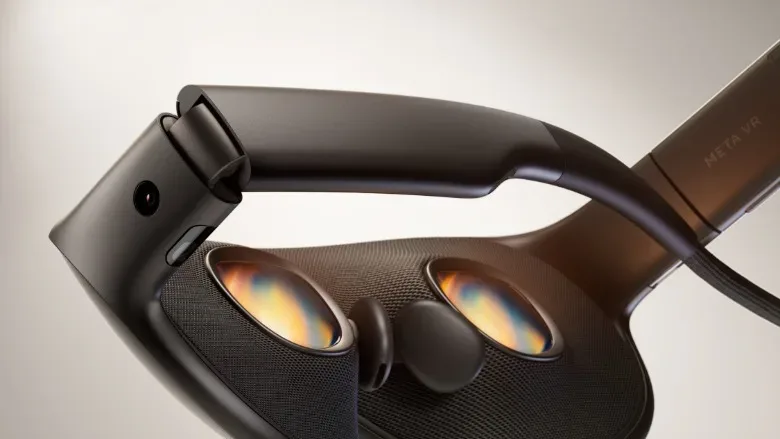
Meta is building the Glasses around camera-based sensing. Six outward-facing cameras support full-color passthrough and motion tracking, while four inward-facing cameras handle eye tracking. Passthrough means cameras capture the world around the wearer and show that feed inside the device, allowing virtual windows, interfaces or effects to be placed alongside a view of the real room. It is not the same as looking through ordinary transparent lenses; it is a camera-mediated view.
The Glasses also use their cameras to recognize hands for gesture controls. Meta describes an interface built entirely around hand gestures, along with biometric iris recognition for unlocking. Eye tracking can have several potential roles in spatial computing interfaces, including helping the system understand where the wearer is looking, but the announced details do not spell out every interaction method. The safe takeaway is that cameras are not a side feature here. They are the system’s route to hand control, room tracking, passthrough and eye-related functions.
The gaming pitch: hands first, controllers still welcome
Meta’s promise of more than 75 hand-powered games at launch matters because it gives hand tracking a role beyond navigating menus. Hand input can make casual VR interaction feel immediately understandable: reach, point, pinch or manipulate virtual objects without picking up hardware. In an entertainment device that looks like glasses, that kind of interaction fits the low-friction pitch.
Yet support for Touch Plus controllers is equally significant. It gives the VR Glasses a bridge to existing Quest games rather than treating the new device as an isolated software platform. Many VR games rely on control schemes that benefit from physical inputs and tracked controllers. Meta is therefore offering two ways into its game ecosystem rather than declaring that bare hands replace dedicated controls in every scenario.
That distinction also helps clarify what Meta is trying to sell. These are not merely display glasses that mirror a phone or laptop. They are a VR device running Quest OS, with its own game ambitions and compatibility path for existing Quest titles. Readers looking for the named game lineup can find more on the company’s gaming emphasis in Meta VR Glasses’ $1,300 games push.
There is still a trade-off. A 70-degree horizontal field of view may make these less visually enclosing than headsets that cover more of the wearer’s sightline. Meta’s wager appears to be that many people will gladly accept a less all-consuming view if the hardware feels more like a pair of glasses and less like a full facial appliance. That is analysis, not a measured verdict: comfort, tracking quality, cable management and software execution will decide whether the compromise lands.
Movies, virtual monitors and the return of 3D as a headset feature
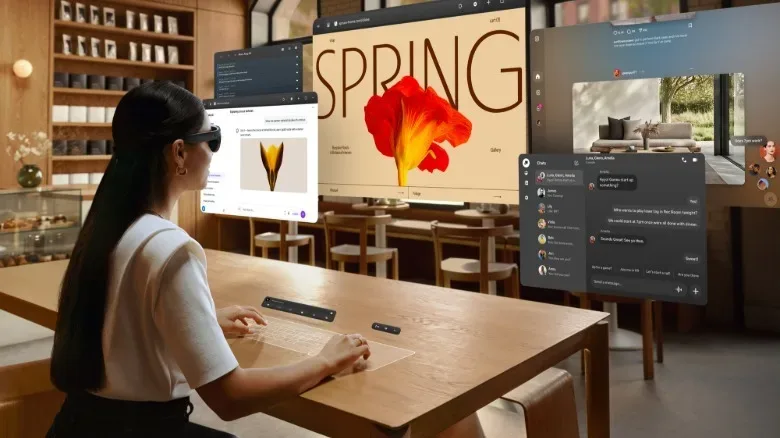
Gaming is only one portion of the plan. Meta is also positioning the VR Glasses as a personal cinema and productivity display. Users will be able to watch movies on large virtual screens and connect a computer to arrange multiple floating windows. The basic appeal is easy to understand: a portable device can create the impression of a large display without physically carrying a television or several monitors.
Meta says hundreds of 3D films will be offered for purchase or rental, with additional 3D material in Disney+ and Peacock. This is a meaningful content promise because 3D video has few mainstream home-screen destinations after 3D televisions faded away. A headset can deliver separate images to each eye, which is the core requirement for stereoscopic 3D, without requiring a specialized television in the living room.
National Geographic is set to launch an app next year with 180-degree 3D video. Unlike a normal flat video frame, 180-degree footage covers a wide half-sphere around the viewer, creating a sense of place while leaving the viewer facing the intended direction. Meta also plans a “VR Enhanced Cinema” format, where visual effects extend into the wearer’s real space. The idea resembles ambient lighting that expands a TV image’s presence beyond the edges of the screen, except this version can use the camera-mapped room as part of the presentation.
Meta says Avengers: Infinity War and Star Wars: Episode IV, A New Hope will arrive in that VR format next year. These are future content plans, not a guarantee that every major film catalog will follow. Still, the strategy is notable: Meta is pairing the conventional virtual-screen use case with formats that seek to justify a headset specifically, whether through stereo depth, a wide 180-degree view, or effects that appear to inhabit the room.
Vision Pro parallels are obvious, but the trade-offs are too
The comparisons to Apple’s Vision Pro are unavoidable. Meta’s Glasses use full-color passthrough, gesture-led controls, iris recognition, virtual desktop-style multitasking and digital “Hologram” representations for social interaction. The computing-puck arrangement also recalls Vision Pro’s external battery approach, even if Meta is placing a much larger share of the system’s core hardware outside the glasses.
Meta’s pricing is the sharpest contrast. At $1,300, the Glasses are far below Vision Pro’s original $3,500 price and its cited current $3,700 price. They are also priced above a casual gadget threshold, especially because prescription customization may be relevant for some buyers. The number positions them as a premium device with a more consumer-facing argument than the ultra-premium alternative.
They also sit near the $1,050 Steam Frame, though the two approaches emphasize different compromises. A traditional, more enveloping headset can deliver a wider, more sealed-off VR view; Meta’s concept puts a greater priority on a lightweight face-worn unit. Neither priority is universally correct. Someone seeking the strongest sense of being visually surrounded may care more about field of view, while someone who has avoided VR because headsets feel bulky may see the reduced facial weight as the point.
Cameras, public use and the trust problem
Meta’s camera count is essential to the product’s functions, but cameras also make the social question impossible to ignore. The device needs outward cameras for passthrough and tracking and inward cameras for eye tracking. Those uses are technically central to the experience. They do not erase concerns some people may have about wearing a camera-equipped product in public or around others.
The VR Glasses are distinct from Meta’s Ray-Ban and Display glasses in both purpose and appearance: they are visibly VR-focused and use an external wired puck. Even so, Meta enters this category with a reputation that will shape public perception. A potential buyer should separate two questions. First, can the device’s camera system enable the interaction features promised? Yes, that is exactly what the announced design describes. Second, will people around the wearer be comfortable with it? That is a social and trust issue, not a display specification, and it will vary greatly by setting.
Meta’s 2027 launch target leaves time for further details on software, comfort, content availability and the practical behavior of the wired design. For now, the announcement is compelling because it makes a specific bet: VR does not have to disappear completely into ordinary eyewear before it becomes more approachable. It may simply need to stop asking the wearer’s face to carry the whole computer.