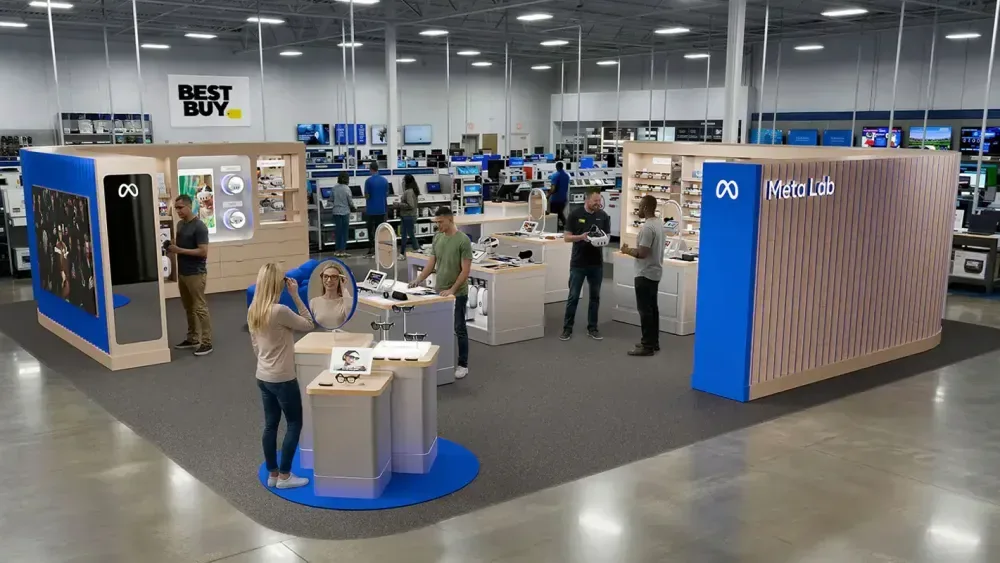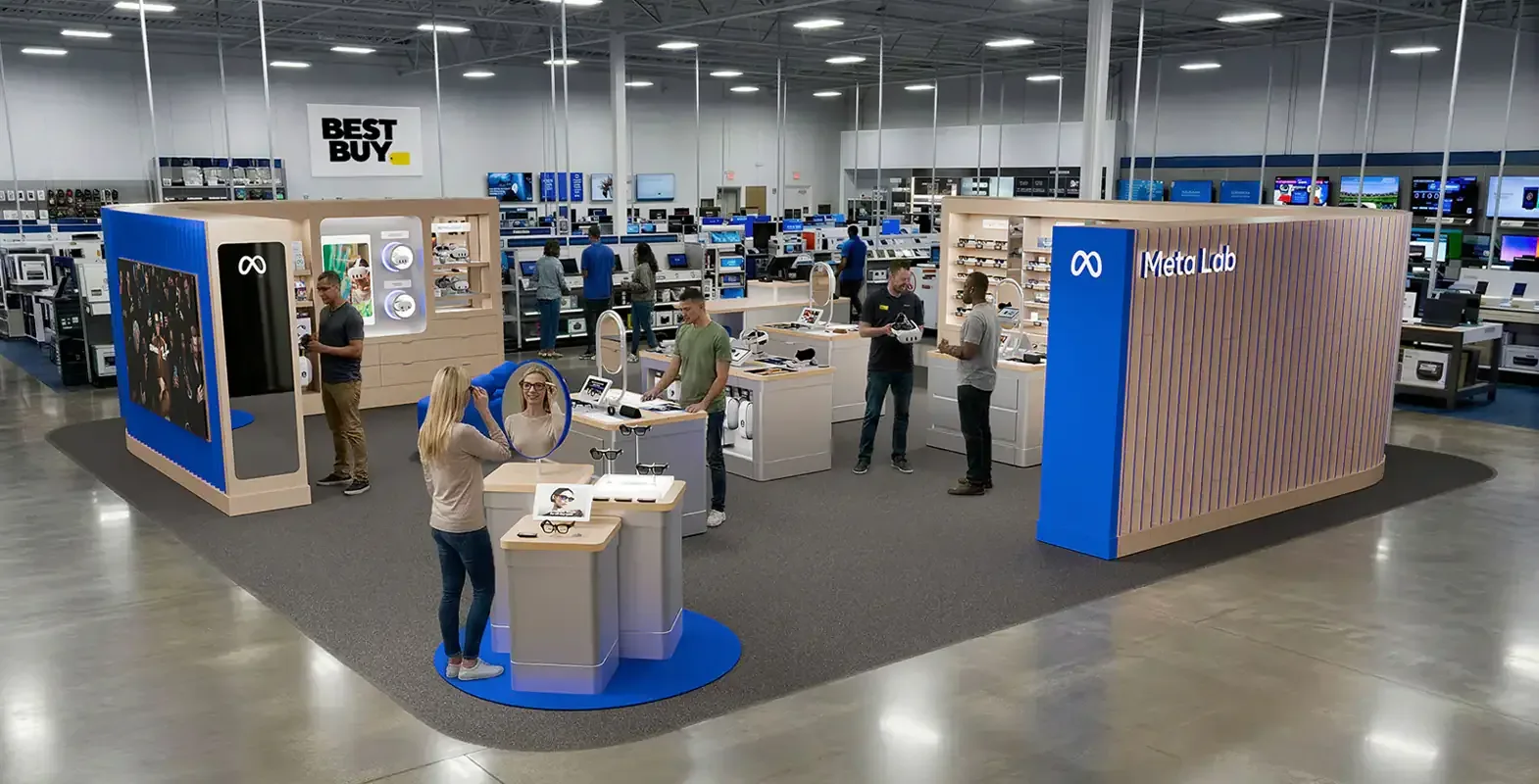
Buying VR hardware or smart glasses has always involved a slightly awkward leap of faith. A product page can list displays, sensors and battery claims all day, but it cannot tell a shopper whether a headset sits comfortably on their face, whether a frame suits them, or how strange it feels to control information with a hand gesture instead of tapping a phone. Meta and Best Buy are leaning into that gap with the expanding Meta Lab @ Best Buy program, a shop-in-shop setup designed to put several Meta devices directly in front of curious customers.
Select Best Buy locations in the United States and Canada are offering product demonstrations involving Meta’s current smart-glasses and VR lineup. That includes the Ray-Ban Meta glasses, Oakley Meta glasses, Meta Ray-Ban Display glasses, and the Meta Quest family, specifically the Meta Quest 3 and Meta Quest 3S. The first Meta Lab @ Best Buy location opened in June, and further locations rolled out through the summer. Meta says the experience is expected to reach more than 50 Best Buy stores across the US and Canada by the end of the year.
That does not mean every store will have every demo station, so interested visitors should verify that a local Best Buy is participating before making a special trip. Still, the basic appeal is easy to understand: this is an opportunity to get past the spec sheet and meet the hardware where it lives—on a face, around a head, and occasionally in the strange little dance space between a person and a motion-tracked virtual menu.
What Meta Lab @ Best Buy is putting on the floor
The Meta Lab installation centers on interactive displays and guided demonstrations rather than simply placing boxed products behind glass. Product specialists are part of the format, helping shoppers navigate the physical fit and feature sets of the glasses while Meta sales specialists demonstrate newer functions. For a category in which setup, fit and comfort are often as important as headline specifications, that human assistance may be the most practical component of the whole arrangement.
The smart-glasses side of the presentation covers three distinct names:
- Ray-Ban Meta glasses, which combine familiar eyewear styling with smart features.
- Oakley Meta glasses, another frame option aimed at shoppers looking for a different style and fit.
- Meta Ray-Ban Display glasses, which can show information in front of the wearer’s eyes through the lenses.
For the Meta Ray-Ban Display model, the demos are intended to show how a wearer can view information through the lenses and interact using hand gestures. The stated examples include swiping or tapping with gestures rather than pulling out a phone. It is the sort of capability that sounds straightforward in a bullet list but is much easier to judge in person. Gesture systems need to feel intuitive, readable and reliable to become habitual; otherwise, users can end up feeling like they are trying to communicate with a particularly judgmental aquarium.
The demos also cover functions beyond recording video. Meta’s smart glasses have expanded their emphasis to include music listening and live translation, among other features. The Best Buy format gives shoppers a setting in which they can learn what those features are meant to do, rather than having to infer the day-to-day appeal from promotional clips alone. Importantly, the available information describes demonstrations of the products and their functions, not a promise that each shopper will be able to test every feature in every retail environment.
Quest 3 and Quest 3S make the gaming case in person
For Joking Joystick readers, the Quest portion is likely to be the clearest reason to pay attention. Meta Quest 3 and Meta Quest 3S headsets are part of the in-store demo lineup, with visitors able to see how VR can be used for games, fitness activities and movie viewing in immersive 3D environments. Games remain the obvious icebreaker for a headset demo: put on the device, look around, and the technology’s core proposition becomes much less abstract than it is on a shelf label.
Related coverage includes Meta Lab @ Best Buy Expands In-Store Demos for AI Glasses and Quest Headsets.
There is a meaningful difference between seeing a headset in a locked display case and experiencing its basic interaction model firsthand. Prospective buyers can evaluate broad, personal questions that no online comparison chart can settle for them: Does the headset feel manageable? Is the visual presentation compelling to their own eyes? Do tracked controls and virtual interfaces make immediate sense? Does the idea of using a headset for a workout or a film feel like something they would actually return to after the novelty wears off?
A brief store demo is not a substitute for long-term use, and it cannot answer every question about comfort across extended sessions, a person’s home setup or their preferred game library. But it can help with the first and arguably most difficult hurdle: deciding whether VR makes sense as a category for that individual at all. Hardware adoption has a tendency to start with a simple reaction—oh, I get it now—and VR has always been unusually dependent on that moment.
It also places Meta’s consumer hardware in a more approachable retail context. Dedicated tech fans may happily research lenses, tracking and platform features late into the night. Plenty of potential players, however, would rather receive a short walkthrough from a person, try the device, and then decide whether it belongs in their entertainment budget. A store demo does not make a purchase decision for anyone, but it replaces some uncertainty with direct observation.
Why physical fit matters for glasses as much as specifications
Smart glasses create a retail challenge that standard gadgets do not. A tablet can be judged in part by its screen size and ports. A pair of glasses has to function as something people are willing to wear on their actual faces. The Meta Lab @ Best Buy setup addresses that by having specialists assist customers in finding frames aligned with face shape, personality and style.
That is not a trivial extra. People regularly choose ordinary eyewear based on frame shape, weight and appearance before they ever discuss technology. A connected pair of glasses adds cameras, audio and smart functions to that intensely personal decision. The presence of Ray-Ban Meta and Oakley Meta options suggests that the retail experience is trying to meet shoppers at the overlap between fashion, audio, camera use and AI-adjacent features, rather than treating every visitor as someone who wants the same gadget in the same silhouette.
The new display-focused glasses add another layer. Information shown in a wearer’s field of view and gesture-based controls are concepts that may sound futuristic, but the test that matters is mundane: can a person understand the interface and picture using it naturally? Giving shoppers a supervised place to try those interactions is a more useful pitch than asking them to decide from a product render. It is less “welcome to the future” and more “please determine whether the future sits level on your nose.”
A broader retail experiment around AI and immersive hardware
The Meta Lab rollout is also a small but notable retail signal. AI-related capabilities are rapidly being attached to consumer devices, while mixed reality and VR continue to seek an audience beyond enthusiasts. Both categories benefit from explanation. A customer may understand the phrase “live translation,” for instance, without immediately grasping how it would work in a real routine. Likewise, people know a VR headset creates a virtual environment, but may not have a sense of its potential for game sessions, movies or exercise until they put one on.
That makes guided demonstration space valuable. The premise is not merely that hardware needs visibility; it needs context. An employee can explain a control, help fit the device and answer basic questions before a shopper commits. It is a different proposition from ordering a device blind and hoping the box contains a portal to another world rather than an expensive head-mounted reminder to check the return policy.
The expansion arrives during a period when AI claims deserve both curiosity and a healthy appetite for specifics. As a recent look at debates over AI, proof and research credit illustrates, bold technology conversations are often most useful when the details are examined carefully. In retail, the equivalent is simple: try the interface, ask what it does, and distinguish a feature demonstration from the way a product might fit into everyday life.
What shoppers should take from the rollout
Meta’s stated plan is for more than 50 Meta Lab @ Best Buy locations across the US and Canada by year’s end, following the June opening of the first location and additional summer rollouts. The experience is built around demos of Ray-Ban Meta, Oakley Meta, Meta Ray-Ban Display, Meta Quest 3 and Meta Quest 3S hardware, with personnel available to demonstrate functions and discuss fit.
For gamers, the immediate draw is clear: a chance to see Quest VR hardware operating in a hands-on setting before purchase. For prospective smart-glasses owners, the more relevant question may be whether the frames, audio, translation tools, display information and gesture controls fit their needs and comfort level. In either case, Meta Lab @ Best Buy is trying to turn a difficult-to-explain hardware category into a try-it-yourself experience—one where the deciding factor is not just what a device promises, but what happens when it is actually placed in someone’s hands, or on their head.