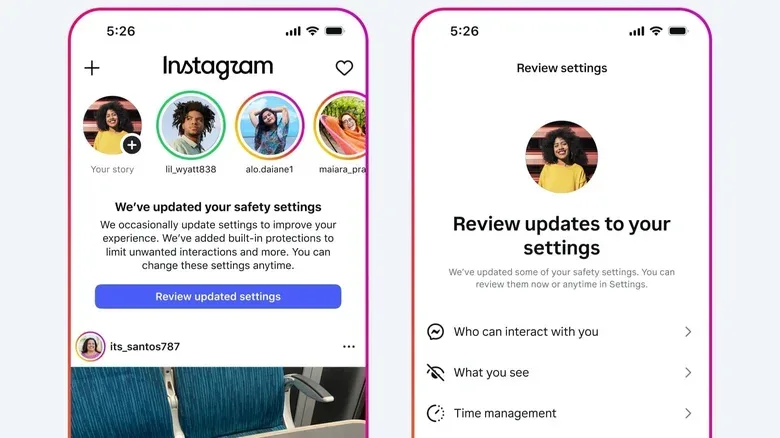
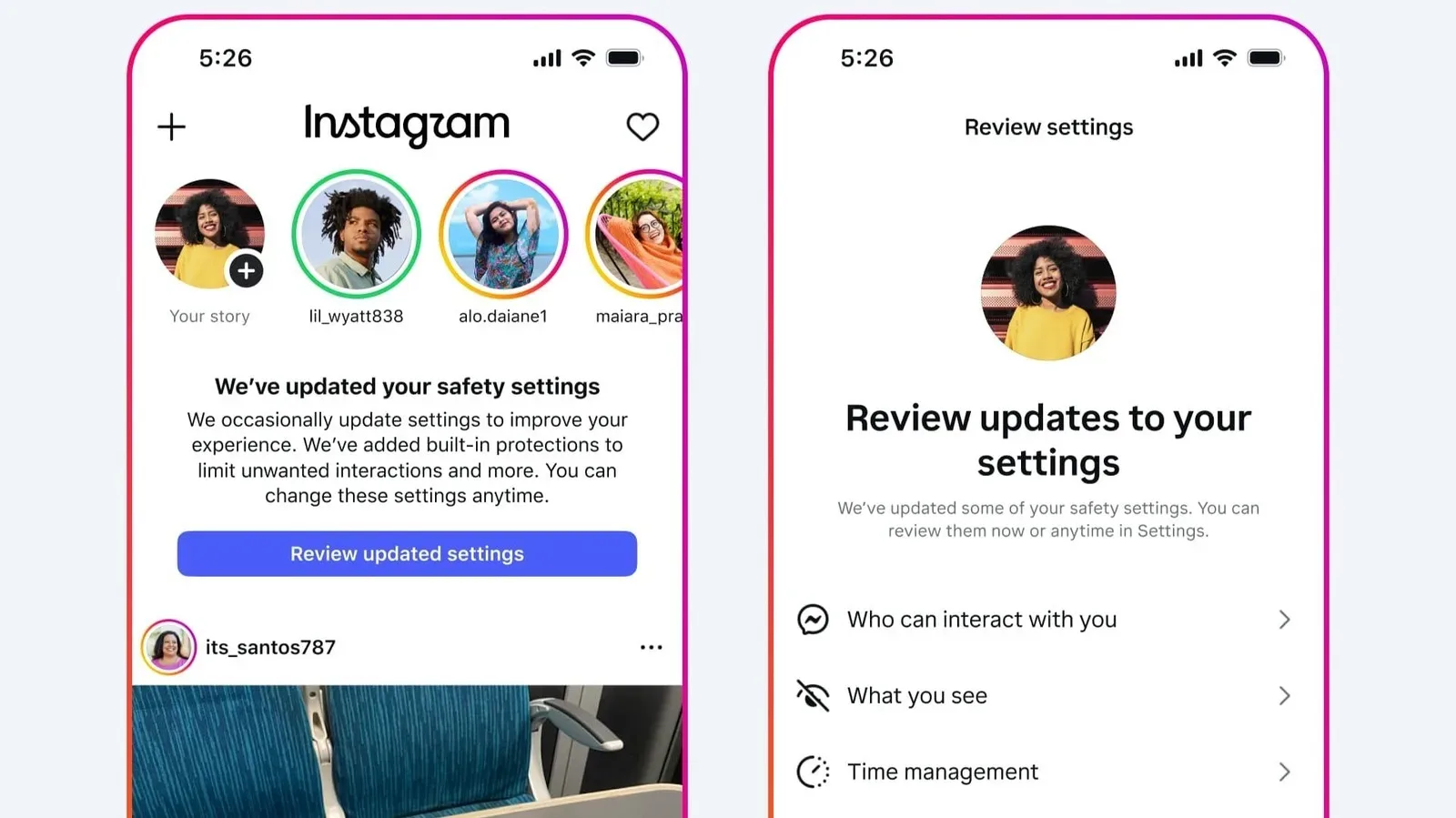
Meta is expanding its AI-driven age-estimation system globally for Instagram, a change intended to place users believed to be between 13 and 17 into the platform’s more restricted Teen Accounts. The key detail is that an account can be moved into those settings even if the date of birth entered at sign-up identifies the person as an adult.
The effort had already been used in the United States, the European Union and Brazil. Its wider rollout makes age assurance a more central part of how Instagram applies protections, rather than relying solely on the birthday a person supplies when creating an account.
For younger users—and parents trying to understand the practical effect—the important point is not merely that an account is labelled a teen account. That label changes several defaults around contact, visibility, time spent in the app and parental oversight.
What changes with an Instagram Teen Account?
Teen Accounts carry protections that are more restrictive than Instagram’s standard account setup. Meta says these accounts prevent strangers from messaging teens, set profiles and posts to private by default, use daily app time limits and include parental controls.
For more context, explore André 3000’s Moncler Re/Icons Film Uses Unreleased Music and a Chalk-Built Mountain World.
Each of those measures addresses a different part of the social-platform experience:
- Limits on messages from strangers: This is designed to reduce unsolicited contact from people a teen does not know.
- Private profiles and posts by default: Privacy becomes the starting position instead of a setting a young user must proactively seek out.
- Daily time limits: These put app use itself within the scope of the teen-account experience, not just posting and messaging.
- Parental controls: Parents have a defined role in supervising account use through the platform’s available controls.
“By default” is meaningful here. It describes the settings a user encounters without taking additional action. In safety design, defaults matter because they shape the baseline experience for every account in a group, including people who may never explore a platform’s privacy menus in detail.
Meta says it will soon send notifications to parents in the US through Instagram explaining how teens are placed into these accounts. That communication may be particularly relevant in cases where the system’s estimate conflicts with the age supplied during registration, since a change in account category could otherwise appear unexpected.
Related coverage includes Meta Expands AI Age Detection for Instagram Teen Accounts Worldwide.
How AI age estimation works in this rollout
Age estimation is not the same thing as traditional age verification. Verification generally means confirming an age or identity against a document or another authoritative process. Estimation, by contrast, uses available signals to infer an age range.
Meta has previously described several signals its systems may use. These include analysis of bone structure in photos and contextual signals in users’ activity, such as references to school grades or birthday celebrations. The stated purpose is to identify accounts that may belong to teenagers who entered an adult age when they signed up.
That distinction explains why the technology can alter an account’s treatment despite the birthday on file. The platform is not simply checking whether one field says a person is 18 or older; it is comparing that declaration with other signals it believes may indicate a user is younger.
The supplied details do not establish how the system weighs individual signals, what confidence threshold triggers a Teen Account placement, or what process applies if an estimate is wrong. Those are consequential unanswered operational questions whenever automated systems are used to make decisions about account access or restrictions. What is clear is the policy direction: an adult birth date will not necessarily prevent a user from being handled as a teen if Meta’s systems identify signals pointing to an age between 13 and 17.
Australia adds Apple’s age-range system as another signal
In Australia, Meta is beginning to use Apple’s age-range system as an additional input. The information provided does not detail Apple’s system or describe how its signal is combined with Meta’s own analysis. Still, its inclusion shows that Meta is not relying on one single method in every market.
Meta has also long argued for legislation that would make app stores responsible for verifying users’ ages. That position places part of the responsibility at the device and app-distribution layer, while Meta’s current approach operates inside its own services using platform-level signals and, in Australia, an additional Apple-provided age-range signal.
Facebook and Threads are part of the plan
The expansion is not confined to Instagram. Meta is continuing to broaden its use of AI age-estimation technology on Facebook, and it plans to bring the technology to Threads later this year.
That matters because users often move between services rather than using only one app. A company-wide age-estimation approach can potentially apply more consistent treatment across multiple social platforms, though the specific Teen Account protections described here are tied to Instagram in the available information. It should not be assumed that Facebook and Threads will necessarily use identical controls unless Meta specifies that they do.
For families, the immediate practical takeaway is to pay attention to product-specific settings and notifications. Instagram’s described teen protections include private-by-default profiles, stranger-message limits, daily app time limits and parental controls. The planned expansion of detection to Facebook and Threads signals a broader direction, but does not itself define every resulting setting on those products.
Why Meta is increasing age-detection efforts
The expansion comes after Meta reached an agreement in August with 52 attorneys general to settle litigation alleging harms to young users of its apps. Under that agreement, the company may have to pay as much as $18 billion.
As part of the settlement, Meta said it was investing in stronger technology to proactively identify accounts that may belong to children under 13, as well as accounts belonging to users aged 13 to 17. The distinction between these groups is important. The current Instagram change concerns routing suspected 13- to 17-year-olds into Teen Accounts. Detecting accounts that may belong to children under 13 is a separate safety and policy challenge, even though both fall under the broader effort to determine whether users are accurately represented by the ages associated with their accounts.
Meta’s disclosed approach is built around proactively detecting accounts that may belong to younger users rather than treating the self-reported birthday as conclusive.
In plain terms, the platform is moving toward an enforcement model where the account’s declared age is one piece of information, not the final word. That can strengthen protections for teens whose accounts were registered with inaccurate adult dates. It also makes transparency, accurate classification and clear explanations to affected users and parents especially important, because the automated estimate can directly change an account’s settings.
What users and parents should watch for
Instagram users who are 13 to 17—or who are identified by the system as likely to be in that range—may find their account moved into Teen Account settings. The clearest reported effects are a private-by-default profile and posts, restrictions on messages from strangers, daily app time limits and parental controls.
US parents should also watch for the forthcoming Instagram notification explaining how a teen is assigned to this account type. Since Meta’s system can act when it believes a supplied adult birth date is inaccurate, those notices may become an important part of understanding why an account’s defaults or available controls have changed.
The broader development is a reminder that social-platform age settings are becoming more dynamic. A birth date entered at registration may no longer be the sole determinant of the protections an account receives. On Instagram, Meta’s global expansion means AI-estimated age can now play a direct role in whether a user is placed behind the platform’s teen-oriented guardrails.