Kotaro Uchikoshi believes artificial intelligence could have changed the outcome for a game that was canceled at his new studio, Crash Keys. The writer and director, known for the Zero Escape series and Hundred Line: Final Defense Academy, has said the cancellation was real rather than part of a playful alternate-reality campaign—and that AI-assisted work might have lowered the project’s costs and development time enough to keep it alive.
It is a strikingly direct position in a game industry debate that often gets reduced to slogans. Uchikoshi is not presenting AI as the origin of a game’s creative identity. Instead, he describes it as a production tool: something that could handle repeated refinements after a human creator has established the idea, direction, story, design intent, or visual target.
His comments are tied to an especially difficult personal moment. After a meeting with the project’s publisher confirmed the cancellation, he wrote on social media that the game might not have been canceled if he had been permitted to use AI to reduce costs and shorten its schedule. He later expanded on that belief, framing AI as increasingly necessary for mid-sized developers—particularly teams making adventure games.
Crash Keys was created to make room for distinctly Uchikoshi-led projects
Crash Keys is not described as a clean break from Too Kyo Games, where Uchikoshi has worked alongside Kazutaka Kodaka, the creator of Danganronpa. Uchikoshi has said he still intends to work with his friends and partners there. His reasoning for establishing a personal studio is instead about clarity for possible collaborators and funders.
In his view, people interested in working specifically with him may hesitate if they see him only through the lens of his affiliation with Too Kyo Games. They may feel obliged to account for Kodaka and the wider studio when approaching him, or may shape a proposal around that existing relationship rather than around an individual Uchikoshi project. Crash Keys, he argues, can function as a clearer point of contact for backers or collaborators seeking a game with a more explicitly “Uchikoshi-like” identity.
That distinction matters because a studio name can communicate more than a payroll structure. It can signal who is creatively central to a project, who prospective partners should contact, and what kind of work they should expect to discuss. For a creator with a reputation for surreal, metatextual narrative games, a personal banner may help make the pitch legible. It does not guarantee financing or protect a game from cancellation, but it can remove ambiguity at the start of a conversation.
The canceled Crash Keys game therefore sits at the intersection of two ambitions: building a vehicle for more individual creative collaborations, and finding a sustainable way to produce those projects. Uchikoshi’s AI argument is fundamentally about the second problem.
His central argument: smaller teams are now competing on speed as well as ideas
Uchikoshi describes a difficult competitive environment for mid-sized teams. He points to very small groups and even individual creators who use AI to make expansive games with substantial amounts of content at lower cost and in less time. In that environment, he argues, a mid-sized adventure-game studio has to contend not only with similarly staffed developers, but with projects whose production capacity may be amplified by AI tools.
Related coverage includes Kotaro Uchikoshi Says AI Could Have Helped Prevent Crash Keys Game Cancellation.
That is an important nuance in the claim. The comparison is not simply between one studio and another; it is between development models. A team that relies entirely on conventional, iterative labor may have a different schedule and budget profile from a small team that uses AI for certain tasks. Uchikoshi’s conclusion is blunt: if rivals are gaining those efficiencies, mid-sized studios may have little choice but to use AI themselves.
His perspective does not establish that AI would definitely have saved the canceled Crash Keys project. The actual decision involved a publisher, and no detailed budget, schedule, scope, or reason for cancellation has been provided here. It would be inaccurate to turn a personal assessment into a proven counterfactual. What he has offered is a belief: that lower costs and faster production could have made a decisive difference.
That distinction is vital for readers following AI stories in games. “Could have helped” is not the same as “would have prevented” a cancellation. Game projects can end for many reasons, but only the possibility of cost and time pressure has been discussed in this case. Uchikoshi is explaining how he sees the production equation, not disclosing a complete account of the canceled game’s business circumstances.
What Uchikoshi means by AI assistance
Uchikoshi’s example focuses on iteration: the repeated adjustment of work until it matches a creator’s intentions. He describes a graphic adjustment where someone is asked to move an element by 10 dots, then receives another request to move it by five, and then perhaps by three. The point is not that the original human worker did something wrong. Creative direction often becomes more precise only after the director sees a revised version.
In production terms, iteration means making a version, reviewing it, changing it, and repeating that cycle. It is a routine part of making games, whether the work concerns interface placement, art assets, writing, animation, or another discipline. The issue Uchikoshi identifies is the cost of repeated micro-adjustments: each request takes time, adds coordination, and can be discouraging when a worker is asked to revise the same small detail several times.
His proposal is that AI can absorb some of that back-and-forth without frustration. He says a human should remain the source of the concept and inspiration, including in visual work, design, and story. But he is comfortable assigning some refining and polishing to AI after that creative origin has been defined. He sees this as a route toward a final game that better reflects the creator’s initial intent.
For Uchikoshi, the claimed value of AI is not replacing the first human idea, but accelerating the work between that idea and the version a creator approves.
There is an evident practical appeal in that framing. A director may have more opportunities to test alternatives quickly, while human specialists may spend less time on tiny repeated alterations. Yet the framing also leaves key questions that each team would have to answer for itself: which tasks are appropriate for AI assistance, what quality bar applies to its output, how human staff retain meaningful creative control, and whether the use of a tool actually produces the expected savings after review and correction.
Those questions are not answered by the claim that AI is useful. They are part of what makes the debate more complicated than a simple choice between technology and creativity. Even under Uchikoshi’s approach, humans set the objective, judge the revisions, and decide when work is finished. AI would be a tool within a human-led approval process, not an independent creative authority.
Faster development, in his view, does not automatically mean fewer people
A recurring concern around AI in game development is that efficiency will be treated solely as a reason to eliminate jobs. Uchikoshi takes a different view in these comments. He suggests that completing a project in half the time does not necessarily require cutting staff. It could instead mean the same team has time to make another project.
This is a meaningful distinction between cost reduction and capacity expansion. Cost reduction means finishing the same work with less money or fewer labor hours. Capacity expansion means using time saved on one project to attempt more work: another game, another phase of production, or more room for revision. Both may result from a shorter schedule, but their effects on a team are not identical.
Uchikoshi’s outlook favors the latter possibility. He imagines AI enabling creators to pursue more ideas rather than simply shrinking the workforce. That remains an aspiration rather than a guaranteed outcome. Whether saved time becomes another project, additional polish, or reduced staffing depends on the choices of the people funding and managing a production. Still, his comments make clear that he does not view AI efficiency as inherently synonymous with fewer workers.
His argument also recognizes that time itself can be a creative constraint. If a project takes years to complete, a studio’s next opportunity is delayed by years as well. Shortening that path could give a team more chances to pursue work before its resources are exhausted. For an independent or mid-sized studio, that may be the difference between attempting a new idea and never getting the opportunity to pitch it.
Industry restructuring has already made the human cost of studio instability impossible to ignore, as reflected in a recent account of a former BioWare art director describing a team split as heartbreaking. Uchikoshi’s position is not a direct response to that separate situation, but it underscores why the stakes of production costs, cancellations, and team continuity matter beyond abstract arguments about tools.
Player resistance is acknowledged, but Uchikoshi remains firmly pro-AI
Uchikoshi acknowledges that many players are uneasy about AI’s presence in game development. His response is not to dismiss the concern as nonexistent; it is to argue that the technology does not inherently diminish human creativity. His dividing line is creative origin versus later execution and refinement.
For him, a human idea remains essential to a game’s art, story, and design. AI is useful when it helps carry that idea through the labor of revision. He believes that can bring a finished work closer to a creator’s vision, rather than pulling it away from it. In his example, a project that might otherwise land at 70 or 80 percent of the creator’s intended result could move closer to the full target because revisions become easier to explore.
That is a notably optimistic theory of the technology: AI as a means of increasing creative fidelity. It contrasts with a fear that automation inevitably makes work more generic or separates artists from their craft. Uchikoshi’s answer is that the result depends on where AI is placed in the process. Use it to originate the work, critics may worry about creative authorship; use it for directed refinement under human judgment, he believes it can serve authorship.
The practical boundary may be difficult to maintain in real productions, particularly because “refining” can be a broad term. A visual adjustment is one kind of task; narrative work and design work can involve decisions that are far more intertwined with creative intent. But Uchikoshi’s stated model is clear enough: the creator supplies the foundational idea, and AI helps make repeated, instructed changes efficiently.
Hundred Line may mark a turning point in his process
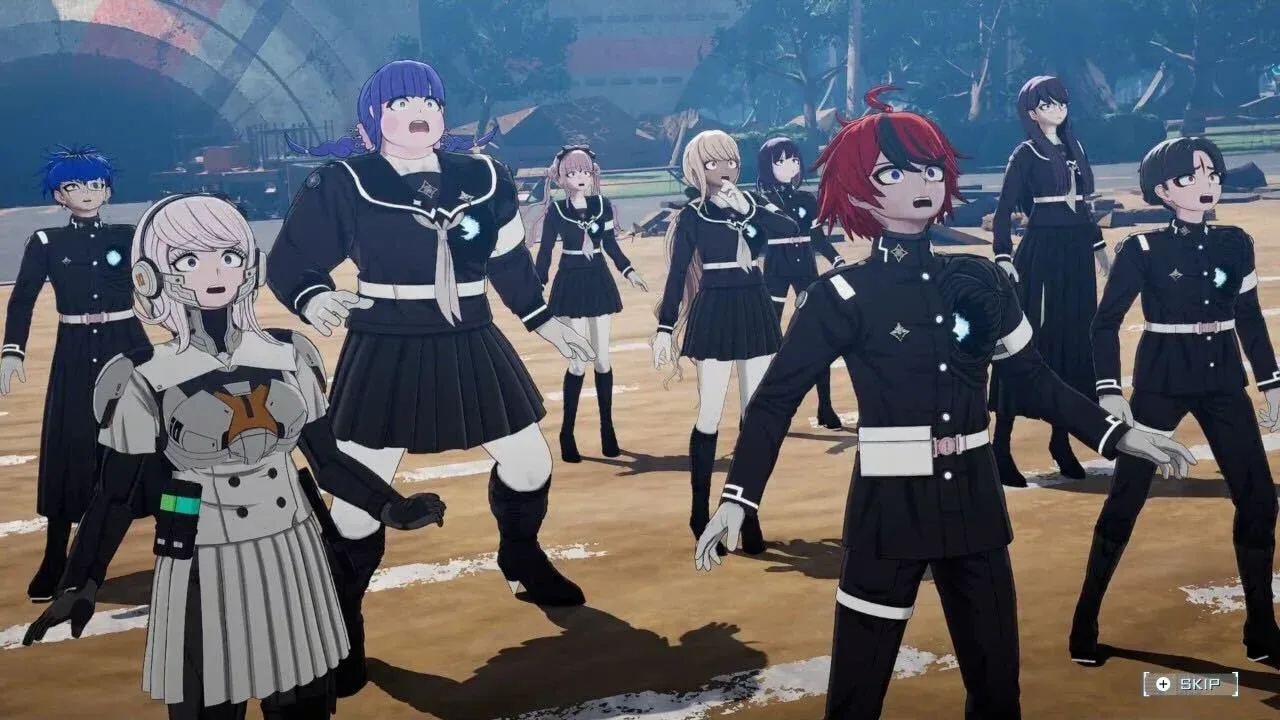
Uchikoshi had previously suggested that Hundred Line: Final Defense Academy could be among the last games of its scale made without AI. His latest remarks make that statement sound less like a passing observation and more like a working principle for future development.
For Crash Keys, that principle is shaped by a concrete loss: a project that was canceled after a publisher meeting, on what Uchikoshi described as one of the worst days of his career as a developer. His argument is not that AI erases financial risk, guarantees a publisher’s approval, or makes game production painless. It is that the industry’s growing emphasis on speed and low-cost output changes what smaller teams need in order to compete.
Whether other creators share his prescription is a separate question. What is unmistakable is the clarity of his position. Uchikoshi sees AI-assisted iteration as a potential way for human-led creative teams to preserve their ambitions, reduce the distance between concept and finished game, and perhaps avoid the kind of cancellation Crash Keys has just endured.