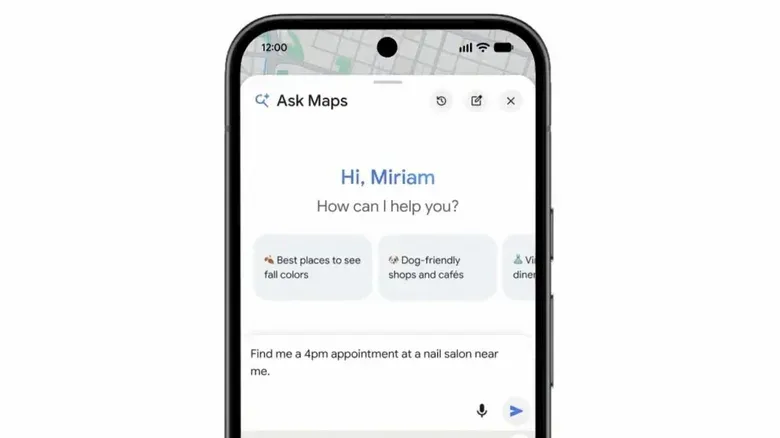
Google Maps is giving its Gemini-powered Ask Maps feature a bigger job: helping users get off the map and into an actual appointment. The chatbot can now search for time slots for services such as beauty appointments, pet care, auto repair and home repair, then call a local business to book on the user’s behalf.
It is a notable shift in scope. Mapping software has long been good at showing where a business is, its hours and perhaps its reviews. Ask Maps is being positioned to handle the tedious step that follows a search: figuring out whether a suitable appointment exists, narrowing down the details, and placing a call when a booking needs to be made.
The expanded feature set is rolling out on Android and iOS. Some capabilities are broadly available wherever Ask Maps operates, while appointment booking and the new pre-trip route advice start in the US. Google says availability for those US-first functions will reach other regions later.
What Ask Maps can do with appointments
A request to find an appointment may not be a one-line interaction. Ask Maps can ask for further details before it presents available times. That matters because a useful service search usually needs more than a category and a location. The system may need enough information to distinguish between the kind of appointment a user wants and the time they can realistically make.
Once it has the needed details, the chatbot can surface slots and call local businesses to make the booking. The supported examples span several practical categories:
- Beauty services
- Pet care
- Auto repair
- Home repair
The wording here is important: Ask Maps is designed to find appointments and call to book them, rather than simply providing a business phone number. For users, the potential appeal is obvious. Calling several local providers to compare openings is a small but repetitive chore, especially when a service is urgent or when availability is limited.
There are still sensible reasons to stay involved in the process. A user should make sure the requested service, preferred time and any relevant details are correct before treating a booking as settled. Local businesses also vary in how they schedule work, and the supplied information does not establish that every business or every appointment type can be handled in exactly the same way. The feature is best understood as an assistant for the search-and-contact portion of booking, not a guarantee that every desired slot will be available.
Restaurant searches can start with saved places
Ask Maps is also gaining a more targeted way to search for restaurant availability. Instead of beginning with every nearby dining option, users can ask it to look for open tables at restaurants already saved to their Google Maps lists.
That can be useful when a list has become a personal backlog of places to try. A user could ask for a table for a specified number of people within the next hour, and Ask Maps can return available options. The distinction is small but useful: saved lists express prior interest, while the chatbot adds the immediate question of whether one of those places can accommodate a group now.
It also keeps the search focused. Someone deciding dinner plans does not necessarily need another broad set of recommendations; they may simply want to turn an existing shortlist into a reservation-worthy choice. The feature makes that kind of last-mile planning more conversational.
Road-trip planning becomes an editable itinerary
Travel is the other major focus of the update. Ask Maps can build a road-trip plan with stops chosen around a user’s interests. Rather than treating a route as only an origin, destination and estimated arrival time, it can generate a schedule that includes places along the way.
That schedule is not meant to be fixed. Users can modify it, share it with others or export it to Google Docs. Those options matter for different kinds of trips: sharing supports coordination, editing acknowledges that plans change, and exporting to a document gives a group a place to view or adjust a plan outside the map interface.
Google Maps’ new planning pitch is therefore not simply “find the fastest route.” It is closer to arranging a flexible sequence of destinations around a journey. The value will depend on the quality of a person’s prompt and on how clearly they can state their interests, but the outcome described is an itinerary rather than a static list of pins.
“Know before you go” route information
Before leaving, users can view route-related information described as “know before you go” guidance. It covers weather, EV charging locations, tolls and potential delays. In plain terms, it brings several trip considerations together before a drive begins:
- Weather: conditions that may affect a journey or influence what a traveler wants to pack and do.
- EV charging spots: locations relevant to drivers who need to plan around vehicle charging.
- Tolls: route costs or decisions that can affect which road a driver prefers.
- Possible delays: disruptions that may alter timing or make a route less appealing.
Once the trip is underway, Ask Maps can bring up the itinerary and display the details needed for the route. Users can also change the itinerary while on the road. Google’s example is a lunch change of heart, but the broader practical point is that the trip plan can respond to a changed preference instead of requiring travelers to rebuild everything from scratch.
That flexibility is useful, though it should not be confused with an invitation to interact unsafely while driving. A route assistant can make revisions easier; drivers still need to use it responsibly and comply with local rules around device use.
What is Gemini-powered Ask Maps?
Ask Maps is a chatbot inside Google Maps that is powered by Gemini, Google’s AI system. A chatbot in this context is an interface designed to accept requests in everyday language rather than forcing users to navigate several separate menus and filters.
For example, the difference between a conventional map search and the newly described experience is not merely a new search box. The assistant can take a goal expressed in a sentence—such as finding a service appointment, locating a free table at a saved restaurant, or planning a road trip around particular interests—and turn it into a sequence of search, scheduling and itinerary tasks.
That approach could make Maps especially handy on a phone, where switching between business listings, booking pages, notes and route screens can be cumbersome. It also continues the broader trend of putting AI assistants in front of existing services. In this case, the underlying map, business and route information remains central, while the conversational layer is intended to reduce the number of manual steps needed to use it.
Google has recently been making a wider case for its mobile AI tools. For a related look at the company’s hardware strategy, see our coverage of the Pixel 11 Pro XL and its positioning for gaming.
Availability: broad expansion, but not every feature everywhere
Ask Maps itself is expanding to more than 200 countries. The rollout includes more than 30 additional countries in Europe, with the UK, Germany and Spain among those specifically included.
Feature availability is split into two tiers. List search and travel-itinerary tools can be used in places where Ask Maps is already available. The appointment-booking function and the pre-departure route advice are initially US-only, with further regional availability planned.
That distinction is worth watching for anyone outside the US. Having access to Ask Maps does not automatically mean access to every new task it can perform. A person may be able to use restaurant list searches and create a trip itinerary while waiting for automated appointment booking or “know before you go” advice to arrive in their market.
The practical change: Maps moves from discovery toward action
The common thread across these updates is a move from discovery to action. Finding a repair shop, saving a restaurant, or plotting a drive has traditionally been only the beginning of a task. The expanded Ask Maps tools aim to help complete the next steps: seek an opening, call for a booking, test a saved restaurant list against near-term availability, build a schedule, and adjust that schedule when the day changes.
Whether that becomes a regular habit will come down to reliability and regional coverage, neither of which can be judged from the feature description alone. But the direction is clear. Google Maps is no longer being framed solely as a place to ask where something is. With these additions, it is increasingly a place to ask what can be arranged next.