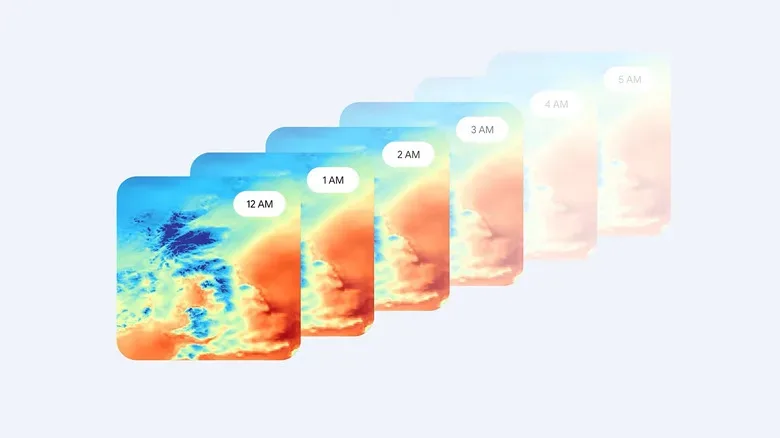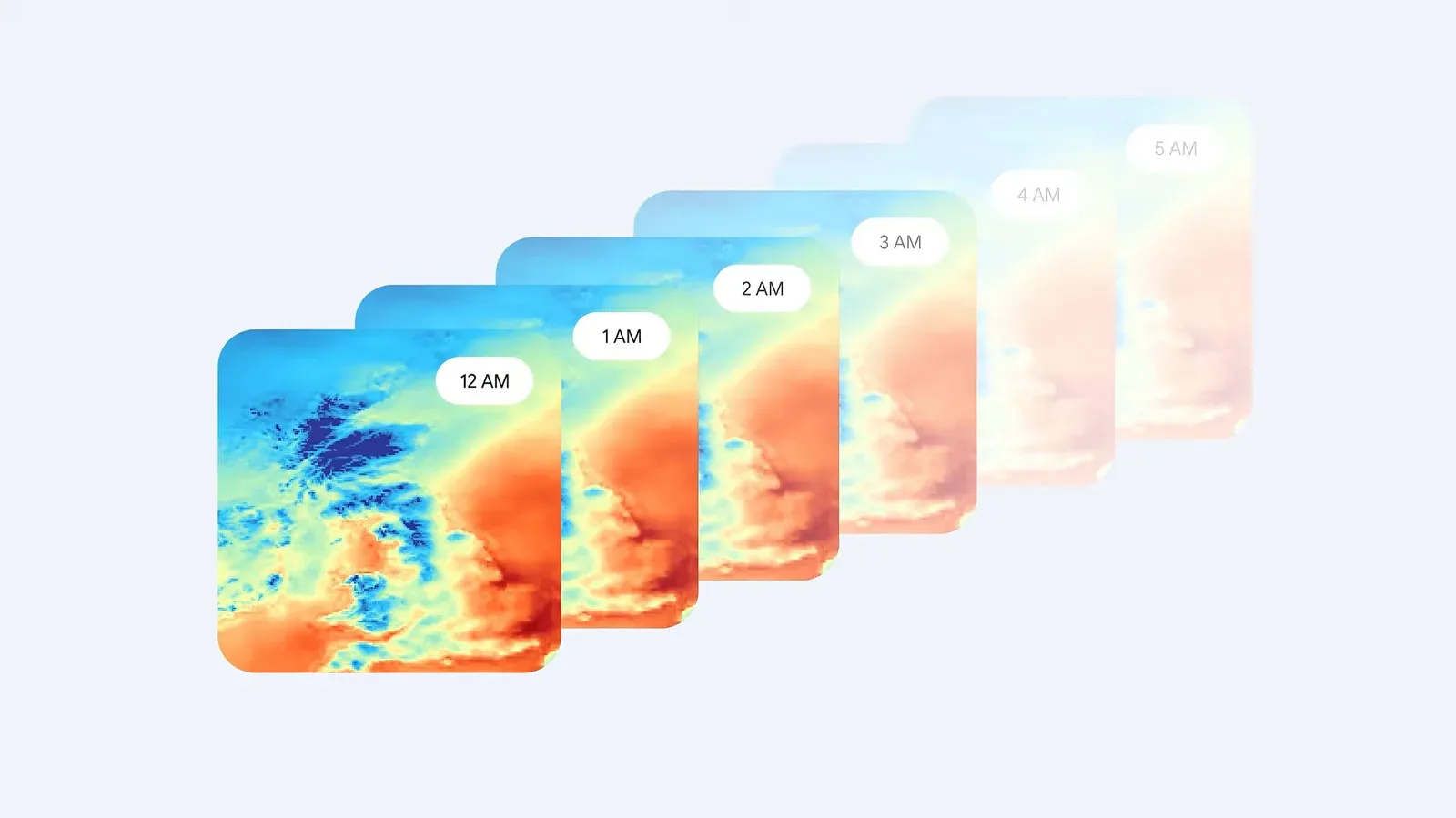
Weather forecasts are about to get a sharper grid and a much busier stream of information behind the scenes. Google DeepMind has released WeatherNext 3, the latest version of its AI-powered weather model, and the headline change is straightforward: it incorporates live satellite data rather than leaning primarily on numerical weather prediction data with a six-hour delay.
That update is intended to deliver more detailed forecasts for major variables including temperature, moisture, and wind speed. It also narrows the model’s forecast grid dramatically. Where WeatherNext 2 used 25-kilometer squares, WeatherNext 3 operates on a 5-kilometer-square grid and can provide hourly forecasting. In weather terms, that is the difference between seeing the broad shape of a changing map and getting a closer look at the local conditions that can complicate a day, a commute, or an energy-production plan.
It is a technical release with very consumer-facing destinations. WeatherNext 3 is set to power weather experiences in Google Search, the Gemini app, and Google Maps, as well as the Google Maps Weather API and Google Earth Engine. People who want to explore the model directly can do so through Google Weather Lab. Developers looking to build with the company’s weather technology have a separate route, too: the original WeatherNext model has been open-source since August 2026.
A forecast built from a more current view of the sky
The core claim around WeatherNext 3 is not simply that it is an AI model, but that the information it receives has changed. Numerical weather prediction models remain an important type of input in weather forecasting, but the data described here comes with a six-hour lag. WeatherNext 3 supplements that approach with live satellite data, providing a continuously updated picture of atmospheric conditions.
That distinction matters because weather is not a turn-based strategy game where every piece politely waits for the next round. Clouds move, moisture shifts, winds alter direction, and local conditions can diverge quickly. A model trained with a more current stream of satellite observations is positioned to work with a fresher atmospheric snapshot instead of depending primarily on information that is already hours old.
WeatherNext 3 also takes in sparse data from weather stations. This is particularly relevant for humidity, a variable that can change substantially across short distances—potentially from one kilometer to the next. The combination of satellite observations and station information is meant to help the system deliver greater detail for conditions that are often highly local.
The move from 25-kilometer to 5-kilometer grid squares is the easiest part of the improvement to visualize. Neither number turns forecasting into certainty, and a finer grid does not mean every street gets its own infallible weather oracle. Still, smaller cells give a model a more granular framework for expressing differences across an area. That is useful when the question is not only whether a region might be windy or damp, but where the strongest wind, cloud cover, or moisture conditions are likely to sit within it.
Rain and snow are a major focus
Precipitation is one of the areas where Google DeepMind says WeatherNext 3 makes its most notable gains. The model combines precipitation data from NASA with Google’s satellite analysis to improve predictions for rain and snow.
The stated result is up to 50 percent more accurate precipitation forecasting, with the biggest gains expected in places where forecasts have historically been less dependable. The “up to” is important: it describes a reported peak improvement rather than a universal promise that every forecast in every location will improve by the same amount. Weather remains a famously stubborn opponent, one capable of ignoring outdoor plans with the casual confidence of a boss fight that has entered phase two.
Even so, the emphasis on precipitation is notable. Rain and snow forecasts are among the most immediately practical parts of a weather service. They affect travel decisions, outdoor events, farming, construction, and the basic choice between carrying an umbrella or performing the ancient ritual of insisting the clouds “don’t look that bad.” Improvements in locations that have been harder to forecast could be especially meaningful, provided the reported performance carries through the weather experiences and tools that use the model.
Why renewable energy is part of the picture
WeatherNext 3 is also being positioned as useful for renewable-energy companies. Its forecast capabilities include wind speeds at 100 meters, roughly the height associated with turbines. More precise wind forecasts can help estimate potential wind-energy output.
For solar operations, the relevant details are high-resolution cloud cover and solar radiation levels. Clouds can sharply change how much sunlight reaches solar installations, while radiation data helps describe the available solar resource. In other words, the model is being aimed at questions that are directly tied to planning energy production: how windy could it be at turbine height, how much cloud cover may be present, and how much solar radiation is expected.
This is one of the clearest examples of why resolution and frequency are central to the WeatherNext 3 pitch. A broad weather outlook may be sufficient for deciding whether to take a jacket. Energy generation can benefit from a more exact view of conditions as they develop. The model’s hourly output and 5-kilometer grid are designed to offer more useful detail for that kind of work, while the satellite feed supplies a more current atmospheric input.
Where WeatherNext 3 will show up
The most visible uses will be within familiar Google products. WeatherNext 3 will support weather features in Search, Gemini, and Google Maps. It will also be used through the Google Maps Weather API and Google Earth Engine, extending its reach to services and projects that rely on those platforms.
The inclusion of the Gemini app places the weather model within a broader push to put AI-driven information tools in front of everyday users. That wider landscape is also producing stranger software ideas across the interactive space, as seen in this indie game roundup featuring a cat confronting office AI. WeatherNext 3 is far less whimsical in purpose, but it shows the same larger reality: AI is increasingly becoming infrastructure tucked inside products people already use.
For people interested in inspecting the model rather than merely encountering an updated forecast in an app, Google Weather Lab is available now as a place to experiment with WeatherNext 3. The open-source status of the original WeatherNext model, effective since August 2026, is a separate detail worth keeping clear. The information provided identifies the original model as open-source; it does not state that WeatherNext 3 itself has been open-sourced.
What the update does—and does not—promise
WeatherNext 3’s release makes several specific claims: finer hourly forecasts, a 5-kilometer grid, live satellite data, station data for better detail around variables such as humidity, and precipitation forecasts that may be up to 50 percent more accurate. It also lays out clear product integrations and renewable-energy use cases.
Those claims should not be read as a guarantee that weather prediction has become perfect. Forecasting remains a matter of estimating evolving conditions, and the stated precipitation gain varies by situation and location. The practical impact will depend on the type of forecast, the area involved, and how the model’s outputs are incorporated into each weather experience.
But the direction is clear. WeatherNext 3 is built around a faster-refreshing view of the atmosphere and a substantially finer forecast grid than its predecessor. If its reported advantages prove valuable across Search, Maps, Gemini, APIs, and energy-focused applications, users may not need to know the model’s name to notice the result. They may simply see a more specific forecast before deciding whether the sky is about to become a minor inconvenience—or the day’s undisputed final boss.