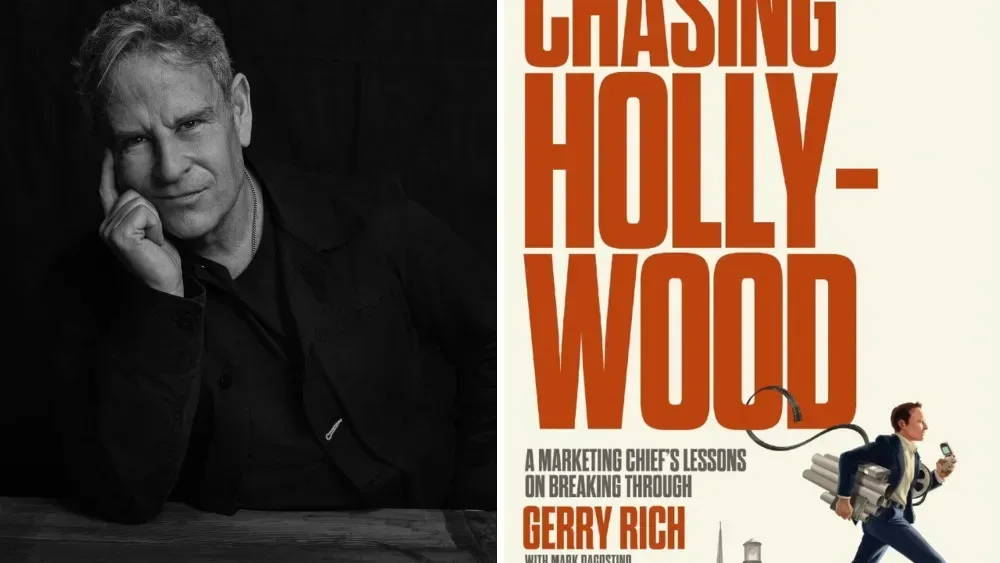

Before Iron Man became a foundation stone for the Marvel Cinematic Universe, it was a high-stakes bet with several obvious question marks. Gerry Rich, a longtime film-marketing executive whose career includes roles at Paramount, Columbia Pictures, MGM, Miramax and Amazon MGM Studios, has revisited the campaign behind the 2008 release while discussing his memoir, Chasing Hollywood: A Marketing Chief’s Lessons on Breaking Through.
The story is a useful reminder that a movie’s eventual cultural status can obscure the uncertainty that existed before audiences saw it. Iron Man was not being introduced with the same public familiarity as Spider-Man or the X-Men. Robert Downey Jr. was not an uncontroversial casting choice, with his previous personal struggles having affected perceptions of his star power. And Jon Favreau still had to prove that he could deliver a superhero production at the needed scope and scale.
Rich’s account puts the emphasis where it belongs: the campaign was not merely a matter of making noise around a sure thing. It was an effort to identify an early point of conviction, then turn the people most ready to champion the film into a force that could reach beyond the convention hall.
An unfamiliar hero with a lot to prove
In entertainment marketing, IP means intellectual property: the pre-existing character, story world or recognizable brand that gives a project built-in awareness. Rich’s point is that Iron Man did not possess the same mainstream recognition as Marvel characters such as Spider-Man and the X-Men. A famous logo or character can make the first marketing task simpler because audiences already have an idea of what they are being asked to watch. A less prominent character must earn that instant understanding.
That does not mean a lower-profile property is doomed. It means the campaign must communicate its appeal quickly and persuasively. In this case, the marketing challenge sat alongside doubts about the people making the film. Rich recalled skepticism around Downey’s suitability for the flawed lead character, as well as questions about whether Favreau could handle the necessary scale.
Those concerns are worth separating from the outcome. The later success of Iron Man makes it tempting to treat each choice as inevitable. Rich instead describes a moment when the team saw footage that convinced them something unusual was taking shape. He specifically points to the response to the film’s dailies, the raw footage reviewed during production. Dailies are not a finished movie: they are an early tool for filmmakers and, in this instance, a source of confidence that the screen chemistry and material had real potential.
That confidence did not eliminate risk. It informed a decision about timing. Rather than distribute film assets immediately, the team waited to show the teaser trailer and additional footage at Comic-Con in 2007, well before the 2008 release.
Why holding material back mattered
A teaser trailer is designed to create interest rather than explain every beat of a film’s plot. The distinction is particularly important for a movie trying to establish a hero who may not already be a household name. Too much too early can dilute anticipation; too little can leave people without a reason to care. Rich’s recollection suggests the Iron Man team chose a third route: delay the major reveal until it could be presented in front of an audience likely to understand the occasion and amplify its reaction.
Comic-Con supplied that setting. Favreau appeared with the cast and crew, received a strong welcome, and used an iPhone to capture the crowd response. The team showed the teaser intended for launch along with film footage. Rich says the reaction turned attendees into enthusiastic advocates for the movie.
“We showed the teaser trailer that we were going to launch, as well as some film footage, and the audience was sold,” Rich recalled of the Comic-Con presentation. “They came out as major champions of the film.”
The important element here is not simply that a trailer played at a convention. It is that the event gave a potentially skeptical project a concentrated first audience. Fans in the room could judge the footage, the scale and the tone for themselves. A positive reaction could then function as an early form of validation for people who had not attended.
That is a broader marketing principle, but it should not be confused with a guaranteed formula. Comic-Con is not a magic button, and an enthusiastic room cannot rescue every campaign. In the Iron Man case, though, the timing of the reveal appears to have been closely tied to the team’s belief that the available footage could convert uncertainty into excitement. The underlying product had to give that audience something worth championing.
From broad reach to scattered attention
Rich contrasts that earlier campaign environment with today’s media landscape. He says entertainment marketers once had stronger ways to reach a broad audience at the same time through linear television, cable, sports, digital and social media. He now sees reaching that simultaneous mass audience as considerably more difficult, particularly through linear television.
Linear television refers to scheduled programming watched as it airs, rather than on-demand viewing selected from a library. Its old advantage for advertisers and studios was shared timing: a sizable number of people could encounter a message during the same broadcast window. Rich identifies live sports, particularly football, as one of the remaining reliable places for a marketer to find a large and captive audience all at once.
“Captive” in this context does not mean viewers have no choice. It describes an audience that is actively present for a live event and therefore more likely to see the advertising placed around it. For a movie campaign, that kind of shared moment can create widespread awareness quickly. The complication is that fewer entertainment-viewing habits now produce that same synchronized reach.
Fragmentation changes the practical job. Instead of assuming that one major placement will introduce a film to nearly everyone a studio wants to reach, campaigns must contend with audiences whose attention is dispersed across different platforms, formats and viewing schedules. The basic purpose remains the same—make a project recognizable, appealing and timely—but the route to that result is less unified.
This does not erase the value of events like Comic-Con. If anything, Rich’s Iron Man recollection underscores why a defined gathering can be so useful: it creates a moment of focus in an environment where attention is increasingly divided. But the specific media conditions surrounding a 2007 convention reveal are not identical to those marketers face now. A campaign that once combined one concentrated fan event with broad television-era reach may need to find different ways to connect distinct audience groups.
AI is part of the new question, not an answer by itself
Rich is also looking ahead at entertainment marketing and audience targeting in the age of AI. The supplied details do not set out particular AI tools, systems or campaign tactics, so it would be premature to claim a specific method is being adopted. What is clear is the context: the tools and practices used to understand and reach audiences are changing at the same time that traditional mass reach is becoming harder to secure.
Audience targeting is the process of trying to deliver marketing to people most likely to respond to a particular project. It involves deciding which audiences matter, what message may appeal to them, and where that message is likely to be encountered. The term is not the same as creativity. Targeting may help a campaign decide where to speak; it does not automatically provide the compelling footage, casting appeal or sense of occasion that makes people want to talk about a film.
That distinction is central to the Iron Man example. Rich’s story contains a strategic choice—wait to reveal assets until Comic-Con—but it also hinges on the team seeing something “extraordinary” in the production material. The campaign’s leverage came from presenting an audience with a convincing early look, not merely from identifying an audience in the abstract.
For readers following the business side of entertainment, the enduring lesson is less about copying one release playbook than about understanding the tension Rich describes. Marketing must increasingly locate audiences across a fractured media environment, while still finding moments where attention can be gathered and excitement can become communal. AI belongs to that evolving targeting conversation. It does not change the need for marketers to make sharp judgments about timing, material and the people they hope will carry a message forward.
The legacy of a carefully timed reveal
Iron Man ultimately launched the Marvel Cinematic Universe, but Rich’s account restores some of the uncertainty that precedes a cultural breakthrough. The hero lacked the mainstream profile of certain Marvel peers. The lead actor and director faced doubts. The film’s marketing team chose not to rush the footage into public view, instead saving its first major showcase for Comic-Con.
In retrospect, that reveal reads as an example of discipline: do not show a promising but uncertain film simply because a campaign needs to begin; show it when the material and the audience can reinforce one another. It is a principle that remains relevant even as the means of distribution, the reliability of television reach and the role of AI in targeting continue to shift.
The industry side of these changes is also visible in other discussions around media businesses and cross-platform audiences, including the growing importance of podcasts across platforms. Rich’s perspective adds a film-marketing version of the same core issue: reach is no longer a single destination, so the value of a well-chosen moment—and a message people genuinely want to share—may be higher than ever.