An old Gabe Newell lecture is circulating again because it poses a question that remains awkwardly current for online games: when a player does something a development team never intended, is that automatically a hack—or could it be the beginning of the game’s best story?
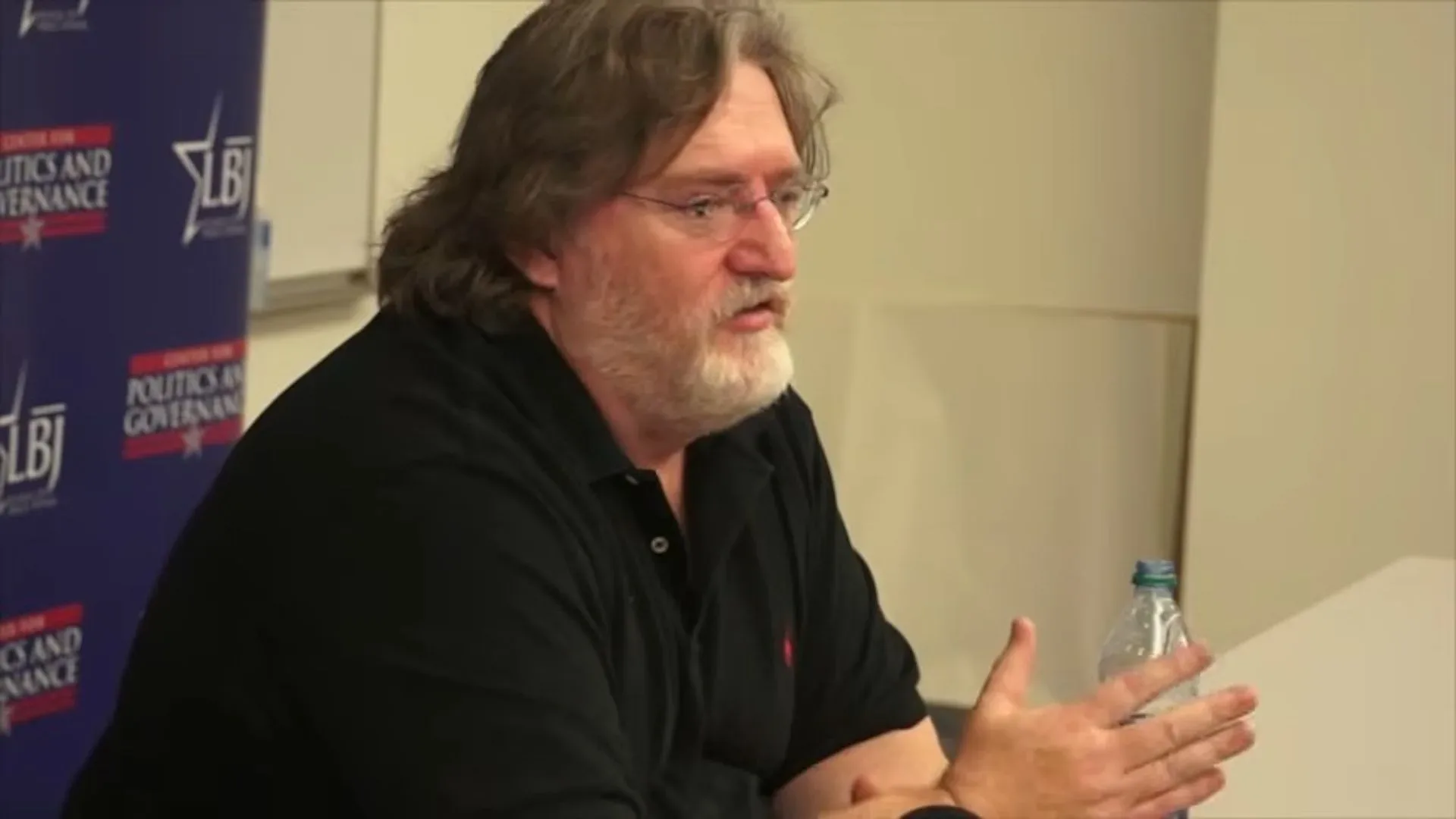
Speaking at the University of Texas in 2013, the Valve co-founder drew a distinction that sounds simple but is not: there are multiple kinds of hacking, and developers can make a major mistake when they label a player action “hacking” even though it is genuinely entertaining. His defining example was one of MMO history’s famous accidents: the killing of Lord British during an Ultima Online event on August 9, 1997.
Newell’s point was not that security is optional. The fuller answer makes the opposite case. In a persistent social game, players need confidence that the world will continue to recognize their time, possessions and expectations. A failure to provide that assurance can spread through the wider “meta world”—the social and economic layer surrounding the moment-to-moment game. But Newell also argues that a team should distinguish damage to that trust from a remarkable, contained disruption that players might remember forever.
That is a much more demanding principle than “let players do whatever they want.” It asks developers to judge two things at once: whether an incident has compromised fairness or safety, and whether the unexpected result has created meaningful drama worth preserving.
The accidental vulnerability behind a legendary MMO moment
Lord British was the in-game persona of Richard Garriott, the prominent figure behind the Ultima series. During a server event in Ultima Online, a crash interrupted proceedings. When Garriott returned, the character’s invincibility had apparently not been restored. Lord British was therefore vulnerable in a setting where players ordinarily expected the character to be protected.
A player called Rainz used a fire spell on Lord British and killed him. The moment is widely remembered as the “grand assassination.” It immediately became bigger than a single spell landing on a temporary vulnerability. Another Ultima Online developer, Starr Long—appearing as Lord Blackthorn—then summoned demons that attacked bystanders. Beta testers protested both the indiscriminate deaths and the ban imposed on the assassin.
The server was rolled back. That response restored the previous game state, but it also erased the event as an official change to the shared world. Newell’s retrospective argument is that the developers could instead have allowed that particular instance to develop into whatever came after the ruler’s assassination.
There is an important qualifier embedded in the story: Lord British died because invincibility was accidentally disabled, not because the game had deliberately offered players an assassination quest or a cleanly balanced combat encounter. Calling it a player-authored story should not erase that it began with an operational failure. The compelling question is what a live-service team does after such a failure produces an unforgettable outcome.
Related coverage includes Gabe Newell's Old MMO Lesson on Player "Hacking" Is Finding New Life.
What “rollback” means, and why it changes the argument
A rollback is the restoration of a game server to an earlier state, undoing changes made after a selected point. In a persistent online world, that can mean reversing character deaths, item movement, combat results and other activity that occurred in the affected window.
Rollbacks have an obvious appeal. If an unintended bug or exploit lets one player ruin other players’ progress, the team has a way to limit the harm. They can also reinforce the principle that the rules apply consistently and that success should not rest on an accidental technical advantage.
Yet the Lord British episode illustrates their cultural cost. A rollback does not merely correct data. It can remove a shared, witnessed event from the official reality of the world. In a single-player game, reloading an earlier save is a private decision. In an MMO, it can amount to telling a whole population that an extraordinary thing they saw together does not count.
Newell’s observation is about that tension, rather than a blanket instruction to preserve every bug. If an incident strips players of property, corrupts progression or causes indiscriminate losses, restoring the world may be necessary to protect confidence in it. If an accident instead produces a singular story with limited and manageable consequences, converting it into fiction, ceremony or an in-world aftermath might strengthen the game’s social identity.
Entertainment is not the same thing as permission
The most useful way to read Newell’s warning is as a classification problem. “Hacking” gets used loosely in game conversations, but it can cover very different situations:
- Security abuse: actions that compromise accounts, systems or the reliability of the service.
- Exploit use: taking advantage of a flaw in game rules or implementation to obtain an unintended result.
- Emergent play: players combining ordinary systems in a surprising way that produces behavior the designers did not explicitly script.
- Memorable live event: an unexpected occurrence that gains significance because a community experiences, discusses and retells it together.
Those categories can overlap. The Lord British assassination depended on an unintended vulnerability, but it was also an emergent public event. The fact that it was exciting does not retroactively make the vulnerability desirable. Conversely, the fact that it was unintended does not settle whether erasing its consequences was the most interesting creative response.
This is why Newell’s framing still lands. Development teams are often forced to make quick calls during incidents, when the safest operational choice is to halt, fix and reverse. Players, meanwhile, may be living through a rare piece of drama precisely because the normal script has broken. Neither perspective can be reduced to a slogan about “exploits good” or “exploits bad.”
A persistent world runs on future confidence
The second half of Newell’s answer supplies the limit to the romantic version of this story. Social systems need participants to have confidence in the future. In game terms, players need to believe that what they earn, build and retain will have some continuing meaning. When ownership and outcomes feel provisional, the value people attach to them changes.
That is especially relevant to MMORPGs because a player’s experience is intertwined with other people’s experience. A technical issue affecting currency, rare items, character safety or competitive results does not remain a private inconvenience. It may alter relationships, economies and perceptions of fairness. Newell’s phrase “meta world” is useful here: it describes the layer of trust, reputation, trade and collective memory around the game’s literal map.
The Lord British incident is therefore not a clean case of “developers should have ignored the bug.” It is a case for proportionality. A team might preserve the broad historical premise—an assassination happened—while still responding to harmful collateral consequences. It could acknowledge the event in narrative terms without treating every accident caused around it as a sacrosanct outcome. That sort of compromise is analysis, not a record of what Ultima Online did, but it follows the competing values Newell describes.
Players generally accept that online worlds require maintenance and intervention. What they are less likely to accept is intervention that feels arbitrary, opaque or detached from the stories the game itself has allowed them to create. The practical standard is not non-interference. It is clarity about what is being protected and why.
Why the assassination outlived the rollback
The rollback did not erase the assassination from memory. The event became part of Ultima folklore, and killing Lord British has persisted as an Easter egg and tradition within Ultima games. That outcome underlines the irony of Newell’s example: a moment need not remain mechanically permanent to become culturally permanent.
It also shows why live games are not made only of their intended content. Communities preserve screenshots, stories, rituals and contested memories. An accident can become a reference point for years because it condensed the appeal of a shared virtual world into a few minutes: a powerful public figure became vulnerable, a player acted, observers reacted, authority retaliated, and the world’s operators decided what reality would remain.
Naoki “Yoshi-P” Yoshida was present for the assassination, adding another notable connection to the event’s long reach. He would later lead the effort to rebuild Final Fantasy 14 as Final Fantasy 14: A Realm Reborn. That does not prove a direct design lesson carried from one game to the other, but it emphasizes how widely remembered this early MMO moment became among people who would shape later online worlds.
Modern service games face closely related pressures when servers struggle under demand, as illustrated by the practical concerns around queue demand and service scaling in World of Warcraft: Forever Beta. Capacity, stability and trust are not glamorous subjects, but they decide whether players believe a shared world will be there tomorrow. Newell’s answer does not dispute that responsibility; it asks teams to notice when rigid damage control might also flatten something extraordinary.
The real design lesson is judgment
The resurfaced clip is appealing because it gives a human answer to a technical question. Security problems in online games are real, and Newell explicitly says inadequate security can have consequences throughout a game’s wider social system. But technical correctness and creative judgment are not always identical.
A developer responding to an unexpected player action has to ask: Who was harmed? What advantage was gained? Can affected players be made whole? Is the activity repeatable in a way that would destabilize the game? And, crucially, did the community just create a once-in-a-lifetime event that can be transformed into part of the world rather than deleted from it?
There is no universal answer, and that is what makes the Lord British story enduring. It is not merely a tale of an old bug, a fire spell and a rollback. It is an argument over who gets to define a living game once players enter it: the designers who establish the rules, the operators who protect its future, or the community whose unexpected actions give the world its history. Newell’s answer is that responsible developers need to take all three seriously—and avoid dismissing the most entertaining possibility before recognizing what it is.