1. Define the business-model vocabulary before arguing about “free”
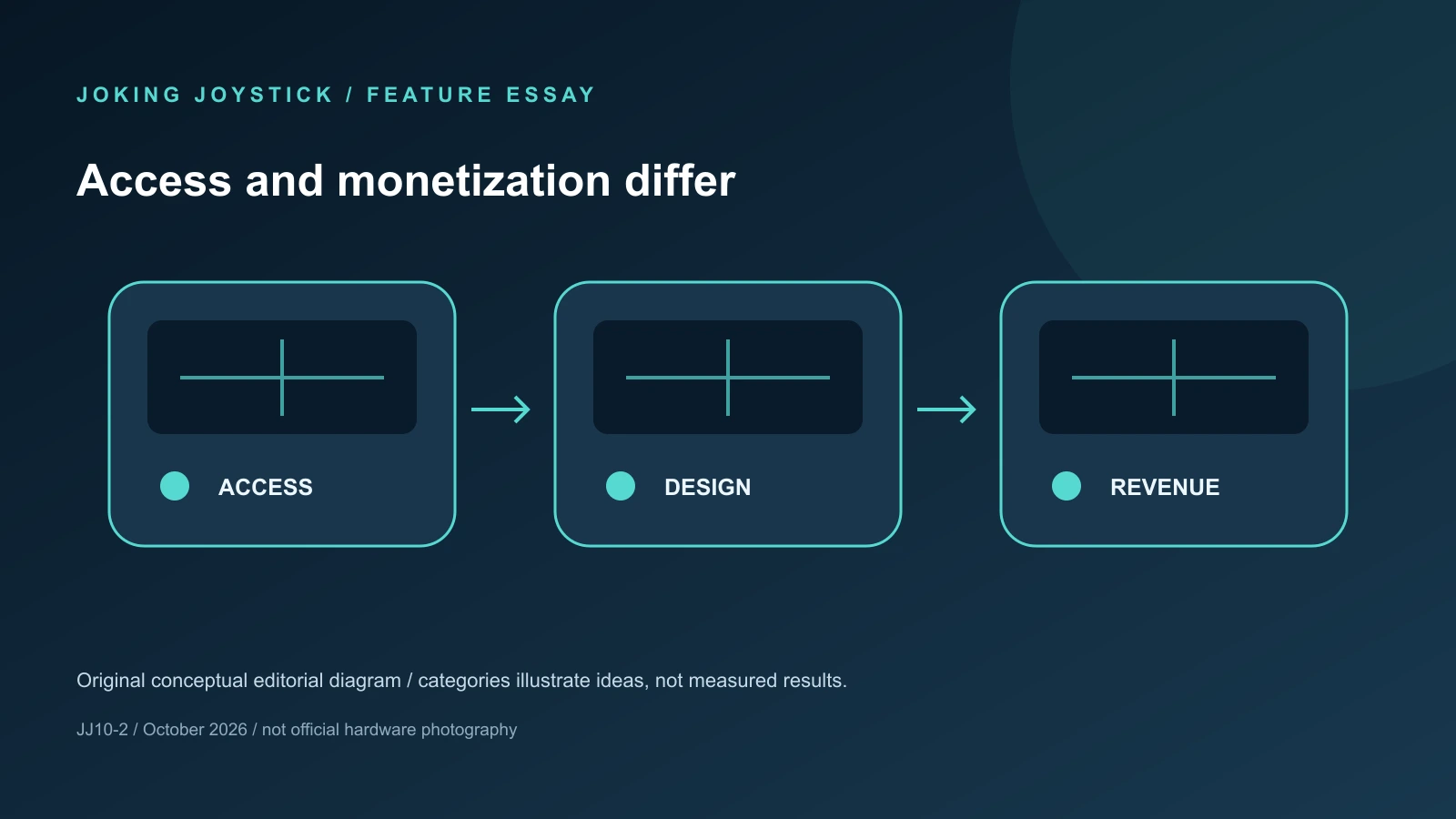
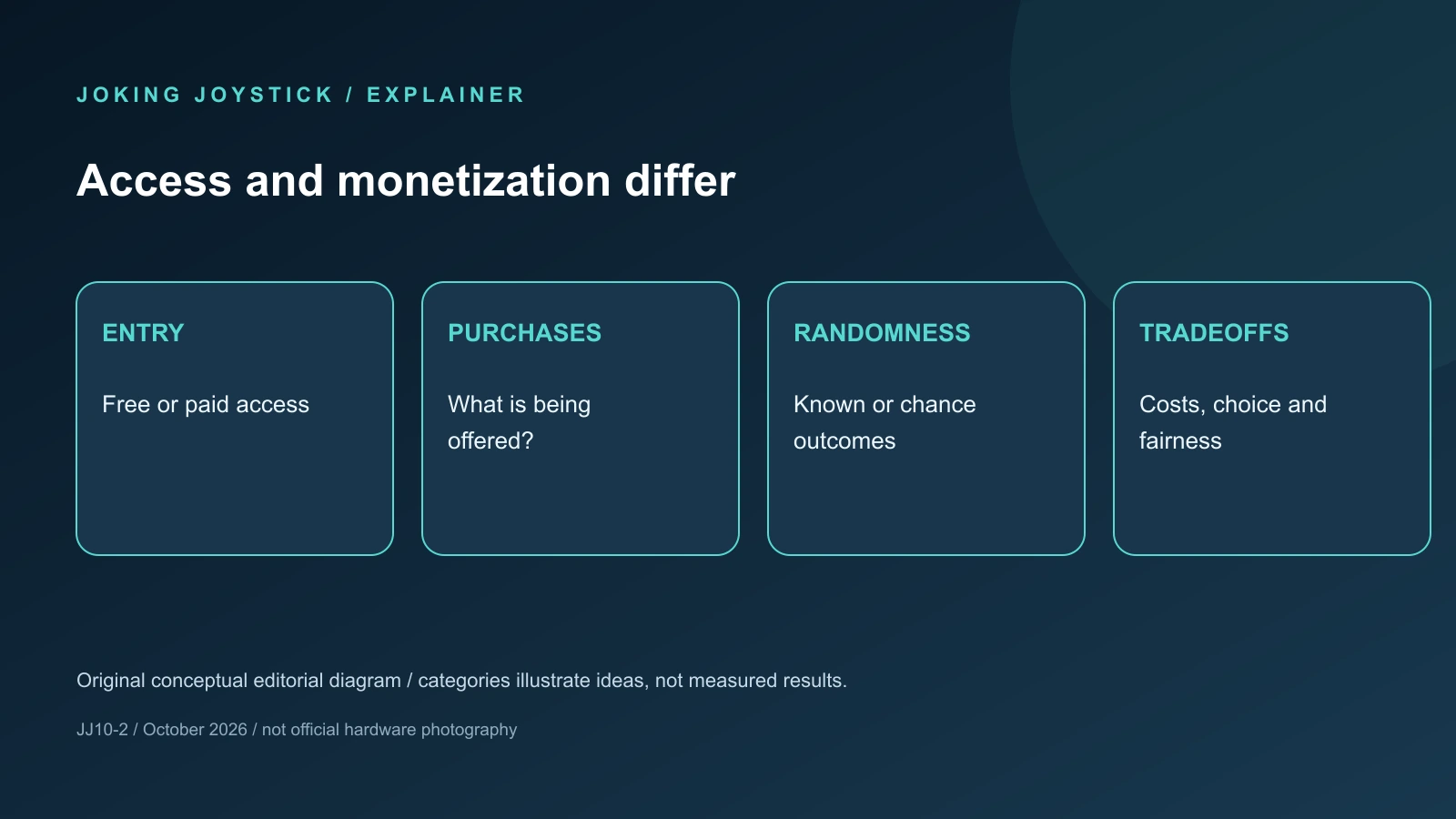
The word “free” does too much work in discussions about games. It can describe the price of entering a game, but it does not by itself describe what happens after entry, what a player can buy, whether purchased items are known in advance, or whether access continues indefinitely. A useful account of the market therefore separates at least four questions: how the player gets access, how the publisher earns revenue, what the player receives in return, and whether any purchase involves randomness.
Free-to-play access means that the initial playable entry point has no mandatory upfront price. A player can download or begin the game without first buying a copy. That definition says nothing about later spending. A free-to-play title may offer cosmetic items, playable characters, expansions, advertising, virtual currency, subscriptions, battle passes, randomized rewards, or advantages that affect play. It may also collect data, require an online account, or depend on a platform subscription for particular online features. “Free” describes the entry condition, not the complete economic relationship.
A premium game is a product whose principal playable offering is sold through an upfront transaction for a digital or physical copy, or for access under applicable license and platform terms. The purchase may unlock a complete campaign, an online game, or both. Some products also offer free trials, demos, free multiplayer components, or hybrid entry models, so “premium” describes the main access transaction rather than an absolute rule. Premium pricing does not prevent later monetization: a premium game can add downloadable content, expansions, cosmetic items, subscriptions, virtual currency, or randomized purchases.
Access and ownership are separate as well. Purchasing a game often provides a license governed by platform and publisher terms rather than ownership of the underlying software in the broadest sense. An upfront purchase normally provides access under those applicable store, account, license, technical, and service conditions; the precise duration and functionality can vary by product. A subscription instead provides access while the subscription is active and while the relevant game remains included. That difference matters even when the screen looks identical after a game launches.
Xbox Game Pass illustrates the subscription model. Its plans offer access to a changing library, with benefits that vary by tier. Depending on the plan, games may arrive on the service at launch, be added later, or be available through streaming or other included features. The catalog, price, and benefits are not fixed worldwide or permanently. A subscriber is paying for access to the service and its current terms, not buying every title in the library. If a game leaves the catalog, or if the subscription ends, continued access may require a separate purchase or renewed subscription.
PlayStation Plus presents a similar but separately structured form of paid access. Its different tiers can include monthly games, a catalog, trials, online features, or streaming, depending on the plan and market. The service describes the possibility that catalog games will be removed. That makes a subscription economically different from buying a game outright even when the monthly payment appears smaller than a retail price. The relevant comparison depends on how long a person subscribes, what they play, which tier they select, and whether the titles they want remain available.
Monetization is the broader category covering the ways a game earns money after or alongside access. A cosmetic store sells items such as outfits, skins, emotes, banners, or visual effects. The important characteristic is that the offered item is identified before the transaction. The buyer may still face a rotating storefront, a limited-time offer, a platform-specific currency, or a bundle that makes the price less direct. But a direct cosmetic sale is not the same product as a chance to receive one of several unknown items.
A loot box, in the regulatory and ratings vocabulary used by the Entertainment Software Rating Board, involves a random or chance-based digital reward whose specific contents are not known before purchase. The category can include item packs, mystery awards, prize wheels, gacha-style mechanics, and similar systems. The purchase might be made with ordinary money or with virtual currency that was itself purchased with money. The shared feature is uncertainty about the particular digital item received, not merely the existence of an in-game purchase.
This distinction explains why “in-game purchases” and “loot boxes” should not be used interchangeably. Buying a named outfit is an in-game purchase. Buying a bundle containing a specified set of items is an in-game purchase. Buying a container that may produce one of several items is an in-game purchase that also contains random items. The commercial and informational relationship is different because the customer knows less about the immediate result in the randomized example.
A battle pass is another separate structure. It normally combines a season or other time period with a progression track. Rewards are displayed in advance, and the player unlocks them by earning experience, completing objectives, or reaching specified levels. A pass may have a free track, a paid premium track, or both. It can include cosmetics, virtual currency, emotes, and other rewards. It is not automatically a loot box merely because the player must play to obtain everything or because some rewards might later appear elsewhere.
Fortnite provides a concrete example of how these axes can overlap without becoming identical. The game has a free entry point, while its passes offer seasonal progression and premium rewards. Current official support information describes reward pages, progression, a Battle Pass bundle offering 25 rewards at a discount, and the possibility that some items may later appear in the shop. Other support material explains that active passes can progress simultaneously, while each pass requires its own purchase for premium rewards. Fortnite Crew can include active passes as part of its recurring benefits. Those rules describe a particular product at a particular time; they do not define every battle pass.
Finally, a premium-plus-live-service product combines an upfront purchase with continuing online features, updates, add-on content, or recurring spending. The game can therefore occupy more than one category. A premium release may later sell a season pass. A free-to-play game may add a subscription-like membership. A platform subscription may provide access to a premium game. These labels describe components of a business model, not mutually exclusive identities.
Prices, catalogs, age gates, payment methods, and included benefits can vary by country, platform, tier, and date. The useful starting point is consequently not “free versus paid,” but a set of separate questions: Is entry free? Is access permanent or conditional? What is sold? Is the item identified before purchase? Does progression depend on time? And is the payment one-off, recurring, or repeated at the player’s discretion?
2. Why the free-to-play entry point is economically attractive
The commercial appeal of free-to-play begins with acquisition. Removing a mandatory upfront price reduces one decision that might stop a prospective player from trying a game. A person does not need to decide that the complete product is worth a retail price before seeing whether the controls, community, performance, or social experience suit them. Downloading remains a commitment of time, storage, attention, and sometimes personal information, but the money decision is postponed.
That postponement can enlarge the group of people who enter the game. It does not mean that every entrant becomes a paying customer. The business logic is instead based on the possibility that a large audience contains different kinds of participants: some never spend, some purchase occasionally, and a smaller group spends more regularly. Revenue can come from a minority while the free population supplies opponents, teammates, viewers, creators, social connections, or general activity.
That audience effect is particularly relevant to games whose value depends on other people being present. A competitive matchmaker needs enough players to form games without excessive waiting or wildly uneven skill levels. A social platform needs people to populate spaces and conversations. A creator platform needs visitors as well as creators. Free entry can help build that density, although it does not guarantee a healthy or profitable community. A game can attract many downloads and still fail to retain players or convert activity into revenue.
Roblox illustrates the scale-and-conversion logic, but only for Roblox. In its 2025 reporting, the company described a platform built largely around free experiences. It reported an average of 127 million daily active users and approximately 1.8 million average daily unique paying users. Those figures show a large difference between daily participation and daily payment within that particular business. They do not establish an industry conversion rate, and they do not imply that every free-to-play game can reproduce the same relationship.
Roblox’s model also demonstrates that the company is not the only participant in the economic system. Users can purchase Robux, the platform’s virtual currency, and use it for avatar clothing, accessories, emotes, and enhancements within experiences. Developers and creators can receive payments under the platform’s arrangements, while Roblox retains a share of transactions. The company’s filing also discusses bookings and the timing of recognizing revenue, reflecting the fact that virtual-currency sales and the services connected to them do not necessarily map one-for-one onto a single moment of play.
The free entry point can therefore serve as a form of marketing as well as a price. Players may invite friends because there is no purchase to coordinate. Streamers can direct viewers to the same game without asking them to buy it first. A publisher can update the product after launch and continue trying to attract new players rather than relying exclusively on the first week of sales. These are plausible incentives, not a guarantee of success. A free game still competes for attention, and an unpopular or poorly supported product can lose its audience quickly.
Free access can also make experimentation easier. A player may try several games in the same genre, abandon most of them, and return to one that fits. In a premium market, each trial can require a separate purchase or a refund decision. In a free-to-play market, the cost of trying may be measured more heavily in download time, storage, account creation, and playtime. That can increase the number of people who reach the point where a purchase becomes possible.
For the company, however, the audience is not free to serve. More players can mean more logins, game sessions, data transfer, account records, payment attempts, customer-service contacts, reports of harassment, fraud investigations, moderation decisions, and security work. A large population can create monetization opportunities while also creating obligations. If a game promises regular events or seasonal rewards, retaining the audience may require new content, testing, localization, community management, and technical maintenance.
The timing of revenue also changes. An upfront premium sale can produce a substantial transaction before the player has used the game for very long. Free-to-play revenue may arrive later, in smaller transactions, or unevenly across the audience. The publisher may need systems that present offers, handle virtual currencies, prevent unauthorized payments, protect accounts, and record entitlements. It may also need to forecast activity months after launch rather than concentrating its commercial judgment on release-week demand.
There are strategic advantages to learning from a live audience, but the interpretation of player behavior is not simple. A high number of daily users can indicate strong engagement, casual repeat visits, or a large number of brief sessions. A paying-user count can include different spending patterns. Bookings can include virtual currency purchased before it is used. Company filings use defined measures that should not be converted casually into universal assumptions about player behavior.
Free-to-play may also fit games that improve when updates and participation continue over time. A competitive title can refresh maps, characters, or events. A social platform can add creator tools. A mobile game can offer recurring challenges. In each case, the publisher is treating the product less like a finished object sold once and more like an operating service. That choice creates a reason to pursue retention, but it also raises the standard for ongoing delivery.
The economic attraction is thus not simply “more players equals more money.” It is a chain of possibilities: lower initial friction may produce a larger audience; a larger audience may improve network effects; a portion of that audience may pay; recurring transactions may support continued operations; and continued operations may help retain the audience. Every link can fail. A free-to-play entry point expands the opportunity to earn from a game, but it does not automatically make the game more profitable than a premium product.
3. The cost structure: development is only one bill
Arguments about game pricing often begin and end with development. Development is certainly a major expense: designers, engineers, artists, writers, producers, testers, audio specialists, managers, and other staff may work for years before a release generates revenue. But a game that remains online after launch adds a second economic problem. The business must keep operating the product, serving players, processing transactions, and supplying content after the original development period has ended.
The first bill is the creation of the product itself. That can include internal salaries, contractors, technology licenses, motion capture, voice work, localization, quality assurance, marketing support, and tools. A publisher may also pay for licensed brands, music, sports leagues, engines, or other intellectual property. These costs arrive before the company knows how many copies will sell or how many players will remain active.
Post-launch content adds another layer. Seasonal updates, new characters, maps, missions, story episodes, events, items, and platform versions require planning and production. Even an item that appears small to a player may pass through concept work, modeling, animation, implementation, testing, approval, translation, and release management. A live product may need content on a schedule because long gaps can reduce activity, but the cost and commercial value of that schedule vary by game.
Online operation creates technical costs that are not visible in the purchase button. Data centers, bandwidth, servers, storage, databases, authentication systems, backups, monitoring, and traffic management can all be involved. Some games use dedicated infrastructure; others rely on a mixture of cloud services, platform services, and player-hosted or peer-to-peer arrangements. The expense depends on architecture, geography, concurrency, session length, traffic patterns, redundancy, and the service agreements the company has negotiated. There is no single server cost that applies to every game.
Electronic Arts’ fiscal 2025 filing shows how these categories can appear in a corporate cost structure. Its cost-of-revenue discussion identified data-center, bandwidth, server, payment-processing, mobile-platform, and personnel costs, among other items. The filing does not provide a universal cost per player or a standard budget for a live-service game. It does show that operating and selling digital products involves more than the salaries recorded under initial development.
Payments themselves can create transaction and platform-related costs. Depending on the platform and arrangement, a company may incur payment-processing fees, platform charges, taxes, currency-conversion costs, fraud losses, refunds, and customer-service expenses. Mobile and console platforms can impose their own commercial terms. A virtual-currency transaction may therefore produce less net revenue than the amount displayed to the player. The exact result depends on the platform, territory, payment method, contractual arrangements, and applicable rules.
Customer support is another recurring obligation. Players lose access to accounts, misunderstand purchases, request refunds, report cheating, contest moderation decisions, or encounter technical problems. A game that handles valuable inventories or virtual currency needs systems for restoring entitlements and investigating suspicious activity. The support requirement can grow with the audience even if the game’s code changes very little.
Moderation and trust and safety are particularly important for products with social features, user-generated content, voice chat, trading, or communication between strangers. Reports may involve harassment, fraud, impersonation, sexual content, threats, or attempts to exploit younger users. The response can involve automated detection, human review, appeals, account restrictions, and cooperation with platform or governmental processes. These activities are operating costs, not optional decorations added after the business model is chosen.
Roblox’s 2025 filing makes that breadth visible at company scale. It reported approximately $1.153 billion in infrastructure and trust-and-safety expense and approximately $1.568 billion in research and development. Those figures cover a platform with many experiences and creators; they are not the budget of a typical game. They nevertheless demonstrate why a large free-access ecosystem has expenses extending well beyond making the initial software. Roblox also reports payments to eligible creators and other costs associated with its platform and transactions.
Security introduces another continuing category. Accounts, payment credentials, inventories, and creator earnings can attract theft, fraud, bot activity, cheating, and attempts to manipulate markets or rewards. Security engineering, detection systems, incident response, and compliance work may be necessary even when they do not produce a visible feature. A free download does not remove these requirements. In some cases, a large free audience increases the number of accounts and transactions that must be protected.
Recurring monetization can help align revenue with these recurring costs. A game that earns from continuing purchases has a potential income stream after launch rather than relying only on the initial sale. That income may support servers, updates, staff, moderation, and customer service. But “may” matters. Revenue can fall when engagement declines, when a season performs poorly, when a platform changes its terms, or when players decide not to spend. Recurring monetization is one way to fund continued operation, not proof that every game needs it.
Premium products face many of the same bills, though the timing can differ. A premium game with a finite campaign may have lower ongoing infrastructure demands than a constantly updated social game. A premium online title may still require servers, support, anti-cheat systems, downloadable updates, and platform payments. Conversely, a free game may be small, offline, and inexpensive to maintain. The access price alone cannot reveal the cost structure.
The relevant economic question is therefore not whether development is expensive enough to force free-to-play. It is whether the chosen product can generate enough revenue, at the right times, to cover its complete cost structure. A company may use upfront sales, downloadable content, subscriptions, advertising, direct purchases, randomized items, or combinations of them. The suitable mix depends on the product, audience, platform, expected lifespan, and obligations created by the service.
4. Premium games are not disappearing from the evidence
The continued expansion of live services and free entry does not demonstrate that premium games are vanishing. One direct way to test that claim is to examine how a major publisher still reports its revenue. Electronic Arts’ fiscal 2025 filing separated full-game revenue from live-services-and-other revenue. It reported $2.002 billion in full-game revenue and $5.461 billion in live-services-and-other revenue. The difference is significant, but so is the continued presence of the full-game category.
EA’s full-game total included approximately $1.478 billion in downloads and $524 million in packaged goods. Its reporting therefore distinguished digital copies from physical products while continuing to group both under full games. That structure matters because digital distribution can change the route to the customer without changing the basic commercial arrangement. A player can pay upfront for a downloadable product instead of purchasing a disc, while the publisher still bears the risks of making, marketing, and supporting that title.
Digital distribution can reduce some physical costs. There may be less need for manufacturing, packaging, inventory, and retail distribution. Updates can be delivered without pressing a new disc. A publisher can sell directly through a platform storefront to customers in many territories. But the disappearance of a box does not eliminate development risk. Staff must still be paid, the product must still be tested, marketing must still reach an audience, and sales remain uncertain before release.
Full-game revenue also includes different kinds of products. A short single-player campaign, a large role-playing game, a sports release, and an online title sold at a premium price may all appear within the category while having different costs and post-launch plans. Some premium games are designed as finite experiences. Others use the upfront price as the first transaction in a longer relationship involving expansions, online features, or additional purchases.
That overlap is why “premium” and “live service” are not opposites. A game can require an upfront purchase and then operate through seasons, downloadable content, or online spending. A publisher may use the initial price to recover part of development costs and later use recurring revenue to support continued engagement. The resulting product is premium-plus-live-service rather than a pure example of either model.
EA separately defines full games, live services, subscriptions, and licensing in its financial reporting. Those categories are accounting and business descriptions, not judgments about which format players should prefer. They also show that a single publisher can operate several models at once. A portfolio does not need to choose one universal answer for every game. Different franchises can target different audiences, release rhythms, and spending patterns.
Premium sales can be attractive when the product’s value is easy to communicate before launch. A publisher may sell a known campaign, a sequel, a licensed sports experience, or a large package of content for a stated price. The customer knows the basic transaction before playing. That does not eliminate disappointment, bugs, downloadable content, or later monetization, but it creates a different initial promise from “download at no charge and decide later whether to spend.”
Premium pricing can also suit games whose commercial value is concentrated around release. A finite narrative title may not need years of seasonal content or a large persistent community. Its costs may be front-loaded, and its sales may be evaluated against a launch window and a longer tail of discounts and digital purchases. That model can still involve uncertainty: production may take longer than expected, the audience may be smaller than forecast, or a release may compete with other major titles.
At the same time, a premium game cannot assume that digital sales are effortless. Store placement, platform fees, refunds, regional pricing, payment processing, customer support, updates, and compatibility work remain relevant. A digital purchase reduces some physical-distribution costs but does not make the product costless to produce or sell. The publisher still needs an audience willing to pay before access begins.
The EA figures should not be turned into a market-wide forecast. EA has a particular portfolio, particular franchises, particular fiscal-year timing, and particular definitions. Its live-services-and-other revenue includes more than free-to-play games, just as its full-game revenue includes more than one kind of premium release. The figures demonstrate coexistence within one publisher; they do not show that the same proportions apply to every company or territory.
Nor do the figures establish that either model is inherently better, safer, healthier, or more ethical. A premium game can have aggressive downloadable content or randomized purchases. A free-to-play game can sell only direct cosmetics. A live service can be well supported or poorly maintained. A finite premium game can be excellent or disappointing. Business-model labels identify payment and access structures, not the complete quality of a player’s experience.
The evidence instead points to segmentation. Free-to-play is well suited, in some cases, to products that depend on large communities, frequent updates, or long operating lives. Premium pricing remains suited, in some cases, to games where a defined package, a campaign, or a major release event is central to the proposition. Between them are subscriptions, expansions, season passes, direct cosmetic purchases, and other combinations.
That coexistence also limits the strongest version of the prediction that every game will become free-to-play. Publishers can pursue recurring revenue without abandoning upfront sales, and they can add live features without making the initial game free. The financial record from EA does not predict what the entire industry will do. It does establish a more modest point: even amid substantial live-service revenue, premium games remain a reported and economically meaningful part of a major publisher’s business.
5. Recurring spending and the incentive to keep a game alive
The financial attraction of a live game is that its commercial life does not have to end with its release week. An upfront sale concentrates the first major opportunity to earn money around launch, even if a title continues selling later. Recurring spending creates additional occasions for revenue: a player may buy virtual currency, downloadable content, an in-game item, an expansion, or access to a new activity months after the original release. The model does not guarantee greater profit, but it changes the timing of the opportunity.
Take-Two’s definition of “recurrent consumer spending” illustrates how broad that category can be. The company includes revenue from virtual currency, add-on content, in-game purchases, and in-game advertising. Those are not interchangeable products. A player buying currency for an online mode, downloading an expansion, and seeing advertising inside a mobile game are all contributing to the category, but the underlying designs, costs, and consumer decisions differ.
For the fiscal year ended March 31, 2026, Take-Two reported that digital-online channels represented 97 percent of net revenue and that recurrent consumer spending represented approximately 78 percent. Those figures indicate how important continuing digital relationships are to that publisher’s reported business. They do not mean that 78 percent of the company’s revenue came from free-to-play games. Take-Two’s portfolio includes premium releases, mobile products, online games, and other businesses, so the percentage is a company-wide measure rather than a free-to-play statistic.
The incentive behind recurring spending is partly a reduction in dependence on a single commercial event. A publisher selling a premium game may spend years preparing for launch and then learn quickly whether demand meets expectations. A continuing game can instead generate several revenue periods. New content, events, expansions, or purchasable items can give existing players reasons to return and give new players additional reasons to enter. The business becomes less dependent on one week, although it becomes more dependent on continued execution.
Engagement is therefore economically relevant. A player who returns regularly has more opportunities to see new content and decide whether to spend. A social or competitive game may also become more valuable when friends, opponents, creators, and communities remain active. Matchmaking requires an available population, while user-generated platforms need both creators and audiences. Recurring monetization can benefit from that activity, but activity itself may require investment in servers, moderation, customer support, anti-cheat systems, and content.
Updates are not merely advertisements for purchases. They may repair defects, rebalance play, add accessibility features, address security problems, expand a story, or support new platforms. Yet the commercial calendar can influence which updates receive priority. A publisher that has promised seasons or regular events must plan production, testing, localization, deployment, and communication on a continuing schedule. If the audience loses interest, the revenue supporting that schedule can weaken; if the schedule weakens, retention may decline further.
Virtual currency can make recurring spending operationally convenient. Instead of processing a separate payment for every digital item, a game can sell units of currency that are later exchanged for content. The currency can support several parts of a game’s economy, including cosmetics, add-on content, or experience-specific enhancements. It can also complicate the player’s calculation of price when bundles, denominations, leftover balances, or platform-specific terms mean that the amount paid does not correspond neatly to the price of a single item.
That complication is not identical in every product. Some games display prices in ordinary currency, some use virtual currency for selected transactions, and some use both. The existence of a currency does not by itself show that a purchase is unclear or harmful. The relevant questions are product-specific: how the currency is acquired, whether its exchange rate is readily understood, whether the player must buy more than the item requires, whether refunds are available, and where the resulting entitlement can be used.
Advertising provides another recurring route, particularly in mobile and platform businesses. In-game advertising can generate revenue from players who do not buy items, but it depends on audience scale, ad inventory, brand demand, and the format of the experience. Advertising can also affect design decisions about session length, placement, rewards, and privacy. It is not a substitute for all other revenue, and its importance varies by product.
The continuing model has a different risk profile from a single-sale model. A publisher must retain enough players for the service to remain active and must persuade at least some of them to keep paying. Content can be delayed, unpopular, or too expensive to produce. A platform policy can change. A game can lose access to an audience when a storefront, console generation, operating system, or online service changes. A player may also decide that the game no longer offers enough value to justify another purchase.
There is a consumer tradeoff in this structure. Ongoing revenue can support years of updates and allow a game to evolve after launch. It can also make the player’s total spending less predictable than a single purchase, especially when new items or events arrive repeatedly. A player may spend nothing beyond the initial access price, make occasional purchases, or spend regularly; the business model is built around those different patterns rather than a uniform customer.
Continuing availability is another condition. A purchase made inside an online game may depend on the game’s servers, account systems, platform access, and operating decisions. Recurring revenue can give a publisher a reason to maintain the product, but it cannot guarantee indefinite operation. A title that no longer retains enough players or covers its costs may receive fewer updates or eventually be discontinued, subject to the publisher’s commitments and applicable terms.
The reasonable prediction is not that every publisher will convert every release into a live service. It is that products with durable communities and repeatable content opportunities may continue to attract recurring monetization, while finite games may still rely more heavily on an upfront price. Take-Two’s reported mix shows the scale of the incentive for one diversified publisher. It does not establish a universal formula, and it does not make free-to-play the only route to post-launch revenue.
6. Cosmetics, direct sales, and the consumer tradeoff
A direct cosmetic sale and a randomized purchase answer different questions for the customer. In a direct sale, the product is identified before payment: a particular outfit, skin, emote, banner, animation, or visual effect is offered at a stated price or a stated amount of virtual currency. In a randomized purchase, the customer receives an uncertain result from a defined pool or reward system. Both can be in-game purchases, but the information available before the transaction is different.
That difference can make direct sales easier to evaluate. A player can ask whether a named item is worth the price, whether it works with a chosen character, and whether it will be available after purchase. The customer does not need to estimate the number of attempts required to obtain a particular reward. But clearer identity does not answer every consumer question. The item may be offered only in a rotating store, bundled with unwanted content, usable only in one experience, or governed by a license that depends on the platform and account.
Roblox describes purchases involving Robux for avatar clothing, accessories, emotes, and enhancements connected to particular experiences. That description shows how a platform currency can serve several kinds of digital goods. An avatar item may relate to a user’s broader platform identity, while an enhancement may have meaning only inside one creator’s experience. The label “cosmetic” therefore needs product-specific examination rather than automatic approval or condemnation.
Roblox also states that user-held Robux have no authorized external market value and that off-platform secondary-market transactions are prohibited under its policies. That does not mean no Robux can ever be exchanged for money: eligible creators may exchange earned Robux for U.S. dollars through Roblox’s Developer Exchange program, subject to its requirements and rates. The distinction is between purchased or otherwise user-held platform currency, which is not an authorized cash-equivalent market asset, and creator-earned Robux eligible for the separate payout program. Roblox says it retains part of transactions and distributes the remainder to eligible creators.
The first practical question for a buyer is what exactly has been acquired. A cosmetic can be a permanent item in an account inventory, a license to use an item while the account remains in good standing, a benefit limited to a particular game or experience, or a time-limited entitlement. Those outcomes can look similar during play but differ when a player changes platforms, loses account access, stops subscribing, or encounters a game shutdown.
Platform boundaries matter because digital items are not necessarily portable. An item bought through one account may not transfer to another account, console, storefront, or game. Even when a publisher operates across several platforms, the applicable purchase rules may differ. A player considering a cosmetic purchase should therefore distinguish the item’s visual identity from the scope of its permitted use. “Owned” in an ordinary conversation may mean “available in my account,” while the governing terms may provide a narrower license.
Rotating stores introduce a time dimension without making every offer coercive. An item may be visible for a limited period and then disappear from the current storefront. That can be a useful merchandising method for a large catalog: not every item needs to be displayed at once, and periodic changes can encourage players to return. It can also create a reason to decide quickly. Whether that pressure is material depends on the product’s actual rules, the frequency of returns, the item’s price, and the player’s own priorities.
Scarcity claims require similar care. A store may describe an item as available for a season, a particular event, or a limited rotation. Another product may later return items or make them available through a different route. The presence of a countdown does not establish that an item will never return, and the absence of a promise to return does not prove permanent scarcity. The relevant information is the product documentation and the terms in force when the offer is made.
Virtual currencies can make a direct item less direct in price. If an item costs a number of Robux or another currency, the player may need to compare the item with available currency bundles rather than with a displayed cash amount. A leftover balance can be used later, but its value depends on future purchases and the platform’s rules. This does not mean every currency system obscures cost to the same degree. It means that the exchange step belongs in the consumer’s calculation.
Cosmetic purchases may also have social or competitive significance even when they do not alter a game’s formal mechanics. An outfit can signal status, identity, affiliation, or participation in an event. An emote can shape communication. A visual effect can be more noticeable in a crowded game. Those functions do not make cosmetics equivalent to gameplay advantages, but they do explain why an item described as “only cosmetic” can still have value to a player.
The same distinction applies to enhancements. Roblox’s description includes experience-specific enhancements alongside avatar clothing and emotes. An enhancement may change convenience, access, or the way an experience operates, making it factually different from a purely visual item. A careful analysis should identify what the purchase does rather than infer its effect from a broad store category.
For publishers and creators, direct sales can offer a relatively legible exchange: a known item is designed, displayed, priced, and delivered. That can simplify the description of what the customer receives, although fulfillment, moderation, refunds, taxes, platform fees, and creator revenue sharing still remain. Direct sales can coexist with free access, a premium price, a subscription, or a battle pass. They are a monetization method, not a complete access model.
The consumer tradeoff is consequently between information, permanence, price, and use. A known item may be easier to evaluate than an unknown reward, but its value can depend on a rotating offer, a virtual currency, an account, a platform, or a game that continues operating. The defensible conclusion is not that cosmetic stores are harmless or coercive in general. It is that their effects and terms must be assessed from the actual item, storefront, currency, timing, and entitlement rules.
7. Battle passes: predictable bundle or engineered obligation?
A battle pass is best understood as a progression product tied to a period of play. Unlike a loot box, it normally presents a reward track in advance. The player advances through levels, pages, or milestones, commonly by earning experience or completing objectives. A pass can contain a free tier, a paid premium tier, or both. Its central transaction is not simply “pay for a random item,” but “pay for the right to unlock a defined set of rewards under the product’s progression rules.”
Fortnite’s official documentation describes passes as reward-page systems involving progression. It identifies possible rewards including outfits, V-Bucks, emotes, and other items. The current support documentation also describes a Battle Pass bundle containing 25 Battle Pass rewards at a discount. These features make a pass a bundle whose value depends on both the listed rewards and the player’s ability and willingness to progress through them during the relevant period.
The visible reward track changes the information available to the buyer. Before purchasing, a player can usually inspect the kinds of items included and the levels at which they become available. That is different from buying a container whose precise content is unknown. Visibility does not settle whether the price is worthwhile, because the player may not reach every level. The effective value depends on participation, available time, season length, and the player’s interest in the particular rewards.
Progression can therefore be part of the price in a practical sense. A pass may cost a stated amount of money or virtual currency, but completing it may require repeated play, objectives, or experience. For one player, that play is the main benefit of the game and does not feel like an additional cost. For another, the time requirement may reduce the value of rewards that remain locked. The product rules can be described objectively without declaring that every pass is fair, manipulative, cheap, or expensive.
Seasonal timing is central to the structure. A pass can be associated with a season, chapter, or other defined period, and progression may be organized around that calendar. A player who starts late may have fewer opportunities to complete the track. A player who buys several passes may divide attention among several progression systems. Those are practical consequences of the schedule, not proof of a particular psychological effect.
Fortnite support material says that active passes progress simultaneously. That means a player’s eligible activity can contribute to more than one active track rather than forcing a choice of only one. The same material says that each pass requires a separate purchase for premium rewards, while Fortnite Crew includes active passes among its benefits. These rules distinguish the subscription-like Crew offering from the individual purchase of premium rewards, even though both can provide access to pass content.
Simultaneous progression does not mean that every reward is automatically unlocked. Each pass can still have its own levels, pages, objectives, or premium entitlement. A player may need to purchase the relevant premium track to claim its paid rewards. A bundle may alter the initial transaction by offering additional levels or a discounted combination, but the product documentation controls what that bundle actually includes. The existence of a bundle is not evidence that it is cheaper than every alternative purchase.
Later availability can also affect the tradeoff. Fortnite documentation says that some pass items may return to the shop at least 18 months after a pass expires. That is a product-specific rule, and later shop availability can vary by season, platform, and region. A pass should not be described universally as the only chance to obtain an item, nor should later availability be assumed for every reward without checking the applicable documentation.
The difference between a pass and a direct store purchase is partly one of packaging. A store may offer one named item immediately. A pass may offer a collection whose components arrive only as progression is completed. The pass can make the bundle attractive to a player who wants several rewards, while a player interested in only one item may value a direct purchase differently. The comparison depends on the listed contents, prices, progression requirements, and whether the player expects to use the other rewards.
Passes can overlap with other monetization systems. A free-to-play game may sell a premium pass, a rotating cosmetic, a virtual-currency bundle, and a subscription at the same time. A premium game can use a pass after an upfront purchase. A pass can include virtual currency that offsets part of a later purchase, but the practical value depends on what the player does next and whether the currency can be used in the same account and region.
There is also a distinction between an expired progression opportunity and an unavailable item. A pass may stop accepting progress after a season while some rewards later return through another store. Another product may allow old passes to remain active or may provide a different completion system. These are design rules, not inherent properties of battle passes. Describing a pass accurately requires stating what happens to unfinished progression and whether rewards remain obtainable.
For publishers, the pass creates a reason to coordinate content with a calendar. New rewards and objectives can support regular visits, while the visible track gives players a reason to monitor progress. The system may also provide more predictable revenue than a store where every purchase depends on a single item catching a player’s attention. But the publisher still bears the cost of producing rewards, operating the game, handling support, and maintaining the progression system.
The central consumer question is not whether a battle pass is a loot box. It is what the player is buying and what must happen to receive it. The answers include the premium entitlement, the reward list, the duration, the progression method, the treatment of multiple active passes, and any later-shop rules. On the evidence available, battle passes are a distinct time-and-progression model. Their fairness or value cannot be determined from the label alone.
8. Loot boxes: what randomness changes
Randomness changes the information exchanged at the moment of purchase. When a customer buys a named outfit, expansion, or emote, the particular digital item is identified before payment. When a customer buys a loot box, mystery award, item pack, gacha draw, prize wheel, treasure chest, or similar product, the specific contents are not known in advance. ESRB’s “In-Game Purchases (Includes Random Items)” is an informational ratings descriptor for offers involving real money, or purchasable virtual currency, where the player does not know the specific digital goods or premiums they will receive. It is not a comprehensive legal definition of every randomized system.
The uncertainty can concern one item, several items, a tier of rewards, or the chance of receiving a particular result. The exact design matters. A box may provide duplicates, guaranteed rewards after a number of attempts, a choice among outcomes, or a mixture of common and rare items. Those features should not be collapsed into one universal description. What they share is that the customer is purchasing an outcome from a range rather than selecting one fully identified digital good.
Randomness also changes the way price must be considered. A player who wants a particular known cosmetic can compare its price with its perceived value. A player seeking one item from a randomized pool may instead consider the number of purchases that might be needed, the value of unwanted results, and any published probability information. A virtual currency can add another calculation when the player first buys currency and then spends it on the chance-based product. That does not mean every currency system makes price unclear, but it can create an additional step between cash and outcome.
Probability is not the same as a promise of a result. A published chance for a reward describes the odds under the stated system; it does not guarantee that a particular player will receive the item after a particular number of attempts unless a separate guarantee applies. Likewise, a high-value reward can have a different probability from a common reward. The useful factual questions are what the product discloses, when the disclosure appears, how the chances are defined, and whether the rules change by region, platform, or event.
Randomized rewards can be used in games that are free-to-play or premium. Free access does not require loot boxes, and a premium price does not exclude them. A product may instead use direct cosmetics, a battle pass, downloadable content, advertising, subscriptions, or a combination of these. The business model and the randomization mechanic are separate axes: one concerns how access is obtained, while the other concerns what a particular purchase delivers.
The legal record surrounding Genshin Impact illustrates why procedural precision matters. On January 17, 2025, the Federal Trade Commission announced a matter involving Cognosphere and a $20 million settlement. The FTC materials included allegations concerning the presentation and operation of chance-based purchases, including issues involving minors, virtual currency, and disclosures. Those allegations belong to the complaint and related enforcement materials; they should not be rewritten as a universal judicial finding about every loot box or every feature of the game.
The settlement terms required protections concerning users under 16 and parental consent, along with disclosure obligations. A stipulated order records obligations accepted as part of resolving the matter. It is not the same thing as a trial judgment establishing that all allegations were proven after contested proceedings. The distinction is important when describing what the action demonstrates: it shows a U.S. enforcement response to a particular company and product, not a general rule that all randomized digital items are unlawful.
The order’s significance is therefore practical as well as legal. A publisher operating a chance-based system may need to consider how odds, pricing, currency exchanges, age controls, and purchase confirmations are presented. It may need to separate the ability of younger users to play from their ability to make certain purchases. These are possible design and compliance considerations drawn from the particular order, not evidence that every publisher must use the same solution.
Consumer understanding can also depend on the relationship between the random purchase and the game’s wider economy. A reward may be cosmetic, functional, tradable within a platform, or usable only in one mode. A duplicate may convert into another resource. The result may have no authorized external cash value. The mere fact that an item is rare does not establish that it can be sold for money or that it has a legally recognized market value.
Known-item sales and loot boxes can coexist in one store. A publisher may sell a named cosmetic directly while also offering randomized packs. That combination gives the player different ways to pursue digital content, but the options are not economically identical. The direct item provides certainty about the immediate result; the randomized product may offer a different price structure or a broader pool of possible rewards. The comparison should identify what each transaction actually delivers.
Chance-based systems can also be connected to progression without being identical to a battle pass. A pass usually displays a reward track and ties access to progression, while a loot box leaves the particular result uncertain at the moment of purchase. A game could include both: a visible seasonal track and separate randomized packs. Calling the entire monetization system a “battle pass” or a “loot box” would obscure the difference between the two transactions.
Regulation is not uniform across jurisdictions. A U.S. FTC settlement applies to the company and conduct addressed by its documents. Other countries may require probability disclosures, apply consumer-protection rules differently, or analyze whether a mechanic involves something with legally defined monetary value. The U.K. Gambling Commission’s guidance, for example, distinguishes certain in-game items and loot boxes from regulated gambling under the statutory framework concerning “money’s worth.” That distinction is jurisdiction-specific and does not create a worldwide classification.
The most defensible conclusion is limited but important. Randomness reduces the customer’s information about the immediate digital result and can make the cost of pursuing a particular item harder to assess, especially when virtual currency is involved. The effect depends on the game’s probabilities, guarantees, disclosures, pricing, age controls, and reward structure. The Genshin enforcement record shows that a U.S. regulator can impose company-specific obligations through a settlement. It does not establish that every loot box violates U.S. law, that every player experiences the mechanic in the same way, or that all publishers will abandon randomized monetization.
9. Access, ownership, and the subscription alternative
A subscription changes the purchase question from “Which game am I buying?” to “What library can I access while this payment remains active?” That difference matters because access and ownership are not interchangeable. A separately purchased game normally provides access under the applicable store, account, license, technical, and service terms, while a subscription provides access to a changing collection under the conditions of the service. Neither description answers every question about refunds, account restrictions, server operation, downloadable content, or offline play, but the underlying relationship is different.
Xbox Game Pass illustrates the subscription approach through multiple tiers rather than one universal product. Depending on the plan, a member may receive access to a catalog, online console multiplayer, cloud streaming, perks, or new first-party titles on their release date. Other plans may receive certain games later rather than on day one. The precise benefits are attached to the selected tier, and the catalog and terms can change. A player must therefore compare the plan available in their country, on their platform, and at the date of the decision.
PlayStation Plus uses a similar access structure with its own tiers and conditions. Its descriptions include recurring membership, monthly games, game catalogs, trials, and streaming in supported circumstances. Catalog titles can leave the service, and access to some benefits depends on maintaining the relevant membership. A title downloaded through a subscription is therefore not necessarily a permanent addition to the player’s library in the same sense as a separately purchased game. The account may record the entitlement, but the ability to launch or continue using the title can depend on payment and catalog status.
Subscription access can lower the initial barrier to trying a game. Instead of paying the full asking price for one title, a player can enter a library and test several games within the same billing period. That variety can be particularly useful for players who are uncertain about a purchase, who move between short campaigns, or who want access to a broad selection without buying each title individually. It can also help a platform expose players to games they might not have selected at a storefront’s full price.
That benefit should not be translated into a universal claim that subscriptions are cheaper. The result depends on how often the member plays, how long the membership continues, which tier is selected, and whether the games would otherwise have been purchased. A player who completes one game quickly may value a month of access differently from a player who returns to the same purchased title for years. A person who maintains a membership continuously may also spend more over time than someone who buys a small number of carefully selected games.
The comparison with ownership is therefore partly about duration. A purchased game can remain available after the initial transaction, subject to its platform, account, technical, and service conditions. A subscription title may disappear from the catalog even while the membership remains active. Conversely, a subscription can provide immediate access to many games whose individual purchase prices would be difficult for a particular player to pay at once. The two arrangements distribute cost and control differently rather than offering identical versions of the same product.
Catalog status is only one condition. The account must generally remain in good standing, the platform must support the service, and the player must meet any applicable age, country, or plan requirements. Streaming may require a supported device and network connection. Downloaded games can still depend on periodic license checks or online services. Included downloadable content, multiplayer access, and add-on benefits may also differ by title and tier. A subscription description should therefore be read as a set of access rules, not as a guarantee of permanent possession.
For publishers, subscription placement can offer discovery and a negotiated route to an audience. A game may reach players who would not have paid its launch price, potentially increasing awareness, participation, or later sales of expansions and related products. But the financial arrangement between a publisher and a platform is not the same for every game, and public platform pages do not establish a universal payment formula. Subscription availability can also affect how a publisher positions a launch, a later catalog addition, a downloadable expansion, or a premium edition.
Subscriptions may work especially well for services built around variety and regular platform engagement. A platform can use a catalog to encourage recurring membership, while publishers can use the service as one channel among direct sales, downloadable content, in-game purchases, and live operations. This creates another form of recurring relationship without requiring every included game to adopt a free-to-play economy. A game can remain a premium product in the wider market while also appearing in a paid access library.
The consumer tradeoff becomes more complicated when a subscription and a game’s own monetization operate together. A player may obtain the base game through a membership but pay separately for expansions, cosmetic items, currency, or a premium battle pass. A game leaving the catalog can affect the value of those purchases if the player no longer has access to the base experience through the same route. The details depend on the title and its terms, so access to a base game should not be treated as access to every associated product.
Regional qualification is essential. Xbox and PlayStation materials consulted for this feature describe U.S.-market plans and terms as retrieved under the packet’s October 26, 2026 cutoff. Prices, taxes, supported devices, streaming availability, catalogs, day-one treatment, trials, age requirements, and included benefits may differ elsewhere or change after that date. A comparison made for one country or one console cannot automatically be applied to another.
The subscription alternative consequently expands the range of ways a player can reach a game, but it does not erase the distinction between access and ownership. It may reduce the upfront commitment and provide variety. It may also introduce continuing payments, catalog uncertainty, account dependence, and limited control over what remains available. The sensible comparison is personal and factual: selected games, expected duration, membership tier, play habits, and the value placed on retaining access after payment stops.
10. Regulation is fragmented, not a single global loot-box law
There is no single worldwide rule that assigns every randomized digital purchase the same legal status. Treatment depends on the jurisdiction, the mechanic, the payment path, the age of the user, the company involved, the wording of the applicable law, and the date of the enforcement or guidance. A regulator’s action against one publisher may address billing, privacy, disclosures, or design presentation without deciding the legal status of every similar product elsewhere.
The United States provides several examples of that company-specific approach. In the final order concerning Epic Games and Fortnite, the Federal Trade Commission required $245 million for refunds and prohibited practices involving unwanted charges, dark patterns, and charging consumers without affirmative consent. The order addressed consumer-protection and billing conduct associated with a particular company and product. It should not be described as a general U.S. ban on loot boxes or as a ruling that every digital purchase using a button, virtual currency, or in-game store violates federal law.
The same Epic enforcement package included a separate $275 million federal-court settlement concerning children’s privacy under the Children’s Online Privacy Protection Act. The $245 million refund matter was a separate FTC administrative order concerning alleged unwanted charges and billing practices. The privacy resolution involved the collection and treatment of information relating to children, not a universal classification of randomized rewards. Combining the two amounts into one generalized “loot-box penalty” would blur distinct legal issues. Billing consent, interface design, account access, and children’s privacy can overlap in a product, but they are not the same claim.
The U.S. action involving Cognosphere, the publisher associated with Genshin Impact, also requires procedural care. The Federal Trade Commission’s materials included a complaint, a stipulated order, and settlement documents. The matter resulted in a $20 million settlement and obligations concerning users under 16, parental consent, pricing, and disclosures related to chance-based purchases. A complaint states allegations made by the agency. A stipulated order records terms accepted to resolve the proceeding. Neither should be rewritten as a universal adjudicated finding that every allegation about every loot box was proven after trial.
The significance of the Cognosphere matter is narrower and more useful. It demonstrates that U.S. consumer-protection enforcement can focus on how a chance-based system is presented, how virtual currency affects the transaction, how minors are permitted to participate, and whether disclosures and consent mechanisms are adequate under the specific order. It does not establish that all randomized digital items are unlawful in the United States. Nor does it determine how another agency, court, or country would analyze a different product.
South Korea has taken a more direct disclosure-oriented approach to probability information. Government materials report that probability-information disclosure began on March 22, 2024, under the country’s applicable framework for game products. Initial monitoring reported 105 violations in 64 games. Those figures describe the results of that monitoring period; they are not an industry-wide measurement of all games, nor do they mean that every game with a randomized item violated the rules.
Probability disclosure is not the same as prohibition. A rule can require a publisher to state the odds or other information while allowing the underlying mechanic to continue under specified conditions. The practical effect depends on what must be disclosed, where the information must appear, how updates are handled, which products are covered, and what sanctions follow a failure to comply. South Korean requirements therefore illustrate one regulatory path: making the chance structure more visible rather than automatically eliminating it.
The United Kingdom uses a different analytical framework. The Gambling Commission’s guidance points to the statutory concept of “money’s worth”: items confined to a game and not exchangeable for money or money’s worth may fall outside licensable gambling under that framework, while separate activity involving the trading, selling, or betting of items for cash can raise different questions. The distinction concerns the legal status of the item and transaction, not whether players find a mechanic exciting, uncertain, or expensive. This is jurisdiction-specific guidance, not a worldwide classification of loot boxes.
That U.K. position should not be exported to the United States, South Korea, or another jurisdiction. Legal definitions can differ even when the product design looks similar. One country may focus on the possibility of cash-equivalent value, another on probability disclosure, and another on consent, privacy, or unfair commercial practices. The same publisher may therefore adjust its policies, age controls, disclosures, or available mechanics by market.
Dates also matter. A regulator can issue guidance, amend a rule, begin monitoring, publish an order, or settle a matter after a product has launched. A summary based on an earlier version of a service may not describe the terms in force later. This is particularly important for games that update their reward pools, currency systems, age controls, or store interfaces. Legal analysis should identify the operative date rather than treating a product’s entire history as one unchanged design.
Regulatory status can also depend on the route to payment. A chance-based reward purchased directly with money may be analyzed differently from one obtained with earned gameplay currency. A purchasable virtual currency can add another issue, especially when the player exchanges money for currency before entering the randomized system. Yet the existence of an intermediate currency does not itself determine legality. The relevant law and the product’s specific operation still control.
Ratings disclosures are another tool, but they are not legislation. The ESRB distinguishes ordinary in-game purchases from purchases that include random items. That information can help describe a product’s content to consumers and families. It does not create a worldwide legal classification, establish that a mechanic is gambling, or guarantee that every player interprets the system in the same way.
The jurisdiction map is therefore best read as a set of different interventions. The United States examples emphasize company-specific remedies involving consent, billing, privacy, minors, and disclosures. South Korea provides a probability-disclosure regime with reported monitoring results. The United Kingdom offers guidance distinguishing certain in-game mechanics from gambling under a statutory monetary-value framework. None of these measures is a worldwide ban, and none supplies a universal answer for every loot box, currency, battle pass, or cosmetic store.
11. Regulation changes design incentives without proving a single outcome
Regulation can alter the questions a publisher must answer before launching or updating a monetization system. It does not, by itself, determine which business model will replace another. A company may retain a randomized mechanic, revise its disclosures, restrict purchases by age, change how currency is displayed, remove a feature in one market, or move toward a different product. Which response is chosen depends on the rule, the enforcement risk, the game’s audience, the existing technology, and the expected value of the system.
Scenario A: transparency and controls preserve randomized monetization. As an editorial inference from the different instruments discussed above, a publisher might keep chance-based rewards but make the transaction easier to inspect. It could display probabilities prominently, explain guarantees and duplicate rules, show prices in direct currency alongside virtual-currency prices, require stronger confirmation, and limit or supervise purchases by younger users. South Korean disclosure requirements, ESRB’s random-items information, and company-specific U.S. settlements provide reasons a publisher might consider such measures; they do not establish a general industry standard or require one interface.
This scenario does not mean that clearer information makes every system acceptable to every consumer. It means that disclosure can be used as a compliance and product-design response rather than abandoning randomness altogether. A publisher may judge that a known chance structure remains commercially valuable, especially if the game already has a large reward pool, a functioning account economy, and players who understand the system. That judgment would be a company decision, not a proven industry-wide reaction.
Direct currency pricing could also be partial rather than complete. A game might show a cash equivalent while continuing to sell currency bundles. Another might provide a calculator, a purchase history, or a confirmation screen without removing leftover balances. Parental controls could restrict spending, require approval, or apply only to defined age groups and transactions. The details matter because “more transparency” describes a direction, not a single technical solution.
Scenario B: publishers emphasize non-randomized products. A company may decide that direct cosmetics, battle passes, subscriptions, expansions, or fixed-content bundles are easier to explain and administer than chance-based rewards. A named outfit has a different disclosure burden from a pool of possible outcomes. A battle pass can list its rewards in advance, while a subscription can describe catalog access and recurring benefits. These systems still involve pricing, time limits, account terms, and consumer tradeoffs, but their central transaction is less dependent on an unknown result.
That shift would not necessarily eliminate every concern. A direct cosmetic store can use rotating offers or virtual currency. A battle pass can require progression within a season. A subscription can remove access when payment stops or when a title leaves a catalog. A bundle can contain content a buyer does not want. Regulation aimed at one mechanic can therefore redirect design attention without making all replacement models simple, permanent, or universally beneficial.
Scenario C: regional segmentation becomes more common. A publisher could offer different probability displays, age gates, purchase limits, currencies, item pools, or mechanics in different markets. It might remove a chance-based sale in one country, provide additional disclosures in another, or use a direct-purchase store where a local rule creates greater uncertainty. The differences could be visible to players or embedded in account and storefront systems.
Regional segmentation can solve one problem while creating operational complexity. Teams may need separate product rules, legal reviews, localization, customer-support procedures, payment flows, testing environments, and content calendars. These are plausible business considerations, not measured costs demonstrated across the industry by the cited sources. A company may accept the complexity if a market is important; another may limit availability rather than maintain several versions.
Compliance can also affect the timing of updates. A new reward pool may require revised probability tables, translated disclosures, age checks, or storefront review before release. A change to a currency bundle may need testing across platforms and regions. These steps can influence production planning, but the available evidence does not establish a universal delay, budget increase, or reduction in content output. Those outcomes would require company-specific operational data.
Enforcement remedies can shape incentives without dictating a single design. The Epic order’s focus on consent and dark patterns may encourage clearer confirmation and fewer assumptions that a purchase is authorized. The Cognosphere settlement’s provisions concerning minors and chance-based purchases may encourage stronger age-related controls and disclosures for similar systems. Neither order requires every publisher to use the same interface, remove all randomness, or adopt a particular alternative.
The welfare effects are also not uniform. A probability display may improve information for one player while another remains uninterested in randomized purchases. A direct store may reduce uncertainty about the item while increasing the number of limited-time offers. An age gate may protect some users from purchases while affecting access for others. The evidence supports describing possible tradeoffs, not declaring that regulation will improve outcomes universally.
Publishers may also retain randomness in limited forms while moving major revenue toward known products. For example, a game could sell named cosmetics directly, use a battle pass for seasonal progression, and maintain a smaller randomized feature for optional rewards. Another could eliminate paid randomness but retain chance in rewards earned through ordinary play. The regulatory and commercial significance depends on whether the player pays, what the payment buys, and how the system is disclosed.
The strongest conclusion is therefore conditional. Regulation can make some designs more expensive to operate, more difficult to localize, or more exposed to enforcement if the presentation is unclear. It can also make direct, visible purchases comparatively attractive. But the cited measures do not prove that loot boxes will disappear, that every publisher will move to cosmetics, or that one model will improve consumer welfare in every market. They support a range of plausible responses rather than one inevitable result.
12. Forecast: more free-to-play, but not everything free
Most likely scenario: segmented coexistence. This is an analytical scenario, not a finding that particular categories are inherently suited to one model. Several business models may continue operating at once rather than one replacing all others. Free-to-play access can be commercially compatible with some social, competitive, mobile, platform, and long-lived games because a large active population may support matchmaking, creators, events, advertising, direct purchases, or recurring content. That fit is not automatic. The game still needs a sustainable audience, infrastructure, support, moderation, security, and a monetization system that produces enough revenue to justify continued operation.
Premium releases are likely to remain important for games built around finite campaigns, concentrated narratives, prestige presentation, or a design that does not require a continuing commercial calendar. EA’s fiscal-2025 reporting separates full-game revenue from live-services-and-other revenue, showing coexistence within one major publisher. The figures do not forecast the whole industry, but they do weaken the claim that live monetization has already made upfront games irrelevant.
Premium and free entry can also meet in the same product. A publisher may launch a paid base game and add downloadable content, subscriptions, cosmetics, or online purchases. Another may make the core experience free while charging for a pass, an expansion, a character, or a visual item. The access decision and the monetization decision remain separate. Calling a product “free” does not describe every way a player may spend, just as calling a product “premium” does not mean that no later spending exists.
Roblox provides a different example of scale. Its 2025 filing reported 127 million average daily active users and approximately 1.8 million average daily unique paying users, alongside disclosures about mostly free experiences, Robux transactions, creator payments, infrastructure, and trust-and-safety spending. Those figures show how a platform can combine broad free access with a smaller paying population. They do not establish a universal conversion rate, average spending pattern, or profitability rule for other games.
Take-Two’s reported recurrent consumer spending provides another indication of the industry’s incentive to maintain post-launch relationships. Its fiscal year ended March 31, 2026, included a company-wide figure of approximately 78 percent of net revenue from recurrent consumer spending and 97 percent from digital-online channels. Because the portfolio includes premium, mobile, online, and other products, those percentages cannot be converted into a free-to-play forecast. They do show why publishers may continue looking for revenue after launch.
Subscription upside scenario. Platform libraries could absorb a larger share of consumer access spending. A player might maintain a membership to sample many titles, while publishers use catalog placement for discovery, reach, or negotiated revenue. This could make subscriptions more central to how games are encountered, particularly on platforms that combine downloads, streaming, online multiplayer, and rotating catalogs.
That scenario has clear limits. Subscription access remains conditional on payment, account standing, platform availability, tier, and catalog status. A game can leave a catalog, and a downloaded title can cease to be playable through the service even if it remains installed. A membership may be valuable for one player and poor value for another depending on duration and usage. It also does not give the subscriber permanent ownership of every included game.
Regulatory scenario. Transparent direct purchases and non-randomized progression may expand where publishers consider them easier to explain or less exposed to enforcement risk. Known cosmetics, fixed-content bundles, battle passes, and subscriptions could take a larger share of monetization in some markets. Loot boxes may become more regionally constrained through probability disclosures, age gates, purchase controls, different item pools, or removal from particular storefronts.
That does not amount to a forecast that randomized monetization will vanish. The South Korean disclosure framework shows that a jurisdiction can require probability information while addressing the mechanic through regulation rather than a universal prohibition. The U.S. FTC matters discussed here concern specific companies, conduct, and settlements or orders. U.K. guidance distinguishes certain loot-box arrangements from gambling under its statutory framework. These approaches leave room for different designs and different outcomes.
Regional variation may become a normal part of product planning. A publisher could use a direct store in one market, additional disclosures in another, and a chance-based feature elsewhere, provided the relevant rules and product terms permit those arrangements. It might instead choose one global design to reduce operational complexity. Neither choice is inevitable. The decision would weigh compliance, engineering, localization, customer support, revenue expectations, and the importance of consistent player experiences.
The most defensible answer to “Will more games go free-to-play?” is therefore qualified: probably more games will use free entry where the category benefits from a large, active, repeatedly served audience, but not all games will do so. Free-to-play is an access strategy, not a synonym for loot boxes. A game can be free-to-play with direct cosmetics, a battle pass, advertising, subscriptions, paid characters, or no monetization that has been publicly documented. A premium game can contain recurring purchases, and a subscription can provide access without ownership.
The evidence cannot support a universal forecast because company filings report individual portfolios and periods, platform pages describe terms that change by region and date, and regulatory actions address particular products. Financial data reveal incentives rather than destiny. Design announcements reveal product rules rather than the whole market. Enforcement records show possible legal and compliance exposure rather than a single worldwide standard.
What can be forecast with greater confidence is continued segmentation. Long-lived social and competitive games may favor free entry and recurring monetization. Finite campaigns and prestige releases may continue to favor upfront sales. Platform subscriptions may broaden access while preserving catalog churn and limited ownership. Direct purchases and visible progression may expand where randomization becomes harder to explain or regulate. Loot boxes may persist in some forms and markets, but no evidence here supports the claim that every future game will use them.
Related reading and hardware searches
Check the exact item, edition, seller, compatibility, regional fit, price and availability before buying.
Affiliate disclosure: As an Amazon Associate, Joking Joystick earns from qualifying purchases. Search results do not guarantee stock or price.