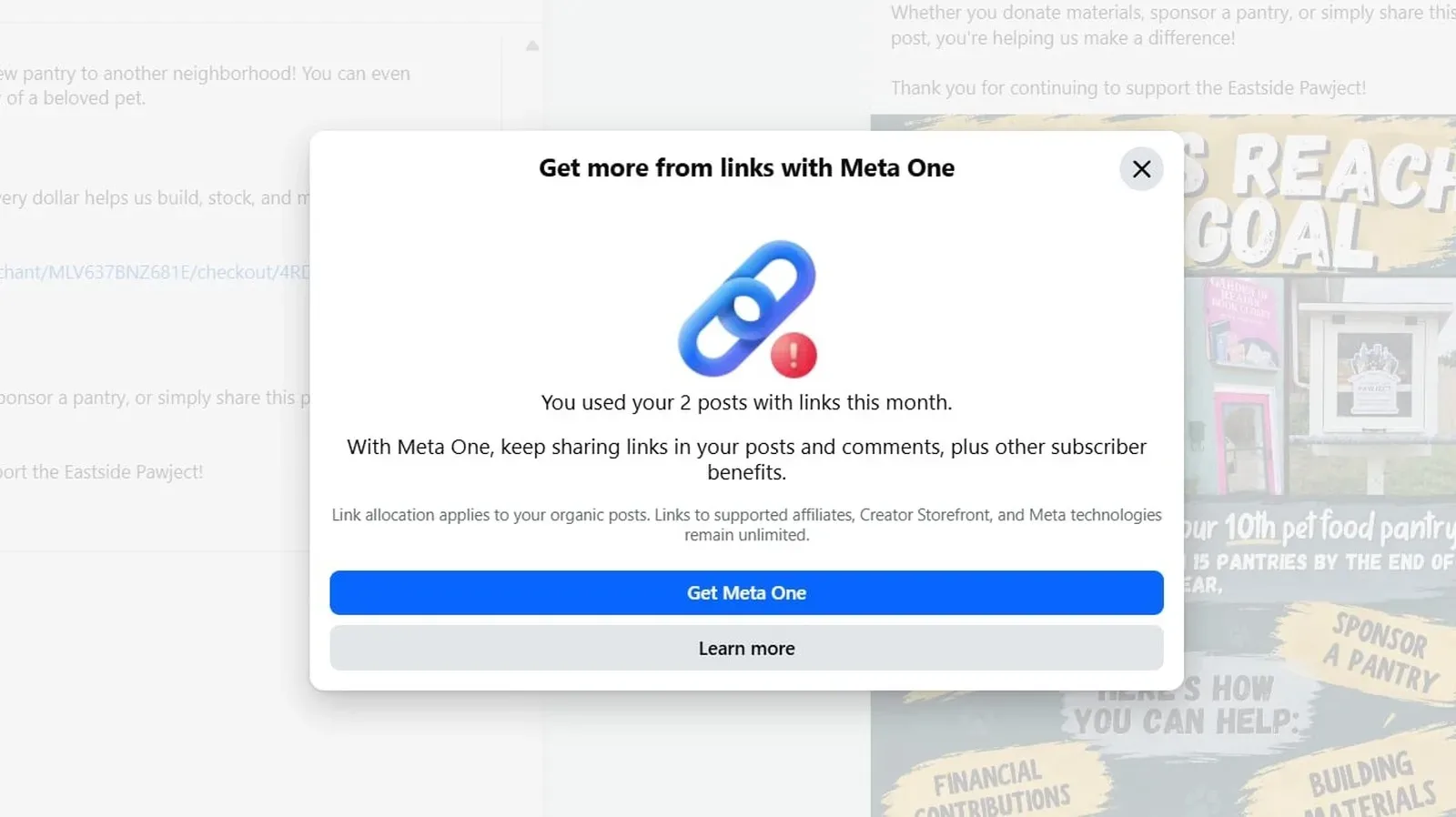
A Facebook post without a link is often just a signpost with no address. For local governments and nonprofits, that address can lead residents to public notices, donation pages, volunteer information, event details, food assistance and other time-sensitive resources. Meta is testing whether the ability to share those links should sit behind a Meta One subscription, and examples from government and nonprofit pages suggest the experiment is reaching organizations it is not meant to affect.
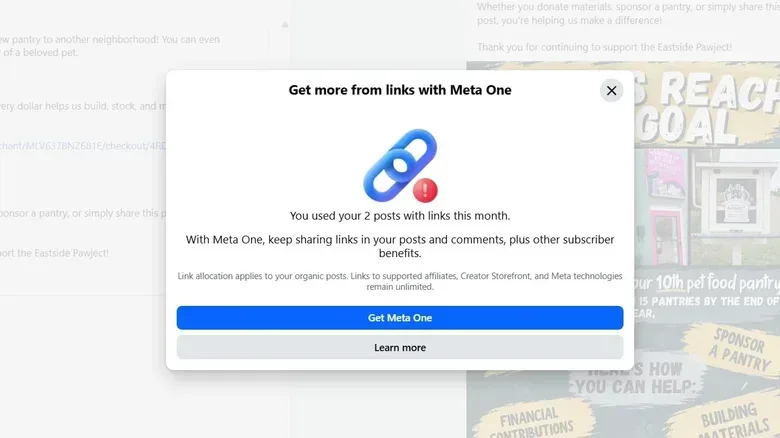
Meta has said the test is not supposed to apply to nonprofit or government entities. Yet the Facebook page for a library in Greenville, Texas, was told it could add links to only two posts per month and had already used its allowance. Further link posts required a Meta One subscription costing $50 or more per month. The library page identifies itself as a government building and had previously been verified.
The result is an awkward and potentially consequential collision between a subscription experiment and basic public communication. A city’s Facebook audience may be accustomed to finding a meeting notice, service update or public resource through a link in the original post. Moving that URL elsewhere adds friction at precisely the point where a post is supposed to make information easier to reach.
What Facebook is testing
The restriction is part of a longer-running attempt to bundle expanded link sharing into Meta’s paid offerings. It was initially connected to Meta Verified and is now presented as a benefit of Meta One, the company’s AI-focused subscription lineup. Meta’s stated position is that it is testing whether link sharing on Facebook should be included with Meta One and will change the experience based on feedback and what it learns.
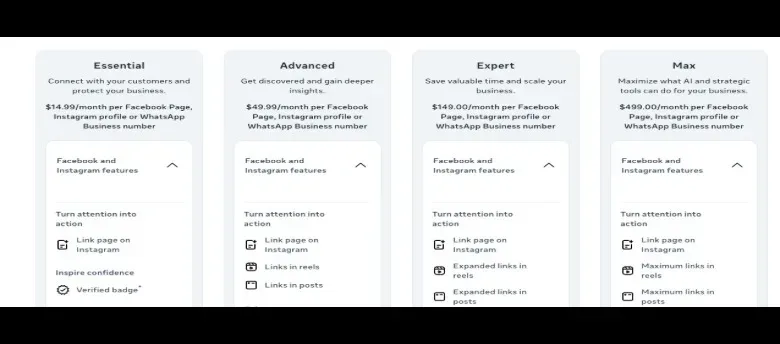
The plans described so far make a clear distinction between paid tiers:
- The $14.99-per-month entry plan does not add Facebook link-sharing privileges, though it includes a dedicated link page for an Instagram bio.
- A $49.99 monthly plan includes eight Facebook links per month.
- A $149.99 monthly plan includes 20 Facebook links per month.
- The $499.99 tier is the only listed option with unlimited Facebook links.
Some affected accounts have seen different prices. California Freethought Day was offered eight links for $40 per month, 20 for $119 per month, or unlimited links for $399. Those differences make it harder for small organizations to understand what rule, pricing structure or eligibility decision applies to their own page.
Important distinction: this is described as a test, not a permanent new rule for every Facebook page. That matters because reports from affected organizations are inconsistent. Some have been able to place links in comments, while others have not. In one case, an organization’s ability to post links was restored without an explanation. The uneven experience means no single workaround should be treated as dependable.
Why two links can be a serious constraint
On a personal account, two posts with links in a month might be enough for an occasional recommendation. On an organizational page, the same ceiling can be consumed almost immediately. Links are not merely promotional tools for a city, a community group or a small charity. They frequently connect a social post to the page where people can complete a task: register, donate, volunteer, check a schedule or find an in-person service.
Daniel Starks, communications manager for Greenville, oversees nearly a dozen city Facebook pages. He said more than half of the city’s work involves directing people back to information on its website. After the library page encountered the cap, he told staff to stop including links in Facebook posts and created a graphic telling followers that relevant URLs would instead appear in comments.
That is a practical stopgap, but it changes the user journey. A resident now has to recognize that a link exists, open the comments and locate it. It also makes the original post less self-contained. For routine material this may be inconvenient; for important information, it creates an avoidable additional step between a resident and an official resource.
The concern is not that Facebook should be a government’s only channel. It should not be. The issue is that a platform that remains central to an organization’s existing audience can become less useful unexpectedly, even when that organization appears to fall within the claimed exemption.
Nonprofits are facing the same uncertainty
East Side Pawject, an Indianapolis nonprofit that helps organize pet-food pantries, found its Facebook page unable to post a link after exhausting a two-link monthly allotment. The group uses its page to point people toward pantry information, donation opportunities, volunteer activity and fundraising resources. It has just under 1,000 followers, a meaningful local audience for a small organization.
Its co-president, Bethany English, was offered an expert-level subscription at $150 per month for up to 20 links. For a small nonprofit, that is not simply another software line item. It invites an immediate calculation: whether a recurring fee for a basic posting function would return enough donations, volunteers or attendance to justify the expense.
ROI, or return on investment, is the value received compared with money spent. A larger company may be able to measure link-driven sales against a subscription. A community nonprofit often has a more complicated mission: getting food to people, recruiting volunteers, or making sure residents know where an event is being held. Those outcomes matter, but they can be difficult to assign a clean monetary value.
English has considered leaning more heavily on Facebook Events and asking board members to post links in comments from personal accounts, which are exempt from the restriction. Neither option is equivalent to a normal page post. Events suit event-based communication, not every resource update. And shifting official links to personal accounts makes communications more fragmented, dependent on individual volunteers and less clearly tied to the organization’s own page.
SparkPoint, a small North Carolina nonprofit focused on public health and stronger social connections in Transylvania County, was also affected. Its marketing manager, Jeff Bannister, questioned the value of paying $50 for eight links a month and is looking into ways local nonprofits might share information with each other to reduce dependence on Facebook.
That response is sensible from a resilience perspective, but it comes with a hard reality: audiences do not instantly relocate because an organization wants them to. Bannister noted that much of the county is still on Facebook. A nonprofit can build an email list, maintain its own website and coordinate with peer organizations, but those efforts do not automatically replace the reach of a page people already follow.
A basic feature bundled with AI subscriptions
The sharpest objection is not merely the price. It is the decision to attach ordinary URL posting to plans marketed around AI capabilities and specialized features. A URL is the web’s basic routing mechanism: it is the address that sends a reader from a Facebook post to an external page. Posting one is not an AI-intensive task and does not inherently require generative-AI credits or tokens.
That does not prevent a platform from packaging features together. Subscription bundles routinely combine services with different costs and purposes. But it does explain why affected organizations view this particular restriction as unusual. Sharing a link has been a foundational Facebook behavior for years. When access to that behavior is limited while a page is being urged toward a premium plan, the change can feel less like an added premium tool and more like paying to retain normal utility.
There is also a transparency problem. Meta’s plan descriptions and help materials reportedly do not make clear that the link restriction is an experiment. Organizations encountering a warning may therefore struggle to tell whether they are seeing a temporary test, a mistaken classification, a new account-level policy or a limitation that will remain in place.
California Freethought Day illustrates the operational risk. The civic-engagement organization was notified of the limitation shortly before its annual Sacramento event, when links to event and fundraising information would be particularly useful. Its restriction was later reversed, but only after the major fundraiser had passed. Restoration is welcome; the lack of an explanation still leaves the group unable to plan confidently around Facebook’s capabilities.
Practical lessons for pages that depend on Facebook traffic
There is not enough information to prescribe one universal fix, especially while the scope of the test remains unclear. Still, the situations above point to a few practical priorities for organizations that rely on Facebook to distribute essential information.
- Keep the official website current and easy to navigate. If a Facebook post cannot carry a direct URL, followers need a reliable destination once they reach the organization’s site by another route.
- Make alternative channels visible before a disruption. Email lists, websites and partner networks are more useful when audiences already know they exist, rather than when a posting limit suddenly appears.
- Use comment links carefully. The approach may work for some pages, but reports are inconsistent. It should be checked as a contingency rather than assumed to be a permanent exemption.
- Document account status and warnings. Pages that are verified as government entities or approved for nonprofit fundraising tools have a clear reason to retain records if a restriction appears to conflict with an exemption.
- Do not make a personal account the sole official path. Personal-profile workarounds may help in a pinch, but they can complicate continuity, accountability and public understanding of where authoritative information lives.
These are not substitutes for a clear platform policy. They are defensive measures for a situation where organizations are being asked to communicate around a limitation they did not expect.
The larger platform-dependence problem
This episode is a reminder that an audience on a social network is not fully controlled by the organization that built it. A page may have followers, a familiar posting routine and a useful local role, but its basic functions remain subject to platform-level experiments, pricing decisions and account classifications.
That dynamic affects far more than local service pages. Game studios, creators and community groups also build audiences on platforms whose rules can shift with little warning; the industry regularly has to adapt when companies alter how users find information or products, as seen in other platform and distribution changes affecting game communities. The Facebook link test is distinct, but it rests on the same practical issue: a communication channel can be important without being under the communicator’s control.
For Meta, the unresolved question is narrower but important: why are pages that appear to be government or nonprofit entities receiving a restriction that is not supposed to apply to them? The company did not explain the cases involving nonprofits. Until it does, the most significant fact is not the existence of subscription tiers. It is the uncertainty surrounding who can suddenly be asked to pay for a link, who is exempt, and whether an exemption will work when the next urgent post needs to go live.