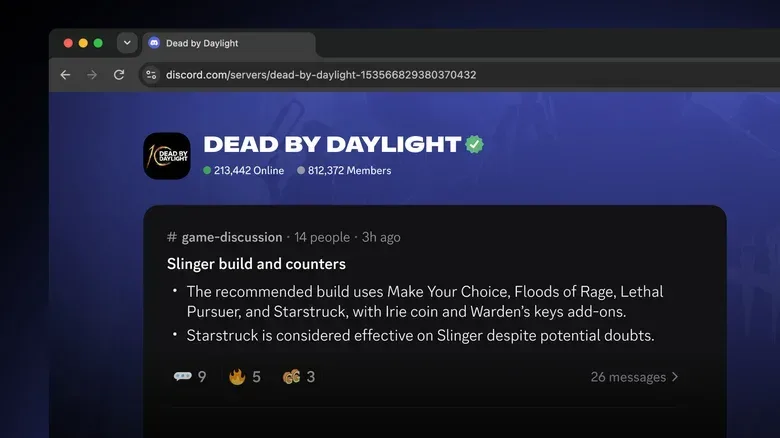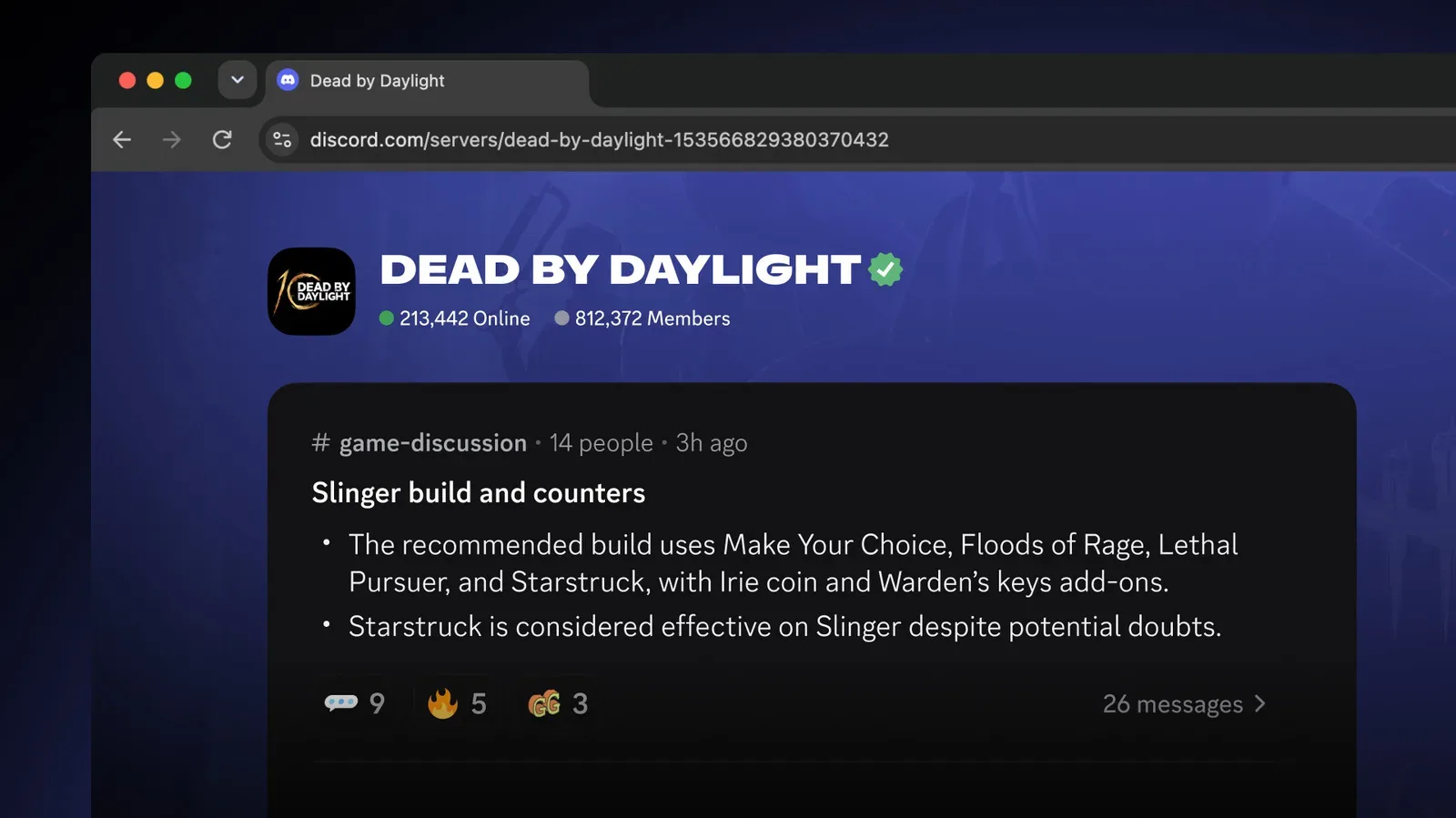
Discord is preparing a major change to how its biggest public communities appear beyond the app: posts from eligible public channels could become searchable on the open web. The shift applies to Discoverable Servers, Discord’s large, no-invite-needed communities with at least 1,000 members, rather than every server on the platform.
On November 16, those servers are scheduled to receive Server Web Pages. The pages will include basic server information, a description and summaries of conversations taking place in public channels. By mid-December, Discord says individual messages from those channels may begin appearing word-for-word on Server Web Pages and in search-engine results.
That distinction matters for gaming communities. Discord is commonly treated as the place where a clan, modding group, tournament organizer, fan community or game-focused creator’s regulars can chat in relative obscurity compared with a conventional social-media feed. A Discoverable Server has always been joinable without an invitation, but web indexing changes the path by which a particular discussion can be found. Someone may encounter a fragment of a conversation through a search result before ever opening Discord or joining the server.
What is changing, and what is not
The planned web presence is limited in scope, but the limits are important. Discord says the searchable material will come from public channels in Discoverable Servers. Private servers, direct messages and group DMs are not included. A server that is invite-only is not a Discoverable Server merely because it has a public-facing community identity elsewhere.
Discord’s stated purpose is to make useful information from these communities easier to find on the web. In practical terms, a search for a game problem, a community question or a piece of shared knowledge could potentially surface a Discord discussion much as a forum thread can appear among normal search results.
Server Web Pages are not simply an archive of every visible account detail. Discord says neither the channel summaries nor the individual indexed messages will show a poster’s username or avatar. That is a meaningful privacy measure, but it should not be mistaken for complete anonymity. A message’s text can itself contain a name, a handle, a distinctive phrase, a link, a game account reference or other identifying context. Removing account presentation from a result is different from removing every clue contained in the words a person chose to post.
Why gamers and community managers should pay attention
For public gaming servers, indexing could bring genuine upside. Long-running channels often contain answers that are difficult to locate even for members: explanations of a game system, event details, platform-specific fixes, community rules or recommendations. Search visibility may help newcomers reach material that otherwise remains buried in a fast-moving chat history. It could also make a well-managed public server easier to discover without relying entirely on invite links and social posts.
There is a less convenient side. Conversation is usually written for a specific room, moment and audience. A brief reply that makes perfect sense next to several earlier messages may read differently when isolated on a web page or in a search snippet. Public-channel participants may also have assumed their words were primarily discoverable by people already inside Discord, even when the server itself was open to join.
The practical question is not whether a Discoverable Server is public in the narrow access sense. It is whether contributors are comfortable with an eligible message becoming part of a much broader search surface. Server owners and moderators should consider that before treating channel structure, topic rules and posting guidance as unchanged.
This is especially relevant where communities collect troubleshooting information or host prolonged debates. A public help channel can become more useful if its answers are searchable, while a casual off-topic channel may carry more context-dependent conversation. The two do not necessarily deserve the same treatment. The feature’s channel-level controls give administrators a way to make that distinction instead of choosing only between an entirely visible server and a closed one.
The controls available to server admins
Administrators of affected Discoverable Servers can begin opting channels out of the server’s eventual web presence now. That makes a channel-by-channel review the most sensible first step for community teams.
- Identify public channels that are intended as lasting references. Rules, announcements and carefully maintained help channels may have a clearer case for wider visibility.
- Review conversational spaces separately. General chat, support exchanges and channels where people regularly share personal details can have different expectations from documentation-style rooms.
- Tell members what policy the server is using. A short, prominent notice can help participants understand which spaces may be included in web pages and search results.
- Revisit moderation guidance. If a channel remains eligible for indexing, reminders not to post personal information become more consequential.
These are operational choices, not a claim that every public channel should be hidden. A community built around guides, competitive information or public event coordination may reasonably favor discoverability. The important point is that opting a channel in or out determines more than whether existing members can read it; it affects whether its content may be surfaced to people arriving from the web.
Teams operating game communities may already be balancing Discord against other searchable resources, including a website, wiki, forum or social account. This change does not turn every Discord conversation into polished documentation. It does, however, create a reason to decide which Discord channels should function like a publicly findable knowledge base and which should remain accessible only within the service. Communities watching other shifts in game-related online spaces may also be interested in the recent discussion around a solo designer’s claims involving Jackbox, where public conversation and community attention can quickly become part of the wider industry picture.
Individual users can opt out too
Discord is not placing the decision solely with server administrators. Individual users can choose to prevent their posts in Discoverable Servers from being indexed through the Data and Privacy area of User Settings. Anyone who participates in large public servers but does not want their eligible messages included in this new web-searchable layer should review that setting.
There is a significant regional default. In the European Union, the United Kingdom, Canada, Brazil, Australia and South Korea, channel messages will be off by default. Users in those markets would need to manually opt in before their messages can be included. Discord says this approach is intended to account for local regulations.
Teen users are excluded from the option to enable channel-message inclusion until they reach adulthood. In other words, they cannot turn the feature on. That boundary is notable because discoverable chat spaces can include mixed audiences and because search indexing can extend the audience for a message well beyond the people present when it was written.
Key terms worth separating
Discoverable Server
In this policy, a Discoverable Server is a large Discord community with at least 1,000 members that can be joined without an invitation. It is the category affected by Server Web Pages and potential message indexing. Not every Discord server fits this definition.
Server Web Page
This is the planned web hub for a Discoverable Server. It will present basic server information, including a description, plus summaries of discussion from public channels. It is the bridge between an in-app community and ordinary web browsing.
Indexing
Indexing is the process that allows content to be surfaced through a search engine. For this rollout, Discord says eligible public-channel messages could appear word-for-word both on Server Web Pages and in search results. Being publicly readable inside an app and being readily retrievable by a web search are related but different forms of visibility.
A sensible checklist before mid-December
There is still a gap between the November 16 Server Web Page rollout and the expected mid-December point at which messages could start appearing in search. That window gives both server leaders and members time to check the relevant controls.
- Confirm whether the server is a Discoverable Server rather than an invite-only or otherwise private community.
- For administrators, examine public channels individually and use the channel opt-out option where broader web exposure does not fit the channel’s purpose.
- For users, open Discord’s User Settings, go to Data and Privacy, and check the setting governing indexing of posts made in Discoverable Servers.
- Do not assume username and avatar removal makes message text impossible to connect to its author; avoid posting information that should not travel beyond the intended audience.
- For users in the EU, UK, Canada, Brazil, Australia and South Korea, remember that channel messages are off by default unless the user chooses otherwise.
The change can make public Discord communities more useful to people looking for answers, but it also changes the practical meaning of posting in an eligible public channel. The strongest response is neither panic nor indifference: admins should make deliberate channel decisions, and members should inspect their personal privacy setting before the search-indexing phase begins.