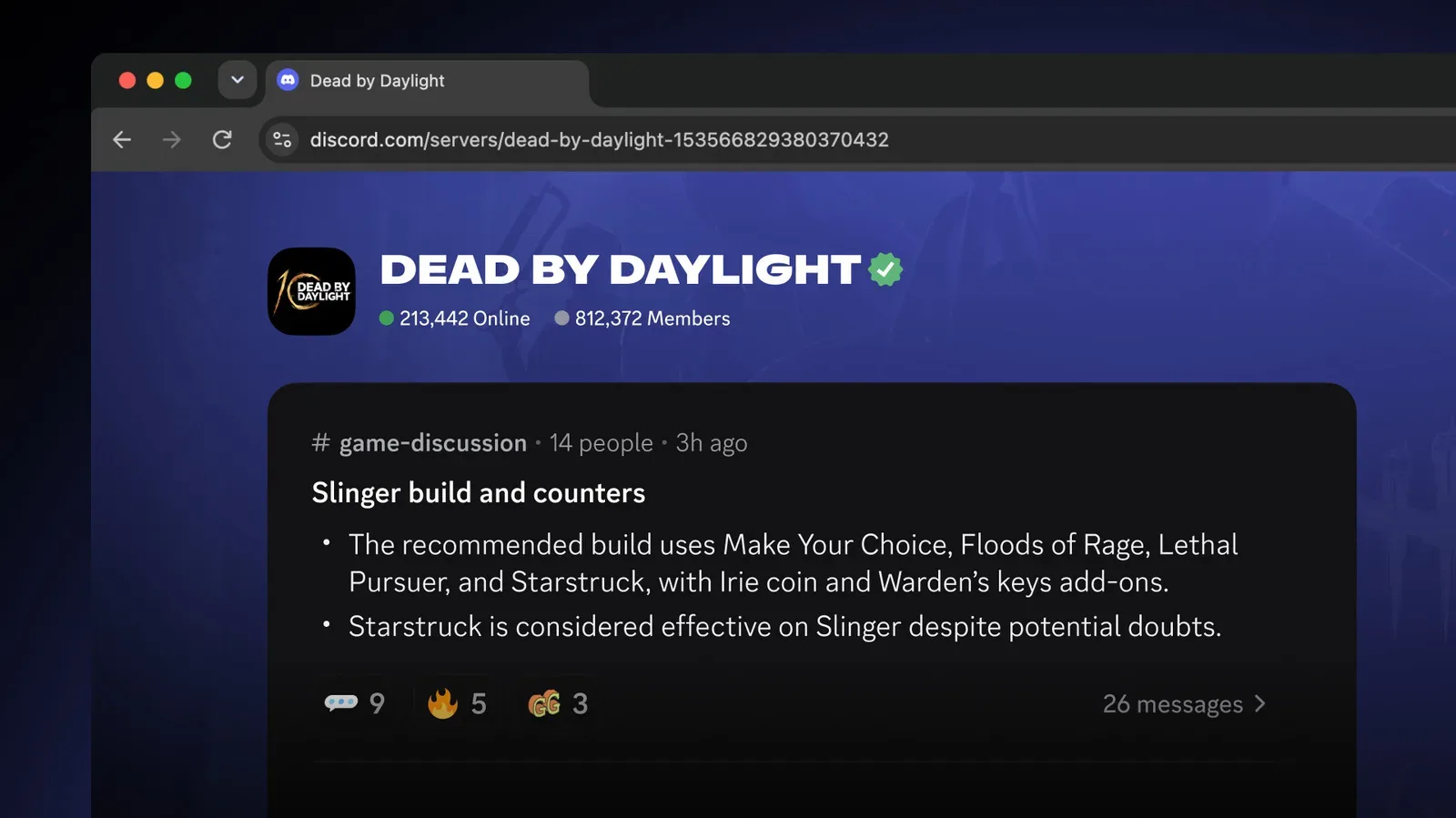
Discord is preparing a change that could make parts of public gaming-server conversation easier to find—and considerably more visible than many users may expect. Beginning in mid-December, messages from certain large, discoverable Discord servers may appear in web search results.
The intended benefit is straightforward: answers currently locked inside busy community channels could become reachable through ordinary web searches. A player looking for a commonly asked question about a game, for example, could be directed to an answer posted in that game’s official Discord community instead of joining the server solely to ask it again.
But the feature also changes the practical audience for a Discord post. A message written for fellow members of a server could potentially be found by someone who has never joined that community. For gaming spaces that have become the de facto home for technical troubleshooting, patch discussion, mod help and player-to-player support, that is a meaningful shift in how public discussion works.
Which Discord messages may show up in search?
The planned web-search visibility is limited to discoverable servers. In this context, those are public Discord servers with more than 1,000 members that can be joined without an invite link. The change does not apply across every Discord server by default.
There are several further limits described for the rollout:
- Server administrators can choose which channels are eligible to appear in search results before the feature goes live.
- Only messages from adult accounts may be surfaced.
- Direct messages are excluded.
- Private servers are excluded.
- Group DMs are excluded.
- Members of an eligible discoverable server can opt out of having their own messages appear through privacy settings.
That structure matters. This is not a plan to index private conversations, DMs or invite-only communities. Nor does it mean every channel in every qualifying public server will be exposed to web search. Channel-level selection gives administrators a way to set aside public-facing areas—such as support, frequently asked questions or guides—while keeping other eligible channels out of the feature.
Still, the individual setting is particularly important because the approach is opt-out. Someone participating in a discoverable server who does not want eligible messages to be surfaced in web results will need to change their own privacy preferences rather than rely on non-participation being the default.
Why this could matter to game communities
Many game communities use Discord as an always-on information hub. Players ask where to find a setting, how a system behaves, whether a known issue has a workaround, or what a developer has clarified. The same questions often recur as a game attracts new players, receives updates or sends people back to a particular activity.
Related coverage includes Discord Will Let Some Public Server Messages Appear in Web Search Results.
Discord’s plan aims to make those existing answers more useful outside the server itself. If a public official community has already answered a question clearly, a web result could theoretically bring the next player directly to that discussion. That could reduce repetitive onboarding questions and give community volunteers, moderators and support-minded regulars a little breathing room.
It also addresses a genuine discoverability problem. Specialized knowledge often lives in chat platforms that are not naturally visible to conventional web search. A person may know that an answer is probably somewhere in a game’s Discord, but still face several obstacles: finding the correct server, joining it, learning its channel structure, searching its internal history and judging whether an old answer remains accurate.
Making selected public channels searchable could turn Discord into a more useful reference layer for the questions it already receives. In the best case, a well-run server might direct newcomers to practical answers without making them navigate a fast-moving general chat.
“Discoverable” does not always feel the same as “searchable”
The privacy concern is less about whether a qualifying server is public and more about the scale of visibility. A discoverable community can already be joined without an invite, but participating inside a server and having a message appear in a general web search can feel like two different levels of exposure.
That distinction is worth taking seriously even when the material is not private. People routinely adapt what they say to the apparent boundaries of a platform. A public Discord server may feel like a community room with shared context: other members understand the running jokes, know the game being discussed and can see the preceding messages. Search results strip much of that context away.
A short answer, an opinion, a troubleshooting suggestion or an old comment may look different when encountered alone through a web query. That does not mean searchable content is inherently harmful. It means that users should recognize that the audience for eligible posts may no longer be limited to people browsing inside the server.
This is especially relevant in gaming, where community members can be generous with detailed help but may not be writing for a permanent, broadly searchable audience. A player explaining a workaround may later be proven wrong by an update. Another may share a personal setup detail to solve an issue. A moderator may make a quick clarification that is clear in the moment but incomplete weeks later.
Searchability can improve access to useful knowledge while increasing the stakes for context, accuracy and privacy. Both outcomes can be true at once.
What server administrators can do before launch
Administrators of qualifying discoverable servers have a direct role because they can select which channels are included. The practical question is not simply whether a server wants search visibility; it is which kinds of discussions are suitable for it.
Public support, FAQ and reference channels are the most obvious candidates. They are generally built around reusable answers, are already intended to help newcomers and can be organized more deliberately than a rapid-fire social channel. A channel that contains official guidance, clearly labeled solutions or maintained resources may benefit from broader reach.
Conversely, a channel dominated by casual conversation, real-time reactions or sensitive support discussions may be a poor fit. Even in a public server, participants may not reasonably expect a fleeting exchange to become easy to locate through a general search engine.
Administrators may also want to consider how their selected channels communicate reliability. A concise answer that is correct today might age badly after a patch, event or rules change. The available information does not describe special labeling or freshness tools for search results, so communities should not assume outside readers will automatically know whether an older post remains current.
Clear channel purposes, maintained FAQs and careful moderation become more valuable if selected discussions can travel beyond Discord’s own interface. That is not because every reply needs to read like official documentation; communities thrive on informal conversation. It is because search tends to reward direct, standalone answers, while chat tends to assume shared context.
What members should check
If you are in a large discoverable Discord server, the key personal step is simple: review your privacy settings before the rollout if you do not want eligible messages to appear in web results. The individual opt-out is the control that applies regardless of which channels a server administrator selects.
Members should also distinguish the categories involved. The described feature does not cover DMs, group DMs or private servers. Those exclusions are significant and should prevent the change from being confused with broad indexing of all Discord communication.
For anyone who stays opted in, the useful mental model is to treat posts in selected channels as potentially findable beyond Discord. That does not require panic or a wholesale retreat from public communities. It simply calls for the same judgment people use when posting to an open forum, writing a public comment or contributing to any other search-visible discussion.
People seeking game help may benefit too. Search visibility could make it easier to find an answer from a community with direct familiarity with a game, rather than relying exclusively on scattered posts or starting a new question from scratch. But readers should still check the date, context and specificity of any answer they find. A community response is not automatically authoritative just because it appears prominently in a search result.
The larger trade-off: preserving useful answers without flattening community context
The rollout speaks to a broader problem with modern online communities. As discussion shifts away from traditional message boards and into chat-based spaces, practical knowledge can become harder to discover from the outside. Useful explanations may exist, but they are tucked into scrolling archives, buried among conversation or accessible only after joining the right server.
Searchable selected channels could recover some of that lost utility. For large public game communities, the change may help surface answers that are already available but difficult to locate. It could make official Discord servers more useful as a reference destination, not just as a place to talk.
Yet this approach does not eliminate the tension that made closed or semi-closed chat spaces attractive in the first place. Discord communities often sit between a fully public webpage and a private conversation. Their social norms were shaped around that middle ground. Bringing selected posts into web search shifts the boundary outward, even with administrative controls and personal opt-outs.
The success of the feature will likely depend less on its raw reach than on how carefully communities use those controls. A sharply defined help channel with clear, durable answers could become substantially more useful to players. A poorly chosen general channel could make members feel as though the room changed without the furniture moving.
For now, the most concrete takeaway is also the most practical: administrators of discoverable servers should decide which channels, if any, are appropriate for web visibility, while members who prefer not to have eligible posts surfaced should use the privacy opt-out. The feature promises to make gaming knowledge easier to find. Whether it feels like a welcome revival of searchable community advice or an uncomfortable expansion of public exposure will depend on those choices.
For more on how platforms can reshape online visibility and incentives, see our coverage of X’s unexplained push toward post promotion for Premium users.