There is a certain kind of game announcement that arrives carrying a trailer, a platform list and an extremely distant date. Dawngazer has all three. Yet its most consequential detail is arguably the ambition around it: the new 2D fantasy RPG is intended to be the focal point for Ignisphere, an original setting designed to support stories beyond a single game.
Takafumi Noda, who departed Vanillaware in March 2025, has founded Ignisphere Studios for the project. Good Smile Company will publish Dawngazer, which is planned for 2028 on PlayStation 5, Nintendo Switch 2 and PC. Monochrome Corporation is supporting development, while Kadokawa is also involved.
That makes this less a case of a new studio simply revealing its first game and more a statement of how it hopes to build an audience: start with an RPG, establish a world, then leave room for characters, places and histories that may not fit into the player’s central route through that RPG. It is a grand plan, but the announcement does not pretend that the larger world is already fully explained. For now, the teaser chiefly gives Dawngazer a visual mood and a few narrative breadcrumbs.
A new studio, a new fantasy framework
Noda’s background naturally puts attention on the visual side of the reveal. Vanillaware has been associated with richly illustrated games including the fantasy titles Unicorn Overlord and Dragon’s Crown, alongside the modern, mecha-driven 13 Sentinels: Aegis Rim. Noda was known there for leadership and artistic ability, in a studio environment especially noted for hand-drawn art.
That history should be treated as context, not a promise that Dawngazer will replicate any particular earlier game. Ignisphere Studios is a separate, newly founded operation, and the details released so far do not establish Dawngazer’s combat system, progression, party mechanics, scope or structure. The confirmed label is simply RPG. The evidence available is much stronger on artistic presentation and the project’s cross-media intent than it is on how the game will play minute to minute.
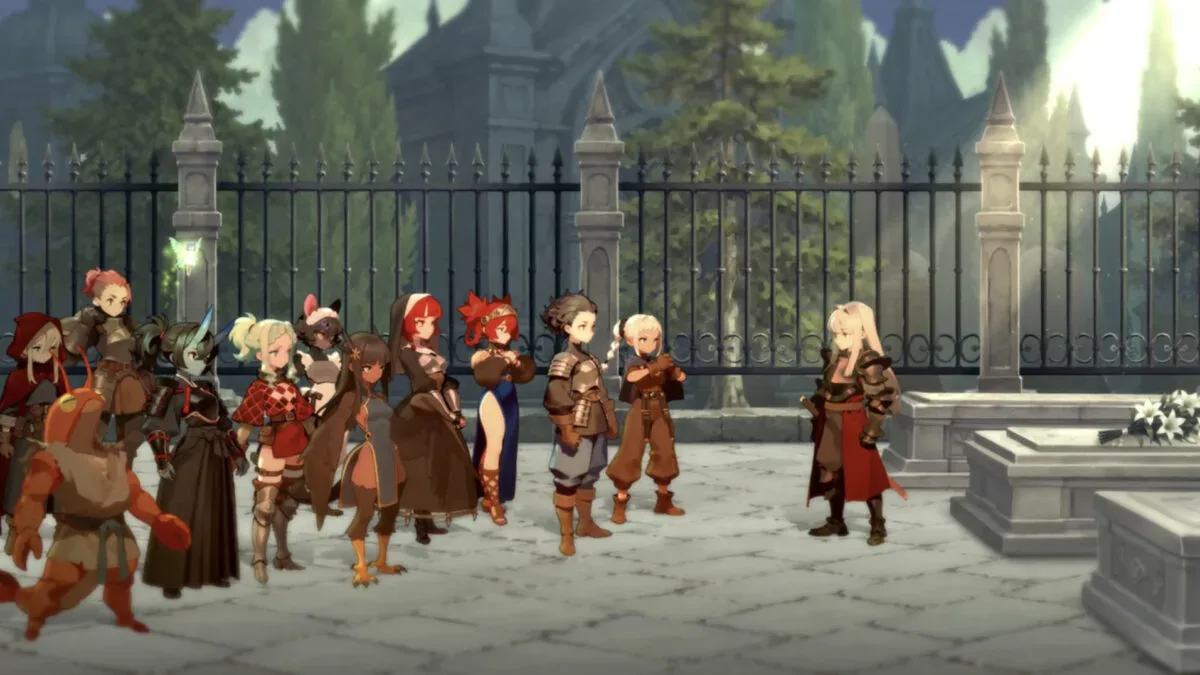
Still, the teaser makes an immediate case for a 2D presentation with considerable animation work. It follows an unnamed female soldier through a colorful settlement occupied by humans and humanoid figures. Other soldiers appear, as does a catlike creature, while a folk-style chant accompanies the imagery. The selection of characters and the town setting communicate a lived-in fantasy society rather than a blank quest map.
The trailer then changes emotional direction. A royal family is shown, apparently the group for whom the growing party fights, before the figures fade away. The protagonist is left placing flowers at their graves. That sequence suggests loss is central to her journey and that the royal family may be absent by the time the game’s main events unfold. But it remains a suggestion, not a complete plot outline. Names, relationships, the cause of death and the actual political situation have not been revealed.
What “multimedia IP” means here
IP, short for intellectual property, is often used in entertainment to describe a shared fictional creation: its world, characters, names, themes and stories. A multimedia IP is one built with the possibility of appearing in more than one format. In Ignisphere’s case, the stated idea is that Dawngazer’s game story is only one way to explore the setting.
Noda has specifically identified novels and merchandise as formats that could illuminate countries, characters and historical material that cannot be fully depicted in a game. The distinction matters. A game has to make choices about perspective and pacing: players require a focused path through an experience, even if that experience is large. A novel can spend its time with a person who never joins the player’s party. Merchandise can foreground a design, symbol or character without asking that item to advance the game’s plot.
In other words, the broader plan is not necessarily about putting every piece of lore inside Dawngazer. It is about designing a setting robust enough to hold stories at different scales. A game may follow the soldier seen in the teaser; a separate work could potentially visit another country, chronicle a previous era or focus on someone who only exists at the edges of the RPG’s main conflict. Those are examples of the structure Noda has described, not confirmed future projects.
The practical benefit of that approach is creative flexibility. If a world has coherent geography, cultures, political institutions and history behind its on-screen events, it can support a central narrative without requiring every detail to be delivered in exposition. It also gives an audience a reason to remain interested between major game releases. The challenge, naturally, is that worldbuilding is not the same thing as storytelling. The first game will still need to make its protagonist, stakes and setting meaningful in its own right.
Nothing in the announcement confirms particular books, animation projects or product lines. The point at this stage is intent: Ignisphere Studios is planning the world with those avenues in mind, rather than retrofitting them after Dawngazer has arrived.
The trailer’s small details do real work
Dawngazer’s teaser is deliberately restrained in what it explains. Rather than offer a long cast introduction or a breakdown of RPG systems, it concentrates on an atmosphere: a bright town, varied inhabitants, companions or fellow soldiers in motion, ceremonial-sounding music and a grave-side image that reframes the preceding royal tableau.
The contrast between vibrancy and mourning is useful because it gives the footage a specific dramatic tension. This does not look like fantasy built only around cheerful town life, nor does it present a uniformly bleak world. The town’s human and humanoid residents indicate social variety, while the soldier protagonist and royal imagery hint at a conflict tied to power and duty. The flower-laying scene introduces remembrance. Together, those elements offer more than a generic medieval-fantasy silhouette while preserving nearly all of the game’s concrete secrets.
Animation is the clearest element viewers can evaluate now. The trailer showcases an array of character designs and 2D motion, an appropriate first impression for a studio led by someone with a record in art-led development. It is also well suited to Ignisphere’s proposed wider identity. Distinctive characters and environments can serve a game’s narrative needs while also making a fictional world legible when viewed outside of play.
Yet there is a productive limit to what can be inferred from polished teaser footage. It does not tell prospective players whether Dawngazer uses turn-based battles, action combat, tactical encounters or something else. It does not verify the size of the playable cast, whether the catlike being is a party member, or how the visible settlement connects to the rest of the world. The 2028 release window leaves substantial time for the studio and its partners to explain those fundamentals.
Why the publishing and development partners matter
The announced collaborators indicate that Dawngazer is being assembled with support rather than as an isolated project. Good Smile Company is the publisher attached to the 2028 release. Monochrome Corporation, whose work spans anime and game production, is supporting development. Kadokawa’s involvement also fits the project’s stated ambition to think beyond one medium.
It would be premature to assign each partner a specific creative role beyond what has been confirmed. The announcement does not detail who is responsible for individual parts of development, any adaptation plans or the precise nature of Kadokawa’s participation. What is clear is that Ignisphere is positioning the setting at an intersection of games and other forms of entertainment from its earliest public presentation.
The platform plan is similarly broad: PlayStation 5, Nintendo Switch 2 and PC are all named for Dawngazer. For PC readers, that places the project among upcoming releases targeting the format alongside consoles rather than treating it as a later afterthought. Anyone following the momentum of the Japanese PC market may also find recent reporting on Japan’s growing PC gaming revenue useful context for why a simultaneous PC presence matters to modern projects. No store, digital distribution details or PC requirements have been announced for Dawngazer.
What is confirmed, and what remains open
For a project scheduled for 2028, Ignisphere has offered a meaningful foundation without overcommitting to details that could change. The confirmed facts establish a clear identity: a fantasy RPG called Dawngazer; a 2D visual showcase; a female soldier protagonist; an original world intended to extend across media; and a release plan covering PS5, Switch 2 and PC.
- Confirmed: Dawngazer is an RPG planned for 2028.
- Confirmed: Good Smile Company is publishing it, with development support from Monochrome Corporation and involvement from Kadokawa.
- Confirmed: It is planned for PlayStation 5, Nintendo Switch 2 and PC.
- Confirmed: Ignisphere is conceived as a world that can support stories in media such as novels and merchandise.
- Not yet detailed: gameplay systems, the protagonist’s name, the game’s full plot, specific future media projects and release-date particulars.
That division is worth keeping in mind as attention turns to the trailer’s implications. The royal graves, catlike creature and bustling settlement are evocative pieces of a setting, not a finished encyclopedia of it. The strongest takeaway is that Noda and Ignisphere Studios are proposing a deliberate long-term canvas, with Dawngazer tasked with being its first playable focal point. Whether the game earns that larger future will depend on information still to come—and, ultimately, on how compellingly the RPG turns its attractive early images into a story players can inhabit.