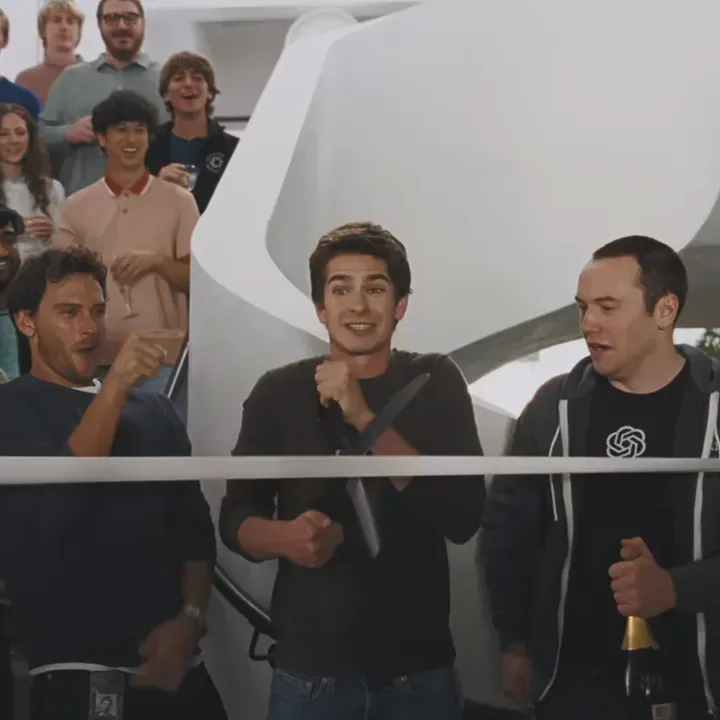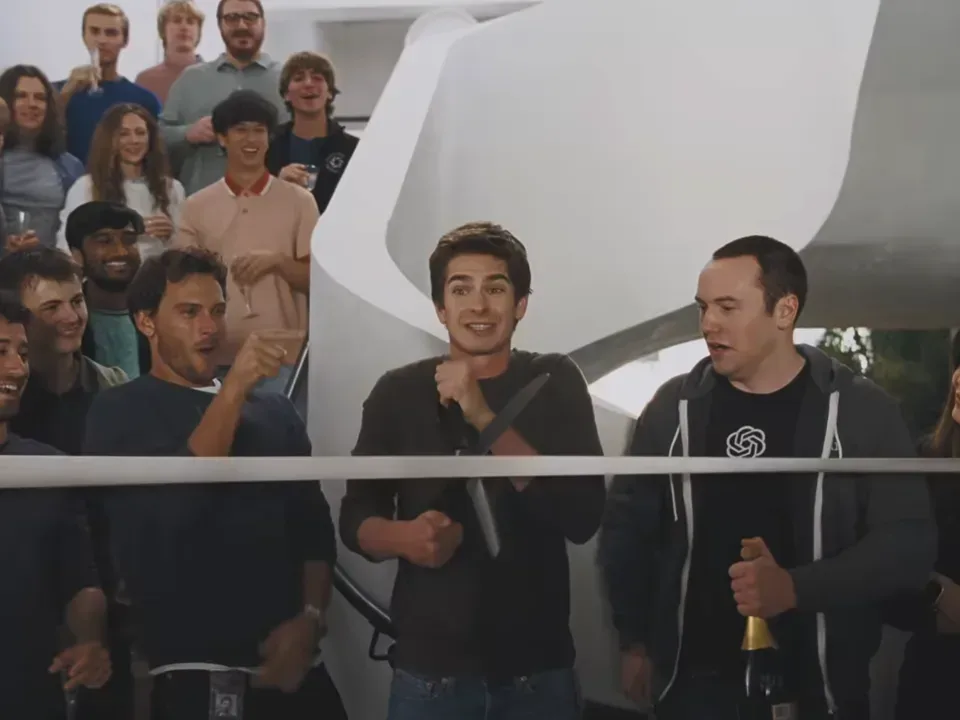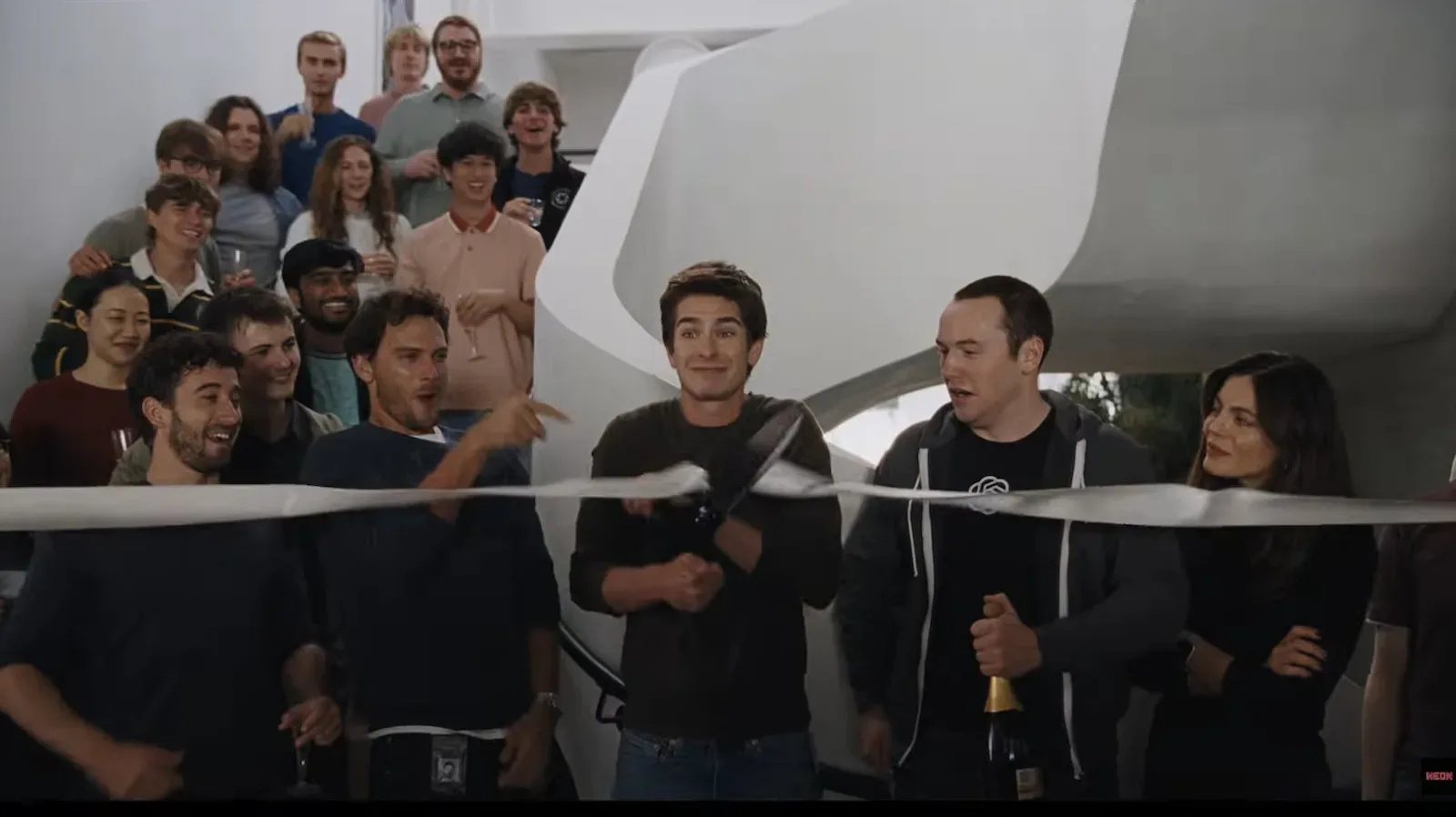
The first teaser for Artificial, Luca Guadagnino’s film about Sam Altman and the turbulent creation of ChatGPT, has arrived with a notably unnerving pitch: this is not presented as a clean, celebratory Silicon Valley success story. In just over a minute, the footage turns dark hallways, hushed dialogue and a blue-lit room full of guns into the grammar of a thriller that seems determined to make the modern AI boom feel like a locked-door nightmare.
Neon is now backing the film following Amazon’s exit from the project in June 2026. Artificial is scheduled for a limited theatrical release on Christmas Day 2026, placing one of the year’s stranger-looking prestige projects into the middle of the holiday movie rush. The teaser does not spell out the full scope of the story, but its atmosphere is clear: Guadagnino and his cast appear to be approaching the rise of generative AI through tension, secrecy and dread rather than through a conventional corporate-biopic playbook.
Andrew Garfield’s Altman enters a shadowy version of tech history
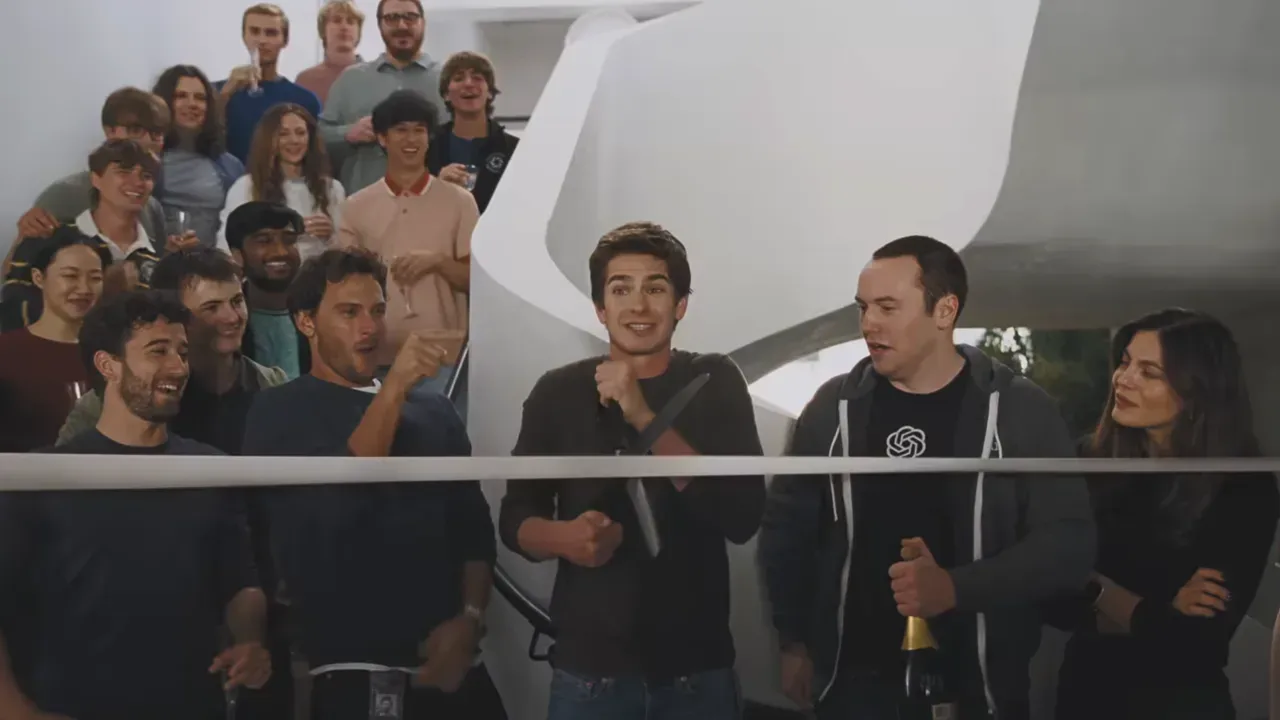
Andrew Garfield plays Altman, the OpenAI chief executive at the center of the film. The teaser’s key visual follows him through dim corridors as unsettling strings build beneath the scene. He eventually reaches a room washed in blue light and stocked with firearms, an image that immediately shifts the movie’s temperature from boardroom drama to paranoia thriller.
Garfield’s version of Altman speaks in a low, intimate voice. Two lines stand out for how directly they tie the character’s ambitions to the teaser’s ominous imagery:
“We opened Pandora’s box together.”
“We get to be the ones to shepherd people into this new world.”
Those fragments give the preview its central conflict. The language suggests both responsibility and an awareness that the technology being built could exceed anyone’s ability to comfortably contain it. The teaser does not establish exactly how literally its gun-filled setting should be taken, or where it falls in the movie’s timeline. It does, however, make a strong visual case that Artificial is interested in power, fear and consequences alongside the personalities involved in OpenAI’s rise.
The visual has a potential real-world echo. Altman discussed the prospect of needing security measures, including a saferoom, in a 2016 interview. The teaser’s staging may be invoking that idea, but the film’s full context remains unknown. For now, the image chiefly works as a signal of tone: technological influence is being rendered as something claustrophobic and potentially dangerous.
A large ensemble beyond the company’s public face
While Garfield is the teaser’s focal point, Artificial has assembled a sizeable cast around him. Monica Barbaro appears as former OpenAI executive Mira Murati. Her presence indicates that the film will not be solely a portrait of Altman, although the trailer leaves the size and nature of Murati’s role unresolved.
The broader lineup includes Cooper Hoffman, Yura Borisov, Jason Schwartzman, Mark Rylance and Chris O’Dowd. The first footage does not clarify every character they play, so it would be premature to draw firm conclusions about which people and incidents will receive the most attention. Still, the range of performers gives Guadagnino considerable room to create a story with competing perspectives rather than a one-person chronicle.
Ike Barinholtz is also in the cast as Elon Musk. The teaser includes brief glimpses of Barinholtz’s Musk, but little else has been revealed about the portrayal. That restraint is probably wise. Musk’s relationship to OpenAI and the current technology landscape is a subject audiences will bring plenty of existing assumptions to, and a few fast shots cannot explain how Artificial intends to handle him.
There is an unusually cinematic collision at work here: actors associated with superhero movies, awards contenders, comedies and prestige dramas are being gathered for a story tied to one of the most consequential technology companies of the era. That alone distinguishes the project from the drier, issue-driven treatment viewers might expect from a movie about AI executives. Guadagnino, whose credits include Challengers, appears to be using genre texture to make recent corporate history feel volatile and immediate.
The teaser’s horror language is the important reveal
Calling the preview horror-flavored does not mean Artificial has been confirmed as a horror movie. The teaser is better understood as a piece of marketing that borrows horror’s tools: oppressive spaces, threatening sound design, whispered declarations and the uneasy implication that someone has unleashed a force they do not fully command.
It is an effective framework for a story connected to ChatGPT. Public discussion of generative AI often swings between grand promises and alarm: productivity and discovery on one side, misinformation, authorship disputes, job anxieties, safety questions and concentration of power on the other. The film’s early imagery appears to exploit that emotional divide. A polished demo or a bright office would communicate innovation; a corridor leading to a weapons room communicates vulnerability.
That choice could make Artificial feel less like an attempt to summarize every technical detail and more like a drama about the people who believed they were helping direct a historic change. The line about “shepherding” humanity toward a new world is particularly telling. It positions the characters not simply as developers of a product, but as figures who see themselves as guides at a massive social turning point. The teaser’s dread then asks whether anyone should be that comfortable holding the map.
The timing also adds another layer. AI remains an active, fast-changing subject rather than settled history. Questions around OpenAI, research claims and accountability continue to invite close scrutiny; Joking Joystick has also examined the wider debate in its report on OpenAI’s Navier-Stokes claim, research credit and proof. A drama that uses real, recent figures therefore has an especially narrow path to walk. It needs to create compelling cinema without letting familiar headlines substitute for characterization or context.
Amazon’s departure makes Neon’s pickup part of the story
Artificial nearly had a very different release route. Amazon had been attached to the project, but ended its involvement in June 2026, reportedly after several private test screenings of a film that was close to completion. The withdrawal drew attention because of the talent involved and because the movie’s subject matter sits so close to current business interests in AI.
The timing was particularly striking: Amazon’s decision came only months after the company committed $50 billion to OpenAI. That investment does not, by itself, explain the release decision, and no conclusion about Amazon’s reasoning should be drawn from the overlap alone. But it made the film’s sudden change in backer all the more conspicuous. A biographical drama about an AI leader can become commercially and culturally sensitive in ways that a more distant historical subject may not.
Neon subsequently picked up the film and set the Christmas Day theatrical plan. Limited release is an appropriate first destination for a conversation-heavy, star-driven drama with a provocative presentation. It also gives the teaser’s mood room to become an event in itself. The movie is being marketed not as an explanatory tech documentary but as an unnerving encounter with recent history.
What the trailer does—and does not—promise
The available footage provides a sharp sense of style, but it leaves key questions unanswered. It is not yet clear how far the narrative reaches into OpenAI’s history, which real events will form its spine, or how much the script will rely on dramatization to connect private conversations and public milestones. Viewers should also not assume that a teaser’s most extreme image—the arsenal-like room, for example—defines the entire film.
What is certain is that the creative team has chosen an audacious entry point. Rather than pretending the arrival of ChatGPT was merely a matter of code, launches and market value, Artificial frames its world as a place where ambition can feel almost supernatural in scale and deeply human in its anxiety. Garfield’s murmured warnings, Barbaro’s appearance as Murati and Barinholtz’s fleeting Musk shots all point toward a film that expects the public familiarity of these figures to carry weight before the plot is fully explained.
With Guadagnino directing, Garfield leading the cast and Neon positioning the film for December 25, 2026, Artificial has already made its first memorable move: it has made a biopic about AI look like it might be stalking its audience through a darkened hallway.