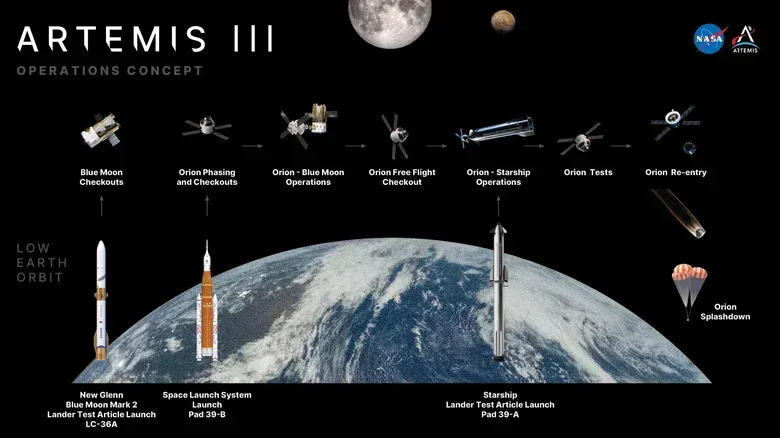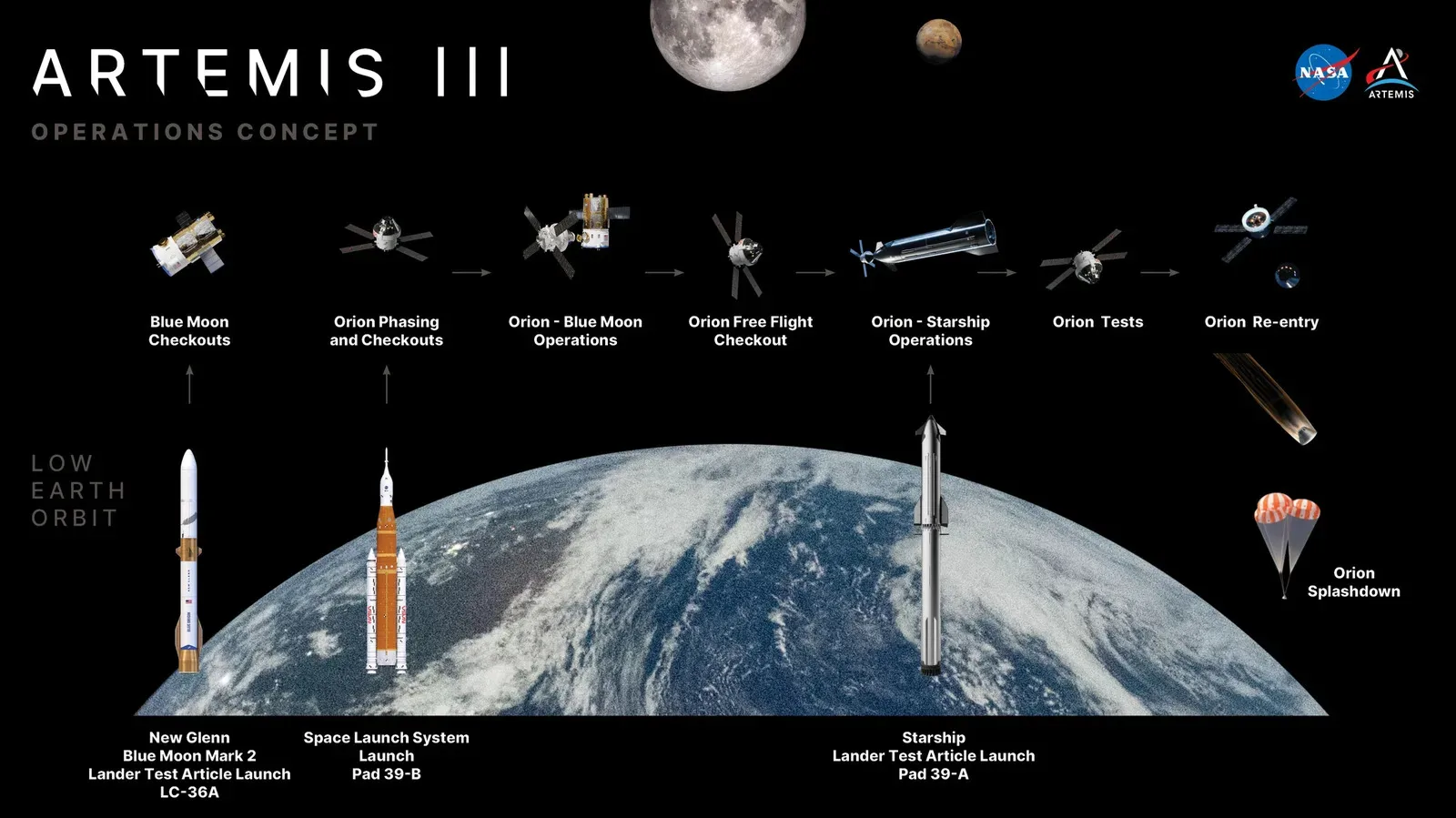
NASA’s reworked Artemis 3 mission is no longer positioned as the flight that returns astronauts to the lunar surface. Instead, it is planned as a high-stakes orbital test of the systems meant to make later landings possible: an Orion crew capsule, a Blue Origin Blue Moon Mark 2 lander and a SpaceX Starship Version 3 vehicle.
The headline challenge is the mission’s structure. Three different heavy-lift rockets are expected to launch three spacecraft from Florida within about two weeks. Blue Origin’s New Glenn would send a test version of Blue Moon Mark 2 into low Earth orbit first. NASA’s Space Launch System, or SLS, would then launch Orion and its four-person crew. Finally, SpaceX would launch Starship Version 3 with a docking system fitted near its forward end.
Rather than treating those launches as three separate demonstrations, Artemis 3 is designed to connect them. Orion is expected to rendezvous with each commercial vehicle in turn. The astronauts will transfer into Blue Moon Mark 2 for a more substantial systems check, while their Starship encounter will be a shorter docking-and-undocking evaluation without a crew transfer.
It is a notably different mission from the Artemis 3 concept that would have been NASA’s first crewed Moon landing since Apollo 17 in 1972. Under the changed program, the next crewed lunar landing has moved to 2028. Artemis 3 is now a proving mission intended to reduce uncertainty around the spacecraft interfaces needed before that attempt.
Three launches, one tightly connected orbital campaign
The first step is planned to be Blue Origin’s New Glenn launch carrying the Blue Moon Mark 2 test article. The lander would enter low Earth orbit at roughly 273 miles above Earth’s surface. Putting the lander in orbit ahead of the crew allows it to be ready for Orion’s arrival rather than asking the astronauts to wait through another launch phase after reaching orbit.
Next comes SLS, NASA’s heavy-lift launch vehicle, with the Orion capsule on top. Orion’s crew is expected to include NASA astronauts Randy Bresnik, Frank Rubio and Andre Douglas, alongside European Space Agency astronaut Luca Parmitano. Their spacecraft would enter an orbit around 345 miles above Earth before beginning its rendezvous with Blue Moon Mark 2.
That altitude difference is not merely a trivia point. A rendezvous is the controlled process of bringing two independently flying spacecraft into the same place and orbit at the same time. It involves carefully managing orbital paths, timing and relative motion. Docking takes the next step, physically joining the vehicles. Artemis 3 is meant to put Orion’s rendezvous and docking capability through those processes with two commercial designs that are described as very different from one another.
After Orion reaches Blue Moon Mark 2, the crew is expected to spend a couple of days confirming that the vehicles are ready before opening the hatch between them. The astronauts will enter the Blue Origin lander and assess whether it can maintain the appropriate atmosphere and pressure. They will also test its software, flight-control systems and life-support functions.
Those are central checks for any future crewed lander. Atmosphere and pressure management concern whether a crewed cabin can remain habitable. Life support refers to the systems that sustain astronauts in a spacecraft environment. Flight-control systems encompass the hardware and software used to direct and manage the vehicle’s movement. Artemis 3’s planned crew transfer therefore goes beyond verifying that two docking rings can meet; it is meant to examine whether the joined spacecraft can support people operating across the connection.
Blue Moon gets the more extensive crew evaluation
The Blue Moon portion of Artemis 3 is the mission’s deeper test. The astronauts are expected to actually enter the Mark 2 test lander, giving the flight a human-in-the-loop assessment of its internal environment and major functions. Once that work is complete, they would return to Orion. Orion would then undock, leaving Blue Moon behind while it moves into position for its second rendezvous.
The plan has practical importance for NASA’s broader lunar architecture. A lunar mission is not only about reaching the destination; the crew vehicle and the landing vehicle have to work as a connected system. Hatch operations, cabin conditions, vehicle controls and the sequence of crew movement are all part of that system. Testing them in Earth orbit gives NASA and its commercial partners an opportunity to examine those interactions without turning the first crewed encounter into a lunar-surface attempt.
Blue Origin’s launch infrastructure remains one of the variables surrounding the schedule. Its New Glenn launchpad exploded during a hotfire test in May. A hotfire test is an engine test in which engines are fired while the vehicle or stage remains secured on the ground, allowing teams to evaluate performance before flight. Blue Origin is working to make the pad usable again by the end of the year, but Artemis 3 depends on the wider launch and spacecraft readiness picture coming together.
Starship’s role is deliberately shorter
SpaceX’s Starship Version 3 is planned to launch for the final major Artemis 3 rendezvous. The vehicle had its first flight in May and would carry a docking mechanism mounted at its forward end. Orion is expected to approach, dock, and later undock from Starship during an encounter lasting about two hours.
There is an important boundary to that test: the Artemis 3 astronauts are not expected to enter the Ship capsule. The objective is to verify how Orion behaves when it approaches, connects to and separates from Starship. That makes this part of the mission an interface test, rather than a crewed inspection of Starship’s internal environment or life-support equipment.
NASA’s stated goal for the two encounters is to demonstrate how Orion interfaces with two distinct commercial lander architectures during one mission. In plain terms, Artemis 3 is checking whether the same crew spacecraft can successfully work with two separately developed systems. The Blue Moon test evaluates a crew transfer and lander functions; the Starship test focuses on the mechanics and operations of Orion’s docking relationship with that vehicle.
That distinction matters when reading the mission plan. A successful docking is a major milestone, but it is not identical to proving every element needed for a crewed lunar landing. Artemis 3 is structured to collect targeted evidence about compatibility and operations in Earth orbit. It is not described as a Moon landing, and the astronauts will not visit Starship’s capsule during the planned two-hour rendezvous.
Orion and the astronauts’ suits are also under evaluation
After the Starship operation, the crew may have about five more days available in orbit before heading home. That remaining time gives Artemis 3 a measure of flexibility within its planned mission profile, though no detailed day-by-day schedule has been specified.
The flight will also assess the Orion Crew Survival System suits. These suits are custom-made for deep-space missions, and Artemis 3 offers NASA a crewed setting in which to evaluate them as part of the wider Orion operation. Their inclusion underscores that the mission is not solely a test of commercial spacecraft. Orion itself, the crew’s equipment and the procedures tying all of these pieces together are part of the exercise.
For technology-minded readers, the key point is that Artemis 3 is fundamentally an integration mission. A vehicle can perform well on its own and still require extensive validation when interacting with another vehicle. Docking hardware, cabin interfaces, software behavior, mission control procedures and crew operations all need to line up. That kind of compatibility work is less visually dramatic than a lunar touchdown, but it is essential to any plan that relies on several spacecraft from different organizations.
Complex systems work also provides a useful counterpoint to the consumer-tech focus of developments such as Apple’s M6 iMac update: in both cases, raw component capability is only part of the story. For Artemis 3, the decisive question is whether independent spacecraft and their crews can operate together safely in orbit.
Schedule remains uncertain, with summer 2027 the best-case target
NASA has not provided a firm Artemis 3 launch date. The best-case scenario described for the mission is a summer 2027 launch, which would preserve two lunar landing opportunities for Artemis 4 in 2028. However, an agency-wide memo from NASA Administrator Jared Isaacman reportedly acknowledged that Artemis 3 was three months behind schedule.
That uncertainty is especially significant because Artemis 3 requires several major elements to be ready within a short launch window: the New Glenn and Blue Moon mission, SLS and Orion with the crew, and Starship Version 3 with its docking hardware. The sequence is designed around rendezvous, so timing across the campaign is a core operational requirement rather than a simple calendar detail.
If the mission proceeds as outlined, Artemis 3 will deliver a clear set of results even without landing on the Moon. It would demonstrate whether Orion can rendezvous and dock with Blue Moon Mark 2, allow astronauts to examine Blue Moon’s pressurized and life-support capabilities, and test Orion’s docking interaction with Starship. It would additionally gather information on the Orion Crew Survival System suits during a crewed deep-space-oriented mission.
Those demonstrations will not erase the difference between Earth-orbit testing and a lunar landing. But they are intended to build the technical and operational confidence needed for the 2028 landing effort. Artemis 3’s new identity is therefore straightforward: not the lunar touchdown itself, but the multi-vehicle rehearsal designed to make a later one more achievable.