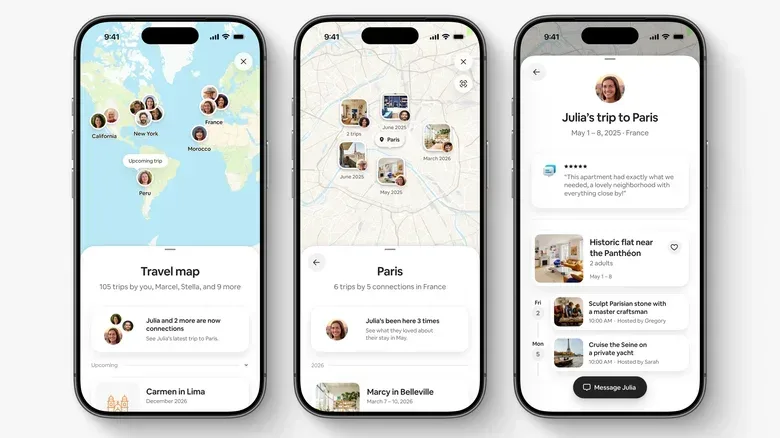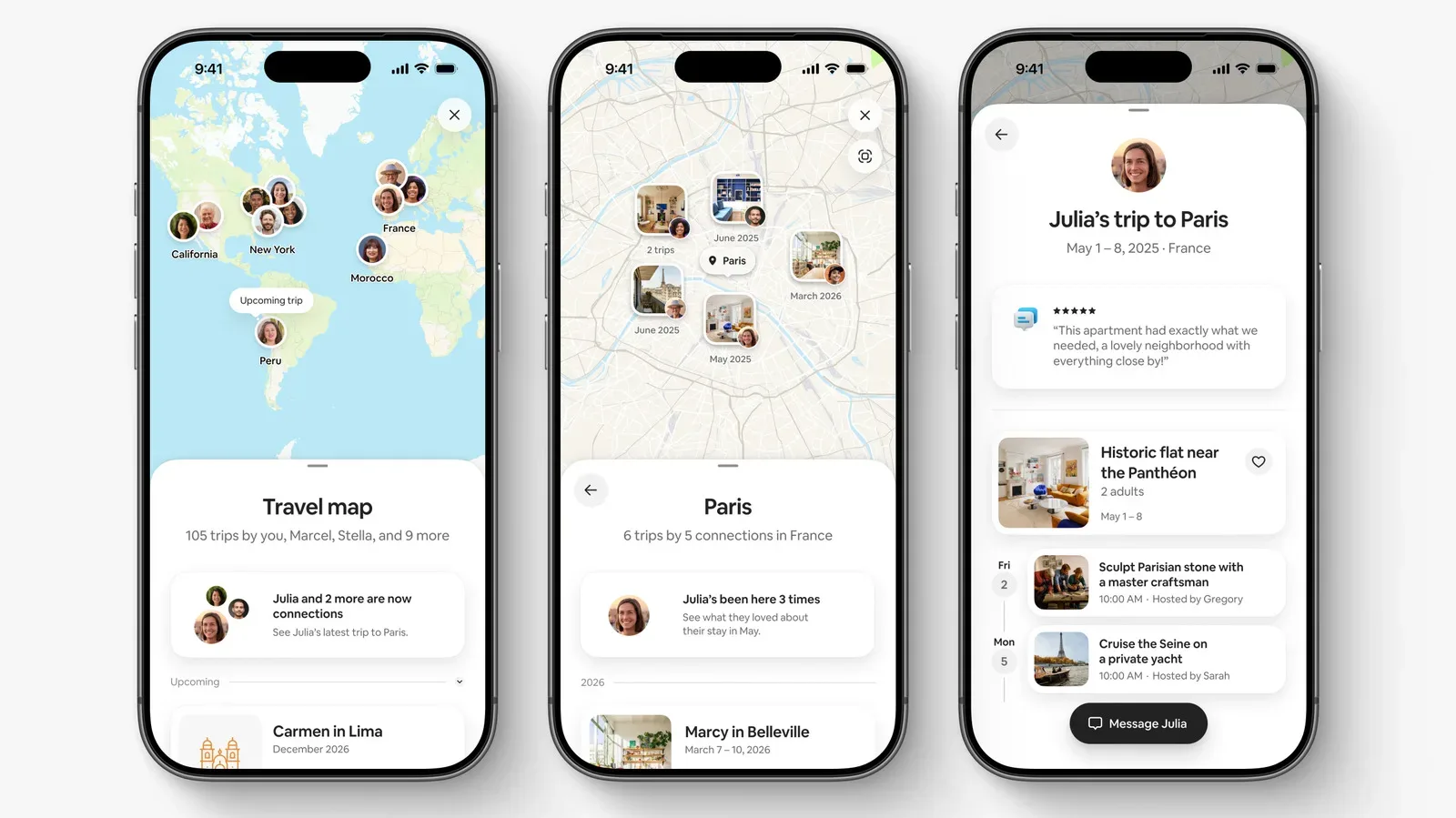
Airbnb is expanding its app with a set of discovery tools that push travel planning beyond the familiar scroll of individual rental listings. Its fall update introduces a social layer built around people a user knows, interactive maps with neighborhood summaries, additional AI-supported search and support features, and a growing roster of services that can be booked around a stay.
The broad idea is straightforward: choosing a place to stay is often only one part of planning a trip. Travelers also weigh the neighborhood, what friends have enjoyed, what can be arranged on arrival, and how difficult it is to compare a crowded field of listings. Airbnb’s incoming features aim to put more of those decisions in one app. But the social elements also make privacy settings more consequential, particularly when past and future travel activity can be visible to connections.
A travel map built around people you know
The headline addition is a new Travel Map. It will let users explore rentals where their connections have stayed, alongside the services and experiences those connections booked through Airbnb. Users will also be able to see reviews written by people in their network and place a connection’s favorites on their own wishlists.
That changes the type of recommendation being surfaced. A conventional listing review is feedback from a stranger, usually useful for practical details such as cleanliness or location but filtered through an unknown traveler’s expectations. A review or saved favorite from a friend can feel more personally relevant because the traveler may already understand that person’s budget, habits, and idea of a good trip. It is still a recommendation rather than a guarantee, but it adds a recognisable reference point to an otherwise large catalog.
The map is not solely a social-history view. Airbnb says its interactive maps will include neighborhood summaries based on information from guests and hosts. Those summaries are meant to give users a quick overview of an area while they are considering a rental. Airbnb also says the summaries will draw on “other sources,” without detailing what those sources are or how their information will be presented.
That missing detail matters. A neighborhood summary can be helpful when it clarifies the character of an area, but a condensed description cannot replace the listing-specific information a traveler needs before making a booking. Users should treat these overviews as an orientation tool, then read the listing carefully and compare it with the details that matter to their own plans.
Trip sharing comes with granular privacy choices
Airbnb’s social features will allow connections to view one another’s past and upcoming trips. However, the platform says users will have privacy controls over whether a trip is shared and over how much information about that journey is revealed.
Granular privacy controls means the setting is intended to offer more than a simple all-or-nothing switch. In this case, users can decide both whether information is shared and the level of detail attached to it. The exact options have not been described, so travelers should review the available settings when the feature reaches their account rather than assume that one choice covers every circumstance.
This is the feature set with the clearest practical trade-off. Sharing may make it easier to exchange advice with friends, coordinate overlapping plans, or discover properties and services that people in a user’s circle have already tried. On the other hand, travel information can reveal more than someone initially expects: a future trip can indicate when they may be away, while historic trips can build a picture of their preferences and routines. The right configuration may differ between a trip shared with close friends and a booking a traveler would rather keep private.
Airbnb will also add in-app messaging between connections. That could make the map and recommendation features more conversational, allowing people to ask why a particular rental was saved or whether a booked experience was worthwhile without leaving the app. It does not change the basic booking decision, but it creates a route from a pin, favorite, or review to the person behind it.
Useful checks before relying on shared travel activity
- Review whether past and future trips are shared separately, if that distinction is offered.
- Check what location and booking details a connection can actually see before enabling sharing.
- Consider whether a public-seeming favorite is appropriate to add to a wishlist connected to your profile.
- Use friend recommendations as a starting point, then verify the current listing details and fit for your own trip.
AI is being added across discovery and support
Airbnb is also introducing AI tools across search, filters, listing descriptions, listing comparisons, and customer support. These resources will initially roll out in the United States, though no schedule was provided.
In this context, AI-assisted discovery refers to tools intended to help interpret or organize a user’s search rather than simply presenting a static list of results. Search and filters are the most direct examples: they can help users narrow a large set of accommodation options. Listing comparisons can reduce the work of moving back and forth between multiple property pages. AI-supported customer service suggests an additional automated layer for seeking help through the platform.
Potential convenience does not remove the need for a careful final review. A comparison tool can organize information, but travelers should still confirm the details most important to their stay directly in each listing before booking. That includes the information presented by the host and any terms that affect the reservation. An AI-generated or AI-assisted summary is best understood as a decision aid, not a substitute for checking the underlying listing.
The use of AI in customer support carries a similarly practical distinction. Automated assistance may make it faster to locate relevant information or route a request, but users should be attentive to what has actually been resolved, especially when a question depends on the specifics of a booking. Airbnb has not supplied a precise US rollout timeline for these tools, so availability may vary while the update is introduced.
The travel sector is not alone in folding AI into tasks that once required a sequence of app screens, searches, and manual checks. Delivery platforms are experimenting with adjacent ideas too; for example, DoorDash is testing an AI ordering assistant in Apple Messages. Across these services, the consistent user-side lesson is simple: automation can speed up discovery, while the final cart, reservation, or request still deserves a human check.
Services expand beyond the accommodation itself
Airbnb’s Services section is continuing the expansion it began in spring. The new additions concentrate on needs that arise around a stay rather than the rental itself.
In Europe, Airbnb users will soon see meal-delivery and grocery-delivery options. In select US cities, guests will be able to arrange quick-turnaround laundry through Rinse and rent baby gear through BabyQuip for delivery to temporary lodgings. Airbnb is also working with partners on location-specific activity bookings, including boat rentals in South Florida and ski and snowboard gear in the French Alps.
These additions do not amount to a universal service catalog. The available options depend on region or city, and some are tied to a particular destination. Travelers should therefore expect services to be contextual rather than assume that a feature available for one trip will appear for another. The practical appeal is clear: arranging grocery delivery, laundry, baby equipment, or local gear through the same app used to book a stay may cut down on app switching and separate searches.
For families, baby-gear rental may be particularly relevant because it could reduce the amount of equipment brought to a temporary lodging. For a shorter stay, quick-turnaround laundry can be a useful option when access to washing facilities is limited. And the regional activity offerings illustrate a more targeted approach to local planning: boating makes sense as a South Florida option, while ski and snowboard equipment matches the French Alps setting.
What the update changes—and what it does not
The update makes Airbnb more of a planning hub. Social recommendations, map-based discovery, neighborhood summaries, AI-supported comparisons, messaging, and add-on services each address a different friction point in travel preparation. Together, they offer a path from “where have my friends stayed?” to “what should I save?” to “what can I arrange for the trip?” without necessarily leaving the platform.
Still, each feature should be assessed on its own terms. Social discovery depends on a user’s connections and their willingness to share travel information. Neighborhood summaries depend on limited, high-level descriptions and unspecified additional inputs. AI tools may help make a complex search more manageable, but the booking details remain the essential record. Services may be convenient, but their availability is explicitly region- and city-dependent.
For now, the timing is clearest only in broad strokes. The update is positioned as Airbnb’s fall release; the AI tools are set to begin rolling out in the US without a stated timetable; European delivery options are described as coming soon; and the US laundry and baby-gear offerings are limited to select cities. Travelers interested in the social component should pay especially close attention to the privacy controls as they arrive, since those settings will determine whether the new map feels like a useful recommendation layer or an unnecessary expansion of their travel footprint.