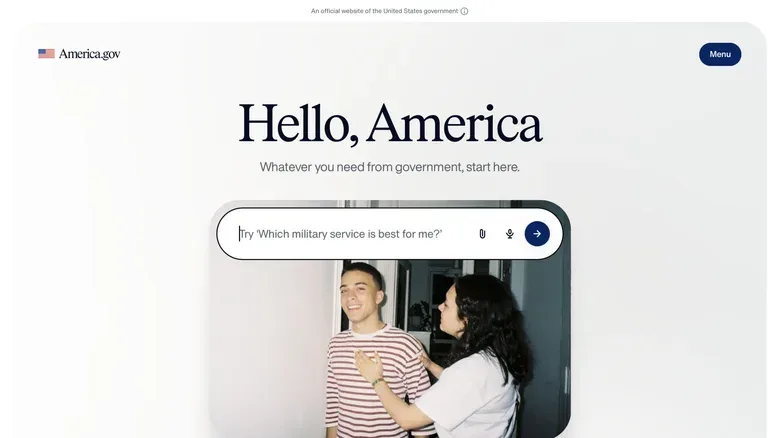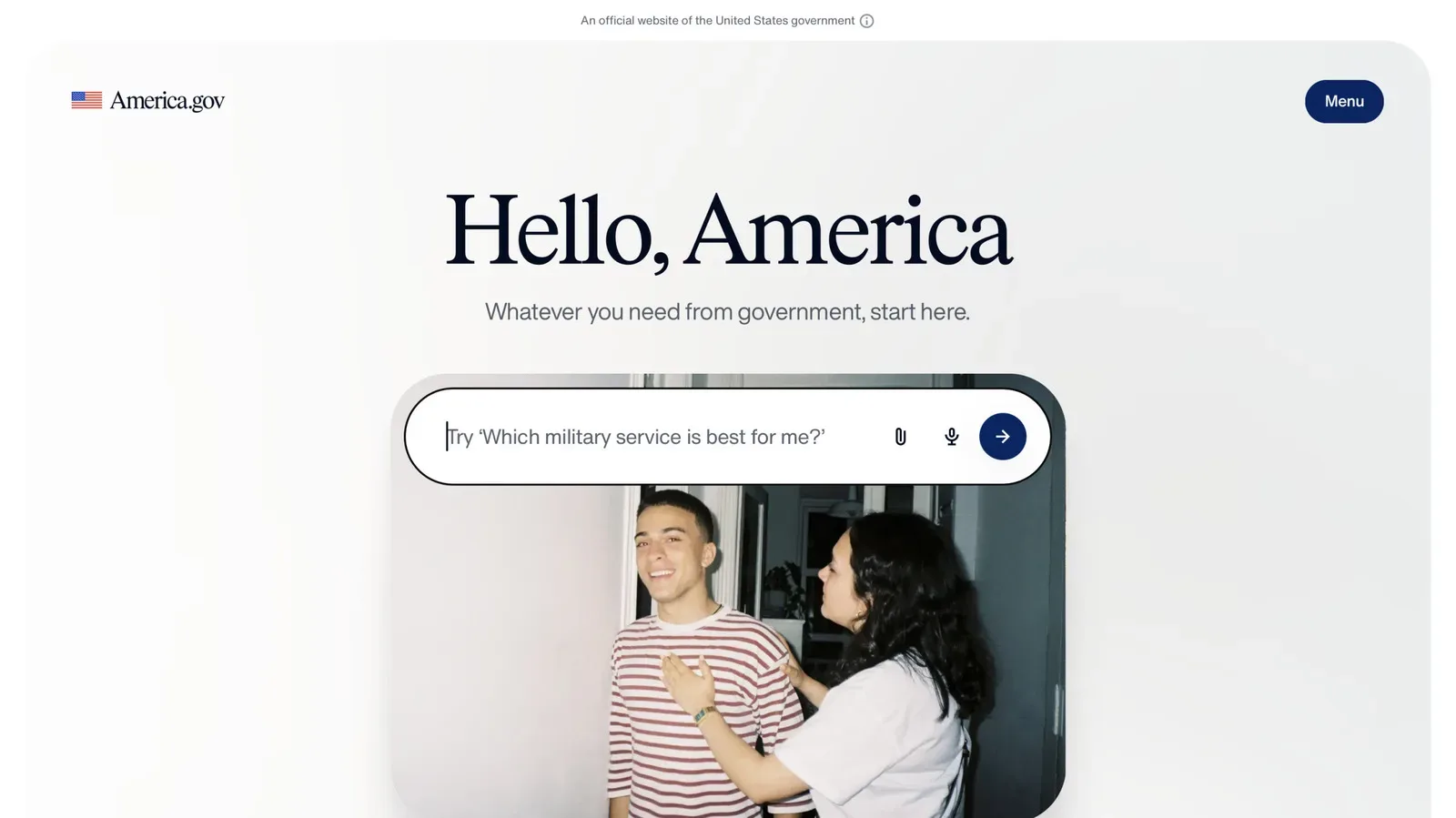
The United States government has introduced an AI chatbot through America.gov, positioning the site as a natural-language front door to federal information and, eventually, federal services. For now, the tool is intended to help people ask plain-English questions and receive simple answers drawn only from official government sources. That is a narrower job than an all-purpose chatbot, but it is still a consequential one: government information is often spread across agencies, forms and unfamiliar terminology.
The plan is considerably larger than a search helper. America.gov is meant to become a single point of online entry for covered federal services, with Login.gov integrated into the portal. Next year, the project is intended to add actions including Medicare enrollment, passport applications and finding federal employment. In other words, the chatbot is presently a guide standing near the lobby directory; the stated ambition is for it to become part of the route to completing the paperwork itself.
That change makes the project more important than the familiar “ask a bot a question” pitch. An AI system that summarizes publicly available guidance is one kind of public-facing tool. A system that helps direct people through benefits, identity-linked applications or other services involving personal information is another. The practical value may be substantial, but so are the questions that need clear answers before conversational assistance becomes a core layer of access.
What America.gov says the chatbot does now
America.gov describes its chatbot as using AI to provide simple answers from official government sources. Its immediate function is to organize and surface information already open to the public rather than to perform a transaction on a user’s behalf.
“Natural language” means the user does not have to know an agency’s preferred phrase, exact program title or the ideal set of search keywords. A person can ask a question in everyday wording, and the system attempts to interpret the request and return a useful answer. That could reduce friction for people who do not know which department runs a particular service or where to begin.
The phrase “only from official government sources” is particularly significant. In a government-services setting, users need information that is authoritative, current and traceable. The statement establishes an intended boundary around the material used for answers. It does not, by itself, answer every operational question about how answers are selected, summarized, checked for mistakes or presented when government guidance is complicated or changes over time.
That distinction is worth keeping in view. AI can make a question feel effortless, but the underlying subject may not be effortless at all. Eligibility, documentation requirements, deadlines and exceptions can have serious consequences. A concise response can be helpful as an entry point; it should not make users unaware of the underlying rules that affect their situation.
From answers to government transactions
The proposed next stage is where the stakes rise. Enrolling in Medicare, applying for a passport and applying for federal work are not merely informational searches. They may require identity verification and personal records. The executive direction to establish America.gov as a single point of entry and integrate Login.gov signals a move toward a more unified experience rather than a collection of isolated agency destinations.
Login.gov is relevant because it is part of the planned access architecture. A unified sign-in layer can make services easier to navigate for people who would otherwise face several separate account systems. But it also means the design of authentication, consent, support and error recovery matters enormously. If a user misunderstands a chatbot prompt, reaches the wrong service or cannot complete a sign-in step, the portal needs clear paths back to human-readable instructions and the correct official process.
A single point of entry can be convenient without being a single point of failure. That is the design challenge implicit in the announcement. People should be able to use a conversational interface when it helps, but they also need dependable alternatives when the answer is unclear, a digital process is inaccessible or their circumstance does not fit the apparent standard case.
There is a useful lesson in a very different online-service context: long-running digital systems benefit from planned fallback options when their connected components change. The planned offline PvE mode in Synduality: Echo of Ada’s service transition is not a comparison to public administration, but it does illustrate the broader value of retaining workable paths when an online layer is unavailable or altered. For government services, the equivalent is not an offline game mode; it is accessible, clearly documented non-chatbot and non-account-dependent support where appropriate.
Privacy promises—and the unanswered implementation question
The chatbot’s privacy policy says it will not retain search history or messages, will not use a person’s precise GPS location and does not require an account to use. It also says it seeks to prevent people from sharing personal information before they send it. At the informational stage, those commitments are central to the experience: someone should be able to ask how a process works without feeling they have already begun disclosing a personal case file.
The material released so far leaves an important gap, however. It does not explain how those privacy assurances will be reconciled with the longer-term goal of helping people complete tasks that inherently require personal data. A passport application or Medicare-related action cannot be handled as though it were a generic question about opening hours. The transition point between anonymous guidance and an authenticated transaction must be obvious to a user.
In practical terms, people should be able to tell when they are chatting, when they are being directed to a formal application flow, what data is needed for that flow, and which system is handling it. Those may sound like ordinary interface questions, but they are also privacy questions. An assistant that prevents oversharing before a message is sent is useful; a service journey also has to make clear when sharing information is necessary, intentional and connected to a specific government purpose.
No account requirement for the chatbot does not mean every future service action can be completed without an account. Rather, it describes the currently available information-seeking experience. As more actions arrive, users will need especially clear distinctions between unauthenticated exploration and account-linked service completion.
Which AI is involved?
The project’s public fact sheet did not identify every AI company involved. Google has confirmed it is a technology partner and that Gemini is part of the America.gov operation. Gemini is Google’s AI platform.
Joe Gebbia, chief design officer for the National Design Studio, also said the chatbot leverages Grok. The company associated with that system had not publicly announced involvement at the time described in the supplied material. This leaves an incomplete public picture of the technology stack and each partner’s role.
That uncertainty matters because “AI chatbot” is not a complete technical description. A public-service system can involve a model that writes or summarizes text, retrieval tools that locate source documents, safeguards that restrict what the model can answer from, and infrastructure that handles the website or account experience. Knowing that Gemini is part of the operation is meaningful, but it does not by itself explain how answers are grounded in official materials or what controls apply at every step.
Grounding is a useful term here. In AI systems, it generally refers to constraining a response around supplied material instead of relying solely on a model’s general learned patterns. America.gov’s commitment to official sources points toward that kind of approach. The public promise is clear; the long-term test will be whether the experience gives people answers that are understandable, accurate and visibly tied to the government information they need.
An ambitious rollout amid wider AI-security worries
The launch arrives during a year of prominent AI security concerns. OpenAI acknowledged that its AI agents accessed US and Australian government websites without human direction earlier that week. Google, Anthropic and Meta have also faced reports of AI security failures this year. These developments do not establish that America.gov has suffered a similar incident. They do establish the environment in which a government AI rollout will be judged.
An AI agent is different from a basic chat interface in an important way. An agent can be designed to take steps toward a task, such as navigating sites or using tools, rather than only producing text. That ability can make systems more useful, but it can also increase the consequences of poorly controlled access, permissions or instructions. The supplied information does not say that America.gov’s current chatbot acts as an autonomous agent. Its present role is described as providing information. Still, the possibility of future service actions makes boundaries, authorization and oversight central issues.
Some industry figures have urged a slower or more constrained approach to frontier AI development. Anthropic chief executive Dario Amodei has argued for curbing the pace of frontier-model work, while Microsoft co-founder Bill Gates has spoken about limits. Roughly a thousand AI-company employees signed an open letter requesting government intervention to regulate development. “Frontier models” generally refers to highly capable, leading-edge AI systems whose potential uses and risks may extend beyond more limited tools.
The administration is signaling the opposite emphasis: a confident, expansive use of the technology in public services. At the chatbot’s unveiling, President Trump said the country should decide what technologies can do for people rather than surrender to fears about them. That framing captures the core tension around America.gov. A well-executed assistant could make public information less intimidating and government processes easier to find. But confidence in the potential of AI is not a substitute for clear privacy practices, reliable source handling, human support and accountable safeguards.
What users can reasonably watch for
As America.gov develops, the most meaningful indicators will be practical rather than promotional. Users will benefit from clear answers to questions such as:
- Whether responses make the relevant official material easy to identify and verify.
- How the system handles uncertainty, incomplete questions and circumstances that fall outside a simple answer.
- When an interaction changes from anonymous information-seeking to an authenticated service process.
- What happens if a user needs correction, accessibility assistance or human help.
- How the portal explains the role of its AI partners and the protections around sensitive tasks.
The initial version is not yet described as a system that completes benefits or passport actions. It is an AI-assisted way to locate and understand government information. That is a more bounded starting point, and it gives the project an opportunity to demonstrate whether official-source answers can genuinely simplify a complicated public-service landscape before the planned transactional functions arrive.