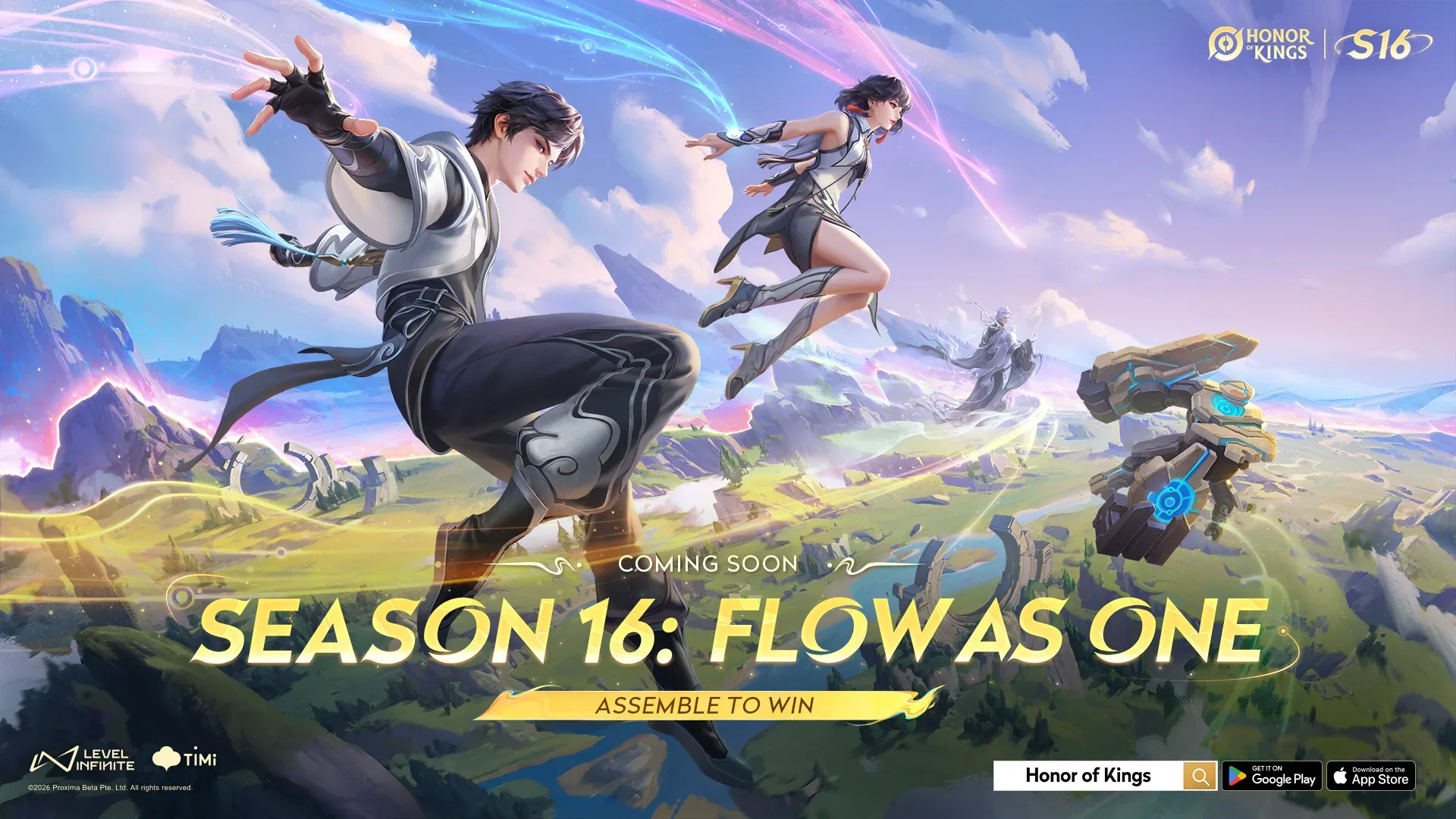
Honor of Kings has rolled out a September 23 version update centered on the Flowborn system, a compact new battle-royale-style mode, and additional ranked-play incentives. The patch makes two more Flowborn classes available at no cost—Assassin and Roamer—while also introducing the three-minute Honor Royale Beta mode and the role-sensitive Flow State summoner skill.
Wang Wei, a new mid-lane hero, is also part of the update’s release slate, though the character arrives later on October 8. Wang Wei will cost 13,888 Gold or 588 Vouchers, and Vouchers receive a 50% discount during the hero’s first week only. The patch additionally establishes Path to Honor prestige rewards for Grandmaster players and a Weekly Hero Challenge intended to add targeted objectives to ranked matches.
The result is an update working on several tempos at once: new class choices for the established game, a short-form elimination mode that compresses a match into three minutes, and progression systems designed to give highly ranked players more milestones beyond ordinary star gains.
All five Flowborn classes are now represented
Flowborn Assassin and Flowborn Roamer are available for free from September 23. Their addition brings all five Flowborn classes together for the first time. While the update does not detail the full kits for those two classes, the broader Flow State system makes role identity especially important, since activating that summoner skill produces a different weapon effect depending on a hero’s primary role.
That is worth separating from a normal hero ability. A summoner skill is an activated match tool rather than a move belonging uniquely to one hero. Flow State has a 100-second cooldown, meaning it is a powerful but infrequent option. On activation, it immediately cuts the remaining cooldown of all skills in half and summons a Flowborn weapon tailored to the hero’s role.
Cooldown reduction is significant because a cooldown is the waiting period before an ability can be used again. Halving that wait can create a sudden window for a team to engage, escape, protect an ally, or follow up after using key moves. Flow State then adds a direct effect on top, rather than being merely a timing tool.
What Flow State does for each role
- Support: Flow Guqin heals the first allied hero and damages the first enemy in range. It then returns to heal the user by the same amount.
- Mage: Flow Artifact deals sustained magic damage and slows its target by 30% for two seconds.
- Tank/Warrior: Flow Shield inflicts physical damage and knocks up nearby enemies for 0.5 seconds.
- Marksman: Flow Crossbow delivers physical damage three times, with its first strike knocking the target back.
- Assassin: Flow Claws dashes to a target, deals true damage equal to 16% of the target’s missing Health, and also deals physical damage to enemies along the route.
Several terms here have particular tactical weight. A slow reduces movement, making a target harder to reposition or flee with. A knock up is forced airborne displacement, briefly interrupting an enemy’s ability to act. The Assassin version’s true damage is also distinct from ordinary physical or magic damage: the update identifies it separately and ties it to a target’s missing Health. Put simply, the less Health the target has remaining, the larger that specified true-damage component becomes.
The weapon effects point toward different uses rather than one universal moment to press the button. A Support can combine allied recovery with enemy pressure; a Mage can impose sustained damage and movement control; and a Tank or Warrior receives a close-range disruption tool. Marksmen gain a multi-hit option with initial pushback, while Assassins receive a dash that appears particularly suited to pursuing weakened opponents. The immediate 50% cooldown reduction remains common across all of them, so Flow State’s value should depend both on a player’s role and on which abilities are currently unavailable.
Honor Royale Beta condenses four teams into a three-minute round
Honor Royale Beta is a 2v2v2v2 battle royale mode. Four two-player teams begin in the map’s four corners, placing a total of eight players in the round. The Safe Zone steadily contracts toward the center, and players outside of it lose Health. That shrinking area is the mode’s central pressure mechanism: teams cannot simply remain in their initial corner indefinitely without taking damage.
Matches last three minutes, a notably short format that should reward quick decisions over prolonged setup. Monsters and chests across the map drop Runes. These Runes instantly upgrade characters, restore Health and Energy, and improve stats, giving the mode a fast in-round power curve. A team must weigh the benefit of collecting them against the risk of revealing its position or arriving late to the safe area.
Health is the resource that determines whether a character stays alive, while Energy is a separate resource used by relevant character actions. Stats are numerical attributes that affect performance. The update does not specify every Rune’s individual values or every stat it can change, but it establishes that Runes deliver immediate upgrades rather than rewards that carry over after the round.
Downed players drop two Runes. They can respawn beside a surviving teammate after 10 seconds, and a team is eliminated only after both teammates have been defeated. This rule creates a major difference between a single player going down and a pair actually being removed from the contest. Keeping one teammate alive is therefore not just a matter of preserving damage output; it is also the condition that allows a downed partner to return.
At the 90-second point, a Boss appears in the center. Defeating it grants a shield and adds a lightning effect to attacks. Since the Safe Zone is already moving teams toward the middle, the Boss creates an additional reason to contest that space exactly halfway through the round. It is not automatically a safe objective: a team pursuing the shield and lightning benefit may have to fight opponents drawn by the same opportunity.
Each Honor Royale Beta round also has its own random events. The update does not specify the event pool, so their precise effects are not yet defined here. Their inclusion nonetheless means that the mode’s three-minute structure will not necessarily unfold in precisely the same way every time.
Practical priorities in the new mode
- Stay aware of the Safe Zone. Its damage makes position a constant concern, not an endgame detail.
- Use Runes as momentum tools. They can restore resources and raise power immediately, but collecting them may expose a team to rivals.
- Do not mistake a downed player for an eliminated team. A surviving teammate can bring that player back after 10 seconds.
- Prepare for the 90-second center contest. The Boss reward offers both a shield and lightning-enhanced attacks, creating a clear mid-round pivot point.
Those priorities follow directly from the rules rather than serving as a promise of a fixed winning formula. Random events, Rune access, positioning, and the presence of three other teams ensure that each match can demand different decisions.
Wang Wei joins the mid lane in October
Wang Wei becomes available October 8 as a mid-lane hero. Players will be able to obtain the hero for 13,888 Gold or 588 Vouchers. During the first week, the Vouchers price receives a 50% reduction; the discount does not apply to the Gold cost.
Gold and Vouchers are presented as the two acquisition routes, while the time-limited offer applies specifically to Vouchers. Players considering the launch-week reduction should note that distinction, rather than assuming the listed Gold requirement will be halved as well. No further ability details for Wang Wei are included in the update information.
For a broader look at how payment and setup ideas continue to surface around game hardware, see this report on a PlayStation controller patent involving card and phone taps. That hardware concept is separate from Honor of Kings’ Gold and Voucher options, but both illustrate why players benefit from distinguishing in-game currencies, discounts, and payment mechanisms.
Ranked systems add prestige milestones and weekly hero assignments
Path to Honor adds a prestige-reward track beginning at the Grandmaster tier, which covers 10 to 50 stars. Players unlock a new prestige reward for every 10 stars earned. The system is aimed at players already operating within that tier range, giving them scheduled reward thresholds instead of leaving their progress defined only by the next rank outcome.
The Weekly Hero Challenge introduces three randomly generated missions each week. To earn its bonus tier points alongside normal ranked rewards, a player must complete those missions in ranked matches using the assigned hero. High-difficulty missions add an extra condition: a victory is required for their rewards.
This is a notable limitation for players evaluating the challenge. Participation alone is not enough for the high-difficulty version. The mission must be played with its designated hero in ranked competition, and the match result must be a win. As a result, the system offers additional tier-point opportunities but also asks players to adapt to a particular hero assignment instead of choosing solely from their preferred roster.
Across the update, Honor of Kings is adding options for different kinds of play without presenting them as the same experience. Flowborn Assassin and Roamer expand the class lineup; Flow State changes the timing and role expression of a summoner-skill slot; Honor Royale Beta focuses on rapid two-player survival; and the ranked additions reward repeated progress and assigned-hero objectives. Players can enter through the free Flowborn classes, test the brief new mode, or pursue the more structured goals in Grandmaster and weekly ranked play.