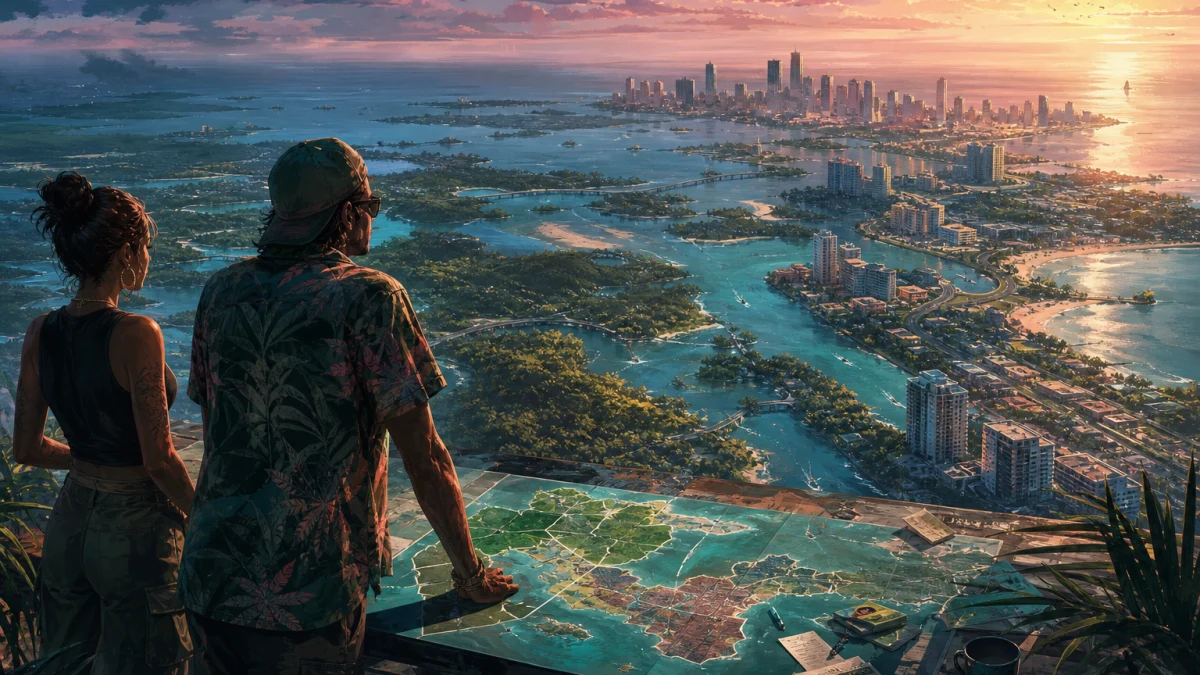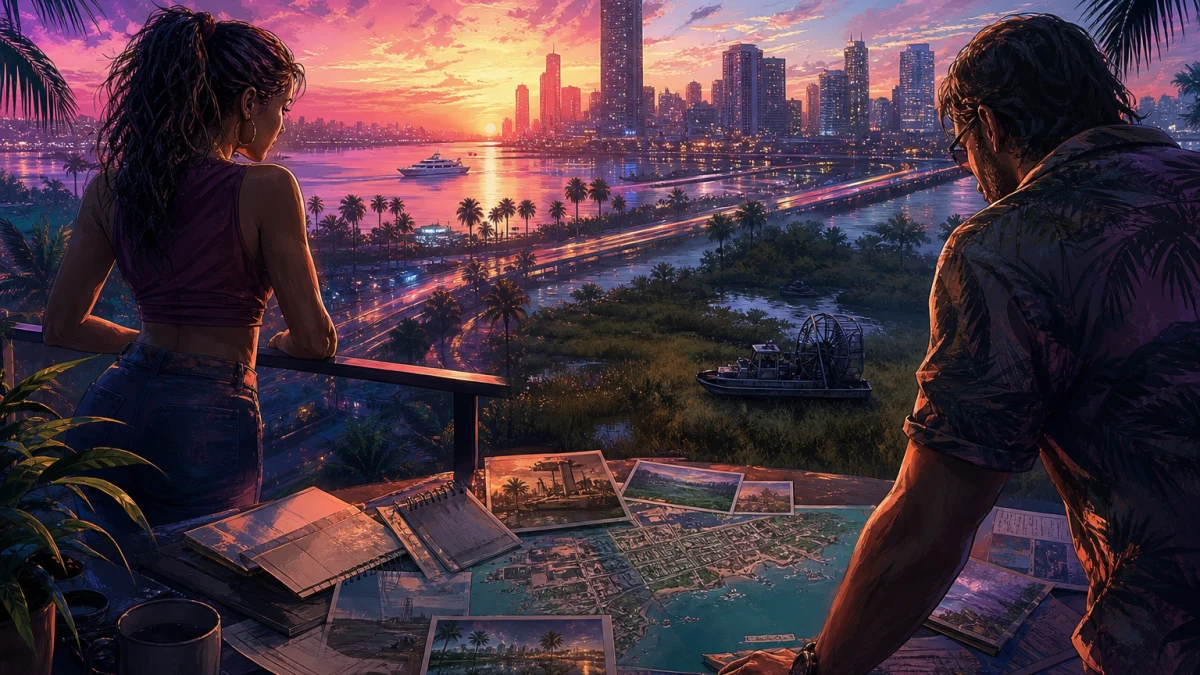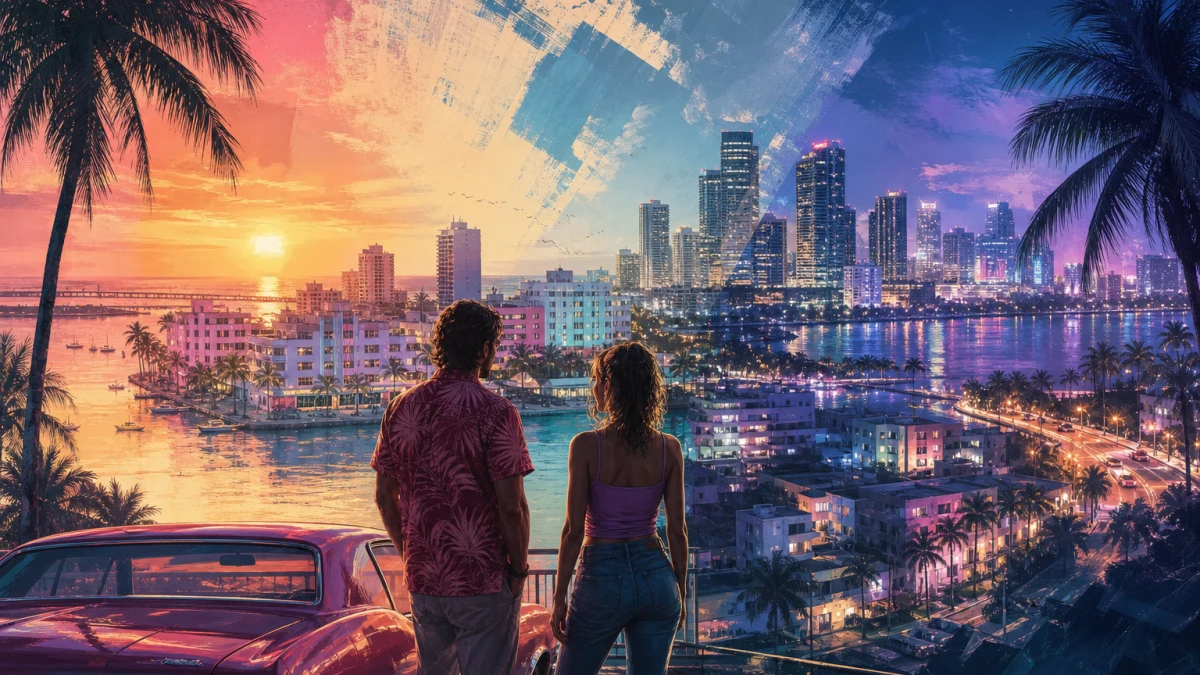
Vice City is coming back, but Grand Theft Auto VI is not being presented as a simple remake of the 2002 game. Rockstar’s official descriptions place the new story in Vice City and across the fictional state of Leonida, expanding the setting beyond the earlier game’s city-focused premise. Rockstar currently lists GTA VI for PlayStation 5 and Xbox Series X|S, with a November 19, 2026 release date.
This is a confirmed-detail comparison based on Rockstar and Take-Two material available on September 18, 2026. Fan maps, alleged leaks, trailer-frame theories, and guesses about returning landmarks are not treated as facts.
The clearest confirmed change is structural. The original Grand Theft Auto: Vice City was built around one man’s rise through an 1980s criminal underworld and his attempt to take control of the city. GTA VI instead follows Jason Duval and Lucia Caminos through a criminal conspiracy that reaches across Leonida. Rockstar has shown Vice City’s neon, beaches, nightlife, music scene, and criminal businesses, while also officially presenting the Leonida Keys, Port Gellhorn, Ambrosia, Grassrivers, and Mount Kalaga as named parts of the wider setting.
However, Rockstar has not confirmed that the new game recreates the original map, restores specific landmarks, or takes place in a precisely identified real-world year. The comparison is therefore less about measuring two maps and more about examining how Rockstar has changed the official framing of Vice City.
Evidence note: This comparison uses official Rockstar and Take-Two material available on September 18, 2026, before GTA VI’s scheduled November 19, 2026 launch. Fan maps, unofficial location lists, trailer-frame interpretations, alleged leaks, and theories about returning landmarks or the exact story year remain unconfirmed and are not treated as facts.
The original Vice City was a city-focused 1980s crime story
Rockstar’s official page for Grand Theft Auto: Vice City describes the game as taking place in the 1980s. Its setting is presented as a broad urban sprawl stretching from beaches to swamps and from glamorous districts to poorer neighborhoods. That description established Vice City as more than a collection of palm trees and nightclubs. It was a sharply divided crime setting built around contrasts within one city.
The original premise centers on one man’s rise through the criminal underworld. Rockstar describes the game as a non-linear, character-driven story in which players can work toward taking over Vice City. The city itself is therefore the main territory at stake. Businesses, criminal alliances, and districts all support the same broad goal: building power inside Vice City.
That structure matters when comparing the older game with GTA VI. The earlier title’s official identity is defined by its time period, its city, and its protagonist’s rise. Its setting description emphasizes different parts of the same metropolitan environment rather than a state containing several separately presented regions.
This does not mean the original game was geographically small or thematically narrow. Its official description already stressed the variety within Vice City, from wealthy areas to poorer neighborhoods and from beaches to swamps. The important distinction is that those contrasts are framed as parts of one city. GTA VI’s official presentation adds a larger geographic frame around Vice City itself.
- Confirmed: Grand Theft Auto: Vice City is set in the 1980s.
- Confirmed: Rockstar describes its setting as extending from beaches to swamps and from glamorous areas to poorer districts.
- Confirmed: its story centers on one man’s rise through the criminal underworld and an effort to take over the city.
- Not confirmed: that GTA VI directly reproduces the original game’s districts or map layout.
GTA VI makes Vice City part of Leonida
Rockstar’s current GTA VI website labels the setting “Vice City, USA,” but its surrounding description makes clear that the city is only one part of the game’s world. The official premise says Jason and Lucia become caught in a criminal conspiracy stretching across the state of Leonida. Rockstar and Take-Two also describe Leonida as the home of Vice City and areas beyond it.
Trailer 1 and Trailer 2 reinforce that wider framing. Rockstar’s Trailer 2 description places Jason and Lucia on “the darkest side of the sunniest place in America” and says their situation extends across Leonida. The wording does not describe Vice City as an isolated city campaign. Instead, it positions the city inside a broader state-level crime story.
This is more than a change in promotional wording. Rockstar’s official “Only in Leonida” material presents different destinations and character groups under separate location headings, including Vice City, the Leonida Keys, Grassrivers, Port Gellhorn, Ambrosia, and Mount Kalaga. The company’s media hub also divides its official material into trailers, screenshots, artwork, and other downloads while describing the collection as a way to explore Vice City and beyond.
The available evidence supports describing GTA VI as a return to Vice City within a broader state setting, rather than as a direct recreation of the earlier city. It does not, by itself, establish exact boundaries, travel times, map proportions, or the complete relationship between the named regions.
- Confirmed: GTA VI is set in the fictional state of Leonida.
- Confirmed: Vice City is part of Leonida.
- Confirmed: Rockstar’s official premise extends the criminal story across Leonida.
- Officially presented: the Leonida Keys, Grassrivers, Port Gellhorn, Ambrosia, and Mount Kalaga as named destinations or regional identities.
- Not confirmed: that GTA VI reproduces the 2002 map or its district boundaries.
Jason and Lucia replace the earlier single-rise structure
GTA VI’s central relationship is between Jason Duval and Lucia Caminos. Rockstar says the pair are forced to rely on each other after an easy score goes wrong. That creates a different narrative foundation from the original Vice City, whose official description focuses on one man’s climb through the criminal underworld.
Jason’s official profile connects him to the Leonida Keys. Rockstar describes him as someone who grew up around grifters and criminals, spent time in the Army, and later worked for local drug runners in the Keys. His background therefore links one of the protagonists to a coastal criminal environment outside Vice City before the full scope of the story is considered.
Lucia’s story has a different starting point. Rockstar describes her as recently released from the Leonida Penitentiary after fighting for her family. Her profile also connects her family history to Liberty City, giving her personal motivations that reach beyond the immediate Vice City setting.
The comparison should not be pushed too far. Rockstar has not said that GTA VI abandons the possibility of taking over businesses or building power in Vice City. Nor has it explained every way Jason and Lucia’s relationship will affect the story. The confirmed difference is the framing: the official story begins with two protagonists and a conspiracy crossing Leonida, not with a single protagonist’s stated campaign to control one city.
That shift also changes the way Vice City functions narratively. In the original game, the city is the central ladder that the protagonist climbs. In GTA VI, Rockstar’s material presents Vice City as one major part of a network that includes the protagonists’ pasts, criminal contacts, and destinations beyond the urban core.
- Confirmed: Jason Duval and Lucia Caminos are GTA VI’s central characters.
- Confirmed: Jason’s official profile connects him to drug runners in the Keys.
- Confirmed: Lucia’s profile includes her release from Leonida Penitentiary and family connections to Liberty City.
- Inference: the two-character structure gives GTA VI a broader narrative frame than the original game’s single-protagonist description.
- Not confirmed: the full gameplay or mission structure built around Jason and Lucia.
Vice City still keeps its original identity
The expansion does not mean Rockstar has discarded the identity associated with Vice City. Official GTA VI material continues to emphasize neon, beaches, music, nightlife, criminal enterprises, and the city’s entertainment culture. These are not merely fan comparisons; they are recurring parts of Rockstar’s own presentation of the new setting.
The city’s entertainment and criminal worlds are also represented through the new cast. Rockstar describes Boobie Ike as a local Vice City legend who has turned his time in the streets into an empire involving real estate, a strip club, and a recording studio. His profile makes the relationship between legitimate businesses, music, nightlife, and criminal money part of the official setting description.
Dre’Quan Priest is similarly placed within the Vice City music scene. Rockstar says he works with the Real Dimez and has ties to Boobie’s strip club while pursuing a future in the music business. That gives Vice City a new cast of figures whose ambitions connect entertainment, social visibility, and crime.
This is a recognizable continuation of the earlier Vice City formula, even though the story and setting have changed. The original game used its 1980s atmosphere, music culture, beaches, and criminal organizations to define the city. GTA VI carries those broad identity markers forward without officially describing itself as a period remake.
Rockstar’s Vintage Vice City Pack is another direct promotional callback to the earlier neon-era identity. The official GTA VI site describes it as a pre-order benefit that flashes back to when the neon burned brightest, and Rockstar’s media page lists separate Vintage Vice City content. That confirms the promotional connection between the two settings. It does not confirm that GTA VI reproduces the original game’s map, landmarks, missions, or exact decade.
- Officially shown: GTA VI’s Vice City retains neon, beaches, nightlife, music, and criminal-business imagery.
- Confirmed: Boobie Ike is described as a Vice City legend.
- Confirmed: Dre’Quan Priest is connected to the Vice City music scene, the Real Dimez, and Boobie’s strip club.
- Confirmed: Rockstar is using the Vintage Vice City identity as a promotional callback.
- Not confirmed: that the callback represents a one-to-one remake of the 2002 setting.
The Keys and other named Leonida regions widen the setting
The most concrete evidence of GTA VI’s broader scope comes from Rockstar’s named locations. The official “Only in Leonida” page presents Vice City, the Leonida Keys, Grassrivers, Port Gellhorn, Ambrosia, and Mount Kalaga as separate destinations or regional identities. Rockstar’s media hub also describes its official collection as covering Vice City and beyond.
The Leonida Keys receive additional context in Rockstar’s character material. Jason is described as working for drug runners there, while Brian Heder is described as a veteran drug runner operating through a boat yard in the Keys. This gives the Keys a confirmed role in the criminal background of the story, rather than leaving the name as a purely decorative label.
The other regional names are confirmed by Rockstar’s official site, but their full roles should not be overstated. Rockstar has not provided a complete geographic explanation for how far each area extends, how the regions connect, or which activities will be available in them. A named location is evidence that Rockstar recognizes it as part of Leonida’s official identity; it is not automatically a promise about its size, accessibility, or gameplay systems.
This is where GTA VI most clearly differs from the original game at the level of official presentation. The 2002 title described a single city with varied districts and surrounding environments. GTA VI’s official materials identify a state containing Vice City and several other regional identities. That does not prove that every named destination will receive equal story attention, but it does establish a broader setting vocabulary than Rockstar used for the earlier game’s official description.
The distinction is especially important because unofficial maps often turn names and visual clues into detailed geography. Rockstar’s current material does not confirm a complete map, a precise coastline, a specific route between destinations, or a definitive list of explorable areas. Those details should remain outside a confirmed comparison until Rockstar provides them.
- Officially presented: Vice City, the Leonida Keys, Grassrivers, Port Gellhorn, Ambrosia, and Mount Kalaga.
- Confirmed: the Keys are connected to Jason’s background and Brian Heder’s boat-yard operation.
- Not confirmed: the size, boundaries, travel relationships, or gameplay role of each named region.
- Not confirmed: that every destination shown or named will receive the same level of story focus.
What the trailers and screenshots actually establish
Rockstar’s official media page lists three GTA VI video materials: Trailer 1, Trailer 2, and Grand Theft Auto VI: An Extended Look. The Trailer 2 page identifies the extended video as 26 minutes and 48 seconds and dates Trailer 2 to May 6, 2025. Rockstar’s current page also lists the extended look as an August 27, 2026 release.
Together with the official screenshots, artwork, and character pages, these materials provide the current visual foundation for discussing Vice City and Leonida. They show a modern presentation of the setting, with Vice City’s beaches, neon-lit nightlife, roads, businesses, and coastal environments appearing alongside scenes connected to the wider Leonida premise. The official media page separately lists Vice City screenshots, character material, artwork, and the Vintage Vice City Pack.
Visual evidence has limits. A location appearing in a trailer is not necessarily a confirmed named district, and an environmental detail is not automatically a promised gameplay system. A building that resembles an earlier landmark is not confirmation that the same landmark returns. The safest description is what Rockstar has shown or named, without converting visual resemblance into a map claim.
The same caution applies to the game’s time period. Rockstar’s official pages used for this comparison identify the original game as an 1980s title, but the GTA VI pages retrieved here do not provide an exact calendar year for the new story. The presentation supports calling it a contemporary or modern version of Vice City, but clothing, vehicles, phones, social-media-style imagery, and visual tone do not establish a precise year on their own.
That uncertainty is not a weakness in the comparison. It simply defines the boundary between official evidence and interpretation. Rockstar has shown enough to establish a modern return to Vice City and a wider Leonida setting. It has not shown enough to support a precise calendar-year claim or a complete account of every district.
- Confirmed: Rockstar has released Trailer 1, Trailer 2, and an extended look.
- Confirmed: the extended look is listed as 26 minutes and 48 seconds.
- Confirmed: the official website includes Vice City screenshots and separate character and location material.
- Shown: the new game presents Vice City and Leonida through modern visual and cultural details.
- Not confirmed: an exact story year, every trailer location’s name, or any one-to-one returning landmark.
What has not been confirmed about the return
Rockstar has confirmed a return to Vice City, but it has not called GTA VI a remake of Grand Theft Auto: Vice City. There is no official confirmation that the new game reproduces the earlier map, restores its districts in their original positions, or revisits its missions and landmarks in the same form.
The official location pages also do not establish map-size comparisons. It would be unsupported to say that GTA VI’s Vice City is larger or smaller than the 2002 city, or that Leonida has a specific number of regions or a particular travel layout. Rockstar’s named locations provide a confirmed vocabulary for the setting, not a complete map specification.
The exact calendar year remains unconfirmed in the official material used here. The original game is explicitly identified with the 1980s, while GTA VI is presented with contemporary-looking imagery and current-feeling social satire. That supports a broad contrast between the two presentations, but it does not justify assigning GTA VI to the 2020s or another exact decade.
Likewise, fan-made maps, unofficial location lists, trailer-frame interpretations, datamines, patents, retailer placeholders, and anonymous claims cannot fill those gaps. They may generate theories about returning buildings or hidden regions, but they are not confirmation from Rockstar.
The same rule applies to gameplay. A trailer may show a vehicle, building, crowd, weapon, business, or environmental interaction, but that does not establish a full gameplay system unless Rockstar has described it as one. This comparison therefore avoids claiming that named places guarantee particular activities, missions, interiors, or progression mechanics.
- Not confirmed: GTA VI is a remake or direct map recreation of Grand Theft Auto: Vice City.
- Not confirmed: a comparison of the two games’ map sizes.
- Not confirmed: the exact year or decade of GTA VI’s story.
- Not confirmed: specific returning landmarks, districts, missions, or boundaries unless Rockstar names or clearly identifies them.
- Not confirmed: gameplay systems inferred only from trailer footage or screenshots.
The clearest comparison: one city versus a state-wide crime story
The most defensible comparison is structural. The original Grand Theft Auto: Vice City is officially framed around an 1980s city, a single protagonist, and a criminal rise aimed at controlling Vice City. GTA VI retains the city’s recognizable cultural identity but places it inside Leonida, a wider state with multiple officially presented locations and a criminal conspiracy that crosses beyond the city.
That does not make the new game unrelated to its predecessor. Vice City remains the title’s central recognizable setting, and Rockstar continues to associate it with neon, beaches, music, nightlife, entertainment, and criminal enterprise. The new characters also give the city a fresh set of social and criminal connections through Boobie Ike, Dre’Quan Priest, the Real Dimez, and the businesses described on Rockstar’s official character page.
The difference is that GTA VI’s Vice City is being used as part of a larger network rather than as the entire official setting. Jason’s Keys background, Lucia’s history, Brian Heder’s boat-yard operation, and the named Leonida regions all support that conclusion. Rockstar has shown a return to Vice City’s identity while expanding the story’s geographic frame.
Until Rockstar provides more detail, that is where the confirmed comparison should stop. GTA VI may contain more landmarks, systems, districts, or connections than the current official material reveals, but unreleased or unnamed content cannot be treated as established fact.
- Confirmed: both games use Vice City as a major criminal setting.
- Confirmed: the original game is explicitly associated with the 1980s, while GTA VI’s official material does not provide an exact year.
- Inference: GTA VI expands the official setting from a city-focused story to a broader Leonida crime narrative.
- Not confirmed: any specific one-to-one recreation of the 2002 game’s map or story.
GTA VI’s Vice City is familiar in identity but broader in official scope. Rockstar has retained the neon, beaches, music, nightlife, and criminal energy associated with the series’ earlier Vice City while introducing Jason and Lucia and placing their story across Leonida.
The confirmed change is not a precise map comparison. It is the way Rockstar frames the setting: the original game treated Vice City as the main territory to control, while GTA VI presents Vice City as part of a state containing the Leonida Keys, Port Gellhorn, Ambrosia, Grassrivers, Mount Kalaga, and other officially presented destinations.
That gives players a clear reason to expect a new kind of Vice City return without requiring unsupported claims about size, landmarks, or the exact modern year. Rockstar has shown a wider Leonida crime story and a contemporary presentation of the city, but the unreleased game’s unshown details remain outside the confirmed record. As of September 18, 2026, GTA VI is scheduled to launch on November 19, 2026, and further official material could still refine what Rockstar has shown about Vice City before release.