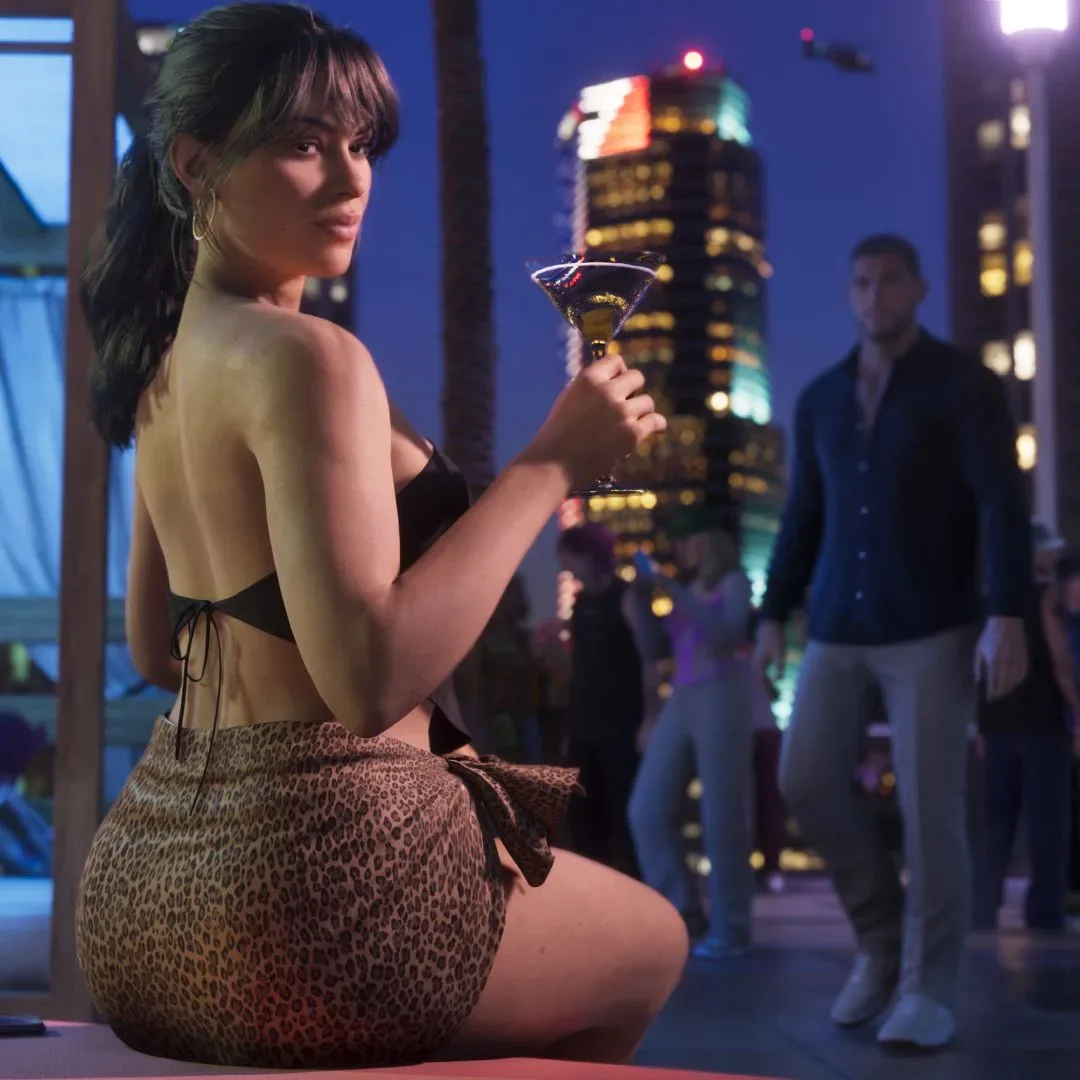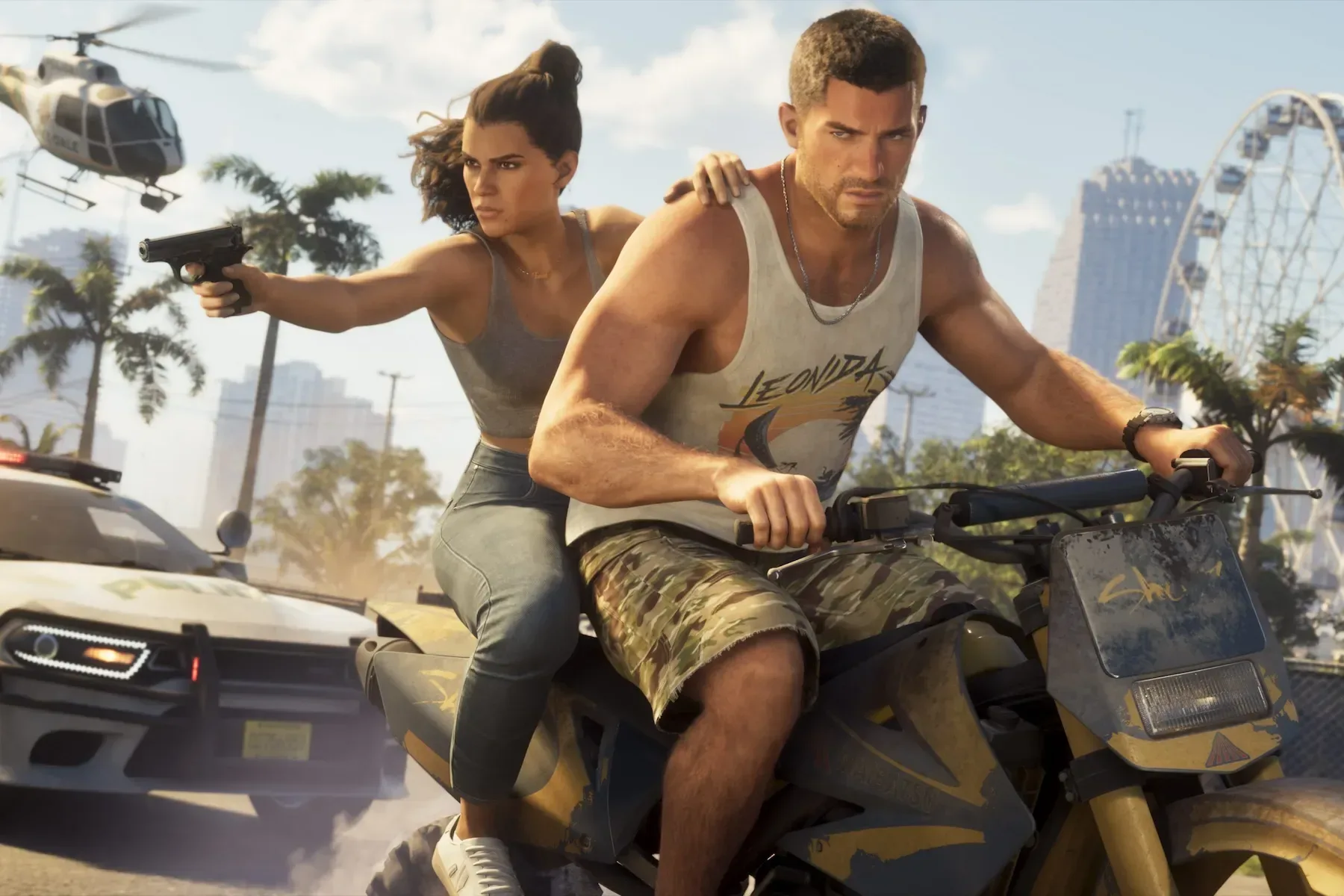
A veteran character artist’s reaction to Grand Theft Auto VI neatly captures why its visual ambition has become such a major talking point: the game appears to be pursuing combinations of crowd density, character specificity and hair simulation that developers are often taught to scale back.
Del Walker, now a lead character artist at Absurd Ventures and previously part of teams at Naughty Dog and Respawn Entertainment, described GTA 6 as a technical leap that initially seemed beyond what current game production could deliver. His background includes work on The Last of Us Part 2 Remastered and Star Wars Jedi: Survivor, making the response especially notable as a view from someone familiar with the compromises behind high-end character work.
“Everything they’re doing is what we have been told never to do in every game I’ve been on.”
Walker’s larger point is not simply that GTA 6 has good-looking models. It is that the game seems to put expensive visual detail into parts of an open-world scene that are traditionally constrained: background pedestrians, their hair, and the degree to which non-player characters feel made as individuals rather than assembled from reusable components.
The usual bargain behind believable crowds
Open-world games constantly balance competing technical demands. A city scene may need to draw buildings, vehicles, traffic, lighting, effects, animation, physics, audio and scores of characters at once. Every additional visual feature carries a cost in processing time, memory, artist labor or all three.
This is why NPCs—short for non-player characters, the people controlled by the game rather than a player—are commonly built through modular production. In this approach, a studio creates sets of interchangeable heads, faces, hairstyles, clothing pieces and other assets. Those pieces can be combined to populate a world quickly and provide variation without requiring every person on a street to receive the same intensive authoring as a story lead.
Modularity is not automatically a flaw. It is a practical production technique, particularly when a game needs a large population. But its limits can be visible: repeated silhouettes, familiar facial features, similar outfits, or crowds that read as a collection of variations on a smaller set of underlying parts.
Walker’s comments suggest Rockstar has pushed beyond that conventional bargain. He highlighted realistic hair that moves strand by strand alongside a larger number of visible characters, and described NPCs as individually art directed with their own personality traits. That combination is what made the work striking to him.
Related coverage includes GTA 6’s crowds stunned a veteran Last of Us artist.
What strand-by-strand hair means
Hair is one of the most demanding visual elements in character rendering. It is made of a very large number of fine strands, and convincing motion has to suggest weight, clumping, gravity and movement without turning each head of hair into a disproportionate drain on performance. Games therefore often simplify it, especially for characters the player may only see briefly or at a distance.
Walker’s emphasis on moving individual strands does not establish every underlying method used by GTA 6, nor does it reveal a specific system or engine technique. It does, however, identify the visual effect he found extraordinary: richly simulated-looking hair appearing across a busy population rather than being reserved for a small cast.
That distinction matters. A meticulously made hero character can concentrate an exceptional amount of detail into one person. Maintaining a similarly convincing impression across an active crowd is a different kind of challenge, because the scene has to remain coherent while the player moves, changes camera angles and adds the rest of the open world’s activity to the screen.
Why the 30fps target is part of the conversation
GTA 6 targets 30 frames per second on PlayStation 5 and Xbox Series X|S. Frame rate, or fps, measures how many complete images a game displays each second. A 60fps target allows more updates per second than 30fps, but it also provides less time for the hardware to finish rendering each frame.
Put simply, a 30fps target can give developers a larger rendering budget per frame than a 60fps target. That does not make a 30fps target effortless, and it does not mean one setting alone explains every visual result. It is, however, a meaningful production choice when a game is attempting dense scenes with complex characters and a large world. The available time can be spent on features such as more detailed geometry, lighting, animation, crowds or hair.
Walker’s reaction frames GTA 6 as notable precisely because games frequently make the opposite choices to preserve scope and pursue 60fps. Studios may show fewer highly detailed figures in a scene, make pedestrians more modular, reduce simulation detail, or use other forms of simplification. The key claim here is not that those choices are failures; they are the standard ways teams fit an ambitious game into real hardware and development limits.
GTA 6’s apparent willingness to lean into a 30fps presentation, while still elevating the density and specificity of its people, is the trade-off that has drawn attention from fellow developers.
Art direction is more than polygon count
Technical detail alone does not necessarily make a crowd memorable. Walker also pointed to individual art direction and personality traits. That observation is important because it moves the discussion beyond raw rendering power.
Art direction is the deliberate visual decision-making that gives a game and its characters a unified identity: how people dress, move, carry themselves, occupy spaces and communicate who they are at a glance. In a city game, that can be the difference between a street full of technically competent models and a street that feels populated by distinct inhabitants.
Personality traits, meanwhile, suggest that the game’s NPCs are intended to project different identities rather than only fill physical space. The available information does not specify how those traits work mechanically, how many NPCs receive this treatment, or whether they affect gameplay. Still, the reported creative emphasis helps explain why Walker’s praise is focused on the crowd as a whole, not merely on close-up showcase characters.
For players, the practical implication is potentially stronger immersion. In an open-world setting, pedestrians are often the texture of the world: they make sidewalks feel busy, establish a local atmosphere and provide the visual context around cars, shops and missions. Greater individuality can make routine movement through the world feel less like passing through a repeated asset library.
It also raises expectations. Players accustomed to inspecting the details of major Rockstar releases may now pay particular attention to how people look and behave at street level. Visual realism will be judged not only in carefully composed scenes, but in ordinary moments where crowded systems have to hold together.
A skyscraper viewed from another era
Walker summarized his surprise with an intentionally oversized analogy: “It’s like looking at a skyscraper, but I’m from the 1800s. I didn’t know this was possible.” The comparison speaks to the gap between accepted production constraints and what he believes GTA 6 has achieved.
He was not the only developer making a grand comparison. A designer associated with The Last of Us Part 2 likened GTA 6 to the Great Pyramids of game development, joking that people could spend centuries wondering how it was made before concluding that aliens were responsible. The humor is hyperbole, but it points to a serious industry reality: games of this scale are built through immense coordination, long-term planning and difficult trade-offs that players rarely see.
Rockstar has not confirmed a specific overall budget for GTA 6 and has said it is not $1.5 billion. Its development cycle has been lengthy, but the supplied information does not establish an exact duration, budget, staffing figure or a technical breakdown of how the reported visual effects are achieved. It is worth keeping those unknowns clear. Admiration from experienced artists is meaningful, but it is not a substitute for a full account of the game’s technology or production.
What is clear from Walker’s remarks is that GTA 6 has prompted a reaction rooted in craft knowledge. His closing assessment was characteristically blunt: “I don’t know shit about fuck. Rockstar do, clearly.” For anyone following the game’s wider world-building, there is also a closer look at the performers behind GTA VI’s Real Dimez.
GTA 6’s crowds may become one of its clearest tests of next-generation open-world design. Not because any one visual flourish proves a technical revolution, but because the game is being praised for trying to make a densely populated city feel lavishly observed at the same time. If that impression consistently survives normal play rather than only selected scenes, it will be a significant statement about where big-budget character art can go on current consoles.