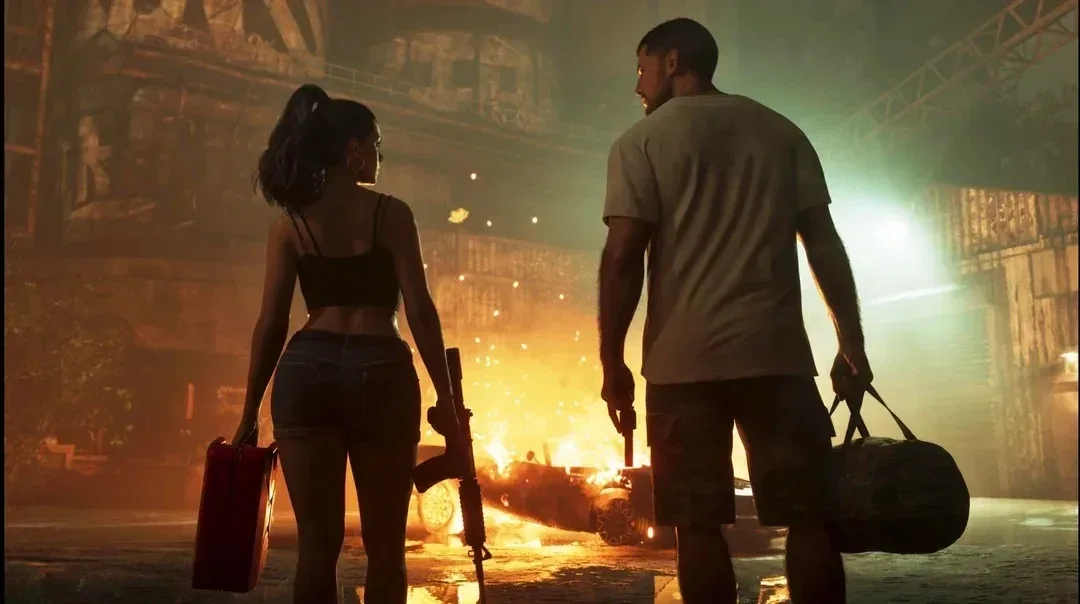

Grand Theft Auto 6 has earned a particularly vivid vote of confidence from a fellow game developer. Barclay, a world design director at Naughty Dog working on Intergalactic: The Heretic Prophet, described the scale of Rockstar’s accomplishment with an intentionally enormous comparison: after 19 years of making games, GTA 6 looked to him like a Bugatti Veyron would look to “a nervous Victorian child.”
The joke is deliberately extravagant, but Barclay’s more detailed comments identify a specific area behind the astonishment: environmental lighting. In a separate post, he praised Rockstar’s use of lighting that is “mostly dynamic,” and singled out the game’s overcast weather for a matte, realistic appearance compelling enough that he found himself simply looking at its streets.
“I’ve made video games for 19 years and GTA VI appears to me as a Bugatti Veyron would to a nervous Victorian child.”
Why lighting can make an open world feel extraordinary
Lighting is one of the quietest but most consequential ingredients in a believable game world. It determines how an environment reads at a glance: whether a road looks wet, whether buildings feel distant in haze, how a cloudy sky softens a scene, and whether the player understands the time, atmosphere and depth of a location without needing explicit prompts.
Barclay’s observation is especially meaningful because GTA 6 is an open-world sandbox. A sandbox is a game structure built around a large space where players can travel, experiment and approach activities in different orders. That broad freedom means the visual presentation has to work across changing places, camera angles, weather conditions and player behavior rather than only within a tightly controlled sequence.
In that context, a convincing cloudy day is not a small decorative achievement. Overcast conditions remove the dramatic, obvious contrast of direct sunlight. The scene has to retain shape, material detail and a natural sense of distance under flatter, softer illumination. When it works, players may not stop to identify the technical reason; they simply accept the street, sky and buildings as a coherent place.
That apparently effortless result is what Barclay is reacting to. His comments do not disclose Rockstar’s production methods or a complete breakdown of GTA 6’s technology. They do, however, point to the visual outcome: lighting that remains striking even under weather conditions that can expose artificial-looking environments.
Dynamic lighting versus baked lighting, explained
Barclay contrasted GTA 6’s environmental lighting with baked lighting. In game-development terms, baked lighting broadly refers to lighting information prepared in advance and stored for use in the finished game. It can deliver carefully authored results, but it is fundamentally based on conditions established beforehand.
Related coverage includes Naughty Dog World Design Director Calls GTA 6 'Alien Technology' After Studying Its Lighting.
Dynamic lighting, by contrast, changes as the game is running. It is relevant to worlds with varying weather, time of day, moving objects and shifting viewpoints because the illumination can respond to changing conditions. The practical appeal is easy to understand: if a world aims to feel alive across changing circumstances, its light needs to keep pace with those circumstances.
Neither term is automatically a verdict on quality. The distinction matters here because Barclay believes GTA 6’s largely dynamic environmental lighting looks at least as good as many games’ baked work. That is the heart of his praise: Rockstar appears to be achieving a highly polished visual result while retaining the flexibility associated with changing in-game conditions.
The phrase “mostly dynamic” is also worth retaining. It is a measured description rather than a claim that every aspect of GTA 6 illumination is handled in precisely the same way. It leaves room for the complexity that large games typically require while focusing on what is visible to players: convincing scenes across their environment and weather states.
Overcast skies are a telling showcase
Barclay specifically highlighted what he called a matte-style look during cloudy weather. The wording captures why this can be such an effective visual test. Bright sunlight can create immediate spectacle through glare, long shadows and high contrast. A cloud-covered day requires a more restrained presentation. Light is spread more evenly, surfaces need to remain legible without looking unnaturally polished, and the whole scene must still feel grounded.
For an open-world game, that restraint can add a great deal to the sense of place. Weather is not merely a switch between attractive postcard conditions; it influences the mood of ordinary travel through streets and public spaces. If cloudy lighting is persuasive, it can make a world feel more consistent during the less theatrical moments when players are simply moving between missions or observing the city.
That is why Barclay’s comment about sitting and looking at the street lands as more than a compliment about visual detail. It suggests a world that holds attention even when the player is not chasing a spectacle, a mission objective or a scripted set piece.
Recognition from a world-design specialist
Barclay’s career gives his reaction particular context. Before joining Naughty Dog in 2016, he worked at Free Radical Design, Cohort Studios, Crytek and Cloud Imperium Games. His past credits include Star Wars: Battlefront 3 at Free Radical Design and The Shoot at Cohort Studios. He has also written in detail about the making of The Last of Us Part 2, alongside other games and design ideas.
That background does not turn a personal reaction into an objective technical audit, and it should not be treated as one. But it does clarify why the remarks carry weight among people interested in how games are constructed. A world-design director works in a discipline closely tied to the player’s movement through spaces, the readability of environments and the overall feeling that an interactive location is worth exploring.
From that perspective, the praise is not limited to raw graphical sharpness. It is about the relationship between technical systems and the experience of inhabiting a place. GTA 6’s lighting is being celebrated because it appears to serve the world itself rather than merely supplying a flashy screenshot.
Tim Soret, head of The Last Night developer Odd Tales, echoed the reaction in brief but emphatic terms, agreeing with Barclay and calling the technology hard to comprehend. The exchange reflects a wider professional fascination with how GTA 6 achieves its presentation, particularly when the game is seen from the standpoint of people who build digital environments themselves.
What players can take from the discussion
For players, the practical lesson is not that they must inspect every cloud layer like a rendering engineer. Instead, the comments offer a useful way to notice the craft that shapes an open world. During free exploration, pay attention to the difference between direct sun and cloud cover, the way buildings sit against the sky, and whether streets still feel dimensional as the atmosphere changes.
Those details can be especially easy to miss while pursuing objectives. Players focused on missions, driving or combat may register lighting only subconsciously. Slowing down can reveal why the environmental work has prompted such strong reactions: mood and realism often emerge from the accumulation of subtle details rather than one obvious visual effect.
Anyone exploring GTA 6’s activities and map systems can also find practical help in this guide to revealing Vice City’s map fog with Southpoint’s Duster plane. It is a reminder that the game’s visual world and its navigable world are connected: seeing more of the city creates more opportunities to appreciate how its environments change from place to place.
A compliment aimed at the invisible work
The Bugatti Veyron line is the memorable headline, especially given Bugatti’s claim that the Veyron 16.4 can reach 100 km/h in 2.5 seconds. Yet Barclay’s accompanying observations are more revealing than the hyperbole. They direct attention to the systems that can be difficult to summarize in a trailer: environmental response, weather presentation and the visual cohesion of an enormous navigable space.
GTA 6 has already inspired sweeping claims about its fidelity and stature. The specific developer discussion is more useful because it narrows the focus. It is not simply that the game looks expensive or detailed. The praise centers on lighting that makes ordinary overcast streets worth stopping to study—and on a dynamic approach that, in Barclay’s view, meets or exceeds the look of many precomputed alternatives.
That is a high bar for any open-world production. If players share that response while exploring the game, GTA 6’s most impressive achievement may not always be its loudest one. It may be the ability to make a cloudy day, a street corner and a few minutes without an objective feel unexpectedly convincing.