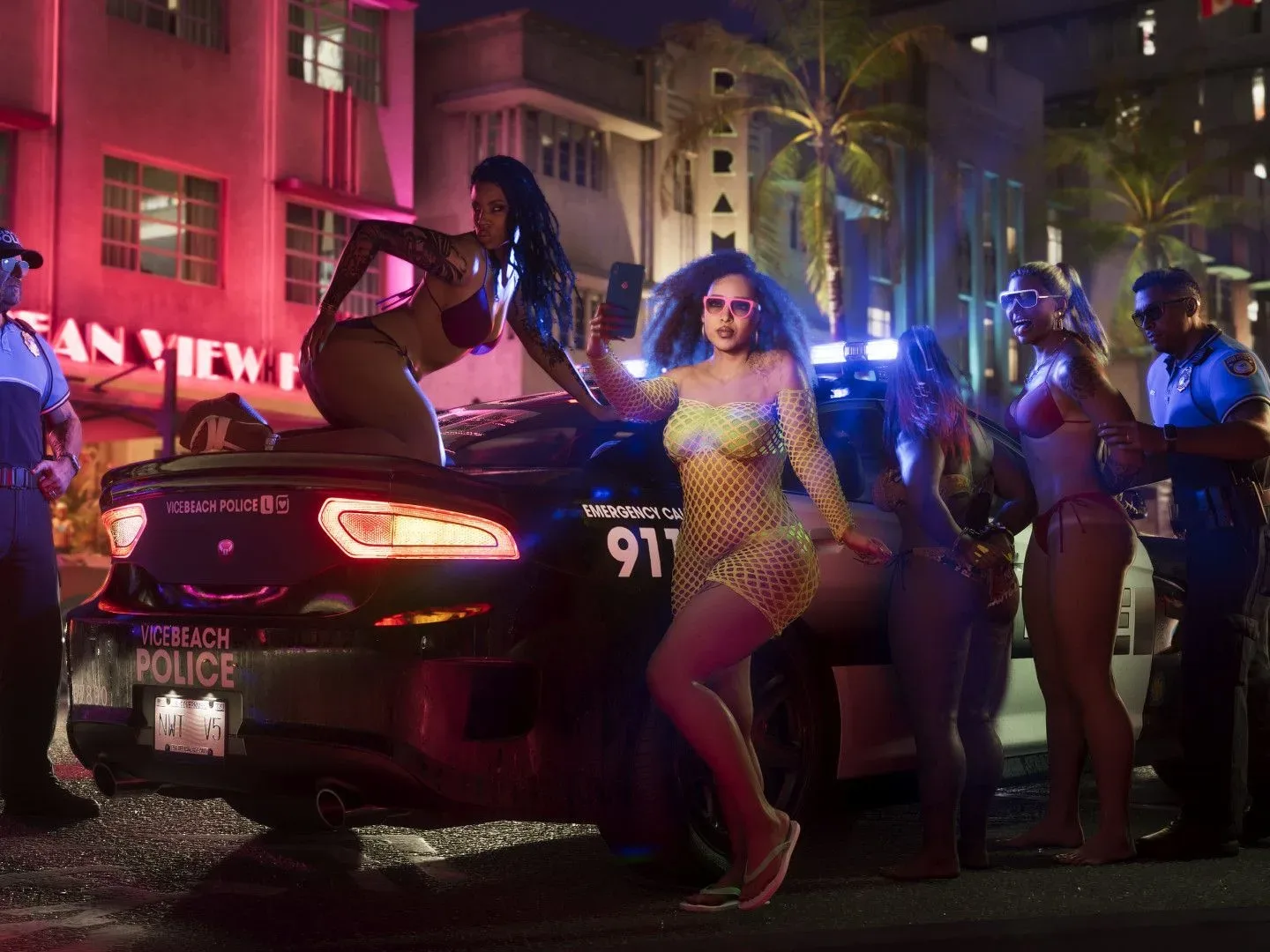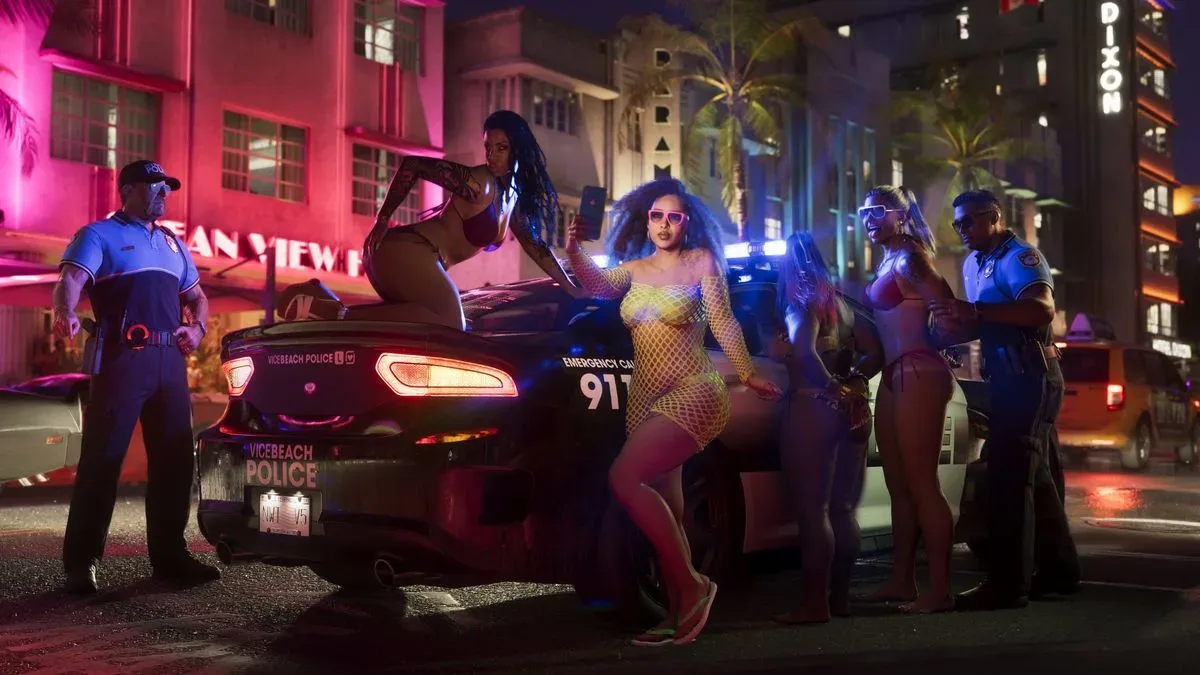
Grand Theft Auto VI has apparently found one of its sharpest comic weapons in an extremely ordinary modern habit: looking at a phone for no good reason, then continuing to look at it anyway. Its in-game social-media parody, Snapmatic, is filled with deliberately ridiculous posts, while other fictional services echo messaging, photo-sharing and music-identification apps. Even the act of turning in for the night has been reframed: Jason reaches for his phone and begins scrolling rather than simply going to sleep.
That small behavior is important. It makes the phone feel less like a menu bolted onto an open-world game and more like part of the world the game is lampooning. Grand Theft Auto has long aimed its jokes at contemporary culture, but the social internet has changed significantly since 2013’s GTA V. In GTA VI, the joke is not merely that people use apps. It is that the feed is an endless, context-free collision of absurd images, impulsive captions and attention-seeking non sequiturs—the recognizable texture of modern doomscrolling.
The approach also turns Rockstar’s own history into material for the feed. Snapmatic posts reportedly make jokes about the wait for the game through the fictional Race’n’Chase 7, a sly choice of name with roots in the series’ past.
Snapmatic’s comedy is built around the feed, not the punchline alone
A shitpost is a deliberately low-context, nonsensical, crude or casually made-up piece of online humor. It often works by pairing a familiar image with a caption that is wildly disproportionate, oddly specific or simply wrong. The individual joke may be silly, but a convincing feed needs more than isolated gags: it needs the sensation that each post has been dropped into view by an algorithm with no concern for coherence.
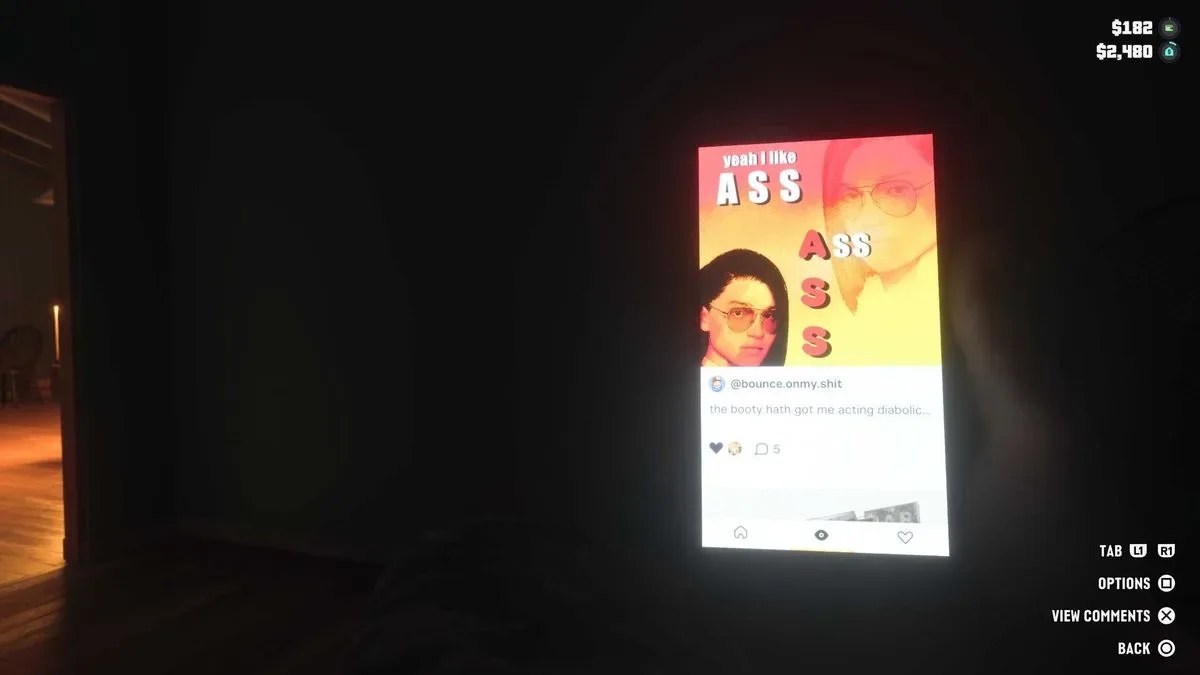
Snapmatic leans into that language. The examples circulating from the game include a superhero-like figure restraining a villain beside a deliberately vulgar complaint, a glamorous pose paired with a joke about an airplane emergency-door latch, and an image of a speedometer at its limit captioned as a selfish dash to a casino after a call about a spouse going into labor. None requires elaborate setup. Their humor comes from abrupt escalation, deliberately bad priorities and the whiplash between image and text.
That is a useful distinction between a game parodying social media and a game merely placing social-media-shaped icons on a phone screen. The satire appears to be observing the grammar of posts: how captions perform a personality, how the feed rewards nonsense, and how an image can become a joke only once it has been attached to an unrelated thought. Players sharing screenshots outside the game further extends the gag. A fictional platform designed to imitate a real sharing culture ends up producing images that are then circulated through that culture.
There is an irony in that loop. The feed is a parody of internet behavior, but its success depends on the posts being legible enough to leave the game. In that sense, the fictional app is doing two jobs at once. It gives the setting ambient jokes for players who stop to browse, and it generates compact visual comedy that can travel well beyond a mission or a cutscene.
More than one app helps sell the setting
GTA VI’s fictional phone ecosystem reportedly includes stand-ins for WhatsApp and Instagram alongside WAInk, a service likened to Shazam but for cars. Shazam is commonly understood as a tool that identifies music; the WAInk comparison communicates the central idea without suggesting that the two services do the same thing. In the game’s version, the concept is vehicle recognition.
Related coverage includes GTA 6's Fake Instagram Feed Turns Doomscrolling Into a Sharpest Satire Yet.
These app parodies matter because they identify a particular era of daily life. A city can be made from roads, shops, traffic and pedestrians, but a contemporary city is also experienced through notifications, chats, feeds and the instinct to document something before reacting to it. Building those habits into GTA VI’s fiction gives its world another route for commentary.
It is also a more flexible form of world-building than a single scripted joke. An environmental gag can be found and left behind. A feed implies volume and recurrence: another post is always ready to appear, and another strange public opinion is always waiting to be absorbed. That makes aimless scrolling a credible activity within the game, not because it is productive in the traditional videogame sense, but because it can be entertaining in the same idle, compulsive way it is outside the game.
There is a practical implication for players, too. Not every memorable discovery in an open world needs to be a weapon, collectible, side mission or secret location. A satirical phone interface can provide texture during downtime between larger activities. That does not make scrolling a replacement for the game’s central play, and there is no indication that it needs to be treated as a required system. Its value is in observation: browsing becomes a way to encounter the game’s sense of humor and the culture it has chosen to preserve.
Race’n’Chase 7 turns the series’ delay jokes back on itself
The most pointed Snapmatic material is aimed inward. For years, variations of “we got this before GTA 6” became a familiar online format, used whenever an unexpected release, event or achievement appeared while anticipation for the next Grand Theft Auto continued. GTA VI’s feed answers that format with its own fictional sequel, Race’n’Chase 7.
One post presents a children’s-game-like title, Barnyard Blue Hot Fursuit, and treats the idea of its arrival before Race’n’Chase 7 as absurd. Another categorizes forms of headache, with the full-head variety associated with the fictional game being delayed for another year. Both jokes work because they mimic the structure of the real meme: an arbitrary cultural object is juxtaposed with a sequel people have waited a very long time to see.
The name carries extra weight. Race’n’Chase was the original working title of the project that became Grand Theft Auto. Using it for an imaginary seventh entry lets GTA VI spoof its own delay discourse without directly making a “GTA 7” post. It is self-reference with a specific historical hook, not just a generic wink at the audience.
That choice is especially effective because it acknowledges the audience’s running joke rather than pretending the joke never existed. Big games accumulate years of speculation, impatience and meme culture before players ever enter their worlds. Once the game is out, those expectations do not vanish. Folding them into Snapmatic gives the game a way to recognize the baggage surrounding its arrival and convert it into a punchline.
It is worth keeping the claim narrow: the material described is a fictional social feed making fun of delays through a fictional title. It should not be read as a statement about a real Race’n’Chase 7, nor as evidence of plans for another Grand Theft Auto sequel. The joke lands precisely because it is invented, exaggerated and framed as another disposable post in a chaotic feed.
A new kind of time capsule for Grand Theft Auto
Grand Theft Auto games are often discussed as time capsules because their places, characters and media parody the assumptions of their eras. The shift from GTA V to GTA VI is particularly visible here. Social media had a presence in the earlier game, but the current version of online life is more thoroughly shaped by algorithmic feeds, image-first humor and the routine act of scrolling without a clear purpose.
Doomscrolling usually refers to compulsively consuming an unending stream of online posts, often negative news. In this case, the word is being used more broadly for Jason’s vacant, repetitive feed browsing. GTA VI turns that familiar behavior into an in-world character detail and a delivery system for satire. The player is not only told that the setting has social platforms; the protagonist visibly participates in the distracted rhythm they create.
That makes the phone comedy a potentially memorable part of the game’s atmosphere. The best parody rarely depends on explaining its target. It recreates just enough of the target’s behavior—here, the fractured captions, casual vulgarity, bizarre oversharing and chronic impatience—to let the audience recognize it immediately. Snapmatic’s posts may be fake, but the act of stopping to read one, laughing, and seeing other players pass the screenshot around is unmistakably current.
For more GTA VI context outside the phone feed, reports about the game’s music have also pointed to a possible Flash FM playlist featuring Nicki Minaj, Madonna and M.I.A.. Like Snapmatic, that discussion underscores how much cultural texture can be carried by the media players encounter while moving through the world.
The larger lesson from Snapmatic is not that every game needs a fake social network. It is that contemporary satire has to account for where contemporary life is now performed. GTA VI’s answer is a phone full of messaging, recognition tools and a feed so strange that it feels immediately familiar—and self-aware enough to turn the franchise’s own long-running delay meme into another thing to scroll past.