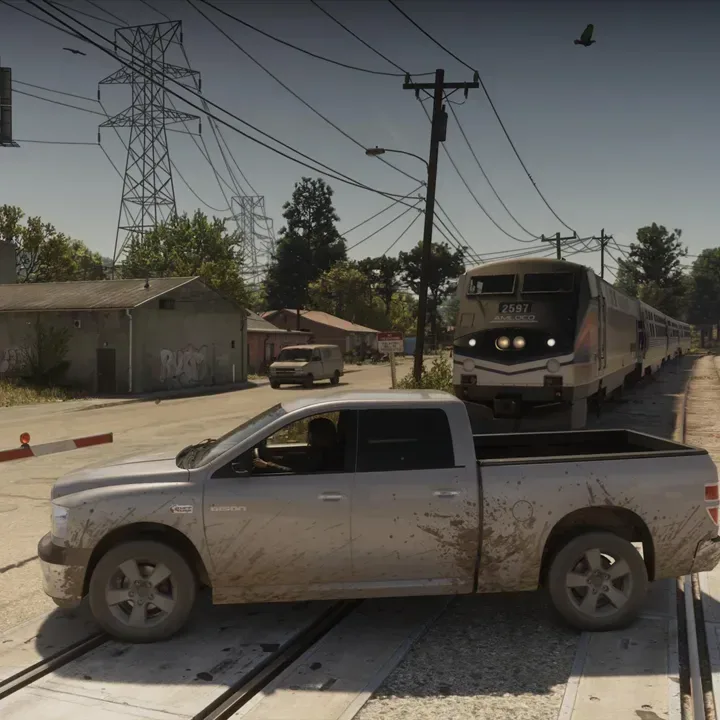
For more than a decade, Grand Theft Auto V’s train occupied a rare position in video game culture: it was less a vehicle than a moving constitutional amendment. Cars could collide. Planes could crash. Explosives could explode with great enthusiasm. But the black, yellow and white locomotive circling Los Santos simply kept going, apparently protected by a higher power with a strict public-transit agenda.
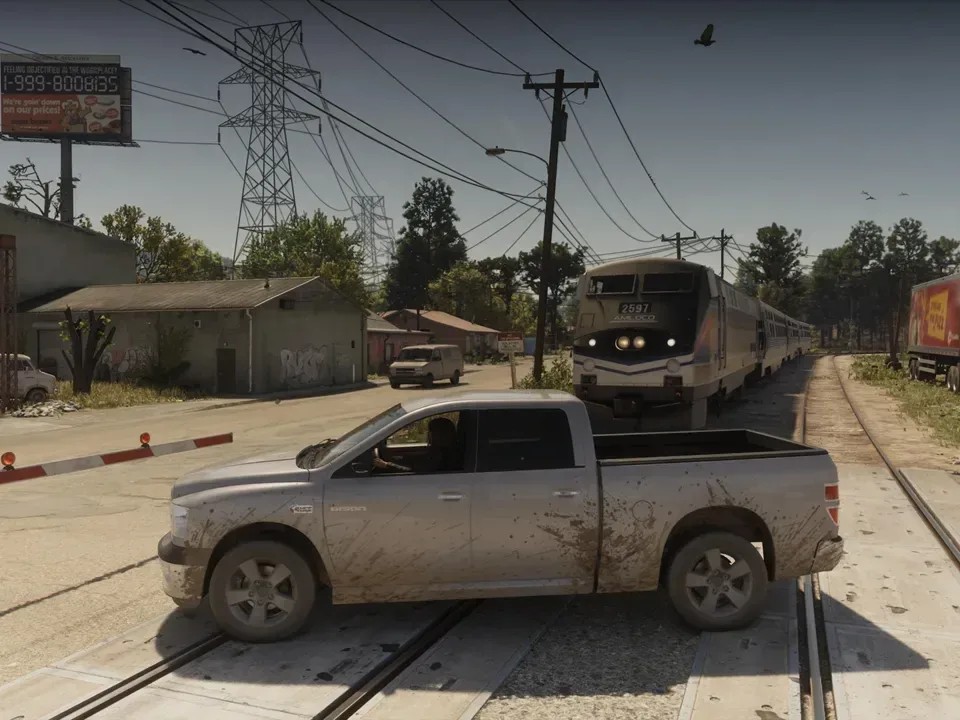
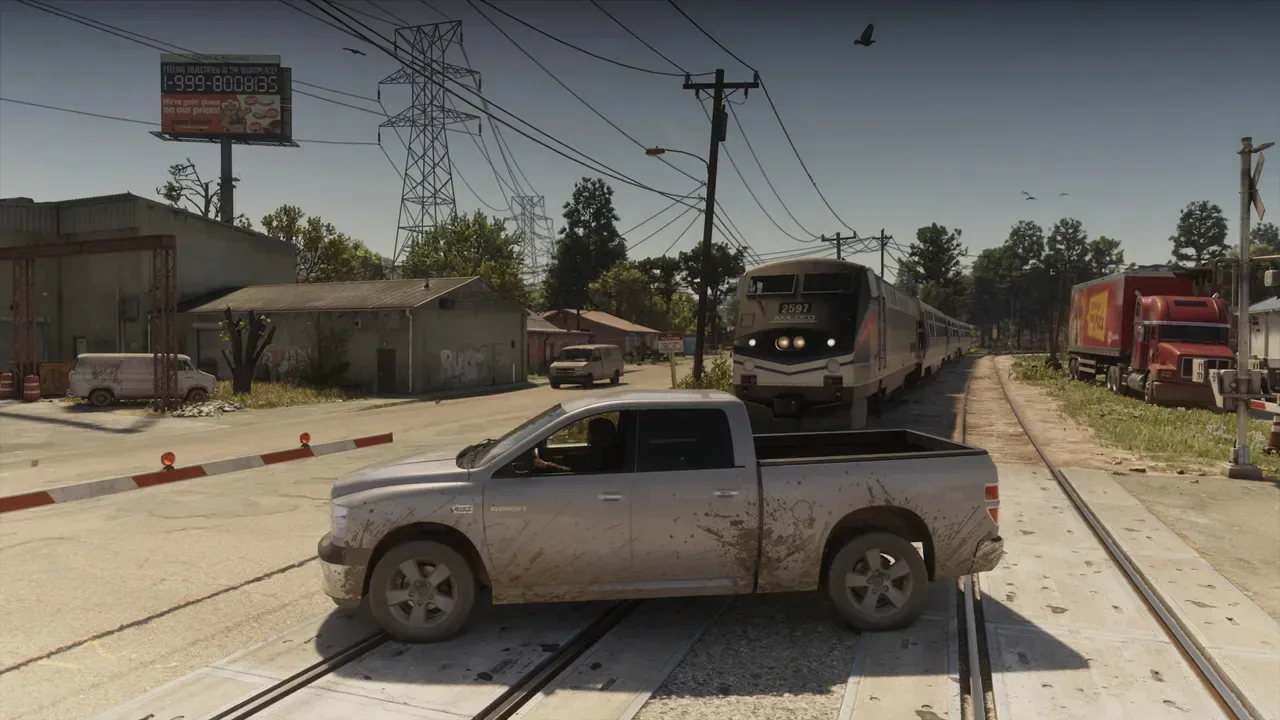
GTA VI players have now performed the inevitable field test on Leonida’s train network, and the result has created a small but very funny crisis of faith. The new locomotive can be stopped.
Not merely delayed by an elaborate engineering operation, either. Players have found that a dump truck can halt it. An excavator placed in its route can halt it. A raised bridge can halt it. Even standing in its path can be enough to make the train’s non-player-character operator apply the brakes. In practical terms, GTA VI’s rail traffic behaves far more like something operating in a world with physics, obstacles, and basic occupational safety procedures.
That is a notable technical upgrade. It is also, to a particular corner of the community, a devastating nerf to the train’s aura.
The old train’s real superpower was consistency
GTA V launched in 2013, and attempts to stop its train became a durable online ritual in the years that followed. Players tried heavy vehicles, explosives, aircraft, barricades and lines of cars. The details of each failed scheme could change, but the central joke did not: the train did not care.
This kind of invulnerability is often described as a game object being “scripted,” meaning its behavior is governed by fixed rules designed to guarantee a result rather than by a fully reactive physical simulation. The exact implementation is not the important point here. From a player’s perspective, GTA V’s train functioned like an immovable force. It was an exception to the chaos that made the rest of Los Santos so entertaining.
That exception gave it personality. A player could bring the most absurd plan possible, and the result was a wonderfully blunt rejection from a locomotive that had places to be. It was a dependable punchline, and dependability is surprisingly valuable in a sandbox built around unpredictable collisions, panicked drivers and airborne sedans.
Over time, the challenge itself became a meme: not because players expected victory, but because the train’s refusal to negotiate was the whole performance. Each new attempt reaffirmed the same legend.
Related coverage includes GTA 6's Stoppable Train Has Players Mourning GTA 5's Unbreakable Locomotive.
GTA VI’s rail system appears to favor reaction over invincibility
The train running around Vice City and the wider Leonida setting is being judged against that unusually high, and unusually silly, standard. Early clips and player discussion point to a system that recognizes blockages and responds in several ways. Large construction vehicles can obstruct the route. A raised bridge can interrupt the journey. The driver can brake when a person is on the tracks.
Those behaviors make the world feel more responsive. In game-design terms, reactivity is the ability of a system to acknowledge and answer what the player does. A reactive train offers more outcomes than an untouchable one: it can stop, create a traffic problem, turn a bridge into a meaningful object, or become part of a player-made stunt.
That matters in an open-world game. Players routinely test whether environmental objects are scenery or systems. Is a bridge merely something to drive across, or can its state change the surrounding world? Is a construction vehicle decorative, or does it have enough physical presence to block rail traffic? GTA VI’s train experiments suggest that these things interact in ways players can meaningfully disrupt.
There is a trade-off. A system that accepts more interactions has fewer opportunities to be an untouchable joke. GTA V’s train had an almost mythic quality precisely because ordinary rules appeared not to apply. GTA VI’s train has brakes. It has self-preservation instincts. It has the sort of reasonable response that, in the unhinged logic of a Grand Theft Auto sandbox, can feel suspiciously un-grand.
Why “realism” is not the whole argument
It would be easy to frame this as realism defeating fun, but the situation is more complicated. The ability to stop a train is not inherently realistic in every circumstance, and an unstoppable train is not inherently bad design. These are choices about what sort of play a game encourages.
An invulnerable train creates a fixed landmark in the game’s ecosystem. Players can rely on it to behave the same way no matter how much mayhem surrounds it. That makes it useful as a recurring gag and a test of the game’s limits.
A stoppable train creates what designers often call emergent gameplay: outcomes generated by systems interacting rather than by a pre-written mission sequence. Putting an excavator on the line, manipulating a bridge, or seeing an operator brake for a pedestrian can all produce scenarios the game does not need to explicitly script as set pieces. The player supplies the ridiculous premise; the game supplies a response.
Neither approach automatically wins. The important distinction is emotional rather than mechanical. A small group of players is not necessarily demanding that every part of GTA VI be less detailed. They are mourning a very specific piece of GTA V weirdness: a locomotive so stubborn that defeating it was never the point.
One player characterized the stoppable train and the absence of a first-person mode as their major disappointments. That reaction should be read as fan preference, not a full verdict on GTA VI’s design. It does, however, show how even a minor environmental behavior can become part of a series’ identity when people have had 13 years to make jokes about it.
Leonida’s new train is a better toy, but not the same legend
There is an irony to the debate. A train that can be affected by the world arguably gives players more to do. It can be blocked, redirected by environmental conditions, and folded into experiments that would have bounced harmlessly off GTA V’s rail titan. For players who want a denser simulation, that is a clear benefit.
But games are not remembered only for their flexible systems. They are remembered for their strange rules, stubborn objects and accidental folk heroes. GTA V’s train earned its status by remaining gloriously uncooperative through every truck, plane, explosive and pileup thrown at it. It was less realistic, perhaps, but it was instantly legible: the train wins.
GTA VI has taken a different route. Its world appears to be designed to acknowledge more player intervention, even when that means the train can be humbled by a worksite vehicle or a raised bridge. That same willingness to let the environment react has already fed other bits of Vice City mischief, including a fake tunnel that has been catching drivers with a cartoonishly solid wall.
The new train may never achieve the old one’s unbreakable-god-machine status. It may instead become something more useful to players: a functioning part of Leonida that can be interrupted, exploited and turned into the centerpiece of fresh disasters. That is hardly a bad fate for a virtual locomotive.
Still, somewhere in Los Santos, an unbudging engine continues its route, immune to logic and apparently every available vehicle in the state. Its successor may have better brakes. The original has legacy power.
What players should take from the comparison
- GTA VI’s train is interactive: reported player tests show it can be stopped by major obstacles, bridge changes and a person on the tracks.
- That interaction suggests broader environmental responsiveness: vehicles and infrastructure appear to affect rail movement instead of serving only as background scenery.
- GTA V’s train remains culturally distinct: its inability to be stopped became a long-running community joke because it was such a conspicuous exception to the game’s usual vehicle chaos.
- The disagreement is about flavor as much as technology: players can appreciate a more reactive world while still missing an iconic, irrationally unstoppable object.
GTA VI launched on November 19 for PlayStation 5 and Xbox Series X/S. The train debate is tiny beside the scale of the game, but it is exactly the sort of tiny detail that open-world players seize upon. Give a crowd an enormous map, construction equipment and a passing locomotive, and the scientific method will immediately become: “What happens if we put this here?”