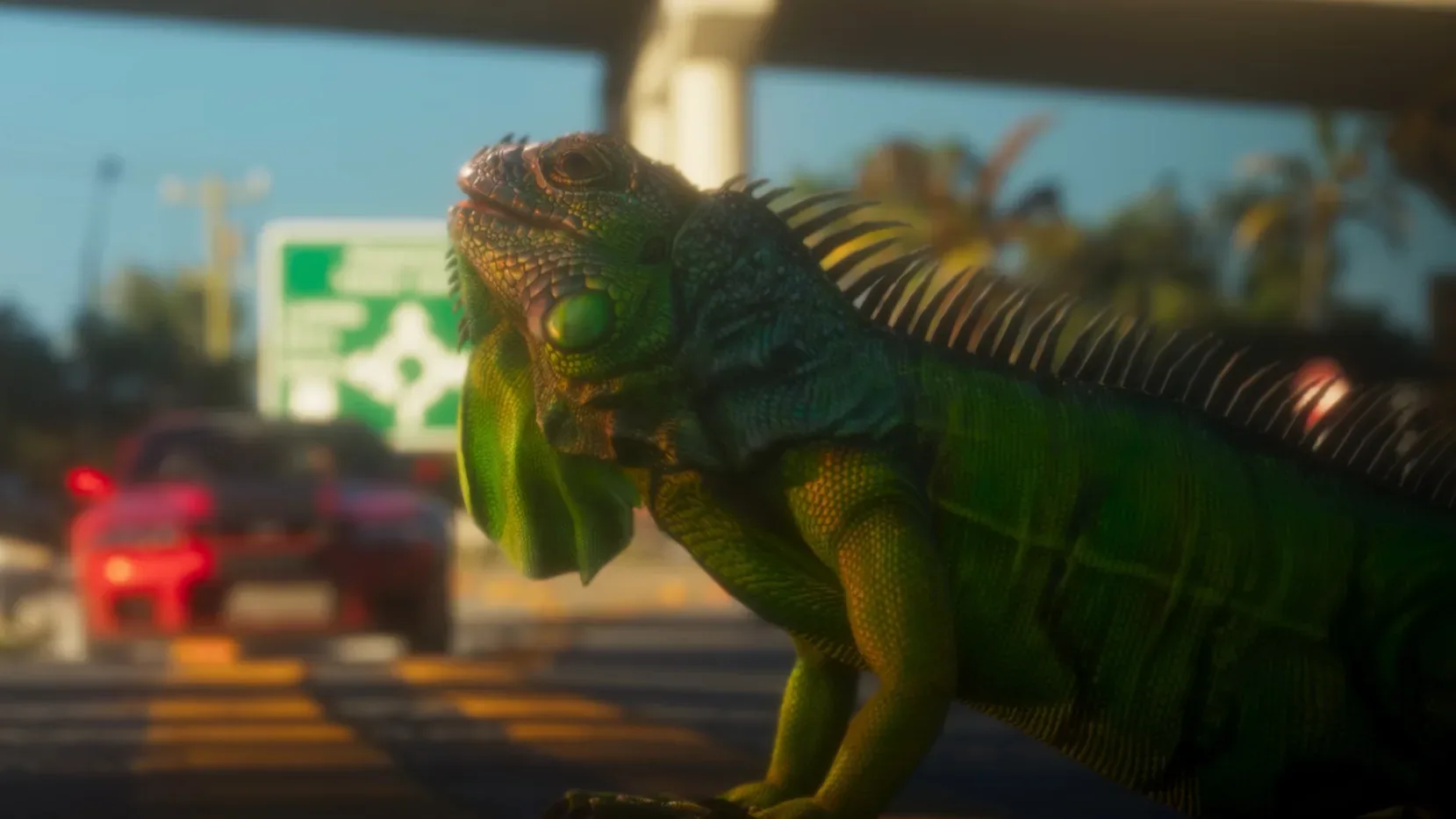
Grand Theft Auto 6’s latest trailer has prompted a familiar kind of internet autopsy: pause the footage, compare it with an earlier video, zoom into the softest frame possible, and declare a visual downgrade. This time, the focal point is not a missing reflection or a character model’s eyebrow geometry. It is the trailer’s noticeably smeared, hazy camera-lens look.
Some viewers have treated that softness as evidence that Rockstar Games has reduced the game’s graphical quality before launch. That conclusion goes considerably further than the footage can support. A trailer is an edited presentation, and its images can be shaped by post-processing effects that affect the whole frame without representing the base rendering quality of every gameplay scene.
The latest video runs for roughly a minute and a half and includes story-oriented material involving Jason, including military-background references and a confrontation on a boat. But the discussion has been pulled toward the image itself: a dirty-lens or blurred-camera aesthetic that makes portions of the footage look less clinically sharp than fans expected from a blockbuster showcase.
What people mean when they call it a downgrade
In this context, “downgrade” means a claim that a game shown closer to release has materially worse graphics than it did in an earlier reveal. It is a serious claim, because it implies that the developer’s actual technology or final visual ambitions have been cut back.
That is very different from saying a particular trailer shot looks soft. Softness can come from several layers of presentation: the way footage is edited, the simulated behavior of a camera lens, motion-related processing, depth effects, compression, or an intentional filter. A frame may therefore look less crisp while still featuring the same—or even more—environmental detail beneath that treatment.
The supplied material specifically identifies the disputed look as image processing, commonly described as Gaussian blur. In simple terms, Gaussian blur is an effect that softens detail by blending nearby pixels. Filmmakers and game creators can use it to make an image feel dreamier, dirtier, more kinetic, or more like it was captured through a physical lens rather than a perfectly clean digital window.
Calling every soft image a downgrade mistakes style for a technical verdict. It is also worth separating sharpness from fidelity. Sharpness is how crisply edges and fine details appear. Fidelity is broader: it can include lighting, material response, animation, density, shadows, geometry, and the consistency of a scene. The former is immediately obvious in a paused social-media clip; the latter is much harder to judge from a short, compressed trailer.
A camera effect can be deliberate—even when fans dislike it
Players do not have to enjoy a smudged-lens presentation. The criticism is understandable on preference alone. Grand Theft Auto is being watched with extraordinary scrutiny, and audiences expecting a pristine technical showcase may find a grime-coated, soft-focus look distracting. In a game built around observing a large world, anything that appears to put a layer between the player and that world is bound to invite complaints.
Related coverage includes GTA 6 Trailer Blur Sparks Fresh Debate Over Visual 'Downgrades'.
But dislike is not proof. The important distinction is between “this makes the trailer harder to appreciate” and “this confirms the game has worse graphics.” The first is an opinion about visual direction. The second needs direct evidence from comparable, representative material under similar conditions.
That evidence has not been established by comparisons between trailers with different cinematography. A prior trailer and a new trailer may differ in time of day, camera movement, scene composition, color treatment, compression, and post-processing. If one is designed to look glossy and clean while another is designed to feel captured through a blemished lens, placing screenshots side by side cannot isolate graphics quality as the cause of the difference.
Why the “lens” distinction matters
A lens effect is meant to change the apparent camera, not necessarily the world being rendered. Smudges, haze, bloom, focus shifts, and blur can make a game image feel more cinematic or more subjective. They can also obscure fine visual information. That trade-off is at the center of the reaction: some viewers see atmosphere, while others see an unwanted veil.
The latest GTA 6 footage appears to have invited the latter response because the effect is conspicuous enough to be read as loss of clarity. Yet conspicuous processing is often precisely the point of a trailer. Marketing footage does not have to function as a neutral graphics benchmark; it can prioritize mood, character, pacing, and a particular visual identity for a sequence.
What Red Dead Redemption II can and cannot tell us
There is a reasonable basis for thinking visual filters may not be fixed in stone. Red Dead Redemption II included a range of filters, which makes it plausible that some image-presentation choices in another Rockstar title could be optional or adjustable. However, that remains an inference rather than a confirmed GTA 6 feature.
That caveat matters. It would be premature to promise a toggle that removes the look, or to state that the trailer’s processing will appear in ordinary gameplay at all. The responsible position is narrower: Rockstar’s earlier use of filters shows that the studio has worked with adjustable presentation options before, but it does not confirm the settings, defaults, or technical behavior of GTA 6.
For players sensitive to blur, that uncertainty is more useful than false reassurance. A trailer cannot settle whether the effect is baked into every scene, limited to particular cinematic shots, present only under certain conditions, or entirely absent from the eventual player-controlled view. Until Rockstar details those choices, the blur debate is mainly a debate about what the trailer is trying to evoke.
How to read trailer comparisons more carefully
The best way to assess a supposed downgrade is to ask what, exactly, is being compared. A broad claim about GTA 6’s graphics should rest on more than one blurry screenshot. Look for like-for-like scenes, similar lighting, equivalent camera distance, and uncompressed footage where possible. Even then, trailer footage remains a limited basis for judging a full game.
- Check whether the entire frame is soft. If foreground and background are broadly affected, that suggests a global processing or lens-style treatment rather than a single low-detail asset.
- Separate a cinematic shot from ordinary play. A cutscene-like sequence can be graded and processed differently from a player-controlled camera.
- Do not use resolution as shorthand for every graphical quality. A sharper image can look more detailed even when other rendering elements are unchanged.
- Wait for confirmed settings information. A previous Rockstar game’s filters are context, not a specification sheet for GTA 6.
The social-media reaction nevertheless has value as feedback. It signals that a portion of the audience prefers a clearer presentation and reads heavy lens styling as a potential barrier rather than cinematic polish. If Rockstar shares further footage, it may be useful for the studio to distinguish creative trailer grading from representative gameplay visuals—especially when every pixel is being treated as evidence in an online trial.
For now, the safe reading is straightforward: the newest trailer has a visual-processing choice that some fans strongly dislike, and that choice has generated downgrade accusations. The available information does not demonstrate that GTA 6 itself has been downgraded. It demonstrates how rapidly a deliberate-looking image treatment can become a technical controversy when attached to one of gaming’s most anticipated releases.
Visuals are not the only GTA 6 trailer detail drawing attention. For more on another creative element connected to the game, see the report on GTA VI’s original score and the Justice reveal.