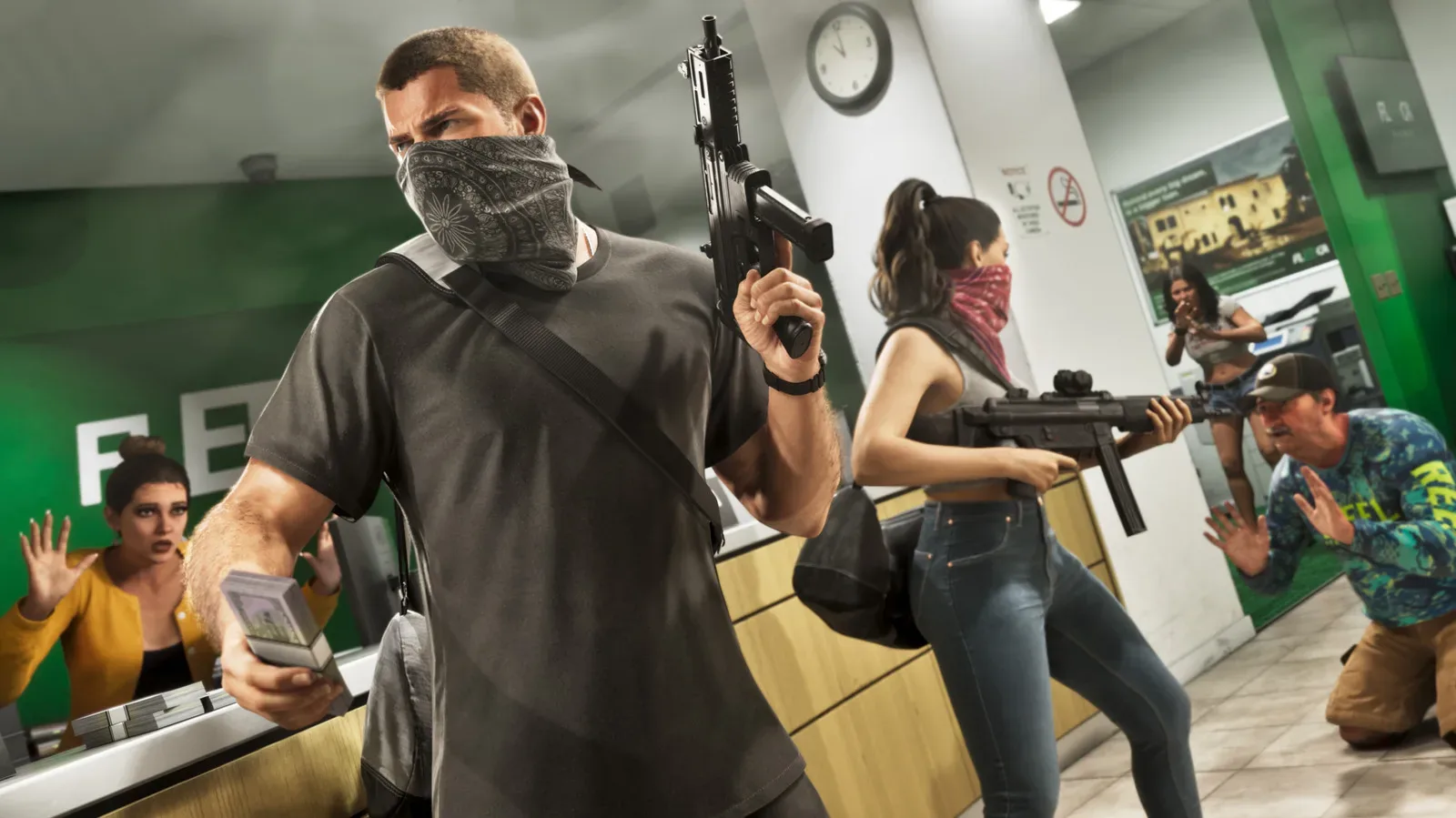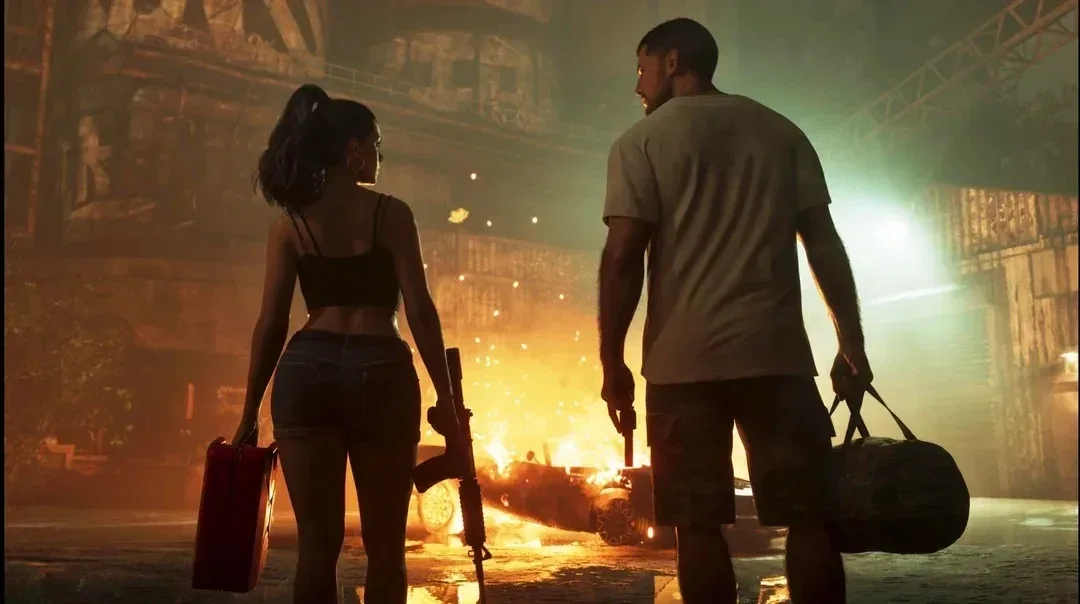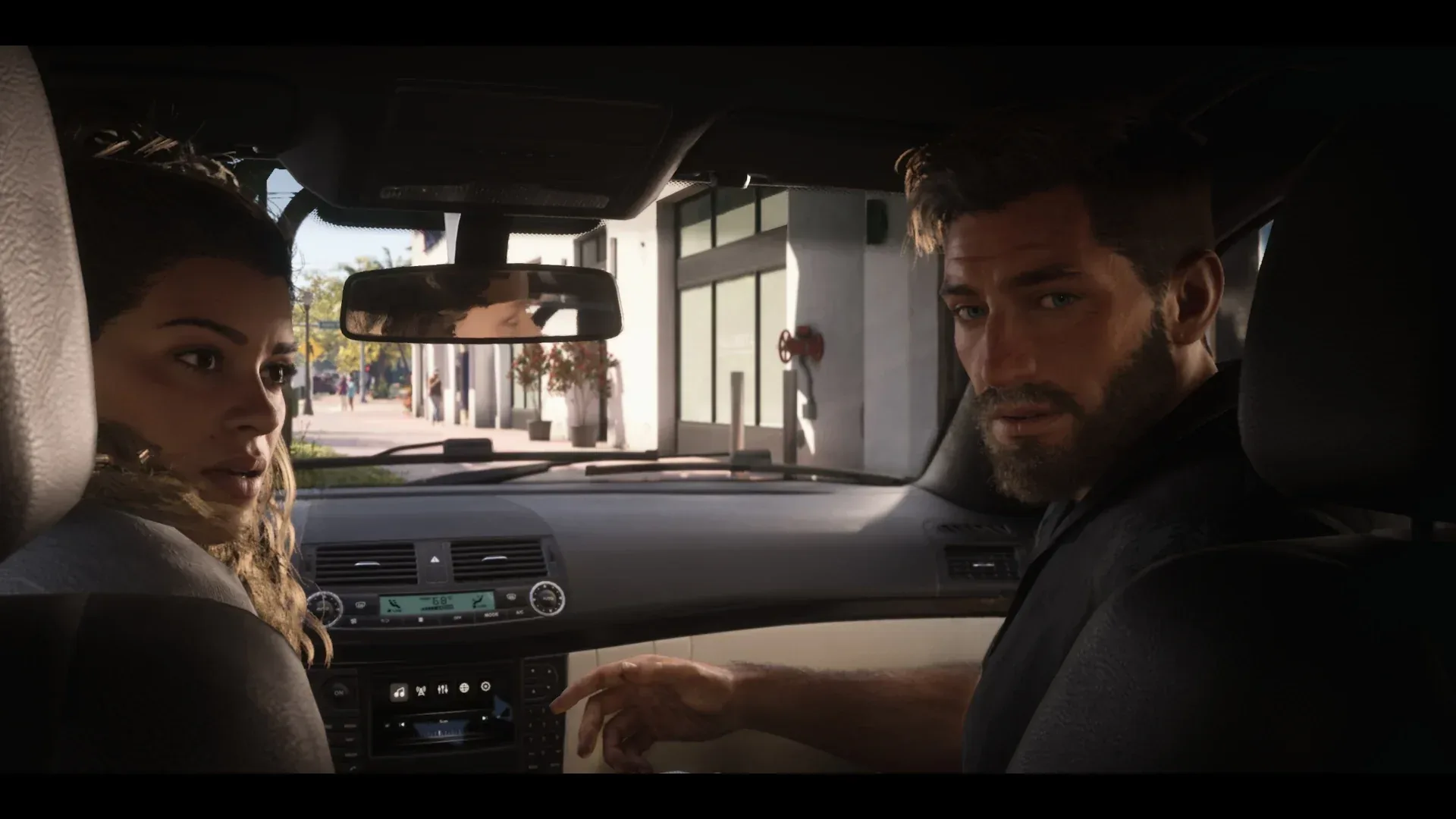
Grand Theft Auto has always relied on the friction between player freedom and a world that has to react to it. A stolen vehicle is usually a shortcut, an escape plan, or simply the fastest answer to the question, “How am I getting over there?” Yet some of the most memorable moments in Grand Theft Auto 6 may come when that shortcut meets a Vice City driver who has absolutely no interest in cooperating.
Players have encountered motorists who do not simply abandon their vehicles when Jason and Lucia attempt a carjacking. Many drivers reportedly run for safety, but a smaller set instead push back, turning what might otherwise be a familiar open-world interaction into a brief, chaotic confrontation. It is a simple variation on a classic GTA scenario, but the contrast is what makes it land: the protagonists may be criminals with momentum on their side, while the person in the driver’s seat is just having a terrible day and refuses to lose their car too.
That reaction does not necessarily make the encounter mechanically complicated. The vehicle can still be taken. But it gives the moment personality. The resistance reframes an anonymous civilian from background traffic into someone with an immediate, understandable stake in what is happening.
A carjacking is funnier when the target has an opinion
NPC means non-player character: a character controlled by the game rather than another human player. The term is often used casually to describe someone behaving predictably, passively, or without much apparent agency. The defiant drivers stand out because they puncture that expectation. They may still be operating within a programmed set of reactions, of course, but the reaction being portrayed is not quiet surrender.
In a game built around disruptive player behavior, the usual civilian response has a clear practical purpose. Fleeing communicates danger and clears space around an escalating incident. A driver who fights to retain their car, on the other hand, briefly becomes an obstacle with a point of view. The resulting humor is not that the player has suddenly encountered an unbeatable opponent. It is that the ordinary person whose day has been interrupted appears to have drawn a line.
That line is especially easy to understand in the context of a vehicle. A car is not just environmental scenery; it is the thing a person was using before the player intervened. The game’s crime-fiction premise makes theft expected, but the driver’s irritation supplies the mundane perspective that the player’s rampage typically erases. The result is a tiny collision between GTA logic and everyday frustration.
Small reactions make a large world feel less automatic
The appeal of Vice City is not limited to missions or major set pieces. Ambient behavior matters because it provides the texture between them. Citizens can reportedly be heard talking with friends while passing by, or carrying loud phone calls about workplace problems. Those details suggest a city designed to sound occupied even when the player is not actively pursuing an objective.
Carjacking resistance belongs to the same broad idea. It is not enough for a world to contain pedestrians, traffic, and dialogue. The most persuasive open worlds make it seem as though those elements have enough variation to surprise the person moving through them. A driver who runs away serves the scenario. A driver who decides they have had enough creates a story beat.
Related coverage includes GTA 6's Most Memorable NPCs Might Be the Ones Who Refuse to Surrender Their Cars.
That distinction is useful when discussing what people mean by a “living world.” It does not require every resident to possess a fully simulated life or unlimited behavior. Rather, it is the impression produced by specific, contextual responses: a person chatting as they walk, someone airing a grievance into their phone, or a driver refusing to let a pair of criminals turn their commute into another inconvenience. A relatively small number of tailored reactions can make the wider environment feel less like a stage reset for the player.
The same principle explains why players remember these moments and circulate clips of them. A polished scripted scene is expected to have character. An incidental encounter that suddenly develops attitude feels less predictable, even if it is ultimately part of a bounded system.
Why the confrontation works as comedy
There is an inherent imbalance in a GTA carjacking. Jason and Lucia are the player-controlled leads, and the player has chosen to interrupt another person’s routine. The driver is at a disadvantage from the opening second. Defiance is funny because it rejects the obvious hierarchy of the scene. The civilian does not have to win for the encounter to feel triumphant in its own way; refusing to make things easy is enough.
One shared example is described as a driver apparently taking a substance before fighting back. Without more context, it would be unwise to treat that as a definitive account of the character or a wider gameplay rule. What it does demonstrate is the kind of exaggerated, sharply drawn moment players are noticing: someone reacts to a theft attempt with a level of commitment that exceeds the expected “run away” animation.
Importantly, these reports point to exceptions rather than a total reversal of civilian behavior. Most drivers are said to flee. That makes the rare stubborn response more effective. If every person fought for every vehicle, the joke would quickly become routine and the mechanic might stop feeling like a surprising slice of local personality. Variation is the asset here.
The practical implication: stealing a car may not always be clean
For players, the immediate takeaway is modest but meaningful: a vehicle theft involving an occupied car may occasionally bring more resistance than expected. That is less about a confirmed new rule than an observable possibility. A player expecting an instant, uncomplicated handoff might instead find themselves in a confrontation before getting behind the wheel.
It also supports a broader playstyle consideration. Not every vehicle interaction has to be approached as an identical transaction. If the world can answer with different civilian reactions, then players may choose to pay closer attention to context rather than treating every passing car as interchangeable transportation. Even when the eventual outcome remains the same, the path to it can be more entertaining because the person being robbed responds differently.
There is no reason to overstate what these encounters prove. They do not, on their own, establish the full depth of GTA 6’s simulation, its crime-response systems, or the range of all pedestrian behaviors. They are anecdotes about a specific interaction. Still, anecdotes are often how open-world games earn their reputations: not through a feature list, but through a five-second interruption that players can describe immediately.
For more on the game’s audience discussion, see GTA 6 stream viewership and its under-25 audience share.
Vice City’s best background characters may be the inconvenient ones
Open-world games need civilians who establish scale, but the most effective ones occasionally complicate the player’s plans. These drivers appear to do precisely that. Their refusal is not presented as moral instruction, and it does not suddenly make vehicle theft impossible. It is a dose of resistance in a series where the player often expects the entire city to yield.
That is why the response feels more memorable than an ordinary escape animation. The driver is not merely clearing the scene. They are, however briefly, protecting the one thing the player wants. In a game centered on Jason and Lucia’s criminal path, that creates a funny counterpoint: one person in traffic who seems to be saying that this particular disaster is not going to happen without an argument.
Sometimes the strongest evidence that a game world has character is not a dramatic monologue or a mission-ending twist. Sometimes it is a stranger in a car deciding that they have already dealt with enough problems today.